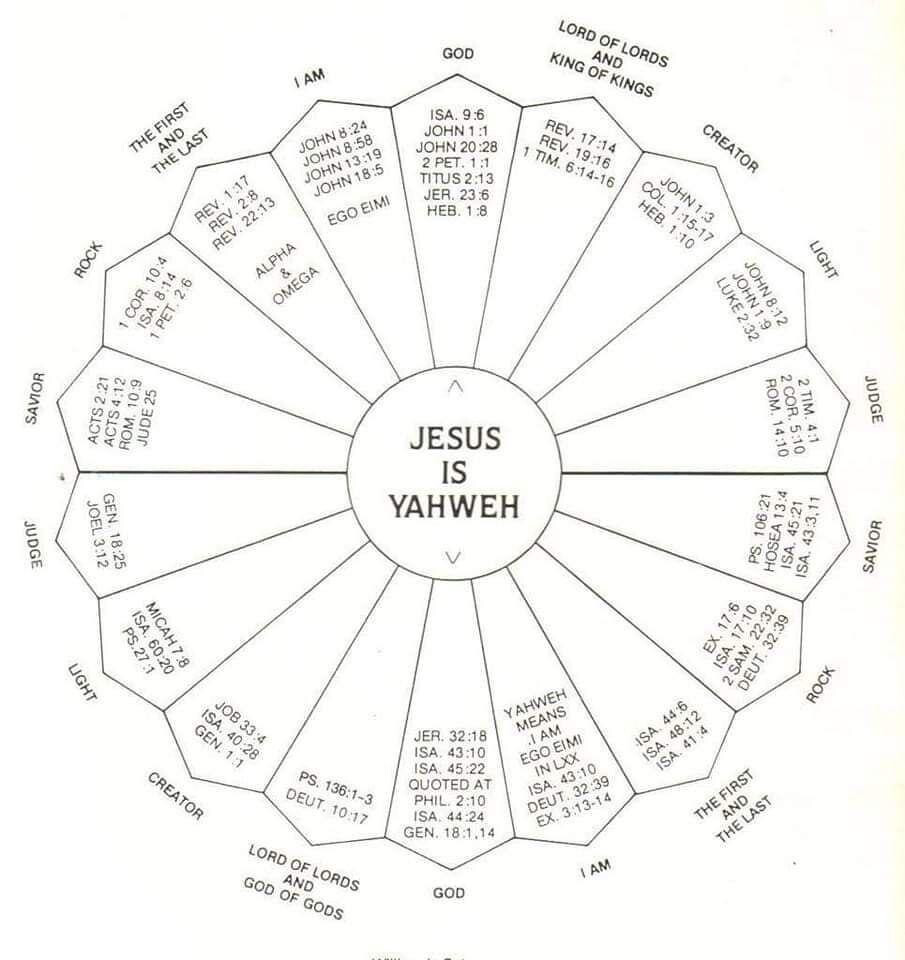
You would say that even in light of this passage: 1 Corinthians 15:28 “And when all things shall be subdued unto him, then shall the Son also himself be subject unto him that put all things under him,
that God may be all in all.”How do you interpret, other than the Role of Sonship ending.
A better question would be why I would interpret that as “the Role of Sonship ending”? Your question presumes I should interpret it that way–yet from where I sit it would simply never occur to me that this passage should be interpreted in that way whatsoever.
I don’t believe in a “Role of Sonship”, that simply isn’t part of my theological vocabulary; the Sonship of Christ is–for the myriad of reasons offered and more–the relationship between the Person of the Son to the Person of the Father. And if you would proffer up an objection that “Person of the Son” is not a phrase found in Scripture, I have to then remind you that, quite certainly “Role of Sonship” is no where to be found in the pages of Holy Writ.
But to answer the question of how I interpret the passage in question. The context is Christ reigning as Lord and King with all things being made subject to Him. Christ reigns until every enemy is defeated, the last enemy is death. So that at Christ’s glorious Parousia, when He comes to judge, and the dead are raised then (as Paul says later in this chapter) “death is swallowed up in victory”. When Christ returns to Judge, and has Judged the living and the dead, and the whole historical and cosmic narrative of redemption, and the conclusion and consummation of all things is accomplished, then Christ brings all things under His Father. Thus concludes the messianic work of Judgment and subjugation, and so Christ submits Himself. Recall, the Lord had said that the Father gave to Him the right to judge (John 5:27), and here Christ returns what was given to Him.
So that God may be all in all. For, in the end, after judgment is concluded, there is that glorious life that is to come, when all has been set to rights. We are reminded, then, that in that glorious unceasing future Age there is no need for sun or moon, for God and the Lamb shall be light; there is no need for a temple in that heavenly Jerusalem which descends upon the earth–God and the Lamb are the temple.
There is no “Role of Sonship”, but there is the messianic work of the Messiah, the Son of David, reigning upon His throne, having been given power and kingdom and authority, to rule and to exercise judgment upon the earth, all things in heaven, on earth, and under the earth. So it would seem to me that what St. Paul is talking about is the conclusion of this particular work of judgment. Taking the whole of what St. Paul has said in 1 Corinthians 15, as well as the collective witness of Scripture together.
Now out of curiosity, as I consider it important that when I examine and try to understand Scripture I am not engaging in some wholly innovative and novel activity I consider it of great value to consider what has been said before concerning this matter. And I must say I consider myself well pleased to discover that I have not said anything radically at odds with those who are more learned than myself:
And going very far back, I then discover the following:
But I am astonished how it can be conceived to be the meaning, that He who, while all things are not yet subdued to Him, is not Himself in subjection, should—at a time when all things have been subdued to Him, and when He has become King of all men, and holds sway over all things—be supposed then to be made subject, seeing He was not formerly in subjection; for such do not understand that the subjection of Christ to the Father indicates that our happiness has attained to perfection, and that the work undertaken by Him has been brought to a victorious termination, seeing He has not only purified the power of supreme government over the whole of creation, but presents to the Father the principles of the obedience and subjection of the human race in a corrected and improved condition. If, then, that subjection be held to be good and salutary by which the Son is said to be subject to the Father, it is an extremely rational and logical inference to deduce that the subjection also of enemies, which is said to be made to the Son of God, should be understood as being also salutary and useful; as if, when the Son is said to be subject to the Father, the perfect restoration of the whole of creation is signified, so also, when enemies are said to be subjected to the Son of God, the salvation of the conquered and the restoration of the lost is in that understood to consist. (Origen, De Principiis, III.V.7)
Though not to suggest Origen stands alone: