Good. Stop trying to change what the Bible actually says. God’s Word is not clay for us to reshape. We’re commanded to handle it honestly, not bend it to fit a narrative ~2 Timothy 2:15. The problem isn’t the discussion. It’s resisting the plain meaning of Scripture. Take a break, open the Word of God, and give the false-teacher books a rest.
Why Some Avoid Them [commentaries]
Some Christians might be reluctant to use reference materials, particularly if they’ve been taught that true spirituality is separate from the academic world. Commentaries focus on the mind, whereas Bible reading ought to nourish the soul, the thinking goes. Commentaries are stale—irrelevant to my daily life. Some may associate commentaries with seminaries or academic institutions, or consider them only appropriate for educational settings, papers, and PhDs.
Others have been warned that commentaries present a direct danger to their personal Bible study. Naysayers caution Christians that reading the words of others may prevent them from thinking their own thoughts and coming to their own conclusions about Scripture. The vital steps of observing the text and interpreting it for ourselves, they worry, may be missed if we allow others to do it for us.
Why Christians Should Use Them
Because of the perspicuity (clarity) of Scripture, the central message of the Bible can indeed be understood through simply reading the text, with no outside helps. But that doesn’t mean we can’t benefit from assistance. In fact, instead of preventing beneficial study, good commentaries can protect us from heretical interpretations, correct our personal biases, and help us come to the conclusions God intended when he wrote his Word. When used judiciously, these resources give rich, deep material for the Bible student, leading to informed observation, accurate interpretation, and appropriate personal application.
Good commentaries can protect us from heretical interpretations, correct our personal biases, and help us come to the conclusions God intended when he wrote his Word.
Commentaries also give us windows into the historical context of the people to whom the books were written. Imagine walking outside one night and looking at the moon with your naked eye. You could appreciate its beauty and be amazed by its ability to reflect the light of the sun. But its intricacies—mountains, valleys, incredible impact craters—would be inaccessible to your vision without a telescope. Commentaries act like that telescope, helping you to see more clearly the beautiful features of the text. They explain nuances of language and culture you wouldn’t otherwise know. They help break down barriers between the biblical world and ours.
Yes, we must still do the work of observing and interpreting the text. But with commentaries we can do so in an informed way, with a clearer understanding of the way the first hearers would’ve understood the passage. The Holy Spirit has gifted the church with professors and writers who have spent the better part of their lives studying certain biblical books, poring over the original languages and noticing word play, euphemisms, cultural references, and a host of other textual features. Such writers interact also with the church’s teaching throughout history, bringing the richness of centuries of Bible study to even the newest believer.
The Woman’s Nard: A Case for Commentaries
This brings us back to Luke 7 and the sinful woman’s bottle of nard. Commentaries tell us that this type of bottle was often worn around prostitutes’ necks in Palestine at the time of Jesus. It held expensive perfume, possibly this woman’s entire life savings. By breaking her bottle, the woman may have been indicating a break with her profession as she poured out her affection for Jesus.
Commentaries then explain that the Greek word used to describe the woman’s weeping also describes rain showers in the books of Matthew and James. This woman was not quietly dabbing her eyes. She was sobbing over the Savior’s feet.
A commentary also helps us to see a pattern in the Gospels: Jesus highlights the faith of the forgiven as the means of receiving God’s salvation gift. And this story illustrates one of Luke’s themes: the great reversal. As Christ welcomes the prostitute, he puts his upside-down kingdom on display. In him, the first are last, and the last are first. Without a commentary, we might miss this point.
Finally, commentaries can help us apply such a story to our own lives, reminding our shame-drenched hearts that Jesus is not ashamed of us (Heb. 2:11). Just as he did for the sinful woman, Jesus dignifies us with both words and forgiveness when we come before him, willing to give him all we have and are.
Two Places to Start
Just as you would carefully select a Bible teacher or pastor for orthodoxy and trustworthiness, so you must be deliberate in your use of commentaries.
First, ask your pastor what commentaries he trusts and uses. Ask if you could borrow one of his or buy it yourself to correspond with whatever you happen to be reading and studying in the Bible.
Second, read the Bible passage multiple times. Linger there before you open the commentary. Get a good idea of the story, teaching, or principles. Try to form a few questions—things you don’t understand or ideas you’d like to investigate. Then bring these questions to your commentary. Commentary writers—your brothers and sisters who have labored to understand the Word in a detailed and careful way—will help to clarify the text and encourage you as you read.
Commentaries are a gift to the Bible student—whether you’re a Sunday-school teacher, attorney, janitor, or stay-at-home parent who loves the living Word of God. Don’t be afraid of these resources. Rather, let them be a part of bringing the beauty and majesty of the Lord Jesus into focus as you seek him in his Word.
Yes, Bring Commentaries to Bible Study.
J.
1 Like
The God of the Old and New Testament is a God of love and mercy but also justice, holiness, and righteousness. In Jesus Christ, he showed all of those qualities by satisfying the latter qualities with the former ones.
In other words, he is the righteous Judge who transferred his verdict of “guilty” from us who trust in him to Jesus, who died in our place and for our benefit.
Thus, he justifies us, that is, declares us “not guilty.” Jesus took our verdict of “guilty” on himself when he died for us.
Therefore, the God of the Old and New Testament is the same God with those amazing qualities that he exercises for believers in both testaments.
I don’t think people avoid them at all. They just know better than to use the ones put out by false teachers who twist Scripture. The Bible warns us plainly that some “wrest the scriptures… unto their own destruction” ~2 Peter 3:16. The issue isn’t using helps. The issue is letting men explain away what God has already made clear. Scripture interprets Scripture. Anything that reshapes the text instead of submitting to it belongs in a fire, not in Bible study.
Ok, plain language. You can’t half-believe God and have the God of the Bible. The God of the Old Testament is not a primitive version. He is the same God further revealed in Jesus Christ. The Bible says “Jesus Christ the same yesterday, and today, and for ever” ~Hebrews 13:8.
Jesus never repudiated the God of the Old Testament. He quoted Him, obeyed Him, and came to fulfill what He said. “Think not that I am come to destroy the law, or the prophets: I am not come to destroy, but to fulfil” ~Matthew 5:17. If you claim to follow Jesus and yet reject God of Moses and the prophets then you follow a Jesus that the Bible never knew.
Christians aren’t rejecting the Old Testament. They are rejecting God’s holiness, His justice, and His right to judge sin. But you can’t have His grace without His justice. The God who judged sin also offered redemption, and redemption comes through Christ.
God is one, his story is one, and his plan is one. Remove the Old Testament and the New Testament falls away with it. There is no middle ground in Scripture. The Bible does not offer us a watered-down, less offensive version of God made in our own image. We either accept Him as He revealed Himself or we create a god who cannot save.
1 Like
Classic example of neglecting context, and you are getting bolder and bolder with each post.
2Pe 3:14 Therefore, Διό, beloved, ἀγαπητοί, as you anticipate προσδοκῶντες these things, ταῦτα make every effort σπουδάσατε to be found εὑρεθῆναι at ἐν peace εἰρήνῃ, with Him, αὐτῷ without spot ἄσπιλοι [or] καὶ blemish. ἀμώμητοι
2Pe 3:15 vvv Καὶ Consider also that ἡγεῖσθε, our ἡμῶν - τοῦ Lord’s Κυρίου - τὴν patience μακροθυμίαν [brings] salvation, σωτηρίαν just as καθὼς our ἡμῶν beloved ἀγαπητὸς brother ἀδελφὸς - ὁ Paul Παῦλος also καὶ wrote ἔγραψεν you ὑμῖν, with κατὰ the τὴν wisdom σοφίαν [God] gave him δοθεῖσαν . . . . αὐτῷ
2Pe 3:16 [He writes] this way ὡς . . . καὶ in ἐν all πάσαις [his] ‹ταῖς› letters, ἐπιστολαῖς speaking λαλῶν in ἐν them αὐταῖς about περὶ [such matters]. τούτων, Some [parts] τινα, of ἐν [his letters] αἷς are ἐστιν hard to understand, δυσνόητά which ἃ - οἱ ignorant ἀμαθεῖς and καὶ unstable [people] ἀστήρικτοι distort, στρεβλοῦσιν as ὡς [they do] καὶ the τὰς rest of λοιπὰς [the] Scriptures, γραφὰς to πρὸς their αὐτῶν own ἰδίαν - τὴν destruction. ἀπώλειαν.
2Pe 3:17 Therefore, οὖν, beloved, ἀγαπητοί, [since] you Ὑμεῖς already know [these things], προγινώσκοντες be on your guard φυλάσσεσθε not μὴ to ἵνα be carried away συναπαχθέντες by the τῇ error πλάνῃ of the τῶν lawless ἀθέσμων [and] fall from ἐκπέσητε [your] τοῦ - ἰδίου secure standing. στηριγμοῦ,
2Pe 3:18 But δὲ grow αὐξάνετε in ἐν [the] grace χάριτι and καὶ knowledge γνώσει of our ἡμῶν - τοῦ Lord Κυρίου and καὶ Savior Σωτῆρος Jesus Ἰησοῦ Christ. Χριστοῦ. To Him [be] αὐτῷ the ἡ glory δόξα both καὶ now νῦν and καὶ to εἰς [the] day ἡμέραν of eternity. αἰῶνος. Amen. ‹Ἀμήν›.
2Pe 3:14 Διό, ἀγαπητοί, ταῦτα προσδοκῶντες, σπουδάσατε ἄσπιλοι καὶ ἀμώμητοι αὐτῷ εὑρεθῆναι ἐν εἰρήνῃ.
2Pe 3:15 Καὶ τὴν τοῦ Κυρίου ἡμῶν μακροθυμίαν σωτηρίαν ἡγεῖσθε, καθὼς καὶ ὁ ἀγαπητὸς ἡμῶν ἀδελφὸς Παῦλος κατὰ τὴν αὐτῷ δοθεῖσαν σοφίαν ἔγραψεν ὑμῖν·
2Pe 3:16 ὡς καὶ ἐν πάσαις ταῖς ἐπιστολαῖς, λαλῶν ἐν αὐταῖς περὶ τούτων· ἐν οἷς ἐστι δυσνόητά τινα, ἃ οἱ ἀμαθεῖς καὶ ἀστήρικτοι στρεβλοῦσιν, ὡς καὶ τὰς λοιπὰς γραφάς, πρὸς τὴν ἰδίαν αὐτῶν ἀπώλειαν.
2Pe 3:17 Ὑμεῖς οὖν, ἀγαπητοί, προγινώσκοντες φυλάσσεσθε, ἵνα μή, τῇ τῶν ἀθέσμων πλάνῃ συναπαχθέντες, ἐκπέσητε τοῦ ἰδίου στηριγμοῦ.
2Pe 3:18 Αὐξάνετε δὲ ἐν χάριτι καὶ γνώσει τοῦ Κυρίου ἡμῶν καὶ σωτῆρος Ἰησοῦ Χριστοῦ. Αὐτῷ ἡ δόξα καὶ νῦν καὶ εἰς ἡμέραν αἰῶνος. Ἀμήν.
Critical Text Greek Majority.
This is Scripture interpreting Scripture.
in all: 1Pe_1:1
speaking: Rom_8:1-39; 1Co_15:1-58; 1Th_4:1 - 1Th_5:28; 2Ki_1:1-18
hard: 1Ki_10:1; Heb_5:11
unstable: 2Pe_2:14; Gen_49:4; 2Ti_3:5-7; Jam_1:8
wrest: Exo_23:2, Exo_23:6; Deu_16:19; Psa_56:5; Hab_1:4
the other: Jer_23:36; Mat_15:3, Mat_15:6, Mat_22:29
unto their own: 2Pe_2:1; Phi_3:19; 1Pe_2:8; Jud_1:4
Reciprocal: Pro_1:6 - dark Pro_9:8 - rebuke Pro_9:12 - General Pro_11:9 - through Pro_28:23 - General Isa_28:13 - that Joh_6:60 - This 1Co_7:40 - I think 2Co_11:6 - not 1Ti_5:15 - General 2Ti_3:15 - the holy 1Pe_2:6 - it
And you have YET to show me my radical departure from the fundamental doctrines and…
[1].
The phrase “once delivered” translates hapax paradotheisē, meaning delivered once for all, not repeatedly revised, not periodically upgraded, and not awaiting modern clarification from whoever discovered YouTube last.
That verse alone establishes three things that matter: the faith has definable content, it has already been delivered, and believers are commanded to guard it rather than improve it.
The rest of the New Testament reinforces the same idea without repeating the exact wording.
Galatians 1:8–9 places a curse on anyone who alters the apostolic gospel, even if the messenger claims spiritual authority or supernatural endorsement[2].
That text only makes sense if the gospel is already settled and identifiable, not fluid or evolving.
2 Timothy 1:13–14 commands preservation, not innovation, explicitly framing doctrine as something to be guarded through the Holy Spirit, not reimagined through creativity[3].
Paul does not tell Timothy to refine the faith, contextualize it, or reconstruct it for a new era, but to keep what was entrusted.
What you are accusing me of. Personally, my observation is that you have became unhinged and I am your Kryptonite.
J.
Beloved, when I gave all diligence to write unto you of the common salvation, it was needful for me to write unto you, and exhort you that ye should earnestly contend for the faith which was once delivered unto the saints. - KJV ↩︎
But though we, or an angel from heaven, preach any other gospel unto you than that which we have preached unto you, let him be accursed. - KJV ↩︎
Hold fast the form of sound words, which thou hast heard of me… That good thing which was committed unto thee keep by the Holy Ghost which dwelleth in us. - KJV ↩︎
I’m not talking about intelligence here. I’m talking about ignorance. Ignorance of what Scripture actually says. The Bible doesn’t esteem those who sound smart. It esteems those who bow to what it says. 2 Timothy 3: 7 describes hypocrites as those who “ever learning, and never able to come to the knowledge of the truth”. Spending all your time studying theology while failing to see the obvious truths of Scripture qualifies you for that verse.
At no point did God say that His Word would be clear to the scholar before it’s clear to the student. In fact, God said just the opposite. “The entrance of thy words giveth light; it giveth understanding unto the simple” ~ Psalm 119:130. When someone’s argument constantly boils down to “…but the theologians say,” they aren’t displaying wisdom. They’re displaying pride.
Jesus called this hypocrisy. “Ye have made the commandment of God of none effect by your tradition” ~Matthew 15:6. Hypocrisy isn’t intelligence. Hypocrisy is sin. It’s not that people aren’t smart enough to understand the Bible. People are not letting the Bible speak for itself.
God’s Word has a lot to say about pride. You know, that arrogant feeling that you’re smarter, better or above everyone else. For starters, God is clear about where He stands on pride: Against it.
“God resisteth the proud, but giveth grace unto the humble” ~James 4:6.
Notice that God “resisteth” the proud. Resist means he opposes them. He doesn’t just ignore arrogant people or politely smile while they run their mouths. The Bible does not say pride merely irritates or annoys God. It says pride puts a person in active opposition to Him.
Being prideful also blinds people to truth. “Seest thou a man wise in his own conceit? there is more hope of a fool than of him” ~Proverbs 26:12. When we assume we know more than what someone else has to say, we shut our ears to hearing it. Correction becomes futile.
Proverbs also points out pride disguised as religiosity. “Knowledge puffeth up, but charity edifieth” ~1 Corinthians 8:1. It’s possible to be “knowledgeable” and completely lack humility or love. When your knowledge starts making you look down on others, the knowledge has poisoned you.
God even links pride to destruction. “Pride goeth before destruction, and an haughty spirit before a fall” ~Proverbs 16:18. Pride doesn’t eventually lead to a fall, pride guarantees a fall.
Jesus called this treacherous heart attitude to attention. “For every one that exalteth himself shall be abased; and he that humbleth himself shall be exalted” ~Luke 14:11. God is the one who brings the proud low. No one gets away from that.
Furthermore, Scripture leaves no avenue for pride in a Christian. “Who maketh thee to differ from another? and what hast thou that thou didst not receive?” ~1 Corinthians 4:7. The only rightful place for boasting is in what God has done, not in what we think we’ve accomplished.
If intelligence is boasting about how you’ve studied Scripture more than anyone else and you “know better,” than you are absolutely ignorant of what God’s Word says about pride. Intelligence bows before God’s Word. Pride lifts you up for a second to crash you down even harder.
I will speak to you directly, since you have chosen to speak about Scripture while repeatedly failing to read it in context.
You begin by equating disagreement with ignorance, yet Scripture never authorizes that shortcut.
2 Timothy 3:7 is not a warning against learning deeply, but a description of false teachers who reject apostolic truth while accumulating ideas that never submit to it. Paul explicitly identifies them earlier in the passage as corrupt in mind and reprobate concerning the faith, not as believers who labor to understand Scripture carefully. Using that verse against theological study is not obedience; it is misapplication[1].
You then appeal to Psalm 119:130 as if “the simple” means the unstudied, when the Hebrew term refers to the teachable, not the intellectually idle. The same Psalm celebrates meditation day and night, love for commandments, and deep understanding gained over time. You are not letting Scripture speak for itself here; you are silencing the rest of the Psalm to protect a slogan[2].
When you accuse others of pride for citing theologians, you ignore that Christ Himself gives teachers to His church to guard believers from instability and private error. Rejecting teachers is not humility; it is resistance to Christ’s own design for His body[3].
Your use of Matthew 15:6 collapses a distinction Scripture carefully maintains. Jesus condemns traditions that nullify God’s command, not all received teaching. Paul commands believers to hold fast to apostolic tradition explicitly, which means your blanket rejection of historical theology is itself unbiblical[4].
Your extended lecture on pride relies on repetition rather than proof. You quote verses condemning arrogance, yet never demonstrate that studying theology, learning from the historic church, or engaging with interpretation is pride. Scripture condemns self-exaltation, not disciplined learning. In fact, Scripture commands the pursuit of wisdom repeatedly[5].
You misuse 1 Corinthians 8:1 by implying that knowledge itself is suspect, when Paul’s actual argument is that knowledge without love is destructive. The solution is not ignorance but charity. Paul never tells the Corinthians to stop learning; he tells them to stop weaponizing knowledge against weaker consciences[6].
Your warnings about pride would carry more weight if they were not delivered from a posture that assumes your reading is obvious and everyone else is blinded by hypocrisy. Scripture warns against being wise in one’s own conceit, and that warning applies just as much to anti-intellectual certainty as to academic arrogance[7].
When you cite 1 Corinthians 4:7, you miss its force entirely. Acknowledging that one has received understanding through teachers, history, and the church is the opposite of boasting. It confesses dependence rather than self-origination[8].
Your final contrast between intelligence and obedience is simply foreign to Scripture. Christ commands love of God with the mind. Paul commands renewal of the mind. Peter commands growth in knowledge. Scripture never presents obedience as intellectual minimalism, nor humility as interpretive isolation.
The issue here is not pride versus humility.
The issue is private interpretation versus accountable interpretation.
Scripture does not commend the posture that says, “I read it plainly, therefore I am humble, and everyone else is proud.” That posture is nowhere praised in the Bible. What Scripture condemns is arrogance that refuses correction, and that danger applies equally to those who reject the church, history, and teachers while claiming exclusive clarity.
If you wish to contend for truth, do so with careful exegesis, not rhetorical accusations.
If you wish to warn against pride, begin by refusing the assumption that disagreement equals rebellion.
And if you wish to bow before God’s Word, then submit to all of it, including the parts that say Christ governs His church through teachers, handed-down doctrine, and disciplined understanding centered on the cross and the resurrection.
J.
Ever learning, and never able to come to the knowledge of the truth. - KJV ↩︎
The entrance of thy words giveth light; it giveth understanding unto the simple. - KJV ↩︎
And he gave some… pastors and teachers; For the perfecting of the saints… That we henceforth be no more children, tossed to and fro. - KJV ↩︎
Therefore, brethren, stand fast, and hold the traditions which ye have been taught. - KJV ↩︎
Wisdom is the principal thing; therefore get wisdom: and with all thy getting get understanding. - KJV ↩︎
Knowledge puffeth up, but charity edifieth. - KJV ↩︎
Seest thou a man wise in his own conceit? there is more hope of a fool than of him. - KJV ↩︎
For who maketh thee to differ from another? and what hast thou that thou didst not receive? - KJV ↩︎
Utley.
We are a non-profit Bible study ministry dedicated to empowering people to interpret the Bible for themselves. These verse-by-verse, exegetical video, audio and text commentaries are committed to the trustworthiness and authority of Scripture (view these lectures), emphasizing the intent of the original inspired authors by means of their:
- Historical Setting, 2. Literary Context, 3. Grammatical Features, 4. Choice of Words, 5. Genre, 6. Parallel Passages.
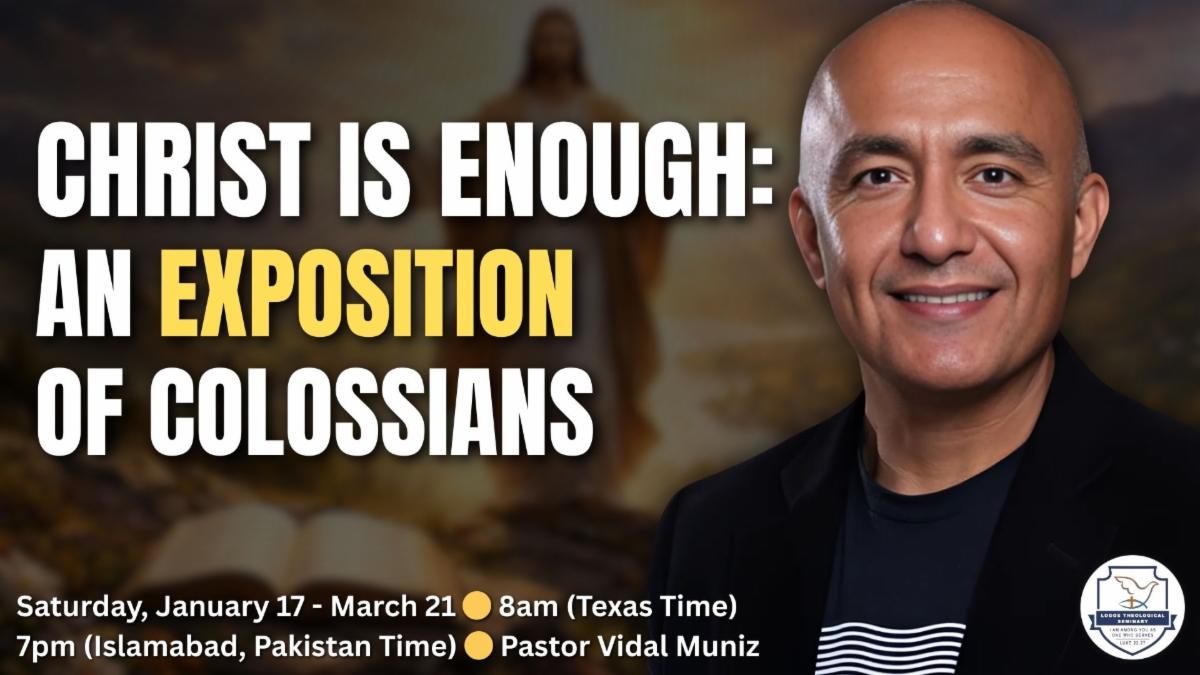
Virtual Bible Course (Via Zoom)
Starts: Saturday, January 17
Ends: Saturday, March 21
The Epistle to the Colossians presents a robust Christological theology that affirms the absolute supremacy and sufficiency of Jesus Christ over creation, redemption, and the life of the church. Interpreted through a historical-grammatical lens, the letter addresses false teachings that threatened to diminish Christ’s person and work by supplementing the gospel with human philosophy, legalism, and mystical practices. Paul responds by exalting Christ as fully divine, preeminent, and the sole mediator of reconciliation, grounding salvation entirely in God’s sovereign grace.
This high Christology is not merely doctrinal but pastoral, calling believers to live out their new identity in Christ through gospel-shaped holiness, unity, and mission in everyday life. Colossians thus unites sound doctrine with transformed living, demonstrating that authentic Christian faith flows from union with Christ alone.
08:00 Hrs - Texas, USA 
14:00 Hrs - Monrovia, Liberia 
15:00 Hrs - Democratic Republic of the Congo 
15:00 Hrs - Lagos, Nigeria 
16:00 Hrs - Juba, South Sudan 
16:00 Hrs - Blantyre, Malawi 
16:00 Hrs - Helsinki, Finland 
16:00 Hrs - Bujumbura, Burundi 
16:00 Hrs - Kigali, Rwanda 
16:00 Hrs - Lusaka, Zambia 
16:00 Hrs - Cape town - South Africa 
17:00 Hrs - Dar es Salaam, Tanzania 
17:00 Hrs - Busia, Uganda 
17:00 Hrs - Nairobi, Kenya 
17:00 Hrs - Addis Ababa, Ethiopia 
18:00 Hrs - Dubai, United Arab Emirates 
19:00 Hrs - Islamabad, Pakistan 
19:30 Hrs - New Delhi, India 
19:45 Hrs - Kathmandu, Nepal 
20:00 Hrs - Dhaka, Bangladesh 
20:30 Hrs - Burma, Myanmar 
22:00 Hrs - Manila, Philippines 
23:00 Hrs - Soul, Korea 
Thank my Lord Jesus Christ for this man and his team and the underground church!
J.
1 Like
No!! HE is still the same GOD! The I AM never changes.
The man of GOD who served them is not the true man GOD, and from whom these Christians learn from made them ‘shortsighted’.
2Timothy3:16&17, to us today refers to All Scripture = Holy Bible, then to Timothy the scripture he grew up with.
Shalom in the name of Jesus Christ our Lord
Hebrews 1:
- GOD, who at sundry times and in divers manners spake in time past unto the fathers by the prophets.
- Hath in these last days spoken unto us by HIS Son, whom HE hath appointed heir of all things, by whom also HE made the worlds;
John 1:
17. For the Law was given by Moses, but grace and truth came by Jesus Christ.
We born again church come under grace and truth, the new covenant GOD has given and made through HIS Son Jesus Christ.
With the Israelites first, where there’s a remnant saved under the election of grace.
Amd furthermore through these remnant the Apostles, the Son furthermore gave and made with the Gentiles.
Ephesians 2:
18. For through Him we both(Jews and Gentiles) have access by one Spirit unto the FATHER.
19. Now therefore ye are no more strangers and foreigners, but fellowcitizens with the saints, and of the household of GOD.
20. And are built upon the foundation of the Apostles and Prophets, Jesus Christ Himself being the Chief Corner stone;
21. In whom all the building fitly framed together groweth unto an holy temple in the Lord:
22. In whom ye also are builded together for an habitation of GOD through the Spirit.
The New Testament is the foundation of the Apostles and Prophets of the Old specifically quoted in fulfillment, which we’re are built upon.
Be blessed in Jesus name
You scream “context” as you dissect the passage of its backbone.
Context does not lurk behind Greek words. Context allows the passage to speak what God has said. Peter isn’t contradicting the Old Testament God. He is pronouncing judgment on men who reject Him. “The heavens and the earth, which are now stored up by his word, are kept in store, reserved unto fire against the day of judgment and perdition of ungodly men.” ~2 Peter 3:7. Say what you want that is not hyperbole. That is judgment.
You desire child-like language. God does not provide that here. Peter explains scoffers WILL come who walk after their own lusts, and deny accountability. That IS the sin from Genesis to Revelation. “God is angry with the wicked every day” ~Psalm 7:11. That promise didn’t suddenly become void when Christ was born.
Pulling Greek words apart will not water down what God has already CLEARLY spoken. It only causes you to stray from the Fear of the Lord. Scripture doesn’t need “saving” by academics. “The entrance of thy words giveth light; it giveth understanding unto the simple” ~Psalm 119:130.
The problem isn’t context. The problem is hard hearts. Men trip up over God’s judgment because they want the freedom to ignore His mercy. Judgment without repentance. But Peter is not preaching that message. He says the reason we haven’t seen judgment is a mercy, NOT an unwillingness. “The Lord is not slack concerning his promise… but is longsuffering to us-ward, not willing that any should perish, but that all should come to repentance.” ~2 Peter 3:9.
Repentance. Not replacement.
God who judged the world by water WILL judge the world by fire. Same Word. Same power. Same God. “It is a fearful thing to fall into the hands of the living God.” ~Hebrews 10:31
If that upsets you. The issue is not the passage. It is your heart reading it.
One of the most ancient heresies, Marcionism, was the teaching of Marcion of Sinope. Marcion at some point in his life came to the conclusion that the God of the Old Testament was not the same God as the God which Jesus came to reveal. Marcion attempted to promote his doctrine when he was visiting Rome, but the leadership of the Church in Rome quickly put a stop to it, condemning Marcion’s doctrine.
As a result, Marcion ended up not only starting his own rival church (which actually ended up surviving for several centuries before fading into obscurity), but Marcion actually created his own Biblical Canon. Marcion’s “Bible” consisted solely of a heavily edited version of the Gospel of Luke (which the Marcionites renamed as “The Gospel of the Lord”) and heavily redacted and edited versions of a number of St. Paul’s epistles. Marcion edited and redacted these books to remove anything that referred to the Old Testament, or spoke positively about ancient Israel, and stripped all Jewishness from these texts.
From the earliest times, Marcion has been condemned and anathematized as a heretic because of his false doctrine that the God of Israel and the God of Jesus Christ are separate and different. And so a blatant rejection of the Old Testament, and an attempt to differentiate between the God of the OT and the God of the NT is properly called Marcionism–or is rightly condemned as a form of Marcionism.
What the Christian Church has, indeed, always confessed is that there has been one God who made all things, who worked and acted and spoke through history–to Abraham, to Moses, who spoke through all the Prophets, the God of the Covenants, and who led Israel out from Egypt, and who brought judgement and redemption–is the very same God who promised the Messiah, and Jesus is that Messiah. And that through Jesus we have the fullest revelation of God.
This does mean that Christians have always read the Old Testament through Jesus Christ. Meaning that the Old Testament is understood as proclaiming Jesus Christ. As that is the whole point of the Bible, both OT and NT: to proclaim Jesus. St. Augustine reminds us that the whole of Scripture contains one unanimous Utterance: Jesus Christ. Martin Luther compared the Scriptures to the manger which held the Christ Child; the Scriptures “contain” Christ. So there can also be a danger of reading Scripture in a way that is “Christless”, where Christ is not the focus. So good Scriptural understanding and reading must be always done carefully–it must always be done in a Christocentric way. Because Jesus is always front and center of everything.
1 Like