I’m a Jehovah’s Witness

Sadly I really do not even think you can see what you are doing.

You say “position.” Where did you get that? Oh right. He could not be talking about Him being God because you refuse to believe that.

Yup. Because He is God. Not a God, that was added. He IS God.

Says you.Along with maybe some of the “Scholars” that you love to talk about. But as we learned before, many of them, whom you shared, do not even agree with the JWs’ view of Jesus.

Again, because you disagree with what is clearly written. It is nonsense to you because you have been taught it must be wrong because the JWs believe that Jesus is not.

(Sigh) Let me try to explain where the belief that this is a gottcha is completely wrong.
Continued

I hope you can at least see that there is another possibility other than what you and your religion claim.

This verse, Acts 2:36, must prove it. Look, it says it right there. To understand if it “proves” Jesus was created, it helps to look at the Greek terminology and the historical context of Peter’s sermon.

The Greek Word: EpoiēsenThe word translated as “made” in this verse is the Greek $epoiēsen$. (Function vs. Essence) In this specific context, most scholars argue that it refers to appointment or designation to a role rather than the creation of a being. For example, if a king “makes” someone a Duke, he isn’t creating the person from scratch; he is assigning them a new status or office. Peter is speaking to an audience that knew Jesus as a man from Nazareth; he is arguing that God has now “installed” or “vindicated” this same Jesus in the official roles of Lord ($Kyrios$) and Christ ($Christos$).

The timing of this “making” is crucial. Peter isn’t talking about the beginning of time or Jesus’s birth. He is talking about the Resurrection and Ascension. The logic of the sermon follows: Jesus was crucified, God raised him from the dead, and therefore God has “made” (exalted) him to the position of supreme authority. In this view, Jesus didn’t become a created being at the resurrection; he was demonstrated to be the rightful King through his victory over death.

To get a full picture, theologians usually weigh Acts 2:36 against other passages that discuss Jesus’s origins: John 1:1 without the added a, Colossians 1:16. These verses describe Jesus as being “with God” in the beginning and the agent through whom all things were created.

Acts 2:36, Hebrews 1:4. These focus on the titles and authority Jesus “inherited” or was “given” following his earthly ministry. Your perspective aligns with these traditions, which suggest Jesus is a subordinate being created by the Father. You point to “made” as literal evidence of a beginning point for Jesus.

However, the truth is that Jesus is co-eternal with God. In Acts 2:36, God publicly “appointed” the incarnate Jesus to his messianic office in the eyes of Israel. The verse highlights a change in Jesus’s status from a crucified teacher to the exalted Lord.
Peter

I believe the weight of scriptural evidence supports subordinationism, the Son’s total submission to the Father, and God’s paternal supremacy over the Son in every aspect.

I acknowledge the Son’s high rank at God’s right hand, but the Scriptures teach that the Father is still greater than the Son in all things.

Father, Son, and Spirit all participated in creation and salvation, but that in itself does not confirm that the three are each co-equal or co-eternal.

God is only explicitly identified as “one” in the Bible, and the doctrine of the Trinity, meaning a set of three, ascribes a co-equal threeness to the being of the infinite God that is not scriptural!

“The present which indicates the continuance of an action during the past and up to the moment is virtually the same as Perfective, the only difference being that the action is conceived as still in progress…it is frequent in NT: Lk.2:48; 13:7; 15:29, Jn.5:6, 8:58”—Moulton; A Grammar of the NT

Present tense “I am” is not an acceptable English translation when combined with a past tense indicator. We would never say “Before last week I exist [am],” or “Since last Tues. I exist [am].”

"We use the present perfect “have been” to describe a situation which was in the past and continues into the present.

Many translations render it correctly:
“I am here-and I was before Abraham.”–Klist & Lilly
“I tell you that even before Abraham was, I was, and I am.”–CEV
“The absolute truth is that I was in existence before Abraham was ever born.”–The Living NT
“I tell you I existed before Abraham was born.”–See: Nida’s “A Translators Handbook to John” Goodspeed’s Translation; NASB’s marginal note; Williams; and Moffatt’s.

Biblical monotheism is monolatrism, the consistent worship of only one divine person in the divine/supernatural realm inhabited by divine/supernatural persons. The one divine person who receives full devotion and worship is the almighty creator.

For instance, Psalm 8:5 calls the angels elohim , literally “gods” (the NET Bible translates it as “heavenly beings”), and the LXX replaces elohim with “angels,” and Hebrews 2:7 confirms that these are angels by quoting the LXX, showing that the LXX translators understood it correctly. Angels are called gods elsewhere too in Psalms 86:8 and 136:2.

Angels are also described as gods in the rest of the Bible, before and after Psalm 8:5, from Genesis to Revelation. Some notable examples of such are found at Genesis 32:25; Judges 6:21; 13:19, 20; Daniel 3:25; 6:22; 7:10; 10:5, 6; Acts 12:6-10 and Revelation 8:5. Also note the supernatural power of the fallen angels, the demons, at Genesis 6:2 where they were able to produce male bodies for themselves, and at Job 1:14-19 where Satan directed groups of people and controlled the elements of fire and wind. Thus, all spirit creatures inferior to the Almighty God are described as supernatural and therefore are divine beings or gods by nature.

So JEHOVAH’s Witnesses do not deny Jesus’ godship, or divinity. But Jesus has a God above him (1 Corinthians 11:3), to whom he owes his life (John 6:57), and to whom he submits (Luke 22:42) So JEHOVAH’s Witnesses, in imitation of our Lord Jesus, also submit to the God of Jesus, whose name is JEHOVAH.

We do not share the Trinitarians’ philosophical understanding of Jesus’ divinity. When Trinitarians speak of the “divinity of Jesus,” they mean that he ” one of the three co-eternal persons of the “Godhead.” The reason why we do not share your view is that the God of the Bible is never described as being part of a Trinity:

“JEHOVAH our God is one JEHOVAH.”—Deuteronomy 6:4.

“You, whose name is JEHOVAH, you alone are the Most High over all the earth.”—Psalm 83:18.

“This means everlasting life, their taking in knowledge of you, the only true God, and of the one whom you sent forth, Jesus Christ.”—John 17:3.

“God is only one.”—Galatians 3:20.

There’s a fine line between argument and debate when it comes to topics you are passionate about. I am completely fine with a Jehovah’s Witness debating Christianity so long as both stay on the side of debate. :slightly_smiling_face: @PeterC @Inmate and I will be paying close attention to make sure the conversation doesn’t turn. :eyes:

All that said, here are some Terms of Service reminders to keep in mind: please keep the discussion civil, address ideas rather than attacking people, avoid questioning anyone’s salvation or motives, and do not use the thread as a platform for excessive promotion of beliefs contrary to Crosswalk’s evangelical statement of faith. Respectful disagreement is welcome, but personal attacks, inflammatory remarks, and attempts to derail the thread are not.

Let’s keep this conversation thoughtful, respectful, and within forum guidelines.

6 Likes

It pretty much does. They were always here, minus the “flesh of God” until He was born of Mary.

But it most certainly does. Just don’t in your altered and false book.

The reason some Bibles say “angels” and others say “gods” is often due to the Septuagint, which is a 3rd-century BC Greek translation of the Hebrew Bible. The Jewish translators of the Septuagint often replaced the word Elohim with angelos (angels) when it referred to heavenly beings to avoid any confusion with polytheism (the belief in many gods).

The New Testament writers primarily used the Septuagint, which is why when the Book of Hebrews quotes Psalm 8, it uses the word “angels” instead of “gods.”

I’m sorry, but this is simply not true. You are even contradicting the JWs’ claim that God says He is the one and only God. Now you want to say Jesus is a god, like the angels are gods, and gods are all over the place?

Sorry, you do not believe Jesus is God. I hope you do come to realize that you need to get out of the vor4urrpt and into the infalable Word of God.
Peter

Amen! Discussion, debate, and attempting to share one’s faith are great. However, personal attacks will not be tolerated. Outright Heirises will not be tolerated. 100 percent agree.
Peter

1 Like

Regarding the “true God/false God” dichotomy of Trinitarianism, you need to be informed of the Biblical definitions of “god.” One meaning is nature or being , the other is worshipful .

  • Thus, true Christians worship the one true God the Creator. Other competing objects of worship are false.
  • But in terms of nature or being, there are many supernatural beings or gods.

Maimonides wrote: “Every Hebrew knows that the term Elohim is a homonym, and denotes God, angels, judges, and the rulers of countries …” https://www.sacred-texts.com/jud/gfp/gfp012.htm

Additionally, any obeisance (proskuneo ) given to Jesus is to the glory of God the Father. (Philippians 2:11) For example, Joseph’s brothers also bowed to him in Genesis 43:28 (proskuneo LXX), but he was not a false god, because his brothers knew that full worshipful devotion belonged to the Almighty God JEHOVAH.

So Jesus is not JEHOVAH. It is not the view of traditional Christian theology, it was certainly not the view of the earliest Christians, and it is not a view set forth in the Bible.

The Bible, of course, does not have the Trinity, but even when Christendom formulated the doctrine of the trinity, the Father alone was JEHOVAH, and Christ was his son. That’s what Christians who read their Old Testament said.

When Christians wanted to find another divine being in the Old Testament to identify as Christ, they went to passages like Psalm 110: “The LORD said to my Lord, sit at my right hand until I make your enemies your footstool.”

You can reconstruct who is talking to whom here (notice the first LORD is in caps and the second not): “YHWH said to Iadoni….”

In interpreting that passage, Christians asked: who is it that elevated Christ (“our Lord”) to his right hand? Obviously, God the Father. And so, God the Father is JEHOVAH, and the one elevated to his right hand is “the Lord Jesus.”

Christians appealed to this verse in reference to Christ a good deal — it is one of the most common Old Testament verses found in the New Testament, quoted six times (see Matthew 22:4) and referred to more indirectly possibly nine (e.g., Ephesians 1:20).

These Christians were not seeing Jesus as JEHOVAH but as his son whom he exalted to his right hand. JEHOVAH and Jesus.

We believe in the Father, Son and Holy Spirit. But we do not believe they are three co-equal and co-etrrnal persons of one divine essence.

The Father alone is Almighty God and the source of all life. His name is JEHOVAH.

The Son was begotten by the Father before all things. He is the most faithful servant of God.

The Holy Spirit is the force or energy of God, which he uses to accomplish his will.

I will leave the conversation, at least for now, busy day today. I’m not even supposed to be here today, but sometimes, I can’t help myself. It was nice debating with you, I’m sure we may cross swords again in the future; however, it does seem to me that you put more credence in man, and however they wish to explain God’s Word, than you seem to in God’s Word itself.

You can cite "historians, scholars, and what have you. I can as well. I can also show you the people you posted actually believe in the Trinity, all day long. We have gone over, let’s say, John 1:1 several times. I showed you in three languages what it says Jesus, or the Word, is God; however, since you have been taught, and use a corrupt version of the bible, you cannot see it. Since I know that, and why, they added an “A,” I cannot see your point of view.

For now, I say my the LORD bless you and keep you; the LORD make his face to shine upon you and be gracious to you; the LORD lift his countenance upon you and give you peace.
Peter

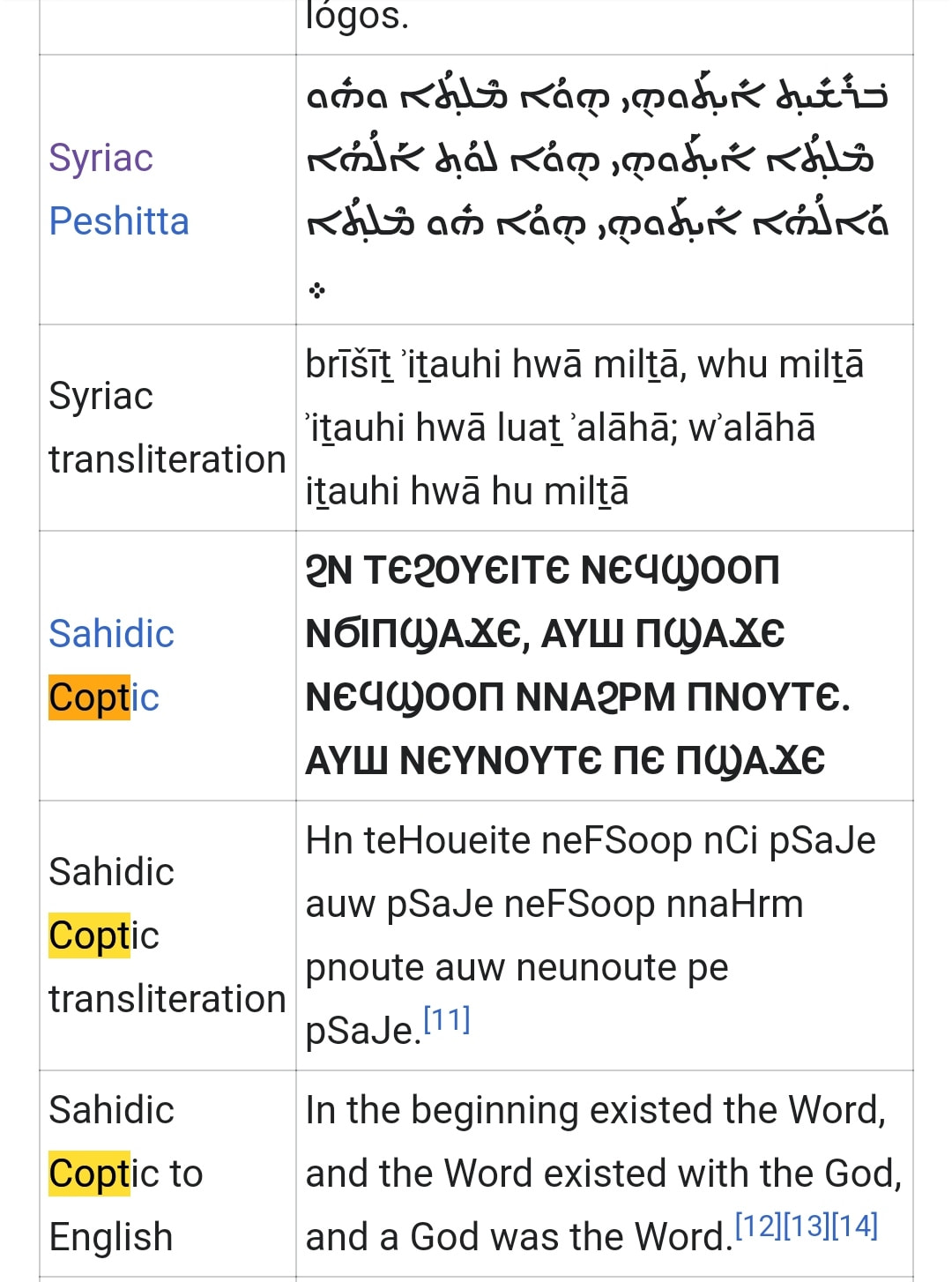
The Coptic translation supplies interesting evidence as to how John 1:1 would have been understood back then. The Sahidic Coptic translation uses an indefinite article with the word “god” in the final part of John 1:1. Thus, when rendered into modern English, the translation reads: “And the Word was a god.”

(screenshot from Wikipedia)

Evidently, those ancient translators realized that John’s words recorded at John 1:1 did not mean that Jesus was to be identified as Almighty God. The Word was a god, not Almighty God.

As Jesus said in the clearest possible terms imaginable at John 17:1-5, the Father is the Almighty God, and He is the only one to receive full worshipful devotion.

I see nothing in the Samuel account which precludes at least a portion of each one of three daytimes and at least a portion of each one of three night times.

In that passage, a man says he hadn’t eaten “for three days and three nights,” yet the context (verse 13) indicates it had been “three days ago”—not necessarily a full 72 hours. Similar inclusive reckoning appears elsewhere (e.g., Esther 4:16 vs. 5:1).

So the reasoning is:

  • Biblical timekeeping often used inclusive counting (any part of a day counts as a day).
  • “Three days and three nights” can function as a figure of speech meaning “within three days.”
  • Therefore, Jesus’ statement can align with a Friday burial and Sunday resurrection without requiring a literal 72-hour span.

Some people disagree and argue for a literal interpretation (leading to alternative timelines like a Wednesday or Thursday crucifixion), but the idiomatic explanation mentioned is widely accepted in mainstream scholarship.

I’m sure you agree with the first commandment, You shall “worship” the Lord your God and serve only Him. Worship, is only reserved for Almighty God. Then why did Jesus accept worship over and over. There are also many examples of angels rebuking worship by saying “don’t worship me only God who is in heaven”. Even in His human form, Jesus as rabbi/teacher should have called this worship blasphemy and He never did. There settled it for you!

1 Like

Gospel,
re: “In that passage, a man says he hadn’t eaten for ‘three days and three nights,’ yet the context (verse 13) indicates it had been ‘three days ago’—not necessarily a full 72 hours…So the reasoning is: Biblical timekeeping often used inclusive counting (any part of a day counts as a day).”

I haven’t said anything about 72 hours, nor does Matthew 12:40 say anything about 72 hours. It only says that 3 daytimes and 3 night times would be involved. While it was true that any part of a calendar day could be counted as a full calendar day, when a daytime and a night time is specifically mentioned to be included within a calendar day, and as I previously mentioned, E.W.Bullinger writes in his Appendix 144 in The Companion Bible - “… when the number of ‘nights’ is stated as well as the number of ‘days’, then the expression ceases to be an idiom, and becomes a literal statement of fact”. And the same practice with counting a calendar day as a whole day could be applied to counting any part of daytime as a whole daytime and counting any part of a night time as a whole night time.

So, again, I see nothing in the Samuel account which precludes at least a portion of each one of three daytimes and at least a portion of each one of three night times.

And your Esther account might be an example if “three days, night or day” means the same thing as " three days and three nights". But I don’t think it’s a slam dunk.

First, we have to understand what the New Testament meant here by worship.
It used the Greek word *pro·sky·neʹo.

Unger’s Bible Dictionary* says that this word literally means to ‘kiss the hand of someone in token of reverence or to do homage.’ An Expository Dictionary of New Testament Words, by W. E. Vine, says that this word “denotes an act of reverence, whether paid to man . . . or to God.” In Bible times pro·sky·neʹo often included literally bowing down before someone of high stature.

Consider the parable Jesus gave of the slave who was unable to repay a substantial sum of money to his master. A form of this Greek word appears in this parable, and in translating it the King James Version says that “the servant therefore fell down, and worshipped [form of pro·sky·neʹo] him [the king], saying, Lord, have patience with me, and I will pay thee all.” (Matthew 18:26

Was this man committing an idolatrous act? Not at all! He was merely expressing the kind of reverence and respect due the king, his master and superior.

Such acts of obeisance, or expressions of respect, were fairly common in the Orient of Bible times. Jacob bowed down seven times upon meeting his brother, Esau. (Genesis 33:3) Joseph’s brothers prostrated themselves, or did obeisance, before him in honor of his position at the Egyptian court. (Genesis 42:6)
In this light we can better understand what happened when the astrologers found the young child Jesus, whom they recognized as “the one born king of the Jews.” As rendered in the King James Version, the account tells us that they “fell down, and worshipped [pro·sky·neʹo] him.”—Matthew 2:2, 11.

Clearly, then, the word pro·sky·neʹo, rendered “worship” in some Bible translations, is not reserved exclusively for the type of adoration due Jehovah God. It can also refer to the respect and honor shown to another person.

Ok, so what was the Greek word used for worship that the angels rebuked? I can look it up but maybe you can shed some light on it.

Why did the angel reject pro·sky·neʹo? Because John was bowing to the angel to honor him, who has no kingship or special authority within God’s kingdom. (Re 19:10 [pa|in], 22:9 [pa|in])

If the angel had accepted the obeisance, he would have been usurping authority he did not have.

But is Jesus worthy of special honor?

Yes, because he is the one who received the kingdom from God and will wrest the world away from Satan and rule as “Lord of Lords and King of Kings” until the day he hands over all authority and power to his Father. (1Co 15:20-28 [pa|in]; Re 17:14 [pa|in]) Thus, as king of God’s kingdom, he deserves the honor due his positoin, just as with any other king. He is “the Son of the kingdom.”

At Re 3:9 [pa|in], Jesus promises Christians that he would make “the synogogue of Satan” to ’proskuneo’ at their feet. Are we, then, to believe that Christians are also to be given exclusive devotion in the way given to God? Of course not, but the same word is used there.

This is the first time i have seen this level of liberty provided on a Christian forum. And I think it is an incredible opportunity to learn as well as providing mature and real-world level discussions. However, I am unclear as to how to process the following…

Again, I think this is a very healthy stance to provide such level of discussion. And I understand the way @Gospel has entered the forum was for us to ask them questions. This can be a noble approach. And it looks for the most part like Peter has honored this. But how do we measure the difference between these two stances:

A) A JW take on scripture would be understood as beliefs contrary to evangelical faith. So in that sense is not every single answer from @Gospel not promoting contrary beliefs? How could @gospel answer any questions not doing that though?

B) @Gospel is within TOS in answering questions according to the JW belief system. As this provides context for academic insight for the forum to consider.

. . . . .

Please don’t misunderstand. I actually think what is going on in this thread is helpful to the community. But it would seem “B” to most accurately be done in concert with TOS if @gospel were a former JW not defending their own positions. By this i am not trying to be without compassion. I actually respect @Gospel to have conviction enough to be questioned on Christian forum. And I respect the forum for allowing such an event. What i am asking is where is the line between A & B? Or could there actually even be one?

By this I am not suggesting we don’t do this thread. As i see it, this thread provides enormous advantage for the body to see respectful discussion that is extremely hard for most to weather. For that alone, this thread should get an A+ for its pioneering spirit in helpful mature worthy transparency to the Christian community. But still, the reason most Christian forums won’t do this sort of thing (or at least to this degree and length) is because the line between A & B is likely subjective at best, no? Or what might i be missing here?

Other than that this is an excellent exchange. One of my biggest concerns in evangelicalism is that we can super tend to be a bit on the defensive side or can tend to be perhaps too bias in areas beyond the core doctrines. Or at least in how we might be willing to treat or interact with others. So seeing this thread and all this engagement in this way is fresh. :slight_smile: Blessings.

A few key points to weigh your argument:

1. “Day and night” can still function as a single idiom
In Jewish usage, “day and night” often forms a merism (a pair expressing a whole), like “heaven and earth.” So “three days and three nights” can mean a complete period spanning three days, not necessarily six distinct segments (3 daylight + 3 nighttime portions). This is why many scholars don’t treat the nights as adding extra precision.

2. The Book of Jonah parallel matters
Matthew 12:40 echoes Jonah 1:17. In Hebrew narrative style, “three days and three nights” there is widely understood as a stock expression for a period covering three days, not a stopwatch-like statement. The phrase shows up in contexts where strict literalism creates tension with parallel wording elsewhere.

3. Internal Gospel evidence leans “inclusive,” not segmented
Jesus repeatedly says He will rise “on the third day” (e.g., in the Gospel of Luke 24:7, 21). Those same disciples say, “it is now the third day since these things happened.” That wording naturally fits inclusive counting, not a requirement for three separate night periods to pass.

4. About E. W. Bullinger’s claim
Bullinger’s rule (“days + nights = always literal”) isn’t universally accepted. Many Hebraists point out that even when both are mentioned, the phrase can still be idiomatic—because Hebrew often uses paired terms for emphasis rather than precision. So his conclusion is one interpretive choice, not a linguistic necessity.

5. Your Samuel point is fair—but not decisive
You’re correct: 1 Samuel 30 doesn’t exclude three partial days and nights. But the text also doesn’t require that level of precision; it comfortably reads as “three days ago” ≈ “for three days and three nights.” That equivalence is exactly what proponents of the idiomatic view rely on.


So where does that leave it?

  • Your argument: the mention of both “days” and “nights” implies at least part of each → could support a longer timeline.
  • The common counter: “day and night” is a set expression for a span, and parallel phrases like “on the third day” control the interpretation → supports the traditional Friday–Sunday view.

It’s not a slam dunk either way—you’re right about that. The real question is which principle you prioritize:

  • Literal segmentation of time units, or
  • Idiomatic usage + cross-text consistency.

You’re right about the line between A & B. Can definitely be subjective. In my eyes, the line is crossed when the belief system we do not adhere to says, “this is 100% true and you must cross over and stand with me.” Until that happens, to me, it’s just healthy debate and exchange of knowledge.

2 Likes