***** Unity (Communion of Nature): Willard emphasized that God is a “self-sufficing community of unspeakably magnificent personal beings of boundless love”. Their unity is not found in being a single “persona,” but rather in their shared nature, purpose, and perfect love. They are “too one to be many but too many to be one”.****
***** Identity (Distinction of Persons): Willard stressed that the Father, Son, and Holy Spirit are not identical; they are three distinct, separate persons. They have different roles and, in some interpretations of his work, different thoughts and feelings that they share in intimate communion.****
***** Key Distinction: Confusing these two leads to heresy. Many people mistakenly believe “unity” means the Trinity is one person with three different “names” or “offices”.****
Is the latter what you are doing? This discussion is way out of my league- so I want to learn as much as I can.
***** Unity (Communion of Nature): Willard emphasized that God is a “self-sufficing community of unspeakably magnificent personal beings of boundless love”. Their unity is not found in being a single “persona,” but rather in their shared nature, purpose, and perfect love. They are “too one to be many but too many to be one”.****
***** Identity (Distinction of Persons): Willard stressed that the Father, Son, and Holy Spirit are not identical; they are three distinct, separate persons. They have different roles and, in some interpretations of his work, different thoughts and feelings that they share in intimate communion.****
***** Key Distinction: Confusing these two leads to heresy. Many people mistakenly believe “unity” means the Trinity is one person with three different “names” or “offices”.****
Is the latter what you are doing? This discussion is way out of my league- so I want to learn as much as I can.
This is from my understanding of video. If being a Person has to do with experiences and experiences are what make up a person, then what can we conclude?
We would have to find scriptures where the Father and son have different thoughts; experiences. And one off the top of my head is that Jesus didn’t come to do His own will but the will of the one who sent Him. Next, would be that the Holy Spirit would not speak on His own authority, but what He hears…Third, the Father has a will.
These 3 show that they are different personas consecutively authority, will, and will.
So now that addresses the personal aspect. And not only that but God’s invitation into His life(His experiences)
There is a concept that can be derived from this passage: if we walk in the Spirit we have fellowship with one another.
After listening to the video it opened my eyes to how we know someone, which is by shared experiences.
Well what is the meaning of fellowship? Could it mean, what you share in common. Could it be said that 3 men watching the Superbowl can have fellowship even without speaking? Unity, communion?
If so could that be what God wants us to share, sense man were made in His image? Not Identity but unity.
Hence back to Genesis God said, let us make man in “our” image and in the image of God He made man male and female
Man are all created from the dust of the ground yet each one has a seperate inward idenity based partly by their own experiences.
The whole ideal in my opinion is to be able to love one another with different identities.
As an I for an I, or the Song “when I move u move”, or a life for a life…We experience God when we are caught up in His experiences. Life for life.
Thats why we are to pursue peace with all man, because the kingdom is peace.
So yes God is in unity because one might partly describe God as unbodily personal power. So power might be the Trinity’s shared essence.
I appreciate you clarifying what you believe. I’m not trying to mischaracterize you. I’m trying to understand how what you’re saying coheres.
You’ve now stated:
The Holy Trinity is Three Divine Persons
Each is fully and entirely God
Not part of God
Each Himself the One indivisible God
That’s a very strong claim. So let me ask something sincere, not sarcastic.
If what you’re describing is the actual reality of God’s being, then describe Him concretely.
Not a diagram.
Not a triangle.
Not a chart with arrows and relational lines.
Draw a portrait — an actual picture — of what God is like the way you’ve just described Him.
If there are three distinct Divine Persons, each fully God, not parts, not fractions, not modes — but distinct — then what does that look like in actual ontological reality?
Is there one divine consciousness or three?
One “I” or three “I’s”?
One self-awareness or three centers of self-awareness?
Because once you try to describe it plainly, without theological shorthand, the tension becomes unavoidable.
If you say there are three distinct self-aware Divine Persons, each fully God, then you have plurality at the level of personal subject. And plurality of fully divine subjects is precisely what Isaiah denies when God says:
“Beside Me there is no God.”
“I know not any.”
“By Myself.”
If, on the other hand, you say there is only one divine consciousness and one divine self, then we are no longer speaking about three distinct personal subjects in any meaningful sense.
This isn’t mischaracterizing your doctrine. It’s asking for clarity.
If the Trinity is the truth about God’s inner being, it should be describable in plain terms without collapsing into contradiction or requiring mystery to shield it from examination.
So help me understand:
What does the God you’ve just described actually look like — not symbolically, but ontologically?
That’s not hostility. That’s a request for coherence.
That’s actually an important question — and I’m glad you asked it plainly.
When Jesus says, “I came not to do My own will, but the will of Him who sent Me,” we have to ask: what kind of will is being discussed?
Scripture already gives us the category we need.
If Jesus is truly human — not pretending, not role-playing — then He must possess a real human will. A real human mind. A real human consciousness. Otherwise the incarnation collapses into something less than full humanity.
In Gethsemane He prays:
“Not My will, but Thine be done.”
If that proves two divine persons, then we have a serious problem — because it would mean Jesus does not possess a real human will at all. It would turn every moment of obedience into an intra-divine conversation rather than the lived obedience of a man.
But Scripture presents something different.
It presents:
One divine will (because God is one).
And in the incarnation, a real human will that submits to that divine will.
Hebrews says He “learned obedience.”
Philippians says He humbled Himself.
John says He was sent.
None of that requires multiple divine persons. It requires a real incarnation.
The Son does not have a separate divine will competing with the Father. That would divide God. Rather, the man Christ Jesus expresses a genuine human will aligned in submission to the one divine will.
To say Jesus had a human will is not to divide God.
It is to affirm that God truly became man.
If we deny that distinction, we risk denying either:
the fullness of His humanity, or
the oneness of God.
So the question isn’t whether Jesus speaks of “another will.”
The question is whether that will is divine or human.
Scripture consistently shows Christ operating within real humanity — praying, submitting, obeying — while still being the fullness of God manifested in flesh.
That doesn’t create two divine persons.
It shows one God living a real human life.
And that preserves both monotheism and incarnation without redefining God’s oneness.
Think about it like this. In his house there are many mansions. Gods house! we are talking spiritual now. Look to things of the spirit. Mosses people gathered him when he died. Where did he go? To his mansion. His people had to take him somewhere. So ponder this. All of your people have a mansion in gods house.the family vault? where your soul goes when your family members die. They call this heaven. Where you go when you die. family=love!church=my mansion. Whose house is this? Gods house. Who runs this house? God runs my house. The questain was how many are in his mansion? that stands at the top. We know a few names. Holy spirit our comforter. Controlled directly by the hand of god. The son. His name is jesus. He can send messages thru the holy spirit. We have evidence god leads a heavenly army. So who do you want to talk to? Them people are real.
Not possible. God, in His Being, is unknowable and incomprehensible; and depicting the Divine Being would be an act of idolatry.
Each Person is Himself. So the Father can say “I” and that is distinct, relationally, to the Son and the Holy Spirit. This is why the Father can say “This is My beloved Son in Whom I am well pleased”.
I don’t believe I am in any position to speculate about the nature of the incomprehensible and ineffable Mind of God so as to speak of “consciousness” as such at all. But insofar as what is revealed to us is Three co-inhering Persons who relate One to Another, then there is very much an “I-Thou” relationship between Father, Son, and Holy Spirit. At the same time, since we can only speak of the one indivisible Will of God, there is only one indivisible Mind. There is a singular Mind, Will, and Being.
I don’t believe we can map that onto our usual language of consciousness. We can say that the Father knows Himself in relation to His Son, and so on; because the Father speaks of His Son, relates to His Son, the Father loves His Son which is why when speaking of Father and Son we are speaking of two Persons, two Hypostases.
Where are you seeing in Isaiah a denial of Divine Persons? What I’m seeing is the unequivocal declaration that there is only one God.
So, no. Isaiah’s declaration that YHWH alone is God does not contradict the Trinity of Divine Persons. If you want to use Isaiah here as a prooftext, you’ll need to offer something more than just your say-so.
As I’ve said already, describing God, or depicting God, is utterly impossible. And I’d rather not have to drink molten gold after fashioning a golden calf.
So the truth of God the Holy Trinity can be most clearly and easily summed up in these words from the Athanasian Creed: We worship one God in Trinity, and Trinity in Unity, neither confusing the Persons nor dividing the Essence.
I respect your concern for what you call “historic, orthodox Christian faith.” But we need to be careful about what that term actually means.
The word orthodoxy—“right belief”—became historically attached to the doctrinal formulations of the 4th-century councils, particularly concerning how to articulate God’s triunity. Those councils defended a specific conceptual framework: three distinct “Persons” sharing one essence.
What I am questioning is not the deity of Christ, nor the reality of Father, Son, and Spirit—but whether the later philosophical language used to describe them is identical with the language of Scripture itself.
A strictly Apostolic view—often described as Incarnational Monotheism—begins with the Bible’s own declarations:
“Hear, O Israel: The LORD our God is one LORD.”
“Beside Me there is no God.”
“In Him dwelleth all the fullness of the Godhead bodily.” (Colossians 2:9)
That last verse is not marginal—it is decisive. Paul does not say “a third of the Godhead,” nor “one person of the Godhead.” He says the fullness dwells bodily in Christ.
Rather than adopting later metaphysical categories like “three distinct persons within one divine essence,” this view understands Father, Son, and Holy Spirit as the one true God revealed in different ways—without dividing God internally.
Think of it this way:
The Father is the eternal, invisible God.
The Son is the visible image of that invisible God (Colossians 1:15).
The Holy Spirit is that same God active and indwelling.
Not three “Whos.”
One “Who,” revealed and acting.
The Son is not a second divine self interacting with the Father. He is the one God made manifest in genuine humanity. The incarnation does not multiply God; it reveals Him.
When later councils labeled this perspective heresy, they were defending a particular explanatory model. But rejecting their terminology does not equal rejecting Scripture. It means insisting that Scripture itself—not later philosophical precision—sets the boundaries of belief.
So the real question isn’t whether something aligns with 4th-century orthodoxy.
The question is whether it aligns with:
the Shema of Deuteronomy 6:4
the absolute monotheism of Isaiah 44–45
and the apostolic proclamation that all the fullness of the Godhead dwells in Jesus Christ.
If holding those texts at face value disqualifies someone from “orthodoxy,” then perhaps we need to clarify whether orthodoxy means fidelity to Scripture—or fidelity to later theological formulations.
I’m not asking for the thread to close.
I’m asking for Scripture to remain central.
The issue isn’t that Isaiah contains the phrase “no Divine Persons.” He doesn’t. The issue is what Isaiah’s Hebrew exclusivity formulas actually deny, and what Trinitarian “three distinct self-aware persons, each fully God” necessarily introduces at the level of divine subjecthood.
In Isaiah 44–46 (and 43, 45) you get a repeating cluster of Hebrew constructions that do more than say “one God exists.” They say YHWH is the only God—no other alongside Him, before Him, after Him, or known by Him. Here are the key phrases and what the Hebrew is doing:
“beside Me / besides Me there is no God”
Common Hebrew forms:
מִבַּלְעָדַי (mibbal‘aday) = “apart from me / besides me / outside of me”
אֵין אֱלֹהִים (’ên ’elohim) = “there is no God”
So: מִבַּלְעָדַי אֵין אֱלֹהִים = “Apart from Me there is no God.”
That is not merely counting “gods” in the abstract. It’s excluding any other ‘elohim’ in the category of deity in relation to YHWH: none outside Him, none alongside Him as another.
“I am YHWH, and there is none else”
אֲנִי יְהוָה וְאֵין עוֹד (’ani YHWH we’ên ‘od)
עוֹד (‘od) here functions like “else / further / additional.”
So it’s: “I am YHWH, and there is no additional (one).” It’s an exclusivity claim: no other in the same class.
“There is no God besides Me” (again) using another exclusivity word
זוּלָתִי (zulati) = “except me / besides me”
בִּלְתִּי (bilti) = “there is not / without (any)”
These are “exception” particles. They’re not philosophical “monotheism” labels; they’re denials of any exception.
“By Myself / I alone”
לְבַדִּי (lebaddî) = “by myself / alone”
When YHWH says He acts lebaddî (alone), the rhetorical force is: no other divine agent shares His deity alongside Him. That’s why Isaiah pairs it with the idol polemic: YHWH does what no other can do because no other God exists.
“Before Me no god was formed… after Me there shall not be”
You see the pattern:
לְפָנַי (lefanay) “before me”
אַחֲרַי (’acharay) “after me”
לֹא (lo’) / אֵין (’ên) negations
This is a temporal sweep: not merely “there is one God right now,” but no other deity at any point—past or future.
“I know not any”
לֹא יָדַעְתִּי (lo’ yada‘tî) = “I do not know”
In Hebrew idiom, this isn’t “I personally haven’t met them yet.” It’s covenant/legal exclusivity: there exists no other God for YHWH to acknowledge as God.
If someone defines the Trinity as three distinct self-aware subjects, each of whom is “fully God,” then you now have plurality at the level Isaiah is excluding: other fully divine “who’s” that are not identical to YHWH as the single “I / Me” speaking.
Isaiah’s speech is saturated with singular first-person identity: “I… Me… Myself… I am He… there is none besides Me… I know not any.” The text never signals, “I am one divine essence shared by three co-equal ‘I’s.” That category (“persons”) is not drawn from Isaiah’s Hebrew; it’s imported later as a metaphysical solution.
A Trinitarian can reply: “But those persons aren’t other gods; they are the one God.” Fine—but then the debate becomes: what kind of ‘oneness’ does Isaiah’s Hebrew naturally communicate? Isaiah doesn’t just deny three gods; he denies any other God besides the one ‘I’—and he does it with “no exception” particles (zulati, mibbal‘aday, we’ên ‘od) and “alone” language (lebaddî) that function to shut the door on “another alongside” in the deity category.
So it’s not, “Isaiah uses the word ‘persons,’ therefore no persons.”
It’s: Isaiah uses exclusionary Hebrew formulas that deny any other God besides the one speaking ‘I.’ If you posit multiple distinct divine subjects each rightly called “God,” you must explain—from Isaiah—how that doesn’t introduce what his language is designed to exclude.
If that proves two divine persons, then we have a serious problem — because it would mean Jesus does not possess a real human will at all.
Whynot following- Help me understand
strong text It would turn every moment of obedience into an intra-divine conversation rather than the lived obedience of a man.
Not following
But Scripture presents something different.
It presents:
One divine will (because God is one). That is not what it says-
He did not “come” to do His will..that means what it says and shows He had a will and the father has a will..Yet Jesus submits to the father’s will.
And in the incarnation, a real human will that submits to that divine will.
Hebrews says He “learned obedience.” Philippians says He humbled Himself. John says He was sent.
None of that requires multiple divine persons. It requires a real incarnation.
The incanation of the word that was with God and is/was God
The Son does not have a separate divine will competing with the Father.
**No one say wills must compete. YOU may have a will to go to bed early, and your spouse to go later those wills are not competing. **
Are they competing when one decides they will do the will of the other?
That would divide God. Rather, the man Christ Jesus expresses a genuine human will aligned in submission to the one divine will.
If 2 people can have different wills without division then JESUS AND His Father can too. One may delay His will because of the love they have for the other until a later time. Division would only occur if the wills went against each other. And sense we dont know what the will Jesus hypothetically delayed was, then you have made a blank statement.
Your daughter might have wanted to go to school right after college but because she needed to take care of her mom she did your will instead and took care of her mom. Love does what is best for someone. A delayed will is not divisive nor competitive. And i’m sure I can come up with more examples of how having a different will is not divisive.
To say Jesus had a human will is not to divide God. It is to affirm that God truly became man.
If we deny that distinction, we risk denying either: Lost me
the fullness of His humanity, or
** the oneness of God.* What distinction? Jesus had A will…and He did not “come” to do it
So the question isn’t whether Jesus speaks of “another will.” The question is whether that will is divine or human.
He came not to do His own will. So rather a divine will that doesnt divide God. 2 people could have different wills that are not against the other. YOUR SPOUSE MAY HAVE A WILL TO MAKE A BLANKET AT NIGHT AND YOU may have a will to watch football at night, where and How is that division. Especially if your wills are in agreement to allow time apart for seperate identities.
Scripture consistently shows Christ operating within real humanity — praying, submitting, obeying — while still being the fullness of God manifested in flesh.GOD IS NOT LIMITED TO TIME IN SPACE, Jesus as man is.
That doesn’t create two divine persons.
**The Divinity already existed Jesus **
came
** not to do His will. Jesus said restore to me the glory I had before while I was with u. ( don’t quote me on my phone)**
To have different experience or wills does not stop Jesus , the FAther, nor The Holy Spirit from being God.
It shows one God living a real human life. It shows God the son, the word made flesh.
And that preserves both monotheism and incarnation without redefining God’s oneness.
GOD’S BEING ONE IS NOT REDEFINED BECAUSE God is shown in 3 different persons. In the same way that man is not redefined because they have different identities. Man still were created from the dust of the ground and are limited to a body, space and time.
While God always existed. And Is the creator and not limited to space and time.
As at the tower of Babel people could be one in unity but have different identies.
Does different Identities or pesonhoods derail the fact of what man share in unity; as being created beings from the dust?
If no then The persons of Trinity do not derail God’s unity. JESUS AS MAN HAS SAME WILL AS FATHER, BUT OUTSIDE OF TIME WE DON’T KNOW OF WHAT THEY AGREED TO.
I understand your concern; however, I think this is a debate that is worthy of being open for others to read and learn. I know we will not convince @The_Omega that he is wrong, but others may be on the fence, and this debate may help them.
THIS is Why Oneness Pentecostalism / Modalism is a DAMNABLE HERESY
Pentecostalism: A Survey of Church History with W. Robert Godfrey
Brother @The_Omega, I have noticed that you often appeal to “Hebrew” when addressing our sister @anon3111385. I sincerely pray that you would come to see the fullness of the Light, because your use of Scripture seems highly selective. Your approach strongly reminds me of Rabbi Tovia Singer.
Have you ever watched his debates with Dr. Michael Brown?
Did you know the early Jewish community were Binitarians?
Ever listen to Benjamin Sommers?
First, passages that emphasize real distinction between Father and Son, not merely verbal differentiation.
John 1:1–2
“In the beginning was the Word, and the Word was with God, and the Word was God. The same was in the beginning with God.”
The phrase “with God” is repeatedly cited to argue relational distinction alongside unity.
John 5:19 “Then answered Jesus and said unto them, Verily, verily, I say unto you, The Son can do nothing of himself, but what he seeth the Father do…”
Here the Son speaks of observing and responding to the Father, language many argue implies interpersonal relation, not merely human consciousness addressing divine nature.
John 6:38 “For I came down from heaven, not to do mine own will, but the will of him that sent me.”
The sending language is central. Trinitarians argue that eternal Sonship grounds this mission, not merely incarnation.
John 8:16–18 “I am not alone, but I and the Father that sent me… The Father that sent me beareth witness of me.”
Two witnesses are invoked, Jesus and the Father, in a legal framework.
John 14:16 “And I will pray the Father, and he shall give you another Comforter…”
The word “another” is significant. It suggests distinction between Son and Spirit.
John 17:5 “And now, O Father, glorify thou me with thine own self with the glory which I had with thee before the world was.”
Pre-existence and shared glory “with” the Father is a major text in this discussion.
Second, passages showing simultaneous manifestation, which critics argue strain a modal framework.
Matthew 3:16–17 “At Jesus’ baptism” the Son is baptized, the Spirit descends like a dove, and the Father speaks from heaven. The simultaneity is heavily emphasized in Trinitarian argumentation.
Matthew 28:19 “Baptizing them in the name of the Father, and of the Son, and of the Holy Ghost.”
The triadic formulation is central to classical Trinitarian structure.
2 Corinthians 13:14 “The grace of the Lord Jesus Christ, and the love of God, and the communion of the Holy Ghost, be with you all.”
Another triadic blessing, treated as reflecting real distinctions.
Third, passages where the Son is addressed directly by the Father.
Hebrews 1:8 “But unto the Son he saith, Thy throne, O God, is for ever and ever…”
The Father speaks to the Son as God.
Psalm 110:1 (applied repeatedly in the New Testament) “The LORD said unto my Lord…”
Used in ~Matthew 22:41–46 and elsewhere to show intra-divine dialogue.
A little bit of “Hebrew” is not going to help your case here at all brother, you still have to deal with the verses and passages that explicitly teach the Triune Godhead.
Cognate with Theos , there are three other words to be noted :
Theotes , rendered “Deity”, and used of Christ. Occurs only in Col_2:9, and has relation to the Godhead personally ; while
Theiotes , rendered “Deity” also, is Deity in the abstract . Occurs only in Rom_1:20.
Theios , rendered “Divine”, and is used of Christ. Occurs only in 2Pe_1:3; 2Pe_1:4; and, with the Article, in Act_17:29, where it is rendered “Godhead”. Gr. = that which [is] Divine.
@The_Omega, God himself said in the first and second commandments that we must not picture him. I believe the reason is that his divine character is unimaginable and mysterious to human thought. The mystery is that God is three Persons and yet also one God. Why do you have to go into that mystery any further, when the Bible doesn’t explain it anymore than that description, according to the Gospel of John (his threeness) and the rest of the Bible (his oneness)?
Deu 6:4 “Hear, O Israel: The LORD our God, the LORD is one.
Joh 1:1 In the beginning was the Word, and the Word was with God, and the Word was God.
Joh 1:14 And the Word became flesh and dwelt among us, and we have seen his glory, glory as of the only Son from the Father, full of grace and truth.
Joh 14:26 But the Helper, the Holy Spirit, whom the Father will send in my name, he will teach you all things and bring to your remembrance all that I have said to you.
That’s a fair question — and it really gets to the heart of what is being assumed in the passage.
When Jesus says in Gospel of Luke 22:42, “Not My will, but Thine be done,” we first have to ask: What kind of will is speaking? Scripture is explicit that the Word was made flesh (Gospel of John 1:14) and that Jesus was “made like unto his brethren” (Hebrews 2:17). That means He possessed a complete human nature — body, mind, emotions, and yes, a human will.
If we say the prayer in Gethsemane proves two divine wills — one belonging to the Son as a separate divine person, and one belonging to the Father — then we are no longer talking about Christ’s humanity at all. We would be saying that the struggle in the garden is happening inside the Godhead itself. But God does not wrestle with Himself. God is not divided internally. Scripture consistently presents God’s will as singular (Isaiah 46:9–10; Ephesians 1:11).
The tension in Gethsemane only makes sense if the will that shrinks from the cup is truly human. The cup represented suffering, shame, and death. A genuine human will would recoil from that. That recoil is not sin — it is humanity. Yet that human will fully submits to the divine will.
So what we see is not “God the Son submitting to God the Father” as two divine centers of consciousness negotiating. What we see is the Incarnate Christ — the one God manifested in flesh — allowing His authentic human will to be brought into perfect submission to the eternal divine will.
This is exactly what Epistle to the Hebrews 5:8 means when it says, “Though he were a Son, yet learned he obedience by the things which he suffered.” God in His divine nature does not learn obedience. Humanity does.
If you interpret Luke 22:42 as proof of two divine persons with distinct divine wills, then you unintentionally remove Christ’s real humanity. But if you understand it as the human will of the Messiah submitting to the one divine will of God, the passage remains coherent, biblical, and fully consistent with monotheism.
The issue isn’t whether distinction exists. It does. The distinction is between deity and genuine humanity — not between two divine beings within God.
If we say that Jesus is a distinct divine Person speaking to another distinct divine Person, then every time Jesus prays, submits, obeys, or says “not My will but Yours,” we are describing an interaction happening within God between two co-equal divine selves.
But the Gospels repeatedly emphasize something else: the Word became flesh (John 1:14). Jesus is presented as a real man — tempted, weary, praying, learning obedience (Hebrews 5:8), growing in wisdom (Luke 2:52). His obedience is portrayed as the lived obedience of a genuine human life empowered by God’s Spirit.
If His human obedience is instead framed as one eternal divine Person responding to another eternal divine Person, then the dynamic subtly shifts. It can begin to sound less like true human submission and more like divine self-communication.
For example:
• In Gethsemane, Jesus says, “Not my will, but Yours be done.”
If two distinct divine wills are speaking, that implies multiple centers of divine willing.
But Scripture consistently says God is one (Deut. 6:4), and presents Christ as the one God manifested in flesh (1 Tim. 3:16).
From an incarnational monotheist perspective, what’s happening in Gethsemane is not two divine “Whos” negotiating. It is:
The eternal Spirit (the Father) dwelling fully in the man Christ Jesus (Col. 2:9), and the authentic human will of that man submitting perfectly to the divine will.
That preserves:
• True humanity
• Real temptation
• Genuine obedience
• And uncompromised monotheism
If instead we treat every prayer of Jesus as an intra-Trinitarian exchange, then the incarnation risks becoming a kind of staged dialogue inside the Godhead rather than the lived obedience of the second Adam (Romans 5).
So the concern is not to deny distinction between Father and Son in manifestation. The concern is to avoid multiplying divine personal subjects in a way that shifts the narrative of the Gospels away from:
God truly manifested in flesh, living a real human life, obeying as man, redeeming as man.
Does that clarify the concern behind the statement?
When revelation is given of the scripture and you say give scripture and it’s given, you will not see it because your thoughts are preoccupied with the belief that the “framework is imposed on”. Bible does speak of one God, and only one and it is true. That one God is Spirit. God, Spirit. The Word, Spirit. And the Holy Ghost, Spirit.
That that is unseen is eternal.
Man is spirit, soul, and body. God is a spirit, eternal.
Angelic beings and demonic beings are spirits, eternal. This is why they, as well as those in hell and hell-bound will forever be consciously aware of their damnation. Though man will not have their natural bodies they will still thirst, hunger, desire, etc. and they will feel pain, horror, etc. i’ve been asked why God won’t just kill Satan and the demons. They are spirits eternal.
There are more than one of every being there is. But there is only one God.
Unlike all that is created, there is a house, temple, shell, or whatever you want to call it, that limits us. We are a spirit and it is within this temple. We have a soul and it is within this temple. Our bodies are also with limitations.
But with God, He has no limitations.
Again, that that is unseen is spirit.
Jesus said that the words that He spoke were spirit and they were life, John 6:63,
63It is the spirit that quickeneth; the flesh profiteth nothing: the words that I speak unto you, they are spirit, and they are life.
If the words of Jesus are spirit and life then John 1:3,
**3**All things were made by him; and without him was not any thing made that was made.
tells us that he was indeed the very Word that God spoke.
God spoke and from Him came the Word, which is what was spoken, and by the Power of God, which is the Holy Ghost, which is the Spirit of God, all things came into being.
You cannot separate God’s Word nor God’s Spirit from God. They are all God.
Just like if your spirit came forth from your body and beside it stood your soul and beside it stood your body, and someone pointed and asked which one was you, would not all of them be you?
The Bible tells us that the Word became flesh and gave his life for us because he loves us, just in case one may say why would he do this.
Yet, God did not leave his throne, never. The Word, God, came as Son of Man, yet Son of God being that he, both came forth from God and by the Power of God, who is God, the Holy Spirit, he was birth in the form of man by way of woman.
Being that the words of Jesus are spirit and life, then the Word of God is spirit and life. YES, the very life that brought everything into existence.
Those of us who can see this can understand whenever God the Father, God the Son, or God the Holy Spirit is mentioned. It is not confusing. God is one and from him came The Word and The Spirit that is of God.
I’m going to respond plainly, because what you’ve just done is not argument—it’s association.
You’ve shifted from engaging the text to implying that because I appeal to Hebrew Scripture, I must somehow be echoing Rabbi Tovia Singer or Jewish anti-Christian polemics. That’s not exegesis—that’s guilt by proximity.
Appealing to Hebrew context when discussing the Hebrew Scriptures is not suspicious. It’s responsible.
If Isaiah 44–45 is written in Hebrew prophetic monotheistic language, then understanding what that language actually meant to its original audience is not “selective.” It’s foundational.
Now let’s address your points directly.
Rabbi Tovia Singer / Michael Brown
Whether I’ve watched their debates is irrelevant.
Truth is not established by which modern apologist someone resembles. If something I say is incorrect, demonstrate it from Scripture. If it is correct, then dismissing it because someone else also says it is not a rebuttal.
The question remains the same:
When Isaiah says:
“I am the LORD, and there is none else.”
“Beside Me there is no God.”
“I know not any.”
Where in that context is there even a whisper of “three eternal divine persons”?
That’s the issue—not YouTube debates.
“Early Jews Were Binitarian”
This claim needs serious clarification.
Second Temple Judaism contained speculation about:
Wisdom personification
The Word (Memra)
The Angel of the LORD
The “Two Powers in Heaven” discussion
But none of these equaled:
two co-equal, co-eternal divine persons within one essence.
The “Two Powers” teaching was later condemned precisely because it was seen as compromising monotheism.
Jewish speculation about exalted agents does not equal Nicene Trinitarianism, nor does it establish eternal intra-divine plurality.
If anything, it shows that Jewish thinkers struggled to articulate divine agency without abandoning monotheism—not that they believed in a tri-personal God.
Benjamin Sommer
Sommer argues for “fluidity” in divine embodiment within the Hebrew Bible—multiple manifestations of YHWH.
But here’s the key:
Even in Sommer’s reading, YHWH remains a single divine identity who can be present in more than one place.
That actually aligns far more closely with Incarnational Monotheism than with three eternal persons.
Fluid embodiment is not tri-personal ontology.
The Core Question Has Not Changed
Appeals to:
modern rabbis
academic scholars
early Jewish speculation
do not answer the primary theological issue:
Where does Scripture redefine God’s oneness as three eternal persons?
Isaiah never does.
Jesus never does.
The apostles never introduce that category.
You say my use of Scripture is selective. Then show me the full picture—textually, not by comparison to apologists you disagree with.
If Incarnational Monotheism is wrong, demonstrate from Scripture that:
God’s oneness consists of multiple eternal persons.
Those persons are co-equal centers of consciousness.
Israel’s monotheism was always secretly tri-personal.
Not inferred. Not philosophically necessary. Explicitly stated or demanded by the text.
Appealing to Hebrew Scripture when defining biblical monotheism is not “going backwards.” It is refusing to let later theological categories override the plain language of the prophets.
If the New Testament intended to overturn or redefine Isaiah’s monotheism, it would say so clearly.
You say John 1:1–2 emphasizes “real distinction between Father and Son, not merely verbal differentiation,” and you point specifically to the phrase:
“and the Word was with God.”
Let’s slow down and actually examine what that means — and what it does not mean.
“With God” (πρὸς τὸν θεόν) Does Not Automatically Mean “Another Divine Person”
The Greek preposition πρός can indicate orientation, relation, movement toward, or intimate association. It does not, by itself, establish a second center of consciousness.
If I say, “A man was with himself in deep thought,”
“She was alone with her thoughts.”
“He wrestled with himself before making the decision.”
“The plan stayed with him from the beginning.”
“His word was with him the whole time.”
“The idea was with her long before she spoke it.”
“He carried the conversation within himself.”
“The truth was with God from the beginning.” (Even this sentence does not require two beings.)
I am not introducing two persons. I am describing relational orientation within a single subject.
John says:
“In the beginning was the Word… and the Word was with God… and the Word was God.”
Notice what he does not say:
He does not say, “the Word was another divine person.”
He does not say, “the Word was the Son.”
He does not say, “the Word was eternally begotten.”
He does not say, “God consists of multiple persons.”
Those are theological conclusions added later.
John’s language is tighter and more Jewish than that.
The Word (λόγος) in Jewish Context
In Second Temple Jewish thought, “Word” referred to:
God’s creative speech (Genesis 1)
God’s self-expression
God’s wisdom in action
God’s revelatory agency
The Word is not described as an independent self alongside God. It is God’s own self-expression.
When John says the Word was “with God,” he is not introducing interpersonal dialogue within God’s inner life. He is describing God’s self-expression existing in perfect union with Him — because it is Him.
That is why the next clause is decisive:
“and the Word was God.”
Not “a god.”
Not “another person.”
Not “God the Son.”
God.
If “With” Proves Personal Distinction, You Have a Problem
Because in John 1:1 the Word is both:
With God
And God
If “with” means “another divine person,” then you have two divine persons both fully God in the same verse — and you have not yet even introduced the Spirit.
John does not present two divine beings in fellowship. He presents:
God
and God’s Word
That is not ontological plurality. That is divine self-expression.
John 1 Must Be Read in Light of Isaiah
John is not writing in a vacuum. He assumes the monotheism of Isaiah 44–45:
“Beside Me there is no God.”
“I know not any.”
If John intended to redefine that as “three co-equal divine persons,” he never signals that shift.
Instead, he does something far more radical and far more Jewish:
He says the one God’s own Word became flesh.
Not a second person became flesh.
The Word — which was God — became flesh.
That is incarnation, not multiplication.
Verse 14 Clarifies Everything
“And the Word became flesh.”
If the Word is an eternal second divine person, then the incarnation is a person entering flesh.
If the Word is God’s own self-expression, then the incarnation is God entering flesh.
Which one fits Isaiah’s monotheism without redefining it?
The Real Question
You say John 1 teaches “real distinction.”
I agree there is distinction — but the distinction is between:
God in His eternal divine identity
and God expressed in flesh
That is distinction of manifestation, not division of divine persons.
Nowhere does John say:
There are two eternal divine centers of consciousness.
The Word is eternally a separate “who” alongside God.
God’s oneness consists of multiple persons.
Those are philosophical inferences.
So here is the challenge again, narrowed:
Show me where John 1 explicitly teaches:
Two eternal divine persons.
Co-equal centers of self-awareness.
A tri-personal divine ontology.
Not implications you derive.
Not what later theology concluded.
Not what “must be true” philosophically.
Show me where John says it.
Because right now, John 1 reads far more naturally as:
God’s Word was with Him —
God’s Word was God —
God’s Word became flesh.
I have participated in live debates, and I regularly listen to them as a matter of interest; however, what I am not willing to do is engage with an AI and its exposition of Scripture as though it were a strategic game of chess @The_Omega
Again, the burden of proof is not on me, bring your receipts.
In John 1:1 the clause καὶ ὁ λόγος ἦν πρὸς τὸν θεόν has drawn significant attention from Greek grammarians and Johannine scholars. The preposition πρός with the accusative does not merely indicate proximity. In this context, it conveys personal orientation and relational communion.
Daniel B. Wallace argues that πρός here emphasizes intimate association, often carrying the sense of “face to face with.” The Word is distinct from τὸν θεόν and yet in active, personal fellowship with Him. The grammar simultaneously safeguards distinction and unity.
A.T. Robertson likewise understands πρός as denoting relationship rather than simple spatial “withness.”
With God (pros ton theon). Though existing eternally with God the Logos was in perfect fellowship with God. Pros with the accusative presents a plane of equality and intimacy, face to face with each other.
In 1Jn_2:1 we have a like use of pros: “We have a Paraclete with the Father” (paraklēton echomen pros ton patera). See prosōpon pros prosōpon (face to face, 1Co_13:12), a triple use of pros. There is a papyrus example of pros in this sense to gnōston tēs pros allēlous sunētheias, “the knowledge of our intimacy with one another” (M.&M., Vocabulary) which answers the claim of Rendel Harris, Origin of Prologue, p. 8) that the use of pros here and in Mrk_6:3 is a mere Aramaism.
It is not a classic idiom, but this is Koiné, not old Attic. In Jhn_17:5 John has para soi the more common idiom.
And the Word was God (kai theos ēn ho logos). By exact and careful language John denied Sabellianism by not saying ho theos ēn ho logos. That would mean that all of God was expressed in ho logos and the terms would be interchangeable, each having the article.
The subject is made plain by the article (ho logos) and the predicate without it (theos) just as in Jhn_4:24 pneuma ho theos can only mean “God is spirit,” not “spirit is God.” So in 1Jn_4:16 ho theos agapē estin can only mean “God is love,” not “love is God” as a so-called Christian scientist would confusedly say. For the article with the predicate see Robertson, Grammar, pp. 767f. So in Jhn_1:14 ho Logos sarx egeneto, “the Word became flesh,” not “the flesh became Word.”
Luther argues that here John disposes of Arianism also because the Logos was eternally God, fellowship of Father and Son, what Origen called the Eternal Generation of the Son (each necessary to the other). Thus in the Trinity we see personal fellowship on an equality.
Raymond E. Brown notes that the construction underscores both differentiation and closeness within the Godhead.
Leon Morris emphasizes the dynamic aspect of the preposition, suggesting a living, reciprocal orientation rather than static coexistence.
C.K. Barrett also recognizes that πρός signals personal relationship and intentional communion.
Across these treatments, there is broad agreement that John’s choice of πρός is deliberate. It conveys more than mere accompaniment. It signals relational directionality and intimate communion between the Word and God, preparing the reader for the theological depth of the following clause, καὶ θεὸς ἦν ὁ λόγος.
Careful attention to the grammar reveals that John’s opening statement is not casual phrasing. The preposition itself contributes to the Gospel’s articulation of distinction without separation and unity without confusion.
Don’t respond, I’m tired of playing AI chess here, with you.
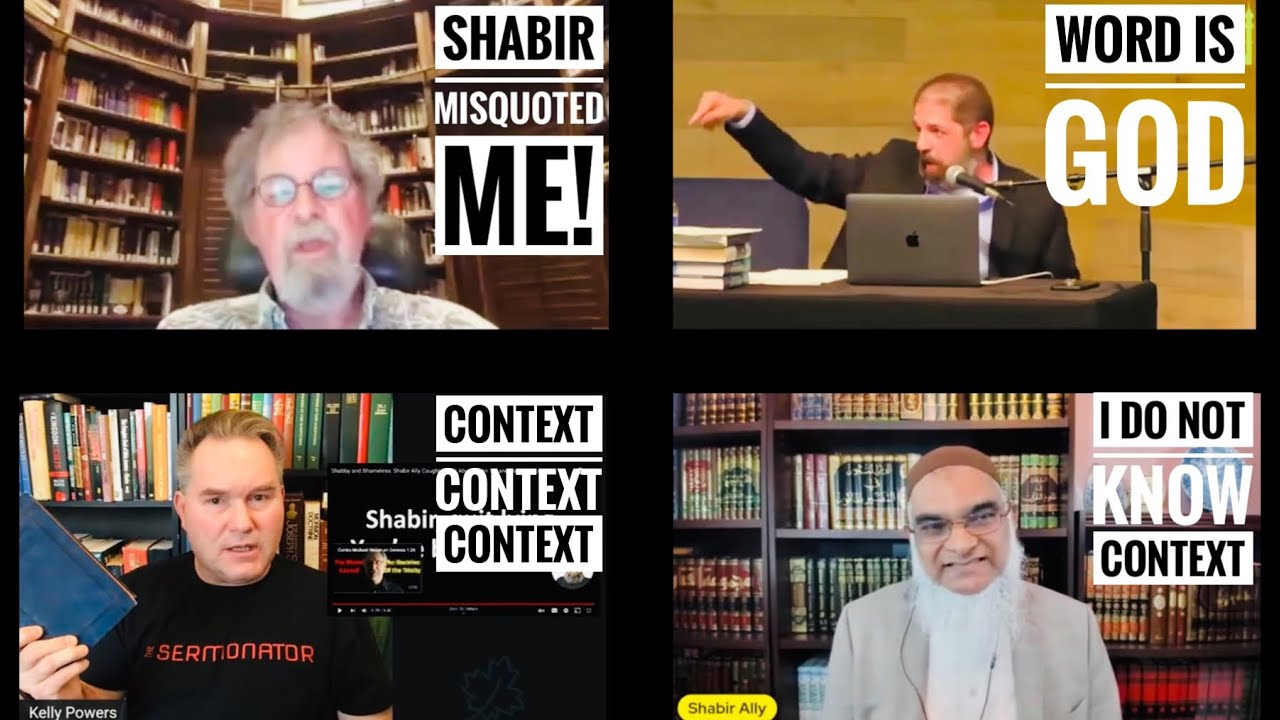
Shabir Ally caught LYING about John1:1 and Daniel Wallace
Your reasoning same as Dr. Shabir Ally And note how Wallace and Anthony debunks you and your eisegesis of John 1.1.