Also, if we continue to willfully do something we know is wrong is a warning indicator!
The problem I see, @TheologyNerd, in someone believing and then not believing is that we can never know for sure who is saved and who is not, because only God knows each person’s heart.
As a pastor for 27 years, now retired, I have known several people who appeared to be Christians whom I learned later that they weren’t.
We can have hope that people are believers because they conform to Christian values, but some of them have never made a real commitment to Jesus.
Because Jesus said that true believers are safe in his arms as the Good Shepherd, I believe that once we’re saved, we will always be saved; but to apply that truth to observable people’s lives is not what I want to do.
Joh 6:37 All that the Father gives me will come to me, and whoever comes to me I will never cast out.
Joh 6:38 For I have come down from heaven, not to do my own will but the will of him who sent me.
Joh 6:39 And this is the will of him who sent me, that I should lose nothing of all that he has given me, but raise it up on the last day.
Joh 6:40 For this is the will of my Father, that everyone who looks on the Son and believes in him should have eternal life, and I will raise him up on the last day."
You say
The problem I see, @TheologyNerd, in someone believing and then not believing is that we can never know for sure who is saved and who is not, because only God knows each person’s heart.
But this is precisely the problem I see in OSAS.
If a person truly believes, and is truly saved–then they are truly saved. If such a person then abandons the faith, throws it away, they are no longer saved. That does not mean they weren’t saved before–they were. Because God’s promise in the Gospel declares them saved.
That is where assurance is found: In God’s promise. I can have assurance, and know, I am saved because I am baptized, because God declares my sins forgiven in the Gospel, because when I sit at the recieving end of grace, hearing the Gospel, and I believe–I am indeed saved.
If OSAS is true, then I can sit at the receiving end of grace, hear the Gospel, believe, be baptized, etc and but if, later, I turn away, then the promise of God in the Gospel was false–for it never applied to me.
This produces a need to find assurance not in the external word of God, but within myself. I must find out how I, within myself, am truly saved. And this leads to all manner of self-impost (or other-imposed) tests of “true salvation”.
Let me speak of my own personal experience. For many years I grew up within a tradition that taught me that a sign and proof of true salvation was becoming more holy. And thus, I should find myself sinning less and less, and becoming more holy. I was hearing this in the midst of my transition into adolescence. Puberty is a monster, hormones rage, and I saw in myself not a saint growing in intimacy with God–but a sinner undergoing a raging beast where my sin multiplied exponentially. To be fair: adolescence is terrible for everyone–but the messaging I received was not one of mercy, but one of trying to ascertain the true-ness of my salvation.
I should also add, my questions did not begin at this time–but much earlier in life. I was a very young child when my earliest questions started to show up. When I was four years old, my parents led me through a form of the sinner’s prayer, and I “accepted Jesus into my heart”–but as I got older I began to wonder, “Did I really mean it?” and “How can I know if I really mean it?” What did “meaning it” even mean? And when frequently the answer I was given was “You’ll know it if you really meant it” provided no relief–because that was precisely the problem.
For years the answer to my deep and existential questions were those which called me to look within myself, to myself.
And all I could ever see inside myself was a sinner worthy of death and hell. For the Law, in its excruciating honesty, righteously judged me a damnable sinner.
What I needed was Good News.
What I’m trying to point out here is that if I am to be able to trust in the promise of God in the Gospel that I am His because of what Christ has done, then this is true even if someone later falls away. Not because a person who falls away remains saved, but because the one who falls away truly was saved when they believed. Because God’s word never fails.
If the person who falls away was never saved to begin with, then it would suggest that a person can never truly trust in God’s promise in the Gospel. And then we are left with trying to look inside of ourselves to figure out if we are “really saved” or just faking it.
I have a feeling that many of the people responding to these points I’m raising aren’t taking the things I’m saying seriously. Offering ready-made dogmatic answers isn’t helpful here, these are genuine concerns that real Christians have, and they need to be taken seriously.
This is the same I have a problem with. OSAS accidentally destroys a Christian’s sense of assurance and forces them into an agonizing, lifelong loop of self-doubt. The way OSAS handles backsliding turns the Gospel from “Good News” into a psychological trap.
If someone claims to be a Christian for twenty years and then walks away into atheism or unrepentant sin, OSAS theology says, “They were never truly saved to begin with; it was a false faith.” @TheologyNerd’s problem with this: If that is true, then right now, while you believe, you can never actually trust God’s promise. You might think you are saved today, but if you struggle or fall away ten years from now, it proves you were “faking it” today without even knowing it. Therefore, God’s promise in the Gospel isn’t a solid rock you can stand on right now, because its validity depends on whether you manage to stick it out until the day you die.
Instead of looking outward at Christ’s work on the cross or the objective promise of baptism, the believer is forced to look inward at their own sincerity, their feelings, and their performance. This shifts the foundation of assurance from God’s faithfulness to human authenticity.
I have stated this many times: I want to believe. Like Mulder searching for proof of aliens, I am searching for the truth of the OSAS (Once Saved, Always Saved) position with the same intensity. I am desperate to understand how this doctrine reconciles with reality, specifically regarding my daughter.
@TheologyNerd, you hit the nail on the head regarding the psychological toll of this doctrine. I am searching for a way to reconcile OSAS with the lived reality of my daughter’s journey, and I’m hoping for something more profound than the standard dogmatic answers.
She was baptized, served as a missionary in Guatemala, and was deeply involved in the Church. After she suffered the loss of her mother, and I experienced a life-altering head-on collision that left me disabled and facing chronic health struggles, she walked away from her faith entirely. Now, she claims she does not believe and wants nothing to do with God.
This brings me to my core struggle: Was all of her service, prayer, and baptism merely a performance? Was it all a false faith, meaning she was never truly saved? Or, if she was saved, does that mean she will reach heaven regardless of her current rejection of God? I am looking for a theological explanation that acknowledges the weight of these questions and honors the pain we have both walked through.
Peter
Which brings up another question, @PeterC.
How do believers, and even those who profess faith in Christ, know that they are truly saved?
Is it normal for a Christian to struggle with doubts about their salvation from time to time? All the time? Or should our assurance rest entirely in the finished work of Christ and the promises of God’s Word?
Sorry, I took the liberty and answered my questions to you brother.
J.
Three Tests for Assurance
Is such full assurance really possible? Chapter 18 of the Westminster Confession of Faith teaches us that it is: “[Those who] truly believe in the Lord Jesus, and love him in sincerity, endeavouring to walk in all good conscience before him, may, in this life, be certainly assured that they are in the state of grace.” The Confession gives us three practical tests: Assurance may be reached through a biblical examination of one’s faith, one’s love, and one’s life.
The most straightforward of these three tests is the third**. A Christian is one who seeks to follow and obey the Lord Jesus Christ in real life.**
Transformed living is a direct result of a transformed heart: “If you love me, you will keep my commandments” (John 14:15).
If we do not even try to follow Christ, then it’s evident we have no real faith in him. Our lives reflect our Lord. Because this test is the simplest and most obvious, I won’t unpack it further.
Assurance may be reached through a biblical examination of one’s faith, one’s love, and one’s life.
The first and second tests, the questions of our faith and of our love, are more difficult, because the sensitive soul is well aware of its capacity for hypocrisy.
“The heart is deceitful above all things, and desperately sick; who can understand it?” (Jer. 17:9). In the face of such capacity for self-deception, how do we discern answers to questions of the heart?
Thankfully, the Confession also reminds us that in these matters we have help. Christian certainty is not an educated guess, “not a bare conjectural and probable persuasion grounded upon a fallible hope.” Rather, we have sure, solid assistance from “the divine truth of the promises of salvation, the inward evidence of those graces unto which these promises are made, [and] the testimony of the Spirit of adoption witnessing with our spirits that we are the children of God.”
Go Forth in Hope
Both the Confession and experience suggest to me that Christian certainty requires two things: sound theological instruction and clear practical guidance. I explore both in my booklet Walking Toward the Dawn: Finding Certainty in Our Christian Experience.
Let’s go forth in hope. Assurance of salvation “doth not so belong to the essence of faith, but that a true believer may wait long, and conflict with many difficulties before he be partaker of it.” To experience doubt does not mean that one is damned.
Moreover, “being enabled by the Spirit to know the things which are freely given us of God, we may, without extraordinary revelation, in the right use of ordinary means, attain [assurance of salvation].”
One may wander long in the valley of the shadow of doubt. But we need not despair. Not all who wander are lost.
Read Bunyan and the Interpreter.
J.
As to OSAS.
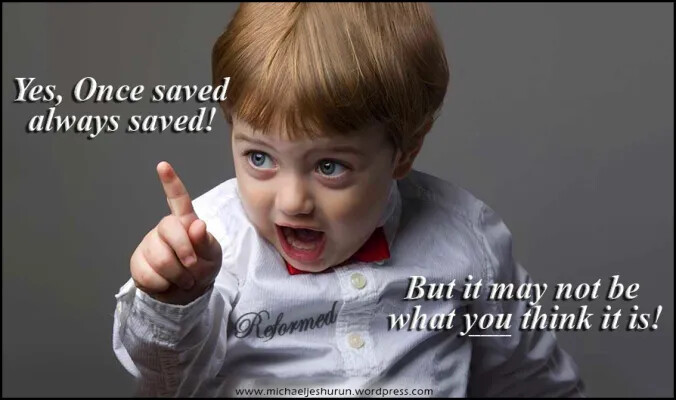
Both Christians and unbelievers always ask, “Are you telling me that if someone just accepted Jesus as his Lord and savior and still lives in sin, that he is still eternally secure and on his way to heaven”?
No that is not what this doctrine teaches!
Then what does it mean?
To understand what it means, we need to understand how one becomes a Christian in the first place. This is vital for our understanding of all the other things pertaining to salvation.
Basically there are three types of Christians.
Preacher-made, self-made, and God-made ones.
In the former are included not only those who were “sprinkled” in infancy and thereby made members of a “church”, but those who have reached the age of accountability and are induced by some high-pressure “evangelist” to “make a profession .”
The “self-made” class is made up of those who have been warned against what has just been described above, and fearful of being deluded by such religious hucksters they determined to “settle the matter” directly with God in the privacy of their own room or some secluded spot. They had been given to understand that God loves everybody, that Christ died for the whole human race, and that nothing is required of them but faith in the gospel. By ‘saving faith’ they suppose that a mere intellectual assent to, or acceptance of, such statements as are found in John 3:16 and Romans 10:13 is all that is intended. It matters not that John 2:23, 24 declares that “many believed in his name but Jesus did not commit himself unto them,” that “many believed on him, but because of the Pharisees they did not confess him lest they be put out of the synagogue, for they loved the praise of men more than the praise of God,” which shows how much their “believing” was worth.
Imagining that the natural man is capable of “receiving Christ as personal Saviour” they make the attempt, doubt not their success, go on their way rejoicing, and none can shake their assurance that they are now real Christians!
God-made Christians on the other hand are a miracle of grace, the products of Divine workmanship [Ephesians 2:10]. They are a Divine creation, brought into existence by supernatural operations. The new birth is “not of blood (by natural descent), nor of the will of the flesh (his own ‘free-will’), nor of the will of man (the preacher’s persuasion), but OF GOD” (John 1:13),
Even these ‘God made’ Christians may initially be deluded into thinking that they became Christians because they ‘accepted Christ into their heart, by their own free-will etc’. But even as they begin to read the Word of God and are taught by the Holy Spirit they will begin to see that just as they had nothing to do with their natural birth, even so they contributed nothing to their spiritual birth! “Of His own will begat He us with the Word of truth, that we should be a kind of firstfruits of His creatures”! [James 1:18]. And they realize the truth of Jesus’ Words – “Ye have chosen not Me, but I have chosen you”! [John 15:16]
These ‘God made Christians’ the Bible calls ‘elect’ or ‘sheep’. [Matt 18:11]And the Lord Jesus came to seek and to save these lost sheep. Now notice carefully, it does not say that Jesus will try to save these sheep. But that He will save them! “and thou shalt call His name JESUS: for He shall save His people from their sins”! [Matt 1:21]
Another thing to bear in mind is that their repentance and the faith with which they believe are both gifts of God and a fruit of regeneration.
A man does not believe the Gospel and get saved, but believes the gospel because he is saved. Now the Apostle says, that “the gifts and calling of God are without repentance”! [Romans 11:29] This just means that God did not give these gifts in the first place because of any merit which He saw in them and neither will He take back these gifts on account of any demerit.
But to return to the question – “What if they sin”?
The Scriptures declare that when God saves His elect, He creates within them a ‘new nature’. This is what the Apostle calls the ‘new man’. [Eph 4:22-24] This ‘new man’ has but one goal in life –To stop sinning and do righteousness. Paul said – “I delight in the law of God after the inward man”. [Rom 7:22].
He has been born of God, and therefore cannot practice sin! Please notice, that I did not say that he cannot sin, but that he cannot practice or habitually live a sinful life.
And the reason he cannot practice sin is because God’s seed is in him. John said – “Whosoever is born of God doth not commit sin; for His seed remaineth in him: and he cannot sin, because he is born of God”. [1John 3:9]…
Continue…matter of fact, I’ll stop here, and hopefully others will be edified. Keep this in mind…
Basically there are three types of Christians.
Preacher-made, self-made, and God-made ones.
J.
I don’t think those who have rejected the gospel and aren’t Christians worry about whether they’re saved or not. Those who do believe in Jesus may being to wonder about themselves, but that’s only because they haven’t reached a full understanding of what the gospel says.
1 Like
Yes and yes. 100 percent agree.
Peter
1 Like
I’m sorry, brother. I really am. I was not going to respond to this, but I feel like I have to. Precher made is Biblical.
“How then shall they call on him in whom they have not believed? And how shall they believe in him of whom they have not heard? And how shall they hear without a preacher? And how shall they preach, except they be sent? as it is written, How beautiful are the feet of them that preach the gospel of peace, and bring glad tidings of good things!” Romans10:14-15
The whole point of the Great Commission.
“Self-made” is a bit deceptive. If I called someone and asked them to come to my house. The come. Yes, they came to my house on their own, but they would not be able to if they had never heard of the invention.
True love requires a choice. If God forced us to serve Him, we would be programming, not partners. Love forced is not love at all; it’s coercion. From the very beginning, God placed a tree in the garden. The presence of the tree wasn’t a trap; it was the presence of a choice. Without the ability to say “no,” saying “yes” has no moral or relational value.
Then God gave man a choice. To be obedient, or not to.
“And the LORD God commanded the man, saying, Of every tree of the garden thou mayest freely eat: But of the tree of the knowledge of good and evil, thou shalt not eat of it: for in the day that thou eatest thereof thou shalt surely die.” Genesis 2:16-17
God gives man a choice. Obey or not. Live or die. Do you see that? This is also man’s first opportunity to lead in a Godly direction.
Sounds a bit like this, does it not?
“See, I have set before you today life and good, death and evil. If you obey the commandments of the Lord your God that I command you today, by loving the Lord your God, by walking in his ways, and by keeping his commandments and his statutes and his rules, then you shall live and multiply, and the Lord your God will bless you in the land that you are entering to take possession of it. But if your heart turns away, and you will not hear, but are drawn away to worship other gods and serve them, I declare to you today that you shall surely perish. You shall not live long in the land that you are going over the Jordan to enter and possess.
I call heaven and earth to witness against you today, that I have set before you life and death, blessing and curse. Therefore choose life, that you and your offspring may live, loving the Lord your God, obeying his voice and holding fast to him, for he is your life and length of days, that you may dwell in the land that the Lord swore to your fathers, to Abraham, to Isaac, and to Jacob, to give them.” Deuteronomy 30:15-20
God desires a relationship, not mere obedience. Robots can obey; only free-willed beings can love. Do you want more examples? Here are a few more powerful passages that highlight God’s invitation versus coercion.
“Behold, I stand at the door and knock. If anyone hears my voice and opens the door, I will come in to him and eat with him, and he with me.” Revelation 3:20
Jesus knocks; He doesn’t kick the door down. He waits for an invitation. The choice is laid out clearly, but the decision is left to the people. Also here. Remember when Jesus was heartbroken?
“O Jerusalem, Jerusalem, the city that kills the prophets and stones those who are sent to it! How often would I have gathered your children together as a hen gathers her brood under her wings, and you were not willing!” Matthew 23:37
This shows the heartbreak of God. He has the power to force them, but He respects their will, even when it grieves Him. Imagine a man who wants to marry a woman. Instead of asking her, he uses a chemical to brainwash her into saying yes. Is that a marriage? Does he actually have her love? No. God wants a bride, not a hostage.
Remember the prodigal Father. No, not the son, although if not for the son, we would not know about the Father. When the prodigal son wanted to leave, the father didn’t lock him in his room. He let him go. He watched him walk away with a broken heart. Then, he waited patiently for the son to choose to come home on his own. Luke 15
Knowing this. Should it not change how you live? Not only on Sunday morning, but Monday? Everyday? See, we can rest knowing that God genuinely wants us. We aren’t draft picks who were forced into His army; we are chosen, and we chose Him back.
Scripture repeatedly commands humans to “repent,” “believe,” and “choose.” If we have no choice, those commands are empty theater. God wouldn’t command us to do something we are utterly incapable of doing just to mock our inability. God chose the Nation of Israel to be His vehicle for blessing the world. He chose the Church, or the body of believers, to be His bride. Anyone who chooses to enter Christ becomes part of that “chosen” group. Think of it like a cruise ship: God chose the ship and its destination, but individuals still choose to step on board.
True sovereignty means God is so powerful that He can create a universe with free-willed creatures, allow them to genuinely choose or reject Him, and still ensure His ultimate plans are accomplished. He doesn’t need to manipulate us to be God’s. He wants our hearts, and hearts cannot be forced.
If God doesn’t force anyone, then the ball is entirely in our court. That changes everything about how we view our relationship with Him. If salvation isn’t a cosmic lottery, if God isn’t pulling strings to force some in and lock others out, then that means something incredibly beautiful, but also incredibly urgent for every single one of us here today. It means God is looking at you right now, holding out His hands, and waiting for your reply.
Peter
Brother, the issue is not whether man makes choices, but whether fallen man can choose Christ apart from the Father’s drawing and regenerating grace (John 6:44, 65).
Yes, Adam had a choice before the Fall. The question is whether fallen man retains that same moral ability after the Fall. Scripture says the natural man is enslaved to sin (John 8:34), cannot submit to God (Romans 8:7–8), and must be born again (John 3:3–8).
Deuteronomy 30:19 - “I have set before you life and death… therefore choose life.”
Joshua 24:15 - “Choose you this day whom ye will serve.”
Isaiah 55:6–7 - “Seek ye the LORD while he may be found…”
Ezekiel 18:30–32 - “Repent, and turn yourselves from all your transgressions…”
Matthew 4:17 - “Repent: for the kingdom of heaven is at hand.”
Mark 1:15 - “Repent ye, and believe the gospel.”
Acts 17:30 - “God… commandeth all men every where to repent.”
Acts 16:31 - “Believe on the Lord Jesus Christ, and thou shalt be saved.”
Revelation 22:17 - “Whosoever will, let him take the water of life freely.”
However, the Reformed response is that divine commands do not imply moral ability. Scripture repeatedly commands what fallen man cannot do apart from grace:
Romans 3:10–12 - “There is none righteous… there is none that seeketh after God.”
John 6:44 - “No man can come to me, except the Father which hath sent me draw him.”
Romans 8:7–8 - The carnal mind “is not subject to the law of God, neither indeed can be.”
1 Corinthians 2:14 - The natural man cannot receive the things of the Spirit.
Ephesians 2:1–5 - Men are “dead in trespasses and sins.”
Jeremiah 13:23 - Can the Ethiopian change his skin? Then may you do good who are accustomed to doing evil.
Likewise:
Acts 17:30 commands repentance.
2 Timothy 2:25 says God may “grant them repentance.”
John 3:16 commands belief.
Philippians 1:29 says faith is “granted” by God.
Brother, Scripture does not say the ball is in our court. It says we were “dead in trespasses and sins” (Ephesians 2:1), that “there is none that seeketh after God” (Romans 3:11), and that salvation “depends not on human will or exertion, but on God, who has mercy” (Romans 9:16).
God is not waiting helplessly for man’s reply; He effectually calls His sheep, and they hear His voice (John 10:27; John 6:37).
Shalom.
J.
On this we very much agree.
At the same time, how is a divine command valid if we have no ability to choose?
Without Jesus, this is all true. With Jesus, we can become a new creature. If not, then yes, let the dead bury the dead.
Again, without Jesus coming and giving us a choice, this is very true. However, if even after Jesus came, if we have no choice, then you are correct, God is waiting in vain for “All” to come to Him. 2 Peter 3:9. He should just call all and end His creation. Or He lacks the ability to complete His own will? I do not see this as possible. I do not believe you do either.
I know this is perhaps the one thing we do not agree on, but we seem to be good with the rest.
Shalom
Peter
I think your question assumes that a valid command requires native moral ability to obey it. But where does Scripture teach that principle?
God commanded Adam not to eat from the tree (Genesis 2:16-17), yet after the fall mankind became slaves of sin (John 8:34; Romans 6:16-20). The command remains valid even though man is now corrupted by his own rebellion.
In Scripture, divine commands often reveal our duty, not our ability. Jesus said, “You therefore must be perfect, as your heavenly Father is perfect” (Matthew 5:48). Does anyone have the moral ability to obey that perfectly? Yet the command is still righteous and binding.
Likewise, God commands all people everywhere to repent (Acts 17:30), but Scripture also says that the natural man does not accept the things of the Spirit of God (1 Corinthians 2:14), cannot submit to God’s law (Romans 8:7-8), and that no one can come to Christ unless it is granted by the Father (John 6:44, 65).
The inability is not physical but moral. Fallen man still chooses, desires, loves, hates, believes, and rejects. The problem is that his heart is enslaved to sin (Jeremiah 17:9; John 8:34). He cannot come because he will not come (John 5:40).
Therefore, the validity of God’s commands rests upon His authority as Creator and man’s obligation as creature, not upon man’s fallen ability to obey. In fact, the Law was given partly to expose our inability and drive us to Christ (Romans 3:20; Galatians 3:24).
The key distinction is.
Natural ability - man has a mind, will, and capacity to make choices.
Moral ability - man lacks the desire and disposition to choose God apart from grace.
Even many non-Reformed theologians have historically agreed that sinners possess free agency (they choose what they want) while denying that they can come to God without the Spirit’s enabling work (John 6:63; Philippians 2:13).
Other than this, we agree on the core doctrines as written in Scriptures my brother.
Johann.
1 Like