No, thank you brother @KPuff, for sharing those powerful God-breathed Scriptures and for the gracious spirit, tone, and humility reflected in your words.
May the Lord continue to strengthen and guide you. Shalom to you and your family.
The thing is, what you’re doing right now is what you’re accusing me of. You’re condemning my motives and tone without ever proving that I’ve sinned against Scripture. You say, “gentle” but your whole demeanor is condescending and self-appointed superiority. That is hypocrisy.
Give me proof. Show me where I have responded to anyone in a way that breaks Scripture. Quote my words. Point out the passage that I have supposedly sinned against. Because so far, you have not given one example.
“For judgment I am not making judgments, but as for the one who is judging, he is on his way to judgment, because he will be judged by the law of the word; not by his own appearance, but he will judge by the word” ~John 7:24. Note that judging righteous judgment is judging with the Word of God as the standard, not personal offense or tone preferences.
If you say my responses are incorrect, then by the Word, not your opinion, prove it. Otherwise, your charge is empty. “Every word must be established by the testimony of two or three witnesses” ~2 Corinthians 13:1. You have given zero.
So yes, you’re doing to me the very thing that you accuse me of, judging without Scripture and assuming that which you cannot prove. Where is your proof? Where is your biblical foundation? Until you can show that, your rebuke is without merit.
God’s people handle one another in truth, not assumption. So until you can support your claim with the Word of God, please stop accusing without evidence.
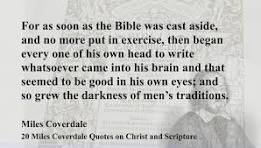
“It shall greatly help thee to understand Scripture, if thou mark not only what is spoken or written, but of whom, and to whom, with what words, at what time, where, to what intent, with what circumstances, considering what goeth before and what followeth after.”
Explanation of each element in Coverdale’s quote:
• “What is spoken or written” - Pay attention to the text itself, its immediate words, phrases, and grammar. Scripture interprets Scripture, and meaning flows from the inspired words, not our assumptions.
• “Of whom” - Identify the speaker or author. For instance, whether it is God, a prophet, a king, or an apostle affects the force of what is being said.
• “To whom” - Determine the audience. Some passages address Israel under the old covenant, others the Church, others individuals or nations. Context defines application.
• “With what words” - Examine the language used. Hebrew, Aramaic, and Greek terms carry shades of meaning that shape the message (e.g., agapē versus philia, or ruach for spirit/wind).
• “At what time” - Note the historical moment or covenantal period. What was true under Moses may have been fulfilled or transformed under Christ.
• “Where” - Recognize the geographical or cultural setting. Jerusalem, Babylon, Corinth, or Rome each carry different contexts that illuminate the text.
• “To what intent” - Seek the purpose behind the statement. Every command, promise, or rebuke has divine intent tied to God’s redemptive plan.
• “With what circumstances” - Understand the situation surrounding the words, whether persecution, exile, correction, or encouragement.
• “Considering what goeth before and what followeth after” - Always interpret within context, not in isolation. What precedes and follows determines the flow of thought.
Coverdale’s principle remains a timeless guide for exegesis, reminding interpreters to handle Scripture with precision, reverence, and awareness of its divine-human context.
“The Christians are right: it is Pride which has been the chief cause of misery in every nation and every family since the world began.”
― C.S. Lewis, Mere Christianity
“There is one vice of which no man in the world is free; which every one in the world loathes when he sees it in someone else; and of which hardly any people, except Christians, ever imagine that they are guilty themselves. […] There is no fault which makes a man more unpopular, and no fault which we are more unconscious of in ourselves.[…]The vice I am talking of is Pride or Self-Conceit: and the virtue opposite to it, in Christian morals, is called Humility.”
― C.S. Lewis, Mere Christianity
I do understand Scripture. Don’t assume I don’t just because I won’t twist it to fit your view. You quote principles about context, but you’re not applying them, you’re using them as a cover to inject your opinion.
Let’s not forget something—you started in on me, not the other way around. I wasn’t the one chasing you down to correct your posts. If there were an ignore feature here, believe me, you’d be on it already.
Scripture interprets Scripture, not your analysis. The Holy Spirit gives understanding to those who belong to Christ, not to those who try to elevate themselves as teachers without showing where the text itself is being violated. You’ve yet to point to anything I said that contradicts the Word of God.
You might want to find a little humility before trying to “correct” others. Pride blinds people from truth ~Proverbs 16:18.
So let’s be clear: I don’t need you to “teach” me your opinion. Show Scripture, in context, or stop pretending your commentary is correction.
If you can’t show me from Scripture where I’ve erred, then you’re not correcting, you’re speculating.
I’m very sorry you feel my comments are “condescending” “self-appointed superiority” and “hypocritical”. I hear your evaluation of me, and my tone, and I appreciate that you shared with me how my conversation is coming across to you. I did not intende to project these attitudes, but I will endeavor to appear less condescending, superior, and hypocritical in the future.
I offered 36 passages to demonstrate that I am not reacting to any “personal offenses” nor is this about my personal “tone preferences”. Those are just strawmen, again. I simply wanted to demonstrate to you, who asked specifically for biblical examples, that the Bible is not silent on how something is said; the bible is clear in instructing us to not only say what is true, but to yield to The Spirit’s way of saying it;. We testify of Jesus not only in our accurate words, but in our Christlike demeanor while presenting them; we yield not only our mouths (words) to The Word of God, but we yield our whole selves (deportment) to testify of Him. I offered you 36 passages to demonstrate this, and you have counted them as “zero”. I’m wondering how many examples might you consider sufficient. You could reject all the examples that you don’t like, or that you feel are not germain and only consider the remaining examples, and I think those ought to be enough for you to hear what I’m saying.
What evidence would you accept if not what I have offered? I am not bringing issue with the words you have posted (mostly), but about how they come across. I have offered much “evidence” that should prove that “tone”, as you say, is important.
Lastly; You quote John 7:24
John 7:24, in my bible says: "Do not judge according to appearance, but judge with righteous judgment.” I’m not really sure what you are trying to say here.
I reconginze that I am not one from whom you are likely to hear, and I know I said I would just let what I have previously said “sit with you”, but you did ask for specifics, and I felt compelled to grant your request. I’m sorry if they did not meet your standard of evidence. I’m happy to provide whatever you would like.
You don’t argue with a four-year old about why he shouldn’t eat candy for dinner. You don’t punch a mentally handicapped guy even if he punches you first. And you don’t argue when a women tells you she’s only making 80 cents to your dollar. It’s the path of least resistance. You save your energy for more important battles.
You’re just going in circles now. I’ve shown you from Scripture on this many times already and you keep trying to repackage the same argument, as if saying it repeatedly somehow makes it true. It does not.
Don’t forget, you’re the one who brought it up in the first place, acting like it’s your duty to correct me. I did not ask you to be my overseer. And for someone so focused on “tone,” you haven’t shown much love in how you’ve gone about it.
You keep pulling verses out of context to say that “tone” is as important as truth itself. Scripture never says that. What it does say is to “speak the truth in love” ~Ephesians 4:15. Love does not water down truth or twist it around to make it sound nice. Jesus did not change His tone to avoid offending people, He spoke the truth plainly, even if they were offended by it.
You said “36 passages,” and not one of them changes the plain command of Scripture that rebuke and correction is biblical ~2 Timothy 4:2. This is not a debate about tone. This is a debate about truth and obedience.
You’re not trying to clarify, you’re trying to argue with something I have already settled with the Word of God. If you still cannot show from Scripture that I have sinned against the clear commands of the Bible, then you are not contending for truth, you are stirring up strife. And Scripture says not to do that either ~2 Timothy 2:23.
So until you can find an actual contradiction from the Bible, not preference, not opinion, not emotion, on this issue, it’s over.
You like to call me “unloving” or “wrong tone” but the truth is, I am standing right in line with what Scripture commands believers to do when we come across error and false teaching. God’s Word doesn’t tell us to dance around lies, it tells us to expose them.
Jesus did not correct false teachers in soft words or sugar coated language. He did not tiptoe around people’s emotions. He called them what they were: “Ye serpents, ye generation of vipers” ~Matthew 23:33. “Ye are of your father the devil” ~John 8:44. That wasn’t unloving, that was righteousness speaking truth.
Paul named names and warned the church: “Their word will eat as doth a canker: of whom is Hymenaeus and Philetus” ~2 Timothy 2:17. He also said, “If any man preach any other gospel… let him be accursed” ~Galatians 1:9. That is the strength of love, because truth that confronts sin is protecting the sheep.
John said, do not even entertain false doctrine: “If there come any unto you, and bring not this doctrine, receive him not into your house” ~2 John 1:10-11. That’s not harsh, that’s obedient. Jude spoke of false teachers as “clouds without water” and “raging waves of the sea” ~Jude 1: 12-13, and he did not mince words to warn believers against false teachers.
Peter said that these false teachers “shall utterly perish in their own corruption” ~2 Peter 2:12. His tone was not soft, it was truthful, because eternity was at stake.
Believers are also commanded to reject those who persist in error: “Reject a man that is an heretick after the first and second admonition” ~Titus 3:10. They are told to “mark them which cause divisions… and avoid them” ~Romans 16: 17, and “have no fellowship with the unfruitful works of darkness, but rather reprove them” ~Ephesians 5:11.
No, this is not about tone. This is about obeying Scripture. The Bible calls us to speak the truth with boldness, not crumble in silence for the sake of comfort. When I directly confront error and lies, that is not pride, that is submission to what God commands His people to do.
The issue here is not that my tone is wrong. The issue is that some people do not want to hear truth unless it comes in their preferred packaging. But the Word of God does not cater to personal preference, it stands alone.
“Them that sin rebuke before all, that others also may fear” ~1 Timothy 5:20.
Now if you’re going to accuse me of being unbiblical, then show me, where in any of my posts have I not spoken according to Scripture? If you can’t show that clearly from the Word of God, then you’re not correcting, you’re just criticizing.
That rendering of John 7:24 - “For judgment I am not making judgments, but as for the one who is judging, he is on his way to judgment, because he will be judged by the law of the word; not by his own appearance, but he will judge by the word” - does not match any standard translation (such as KJV, NKJV, NASB, ESV, NIV, CSB, NRSV, LEB, or NET).
It appears to be a paraphrased or expanded interpretive version, possibly a private translation or commentary-based restatement, influenced by the Greek text rather than any published Bible.
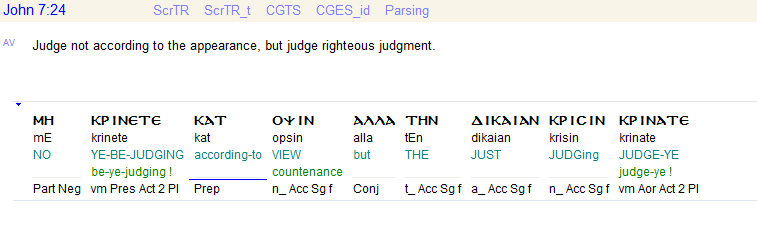
Here’s what the actual Greek of John 7:24 says:
Μὴ κρίνετε κατ’ ὄψιν, ἀλλὰ τὴν δικαίαν κρίσιν κρίνατε.
Mē krinete kat’ opsin, alla tēn dikaian krisin krinate.
Literal translation: “Do not judge according to appearance, but judge with righteous judgment.”
The Greek verbs here are:
• krinete (κρίνετε) – “judge” or “make a judgment” (present active imperative)
• kat’ opsin (κατ’ ὄψιν) – “according to appearance” or “by outward sight”
• tēn dikaian krisin (τὴν δικαίαν κρίσιν) – “the righteous judgment” or “the just judgment”
No reputable translation includes the extended phrasing about “the law of the word” or “being judged by his own appearance.” That seems to be a theological expansion on Christ’s meaning, possibly drawn from a commentary or a Hebrew-Greek idiomatic rendering used by Messianic paraphrases or nonstandard online versions.
If you found this version cited somewhere, it might come from:
• A personal paraphrase attempting to harmonize John 7:24 with John 12:48 (“the word that I have spoken will judge him in the last day”), or
• A Hebraic Roots/Messianic paraphrase, where “law of the word” is used to connect Torah judgment with the Logos (the Word).
But textually and canonically, John 7:24 in the Greek reads simply, “Do not judge according to appearance, but judge with righteous judgment.”
Mockery and condescension aren’t fruit of the Spirit. You said what you did to showcase exactly what’s lord in your heart. You can quote Scott Adams all day but the Word of God says, “For out of the abundance of the heart the mouth speaketh” ~Matthew 12:34. Currently you are displaying arrogance instead of discernment. The Bible doesn’t instruct me to stay silent when truth is being stomped on. It says, “Cry aloud, spare not, lift up thy voice like a trumpet, and shew my people their transgression” ~Isaiah 58:1. That is not childish name calling and getting red in the face, that’s OBEYING GOD. You’re mocking someone for stating something you don’t understand. You mentioned about “saving energy” but Scripture says “Earnestly contend for the faith which was once delivered unto the saints” ~Jude 1:3. Genuine Believers don’t choose which battle they fight based on their energy levels, they stand where God stands regardless if the world laughs at them for it. Listen closely “God resisteth the proud, but giveth grace unto the humble” ~James 4:6. Pride will make you so blind so much quicker than any false teacher ever will. If you honestly believe you can spit out the Word of God like a bad comedy quote then you have already been deceived. You won’t win this one. This isn’t a debate anymore, this is a warning bell “Be not deceived; God is not mocked: for whatsoever a man soweth, that shall he also reap” ~Galatians 6:7. You can continue to mock truth or repent and humble yourself before the Lord, but I promise you that “every idle word that men shall speak, they shall give account thereof in the day of judgment” ~Matthew 12:36. You decide which side of that verse you want to fall under.
You use the same tactic the Pharisees used when they couldn’t answer Jesus with truth.
You’ve missed the point of John 7:24 entirely if you’re getting hung up on a translation argument instead of responding to what Jesus said.
The Greek word krinete (κρίνετε) has the root meaning of “to judge, discern, or decide.” Jesus said, “Μὴ κρίνετε κατ’ ὄψιν, ἀλλὰ τὴν δικαίαν κρίσιν κρίνατε.” This literally means, “Do not judge according to appearance, but judge with righteous judgment.”
Kat’ opsin (κατ’ ὄψιν) means according to outward sight, the face, the superficial. Dikaian krisin (δικαίαν κρίσιν) means judging that is upright, righteous, just, right, and in accordance with the standard of truth, which is God’s Word.
Christ is not forbidding the act of judgment, He is commanding them to judge rightly. To judge by God’s Word and not by human emotion or perception.
This command is completely in line with the rest of Scripture. Paul wrote, “He that is spiritual judgeth all things” ~1 Corinthians 2:15. The word “judgeth” there is also from anakrinei (ἀνακρίνει) — which means to discern, sift, examine, or discuss thoroughly. Scripture clearly calls the believer to test, discern, and evaluate all things by the truth of God’s Word. “Beloved, believe not every spirit, but try the spirits whether they are of God” ~1 John 4:1. Even the book of Proverbs teaches, “Open thy mouth, judge righteously, and plead the cause of the poor and needy” ~Proverbs 31:9. Judgment based on righteousness is not optional, it is a mark of obedience.
Whether one quotes a formal translation or paraphrases the thought, the meaning of the text does not change. Christ is commanding them to judge by righteousness, that is, by the standard of the revealed Word of God. Turning this into a debate about “which version” is missing the forest for the trees. God’s Word interprets itself, and the command to judge righteously stands on its own authority.
The issue here is not Greek phrasing, or whether the text includes “law of the word.” The issue is simple obedience to the text of Scripture. “All Scripture is given by inspiration of God, and is profitable for doctrine, for reproof, for correction, for instruction in righteousness” ~2 Timothy 3:16. That includes correcting false ideas and unrighteous judgments.
So if you truly want to “judge righteously” (John 7: 24), then start by aligning your discernment with the very Word of Scripture itself, not with intellectual pride, or decades-long arguments over words. Jesus’ command is clear: stop judging by appearance, and start judging by the Word of God.
This is just so off. I believe in truth, and I believe in gentleness — the Bible tells us to have both. What you are missing is that there is a time for gentleness, and there is a time for harshness. When I am teaching the Scriptures in love, I am gentle. When I am dealing with deception, or those false teachers who would misuse and abuse the Word of God, I will be harsh, because Scripture tells us to do that.
Paul said to Timothy, “Preach the word; be instant in season, out of season; reprove, rebuke, exhort” ~2 Timothy 4:2. That involves sharp correction when it is needed. “Wherefore rebuke them sharply, that they may be sound in the faith.” ~Titus 1:13. That is not unloving, that is obedience. Jesus rebuked the accusers in John 8 without an ounce of apology.
But when someone falsely accuses me, misquotes my words, or portrays me as unloving because I won’t remain silent, then yes, by all means I will be bold and direct. “Answer a fool according to his folly, lest he be wise in his own conceit” ~Proverbs 26:5. There is a time to be silent, and a time to crush pride.
You go on and on about love, and humility, but what you are doing towards me, is not love, it is hypocrisy. You quote gentleness while you judge and belittle one who is simply standing on Scripture. That is not Spirit of Christ, that is self-righteousness.
Love is not defined by our avoidance of conflict. Love tells the truth even if it hurts. Jesus did not stroke the Pharisees’ egos; He called them out on their sin, because He loved truth and souls more than He loved appearances. “As many as I love, I rebuke and chasten” ~Revelation 3:19.
So yes, I will be gentle when the time is right, but I will be firm, and harsh when the truth requires it. That is not unloving, that is biblical.
You speak of truth and firmness, but the strength of Scripture is not in harshness, it is in holiness. You quote rightly, but you handle loosely. The Word commands rebuke, yes, but always in the spirit of Christ, not in the tone of the flesh. Let us look at the same verses you used, within their own context and meaning.
2 Timothy 4 verse 2 says preach the Word, be ready in season and out of season, reprove, rebuke, exhort with all longsuffering and doctrine. The Greek verbs here, elenxon, epitimeson, parakaleson, are all governed by the phrase en pasē makrothymia kai didachē, which means with all patience and teaching. Paul’s command to Timothy is not to be harsh, but to endure while teaching soundly. Makrothymia means long restraint under provocation. True correction stands firm but stays patient. It does not lose control of tone.
Titus 1 verse 13 says wherefore rebuke them sharply that they may be sound in the faith. The verb apotomōs elenche does mean sharply rebuke, but Paul is speaking about deceivers in Crete who were corrupting households. His goal was restoration, not domination. The grammar shows purpose, hina hygiainōsin, so that they may be healthy in the faith. Even sharp rebuke serves healing. You are not confronting false doctrine here, but a brother.
Scripture never tells us to turn sharpness against the household of faith.
In John 8, Jesus rebuked the accusers, yet His words pierced with holiness, not hostility. He said, he who is without sin among you, let him cast the first stone. That was not a harsh retort, it was divine conviction. He then said to the woman, neither do I condemn you, go and sin no more. Truth and mercy flowed together. To invoke Christ’s rebuke, you must also mirror His mercy.
Proverbs 26 verse 5 says answer a fool according to his folly, lest he be wise in his own eyes. Yet the verse before it says do not answer a fool according to his folly, lest you be like him. The Spirit placed both together to teach discernment. There is a time to answer and a way to answer. The fool in context is the hardened unbeliever, not a believer in discussion. Rebuke without discernment becomes the folly it tries to correct.
Revelation 3 verse 19 says as many as I love, I rebuke and chasten. The Greek elenchō again means to convict. Christ’s rebuke flows from love that restores. He says be zealous therefore and repent. His correction comes with invitation, not insult. He stands at the door and knocks, not pounds with rage. To rebuke like Christ is to call to repentance with compassion, not crush with superiority.
Galatians 6 verse 1 says if a man is overtaken in a fault, you who are spiritual restore such a one in a spirit of meekness. The key verb katartizete means to mend, as one mends a net. The goal is restoration, not humiliation. The manner is prautēs, meekness, controlled strength under the Spirit’s rule. If correction wounds without healing, it is not of the Spirit.
Ephesians 4 verse 15 says speaking the truth in love. The Greek aletheuontes means walking and living truthfully, not merely speaking sharply. The goal is that we may grow up into Him who is the Head, Christ. Truth in love builds the body. Truth without love breaks it. The context warns against deceitful men, but also commands unity of faith and maturity of character.
So, truth without love becomes self-righteous noise. Love without truth becomes soft deception. The Word joins them, never separates them. Philippians 1 verse 27 says stand firm in one spirit with one mind striving together for the faith of the gospel. You say truth requires harshness, but truth requires holiness. The Word of God cuts by itself. It does not need the blunt edge of anger to pierce hearts. The servant of the Lord must not strive but be gentle to all, apt to teach, patient, as written in 2 Timothy 2 verse 24.
If you would walk as Christ walked, then your correction must carry His cross. Firm in truth, but crucified in love.
I don’t expect you to understand this now because you are ill tempered.
@bdavidc
Are there false teachers here, and where exactly does Scripture ever command us to be harsh? Also, how are you defining harshness?
What is the context of this passage you quote?
There is a time to crush pride? Including yours?
Is this how you talk to brothers and sisters eis Christ Jesus, “we” are self-righteous, you not?
Do you see any Pharisees here?
What you are saying stands in direct opposition to what is written in Scripture, so how do you reconcile that?
Matthew 7:1 — “Do not judge, so that you will not be judged.”
Greek: Μὴ κρίνετε, ἵνα μὴ κριθῆτε (Mē krinete, hina mē krithēte).
The verb krinō means to separate, distinguish, or condemn. In this context Jesus warns against self-righteous, hypocritical condemnation. The contrast is between human arrogance in judgment and divine authority to judge rightly.
Luke 6:37 — “Do not judge, and you will not be judged; do not condemn, and you will not be condemned; pardon, and you will be pardoned.”
Greek: Μὴ κρίνετε, καὶ οὐ μὴ κριθῆτε· καὶ μὴ καταδικάζετε, καὶ οὐ μὴ καταδικασθῆτε (Mē krinete, kai ou mē krithēte; kai mē katadikazete, kai ou mē katadikasthete).
Two verbs appear here: krinō (to judge) and katadikazō (to condemn). Jesus contrasts condemnation with mercy. His instruction is relational and ethical, followers of Christ are not to assume the role of divine judge.
Romans 14:4 — “Who are you to judge the servant of another? To his own master he stands or falls.”
Greek: Σὺ τίς εἶ ὁ κρίνων ἀλλότριον οἰκέτην; (Sy tis ei ho krinōn allotriōn oiketēn).
Again the verb krinō appears, highlighting presumptive judgment among believers over disputable matters. Paul teaches that the believer’s accountability is to the Lord alone, not to another person’s private opinions.
Romans 14:10 — “But why do you judge your brother? Or you again, why do you regard your brother with contempt? For we will all stand before the judgment seat of God.”
Greek: Σὺ δὲ τί κρίνεις τὸν ἀδελφόν σου; ἢ καὶ σὺ τί ἐξουθενεῖς τὸν ἀδελφόν σου; (Sy de ti krineis ton adelphon sou? ē kai sy ti exoutheneis ton adelphon sou?).
Here Paul couples krinō (to judge) with exoutheneō (to despise or treat as nothing). His warning is against moral superiority within the body of Christ. Judgment belongs to God, not to self-appointed critics.
James 4:11–12 — “Do not speak evil against one another, brothers. He who speaks against a brother or judges his brother speaks against the law and judges the law… there is only one Lawgiver and Judge.”
Greek: ὁ κρίνων τὸν ἀδελφόν αὐτοῦ… εἷς ἐστιν νομοθέτης καὶ κριτής (ho krinōn ton adelphon autou… heis estin nomothetēs kai kritēs).
James applies krinō in the sense of slanderous judgment, setting oneself above the divine law. To judge in this way is to usurp God’s role as the sole Lawgiver and Judge.
Together these passages show that Scripture forbids believers from condemning others out of self-righteousness, personal bias, or moral superiority. The Greek krinō always turns sinful when it elevates the self to the seat of divine authority. True discernment tests doctrine (1 Corinthians 2:15) but never usurps God’s prerogative to judge the heart.
That line of mine was a paraphrase of John 7:24, it was not a quote from any published translation. I worded it in a way to highlight the same truth Jesus was teaching in that passage. The verse itself, in the KJV, reads: “Judge not according to the appearance, but judge righteous judgment.”
The Greek verb krinete (κρίνετε) literally means to discern, to decide, or to evaluate. Jesus is not telling us not to judge here, but rather, to judge righteously, by God’s standard, rather than by outward perception. “According to appearance” (κατ’ ὄψιν) means “to judge from the surface;” “righteous judgment” (δικαίαν κρίσιν) means “judging by the revealed Word and character of God.”
So when I said “judged by the law of the Word,” I was simply making the point that the judgment needs to be consistent with Scripture, not emotions, tone, or personal preference. That’s consistent with the meaning of the Greek, and the context of the passage.
If you want to just correct me so that I quote directly from the Bible verse, fine, but the point is still the same:
Christ is telling us to have righteous judgment, and not to be deceived by mere appearances. I have been doing that.
So unless you want to just argue about words rather than truth, the point of the verse still stands. Christ is telling us to judge by righteousness, not by appearances, and I am doing that.
I’ve already answered you from Scripture. You’re repeating the same accusations without proof. The Bible says, “Avoid foolish and unlearned questions, knowing that they do gender strifes” ~2 Timothy 2:23.
I’m not arguing this again. The matter’s settled by the Word of God.
So who are you to look into another person’s heart and claim to make a righteous judgment, when Scripture says, “Do not judge, and you will not be judged; do not condemn, and you will not be condemned; forgive, and you will be forgiven” (Luke 6:37 Berean Bible), and again, “Man looks at the outward appearance, but the Lord looks at the heart” (1 Samuel 16:7 )?
1Sa 16:7 But Yahweh said to Samuel, “Do not look at his appearance or at the height of his stature, because I have rejected him. For God does not see what man sees, for a man looks on the outward appearance, [Literally “sees as far as the eyes”] but Yahweh looks on the heart.” [Literally “sees as far as the heart”]
You’re the one asking questions you already answered in your own post. You ask, “Where does Scripture command harshness?” while ignoring Titus 1:13 and 2 Timothy 4:2, both of which you’ve already read. You’re not seeking truth; you’re seeking control.
You claim not to judge, yet you’ve judged my motives, tone, and heart. That’s exactly what Matthew 7 warns against. The very verses you quoted condemn your own behavior.
Correction of error is not condemnation, it’s obedience. “He that is spiritual judgeth all things” ~1 Corinthians 2:15. There’s a difference between judging by appearance and judging by truth ~John 7:24.
You accuse me of pride while sitting as judge over everyone’s tone. That’s not discernment, it’s self-righteousness. “With what judgment ye judge, ye shall be judged” ~Matthew 7:2.
I’m not wasting more time quibbling with you. Your intent is clear, you want argument, not understanding. “A man that is an heretick after the first and second admonition reject” ~Titus 3:10. Case closed.
Tit 1:10 ¶ For there are many rebellious people , idle talkers and deceivers, especially those of the circumcision,
Tit 1:11 whom it is necessary to silence, whoever are ruining whole families by [*Here “by ” is supplied as a component of the participle (“teaching”) which is understood as means] teaching things which must not be taught for the sake of dishonest gain.
Tit 1:12 A certain one of them, one of their own prophets, has said, “Cretans are always liars, evil beasts, lazy gluttons.”
Tit 1:13 This testimony is true, for which reason reprove them severely, in order that they may be sound in the faith,
Tit 1:14 not paying attention to Jewish myths and commandments of people who turn away from the truth.
Tit 1:15 To the pure all things are pure, but to those who are defiled and unbelieving nothing is pure, but both their mind and conscience are defiled.
Tit 1:16 They profess to know God, but by their deeds they deny him , because they [*Here “because ” is supplied as a component of the participle (“are”) which is understood as causal] are detestable and disobedient, and unfit for every good deed.
Right?
“For the time will come” (estai gar chairos) “For there will be a season;” make the most of the present time and opportunities, prepare for the worst, Mat_24:1-51.
“When they will not endure sound doctrine” (hote tes hugiainouses didaskalias ouk aneksontai) “When they will not bear with healthy, wholesome, or sound teaching,” of the Word; the “they” means professing Christians.
“But after their own lusts shall they heap to themselves” (alla kata tas idias epithumias heautois episoreusbusin) “But according to (or in keeping with) their own will or lusts they will heap to themselves, choose over them;” a corrupt will leads to a corrupt life, corrupt conduct, Hos_4:6-9.
“Teachers, having itching ears” (didoskalous knethomenoi ten akoen) “Teachers of ear-tickling kind,” men-pleasers, a rabble of teachers without holiness of character or conduct, Mat_7:13-19.
For the time will come when they will not endure sound doctrine; but after their own lusts shall they heap to themselves teachers, having itching ears;
For - Make the most of the present time: for the time will come when, etc.
They - professing Christians.
Sound doctrine - THE [ tees (G3588)] sound (note, 1Ti_1:10) doctrine [ didaskalias (G1319)]; namely, of the Gospel.
After their own lusts. Instead of regarding the will of God, they dislike being interrupted in their selfish [ idias (G2398)] lusts by true teachers.
Heap - one on another: an indiscriminate mass: a rabble of false teachers. Variety delights itching ears. ‘He who despises sound teaching leaves sound teachers; they seek instructors like themselves’ (Bengel). It is the corruption of the people that creates priestcraft (Exo_32:1).
To themselves - to suit their depraved tastes [`populus vult decipi, et decipiatur: the people wish to be deceived, so let them be deceived (1Ki_12:27-32; Hos_4:9).]
Itching - after teachers who give pleasure (Act_17:19-21), and do not offend by truths grating to the ears. They tickle the levity of the multitude (Cicero), who come as to a theater to hear what will delight their ears, not (Seneca, ‘Ep.’ 10:8 ) what will do them good. ‘Itch in the ears is as bad as in any other part of the body, and perhaps worse’ (South).
So I ask once more, who are you to preside over the hearts of men as judge and arbiter?
And now I am a heretic?
What is the context of Titus 3.10?
Tit 3:8 Final Instructions to Titus
¶ The saying is trustworthy, and I want you to insist concerning these things , so that those who have believed in God may be careful to engage in good deeds. These things are good and beneficial for people.
Tit 3:9 But avoid foolish controversies and genealogies and contentions and quarrels about the law, for they are useless and fruitless.
Tit 3:10 Reject a divisive person after a first and second admonition,
Tit 3:11 knowing that such a person is perverted and is sinning, being self-condemned.
But avoid foolish questions, and genealogies, and contentions, and strivings about the law; for they are unprofitable and vain.
Foolish , [ mooras (G3474)] - ‘insipid:’ producing no moral fruit. Genealogies - akin to the “fables” (note, 1Ti_1:4). Not so much direct heresy as yet, but profitless discussions about genealogies of aeons, etc., which ultimately led to Gnosticism. Synagogue discourses were termed darashowt (H1875); i:e., discussions. Compare “disputer of this world,” 1Co_1:20. Strivings about the law - about “commandments of men,” which they sought to confirm by “the law” (Tit_1:14 : note, 1Ti_1:7); and about the mystical meaning of the various parts of the law in connection with the “genealogies.”
Avoid , [ periistaso (G4026)] - stand aloof from (2Ti_2:16). Vain , [ mataioi (G3152), inanes; empty of results: but kenos (G2756), vanus; empty of contents].
On the contrary, you have sat as my judge and arbiter all day, quoting selective verses to strengthen your own case and to pass judgment on others, have you not? Yet the very Scriptures you cite command otherwise. For it is written, “Do not judge according to appearance, but judge with righteous judgment” (John 7:24). And again, “Be diligent to present yourself approved to God, a worker who does not need to be ashamed, rightly dividing the word of truth” (2 Timothy 2:15).
Your verse selection, when held in its true context, does not grant you license for private interpretation, for “no prophecy of Scripture comes from one’s own interpretation” (2 Peter 1:20). You are commanded to orthotomounta (ὀρθοτομοῦντα, cutting straight) the word of truth, not twisting it to win an argument.
So I must ask, have I become your enemy because I tell you the truth (Galatians 4:16)? You handle Scripture with partiality, and when corrected, you turn that very sword upon those who seek to keep it straight. Yet the Word itself judges between soul and spirit (Hebrews 4:12), not you, not I, but God who weighs the heart (1 Samuel 16:7).