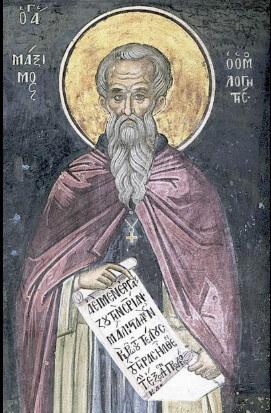
Next @TheologyNerd since we both like theology, I would like to discuss is St. Maximus the Confessor, the Saint which contributed the most to theology…
He was a Byzantine monk, ascetic, and polymath whose epithet confessor, commemorates his unyielding witness unto mutilation and exile, represents the zenith of patristic synthesis in the seventh century.
At the heart of Maximus’s ontology lies a pivotal distinction:
*nature as the shared essence defining a being’s what (eg human rationality, volitional capacity) versus the mode as the contingent “how” of its realization, vulnerable to sin’s distortion yet redeemable through grace. Sin corrupts not humanity’s essence, its divine imprint (imago Dei) isnt corrupted, but rather its existential mode, fracturing the intended harmony of body, soul and spirit, and extending cosmic discord. The Incarnation inaugurates a beautiful exchange where the divine Word assumes uncorrputed human nature in a transfigured mode, enabling reciprocal divinization:
God humanizes in love, humanity divinizes in response, as “a power that divinizes man through his love for God…renders man God to the same degree as it humanizes God for man’s sake”
This exchange is not fusion, many confuse it as pantheistic absorption, but rather energetic participation, where humans become “partakers of divine nature” according to capacity, their modes aligned with eternal divine principles.
These logoi, preexistent rational blueprints in the Word, imprint creation as participatory archetypes, ensuring ontological coherence, each creature’s essence reflects the divine will, without compromising contingency. Humanity, as microcosm (a miniature universe), is vocationally poised to mediate creation’s polarities, uncreated versus created, spirit versus matter, heaven versus earth, paradise versus world, male versus female, fulfilling Eph 1:10’s recapitulation of all things in Christ. Adam’s primordial fault inverts this:
a self-assertive mode divides the unified, birthing tropic entropy
Christ’s hypostatic union rectifies it, descending through divisions to ascend in unity:
“God became man in order to save lost man, and…united through Himself the natural fissures running through the general nature of the universe.”
Soteriologically, this cosmic therapy demands ascetic praxis, purification of passions, yields natural contemplation (beholding logoi in creatures), culminating in mystical union, where the believer’s mode mirrors Christ’s deified humanity. Maximus reframes Evagrian impassibilty (freedom from disordered desires) as purified love, ascending from self-mastery to Godward communion, rendering theology, not speculative but transformative spiritual discipline.
Epistemologically, knowledge is theandric:
propositional grasp yeilds to participatory knowledge, deifying the knower as the Word “transforms, and the things which were transformed he deifies…so as to remain and be in their proper mode, and at the same time to be God by participation in grace”
This counters Origentist intellectualism by grounding cognition in incarnate operations, where Scripture’s dual authorship, human and divine, parelles the Fathers’ inspired witness, demanding exegetical harmony.
Maximus’s Christology bears four interlocking signatures, patristic, Incarnational, composite, cosmic, each a bulwark against heresy, synthesised through logoi theory to preserve Chalcedon’s “without confusion, change, division, or separation.” Patristically, he is a synthesiser par excellence, compiling florilegia to vindicate orthodoxy, interpreting ambiguities in Gregory Nazianzen, Cyril of Alexandria, and Dionysius the Areopagite, as consonant with dyophysitism (two natures). For instance, Dionysius’s theandric activity (human-divine operations) denotes a novel mode of manifestation, not quantitative oneness:
“This newness would be of our power…a new and ineffable manner of the manifestation of the natural energies.”
Cyril’s “one incarnate nature” describes the hypostatic union, not generic fusion, as echoed in the Lateran Synod of 649’s patrisitic citations, likely drawn from Maximus’s Opusculum 15.
Incarnationally, per Gregory’s axion, that the unassumed is unhealed, Christ assumes the full humanity, including the passions and will, to heal it wholly. Maximus explands this into “three incarnations”, that is the Word as flesh (distinct from sinners), as logoi in creation (creatures signifying Him) and as language (revelation through words), with the fourth in virtuous believers embodying the Word. This multifaceted thickening of the Logos preserves distinctions while effecting deification:
“God always willingly becomes man in those who are worthy.”
Compositely, Christ’s hypostasis unites natures via perichoresis, yeilding a composite hypostasis without mingling:
“from which and in which and which” two natures coexist. Dyothelitism (two natural wills) and dyenergism (two operations) inhere in natures, not person, averting a compsite heterodoxy that births a tertium quid, that is netiehr God nor man. Monothelitism estranges Christ:
*his will if singular, opposes the Father’s (yeilding Trinitarian quaternity) or humanity’s (nullifying healing) as “evil consists in nothing else than this difference of our deliverative will from the divine will”. In Gethsemane, Christ’s human will submits impeccably, “not what I will but what you will”, harmonising sans gnomic vacillation modelling deified synergy.
Cosmically, Christ mediates divisions:
his descent unifies them in ascension, rendering “the whole creation…another human being” with liturgy as participatory microcosm (mystagogy 7). This Christocentric cosmology prewires reality for deification, where elect natures realize eschatological telos.