Do All Commentaries Get 1 Corinthians 11:19 Wrong?

The actual title i think should be: Do Just About All Commentaries Get 1 Corinthians 11:19 Wrong? If I am mistaken and any find commentaries that proport according to the one listed below, please do mention and provide.

HOWEVER -– Every commentary, I have seen (including DA Carson’s own comments aside from being the senior editor of PNTC), sees Paul affirming that God has division in the church for the purpose of proving those who are His. Which seems to imply that the modern church kind of assimilates in ways the brokenness expressed in this passage as if it were something we ourselves should be doing.

Please see the commentary below from The Pillar New Testament Commentary (PNTC):

11:18–19 Paul’s first concern is that he has heard a report of divisions among the Corinthians when they come together as a church. To come together as a church was supposed to represent the coming together of one body (10:17) of people who together participate in the body and blood of Christ (10:16). BDAG indicates that the term “church” or “assembly” was used by early Christians “for chiefly two reasons: to affirm continuity with Israel through use of a term found in Gk. translations of the Hebrew Scriptures, and to allay any suspicion, esp[ecially] in political circles, that Christians were a disorderly group.” The sad irony was that the Corinthians were not actually “coming together” when they came together, but gave clear indications of being a divided and disorderly group, which reflected poorly on Christ and on themselves.

Paul’s comment, to some extent I believe it, seems a bit strange, since all the evidence from the rest of this passage and this book clearly indicates that he thought it clear that the Corinthian church was a divided church. It is probably intended to introduce his own ironic comment in the following verse with the sense, “I suppose, to some extent, it stands to reason that there would be divisions among you since No doubt there have to be differences among you to show which of you have God’s approval!” Paul is most likely referring ironically to a view that was reported to him as being held by some Corinthians. They thought the differences among them were a reflection of those who had God’s special approval. The following verses make it clear, however, that the divisions were provoked by the insensitive behavior of some of the social elites within the Corinthian church and that that behavior most certainly did not meet with God’s approval. If anyone could be said to have God’s approval in the Corinthian church, it would not be any of those wealthier and more socially advanced Christians who were snubbing their brothers and sisters! The behavior that, according to worldly wisdom, would have distinguished some of the members as socially superior members of the church who were “considered worthy of high regard, respected, esteemed” was actually shown to be unworthy of high regard, respect, or esteem since that very behavior was a disgrace to the community and an insult to God. That which distinguished the social elites in the Corinthian church was not worthy of praise (cf. v. 22) but had already brought God’s judgment on them (vv. 29–32) and now Paul’s sarcastic blame. They needed to recognize that behaviors that they thought merely marked them as social elites in fact ironically marked them as standing under divine judgment.

As will be pointed out in the comments on vv. 23–26, the Lord’s Supper entailed a reappropriation and reapplication of the Passover tradition in which Christ’s death on the cross was understood to provide the basis for the new and final redemption of God’s people, the second exodus. Peter Craigie points out that “the Passover became the act, symbolically speaking, of the one large family of God.” In 2 Chronicles 30 the celebration of the Passover is depicted as a unifying and sanctifying event that “fit well into Hezekiah’s designs to reunify the nation.” The Lord’s Supper, like the Passover meal on which it was based, should have served as an experience that strengthened the unity of God’s people, not one that would divide them.

. . . . .

Although DA Carson himself differs from this passage, it is understandable why so many see it this way:

This verse reflects the idea that divisions within the church community are necessary to reveal the true believers among the crowd. D. A. Carson explains that these divisions can manifest as heresies or factions, which serve as a means for God to discern the authenticity of faith. The presence of such divisions is seen as a test for unity and love within the church, ultimately highlighting the importance of maintaining harmony and unity among believers.

. . . . .

CONCERN – According to PNTC, Paul is being sarcastic.

What PNTC sees as Paul being sarcastic about, the modern church adopts to incorporate “sarcasm” seemingly into our own theological grids as theology proper itself. A main concern I believe this can suggest is mistaking literary style for doctrine. In this passage, it is as if all our commentaries adopt a heresy while assuming our so doing offers “explanatory power." meanwhile we believing we are being discerning in that.

At the end of the day, DA Carson’s personal take makes sense. But something like the PNTC’s likely accuracy can in ways mirror our own era’s tendency to perhaps idolize preachers/pastors and/or some senses upon our own theology guarded. Not to say we should not guard, but I believe we do tend today to see factions/tribalism serving as orthodoxy, might we not?

1 Like

“For there must be also heresies among you, that they which are approved may be made manifest among you.” 1 Corinthians 11:19

Paul is being sarcastic. His logic goes something like this: “Oh, I see…” He’s basically saying, “I hear there are divisions among you, and I suppose it has to be that way, doesn’t it? After all, how else would we know who the ‘real’ Christians are?”

By saying divisions are “necessary” to show who is “approved,” he is mocking their elitism. The Corinthians were obsessed with status and spiritual superiority. Paul is essentially rolling his eyes at their drama, implying that their constant bickering is a pathetic way to prove who is “better.”

Given that Paul follows this up in verse 22,

“What! Do you not have houses to eat and drink in? Or do you despise the church of God and humiliate those who have nothing? What shall I say to you? Shall I commend you in this? No, I will not.” 1 Corinthians 11:22

It seems clear he’s in a very biting, confrontational mood. He isn’t actually happy that there are divisions; he’s using their own desire for “approval” to point out how fractured they’ve become. Kind of like saying: “I guess all this fighting is great, because now we finally see everyone’s true colors!”

God Bless

Peter

3 Likes

“divisions exist among you” These divisions are first mentioned in 1Co_1:10-17; 1Co_3:3-4, but their presence is assumed throughout the book. In this context the division is not over leaders, but is characterized by socio-economic factors. This may define the factions as representing social classes as well as theological emphases.
1Co_11:19
NASB, NKJV “For there must also be factions among you”
NRSV “Indeed there have to be factions among you”
TEV “(No doubt there must be divisions among you”
NJB “that there should be differing groups among you”

The term is “faction” (1Co_11:19, i.e., hairesis), from which we get the English word heresies. Its basic etymology is “to choose” or “select,” but with the added connotation of showing special favor, choosing one and rejecting other choices (cf. Act_24:14; 1Co_11:19; Gal_5:20). It can be used to describe (1) a person who believes false teaching (cf. Tit_3:10) or (2) the false teaching itself (cf. 2Pe_2:1).

There is a different term used in 1Co_11:18, “divisions” (i.e., schisma), from which we get the English word schism. Its basic etymology is “to split” (cf. Mat_27:51). It was used of groups dividing over an issue (cf. Joh_7:43; Joh_9:16; Joh_10:19; Act_14:4; Act_23:7; 1Co_1:10; 1Co_11:18).

Paul mentions a theological purpose (i.e., hina) and necessity (i.e., dei) for the presence of these differing groups. They were necessary for the true spiritual leaders to be clearly revealed. Mature leaders will become evident in times of crisis.

The other option is that some groups and their leaders will show by their actions that they are not Christians at all (cf. 1Jn_2:19; Mar_4:16-19).

Why? Look at the verbs here and let me know if Utley is doing justice on this verse @TCC .

Utley.

J.

2 Likes

Beautiful take Peter. I would agree its sarcastic but did not see that way you share. Now as I think upon it…yeah. The ones “approved” in that mix are the elite. The ones who affirmed to be “approved” expose themselves as the heretics. That is a pretty big misfire if the majority of commentaries think being “approved” by God is the takeaway here. lol. Have you seen this sarcastic notion recognized in other commentaries? I have only seen in the one mentioned above.

Thanks for your reply Johann. I appreciate the way you break it down. But I’m apologize for not exactly tracking. Who is Utley?

1 Like

He is a professor of Hermeneutics, and his work is freely available in Bible software format, along with thousands of MP3 recordings and video lectures, brother @TCC. His commentary has now been incorporated into Logos.

I have attempted to share the relevant links, but to be candid, it has not been effective, as there appears to be little interest among the members.

Shalom.

J.

1 Like

A careful application of deductive reasoning together with sound hermeneutical method will help clarify and properly distinguish the two groups referenced in the passage, @TCC.

J.

1 Like

One might see throughout the bible for both Israel and the church a sort of filtering process.

It would seem only the humble that seek truth find their way to salvation. Others are diverted like the pharisees and the contentious that Timothy was to deal with.

2Ti 2:25 In meekness instructing those that oppose themselves; if God peradventure will give them repentance to the acknowledging of the truth;
2Ti 2:26 And that they may recover themselves out of the snare of the devil, who are taken captive by him at his will.

1 Like

Thanks Johann for letting me know. I have logos 8 but have not had a lot of recent time in logos. Some of my selections for it from years ago were good sources and some I have developed in such a way as to kind of see quite differently than I was thinking back then.

Actually as I see a video of him, I recall watching some videos of his several years ago. His approach was rare. I remember he went over some passages in what the parable of those invited to the Wedding and one man being caught not dressed for the occasion meant. Bob took the time to lay out the most prominent views and leaned into what he thought was the most likely way to look at it.

I believe we should do that with all scripture. As like how churches might best operate. Have the pastor lay out the various prominent views of the passage. Lay out their strengths and weaknesses. Lay out the pastor’s choice perspective. And be sure to provide those strengths and weaknesses too.

The way teaching is more likely done today on average is bold conviction on one main way to look at it. Hint at other views. Downplay briefly why other views are to be easily dismissed. And make our view look the best it can. I understand why this happens. But I don’t believe it is the best way to teach the body nor provide ways to understand one another better in our for differing denominations. Doing the above, I believe, is the best interacting way the body might have chance to love on each other and with one another-as iron sharpens iron. Instead it can lead to cold indifference or pride/defensiveness or even tribalism unfortunately. Blessings.

I am in full agreement with you brother @TCC . Ever Listened to Nate Sala? Called Wise Disciple?

J.

I reckon most commentaries just don’t have time for that. lol. Which is actually, not funny. It does not look like his material is imprint online. But maybe it is on Logos? I would imagine Bob’s take on 1 Cor 11:19 would agree with my concern and lean in the direction of PNTC, no?

Excellent point. And that version is a blessing in its articulation. Thanks for posting.

Free, for your persusal @TCC

https://www.freebiblecommentary.org/ and available in e Sword as a module, you can also download this Software, along with other exegetical sources.

J.

1 Like

Thanks for the resources :slight_smile: I noticed on youtube how literally huge Bob’s channel is. I’m going to download as much of his library from youtube as i can. Any suggestions on best use in how to use the link you provided?

1 Like

Open link, scroll down to here…

This is the download, unfortunately not available for windows but an APP, should look like this @TCC

Alternatively…

Open this and you are in e Sword.

Let me know if you are having problems brother.

You have all the videos in the downloadable APP.

The beauty of this is that the team regularly updates the site. Free for serious students of God’s Word.

And if you are serious about grammar, verbs, indicatives, imperatives, and the like, this should put an end to the accusations. [Leveled at me], not from your side.
J.

1 Like

Would not go that far brother.

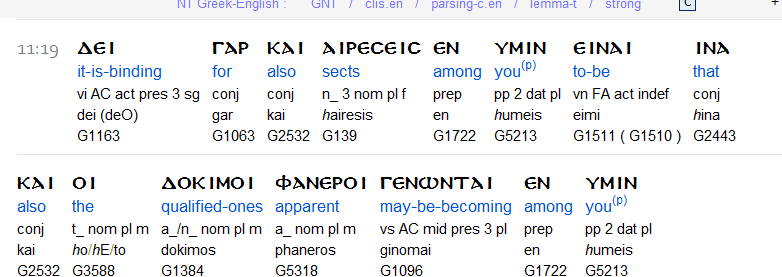
The phrase in 1 Corinthians 11:19 is οἱ δόκιμοι (hoi dokimoi).
Dokimos means tested and approved after examination. It comes from the testing language used for metals refined and proven genuine. The contrast is not between popular and unpopular, but between genuine and exposed.

Context controls meaning.

In 11:17–34 Paul is rebuking the Corinthians for their conduct at the Lord’s Supper. The wealthy arrive early, eat their own food, and humiliate poorer believers. The gathering meant to proclaim Christ’s self giving death becomes a display of social stratification.

Verse 19 says factions must exist so that the approved ones may become manifest among you.

So who are they?

Not a specific named faction.
Not an elite party claiming superiority.
Not necessarily office holders.

The grammar gives no title, only character.

Within this context, the dokimoi are those whose conduct at the Lord’s Table proves genuine alignment with the gospel they proclaim. They are the ones who:

Do not despise the church of God (11:22)
Do not shame those who have nothing (11:22)
Wait for one another (11:33)

  1. “That they which are approved.” (hina [kai] hoi dokimoi) “in order that also the ones approved.” (The members who are standing for truth and right in the midst of these conditions).

That (hina). God’s purpose in these factions makes the proved ones (hoi dokimoi) become manifest (phaneroi). “These haireseis are a magnet attracting unsound and unsettled minds” (Findlay). It has always been so. Instance so-called Christian Science, Russellism, New Thought, etc., today.

In other words, the approved ones are those whose behavior reflects the meaning of the Supper, namely Christ’s self giving death for His people (11:23–26). Their authenticity is revealed precisely because others are acting selfishly.

Notice what Paul does not say. He does not identify them by theological party labels. He does not say “the Pauline group” or “the poor.” He defines them by tested conduct under pressure.

The hina clause makes the logic clear: factions function as the crucible in which authenticity becomes visible. Crisis exposes character.

So the approved ones are the believers in Corinth whose actions demonstrate genuine participation in Christ, not merely attendance at the meal. They are the ones whose love is not contradicted by pride.

It is less about who they claimed to follow and more about whether their behavior embodied the cross they were commemorating.

When communion turns into competition, the genuine become visible by refusing to compete.

Johann.

1 Like

In the way you understand how the Greek functions, is it possible that Paul’s use of sarcasm is of greater potential context than for his comment about factions be the necessary focus? In other words, the reason this passage seems to be misunderstood, to me, is because when Paul says, “there must be factions,” we have taken that as a literal statement. But instead of seeing that as a literal take away, I have understood it in some form or another like this:

“You want to be approved? You who eat all the food and get drunk? You want to feel you are the entitled ones to behave like this? How about if the reason you are doing this, condemns you? By that which you do in action asserting a sense of ones being approved is the very thing that demonstrates to the church and all true believers that you are not approved. But that wisdom vindicates her children who don’t act like you.”

Would that be a possibility in the Greek as far as you see it?

No brother…

1Co 11:19 For γὰρ also καὶ it behooves δεῖ there to be εἶναι, factions αἱρέσεις among ἐν you, ὑμῖν so that ἵνα also καὶ the οἱ approved δόκιμοι should become γένωνται evident φανεροὶ among ἐν you. ὑμῖν.

Because of dokimoi and phaneroi, all plural with ev-among/in you.

And here…

ἵνα. Here we must render in order that, as though God had permitted these evils to arise in order to test the faith and patience of Christian men. Cf. Jas_1:3; 1Pe_1:6-7.
οἱ δόκιμοι. Those who have been tried and stood the test. Opposed to ἀδόκιμοι, rejected. See Jas_1:12; 2Co_13:5-7, and ch. 1Co_9:27.

Can you see it brother @TCC ?

J.

1 Like

@TCC, I don’t think that Paul is being sarcastic at all. Of course, he would be aware of the passage in Genesis 50, in which Joseph’s brothers come to him to plead with him to forgive them of their sinful selling of him into slavery. He responds as follows with his understanding of God’s larger, permissive plan:

Gen 50:19 But Joseph said to them, “Do not fear, for am I in the place of God?
Gen 50:20 As for you, you meant evil against me, but God meant it for good, to bring it about that many people should be kept alive, as they are today.
Gen 50:21 So do not fear; I will provide for you and your little ones.” Thus he comforted them and spoke kindly to them.

In other words, God permits evil in his world in order to show his love to true believers. The factions in the church in Corinth are part of that permissive plan to teach his believers at Corinth an important lesson about the need for unity in their membership. It’s called God’s providence.

1 Like

Thanks for the reply Johann. I appreciate the interlinear. As I read it in whole, I still have some difficulty with it. I can understand in part what you are saying. But I don’t know enough about the Greek for it to be as apparent to me as it is for you.

Perhaps what might help is a bit of mapping if you might. The commentary I mentioned in the OP laid out a kind of map that I could follow to some degree:

“Paul’s comment, to some extent I believe it, seems a bit strange, since all the evidence from the rest of this passage and this book clearly indicates that he thought it clear that the Corinthian church was a divided church. It is probably intended to introduce his own ironic comment in the following verse with the sense, “I suppose, to some extent, it stands to reason that there would be divisions among you since No doubt there have to be differences among you to show which of you have God’s approval!” Paul is most likely referring ironically to a view that was reported to him as being held by some Corinthians. They thought the differences among them were a reflection of those who had God’s special approval. The following verses make it clear, however, that the divisions were provoked by the insensitive behavior of some of the social elites within the Corinthian church and that that behavior most certainly did not meet with God’s approval. If anyone could be said to have God’s approval in the Corinthian church, it would not be any of those wealthier and more socially advanced Christians who were snubbing their brothers and sisters! The behavior that, according to worldly wisdom, would have distinguished some of the members as socially superior members of the church who were “considered worthy of high regard, respected, esteemed” was actually shown to be unworthy of high regard, respect, or esteem since that very behavior was a disgrace to the community and an insult to God. That which distinguished the social elites in the Corinthian church was not worthy of praise (cf. v. 22) but had already brought God’s judgment on them (vv. 29–32) and now Paul’s sarcastic blame. They needed to recognize that behaviors that they thought merely marked them as social elites in fact ironically marked them as standing under divine judgment.”

It is like story boarding along the way. It might help likely if i could get a sense of how you might treat a few things. The primary disconnect for me in a way I believe is verse 17 & 18, and 20-22:

(a) This next instruction i do not praise you

(b) Because you come together for the worst

(c) For the worst is because you come together with divisions among you

(d) I hear when you come together there are divisions

(e) In part I believe it

(f) It behooves there are divisions

(g) So that those among you may be approved

(h) Therefore when you come together come after you eat and drink at home

(I) Can’t you do that?

(J) Because of this i do not approve

So if we make “divisions as a way for approval to manifest” why would Paul challenge those who divide as not praise worthy? It would seem to be a work of God to marvel not. Not use as an opportunity to not praise. It would see more contextual if divisions serving as helpful to be something to praise God about more than something to withhold praise from men over. At least contextually.

If we map it out, to me, there is a disconnect in flow. Coming together for the worse is synonymous with getting no approval. “There must be divisions,” as I understand it is synonymous with nothing at all in the passage. Speaking in logic flow concern. It would appear there is nothing in the passage to connect the good that comes from division. Especially when Paul’s focus is on unity. Nothing else in the passage seems to realize that “there must be divisions” is even in the neighborhood of the discussion. At least to me.

  • you come together for the worse
  • I understand why there are divisions among you
  • Because God permits it as a way to reveal the approved ones
  • Therefor since providence work like that, be on the right side of providence

That last point “might” make sense. But in logic flow its like Paul is speaking practically. Then announces a providential theological point that seems to pretty much be a stand alone detour. And then Paul goes back to the practical. For me it kind of creates grammatical logic flow whiplash. Just like in terms of how rhetorical principle in discussion works.

  • You come together for the worse
  • But God allows for that
  • Therefore be on the godly side of its fallout

The above could make sense. But it would make more sense like something like this:

  • You come together for the worse
  • I don’t praise you in this
  • But i praise God in His helping to expose that you are not approved in this

Yet that last point is never made or even suggested at or hinted. You may see it differently, but does it not stand to reason at some level the way it rolls out is a rather awkward linguistic approach, no? Is there a way you can diagram a paraphrase of this passage in how the flow of it actually reads for you in flow? If you have a moment to do that i think it would help me track a little better I believe. Just trying to make sense of its flow in my mind. Thanks. Blessings.