Do Catholics Believe in the Rapture?

Do Catholics Believe in the Rapture?

The rapture is one of the most debated end-times topics in modern Christianity. Many evangelical traditions emphasize it, but Catholic teaching has historically taken a very different approach. This raises the question: do Catholics believe in the rapture at all—or do they view it as a doctrine outside the bounds of Scripture?
#EndTimesDebate #CatholicFaith #RaptureTheology #christianforums #crosswalkforums #forums #crosswalk #faithcommunity #faithforums

The idea of the rapture—where believers are “caught up” to meet Christ in the air—has been popularized in recent decades through books, movies, and sermons. For some Christians, it’s central to their understanding of the end times. For others, it’s a concept they rarely, if ever, hear about in church.

Catholic teaching, however, places a different emphasis on the return of Christ and the final judgment, often leaving the rapture out of the conversation entirely. This creates tension when Catholics and evangelicals compare beliefs, sometimes leading to misunderstandings about what each group actually affirms.

The deeper question is whether the rapture is an essential biblical teaching or more of a theological lens developed within certain Protestant traditions. If Catholics don’t embrace the rapture the way evangelicals do, does that reflect a disagreement over Scripture itself—or simply a difference in how the Bible’s language is interpreted?

This conversation opens up broader questions too: How should Christians respond when different traditions interpret the same passages in radically different ways? And what does unity in Christ look like when our end-times frameworks don’t align?
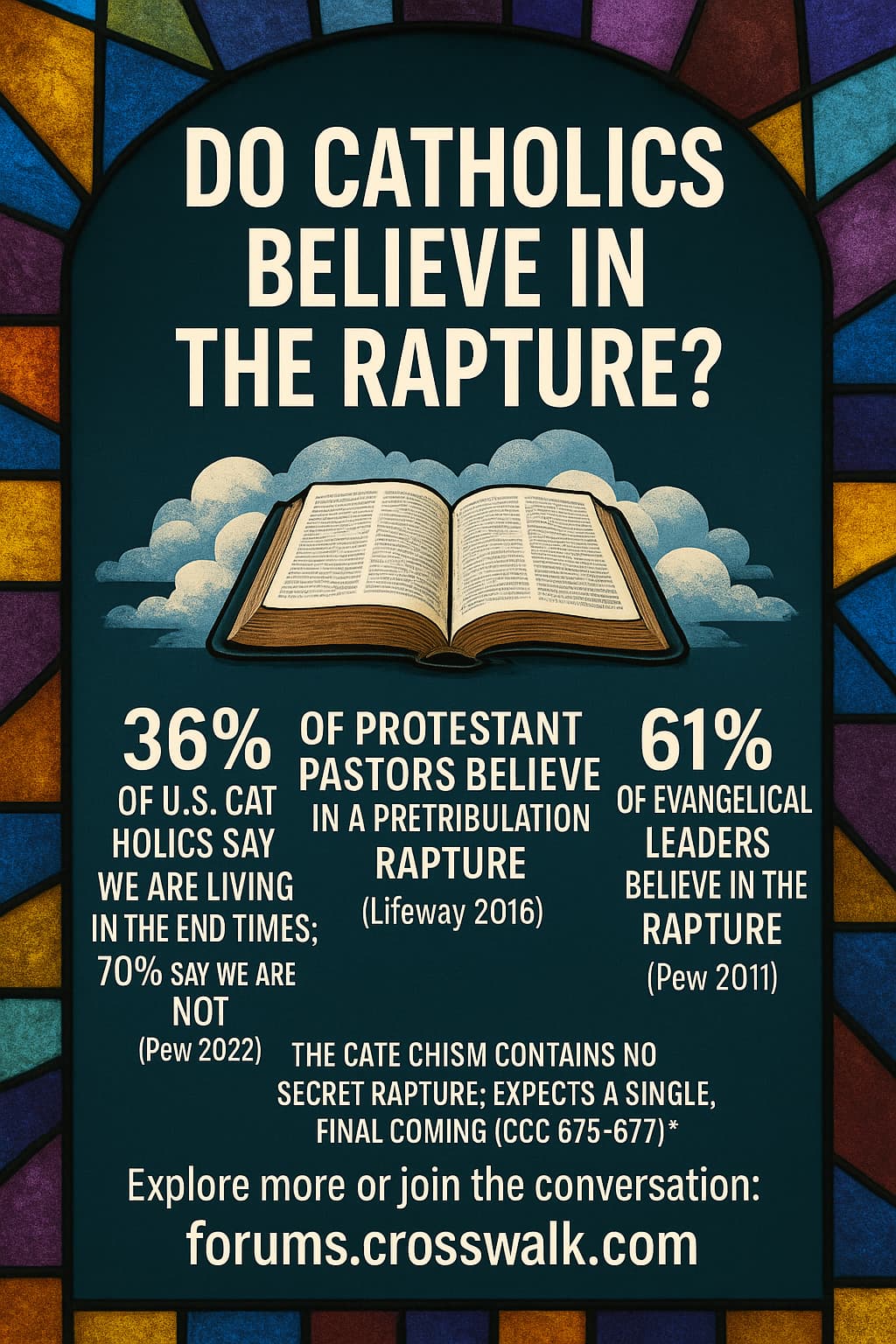
Infographic

Read more here:

The debate over the rapture illustrates how divergent eschatological frameworks can emerge not from a rejection of Scripture but from different hermeneutical traditions and theological priorities. The concept itself arises chiefly from 1 Thessalonians 4:16–17, where Paul speaks of believers being “caught up” (harpazō) to meet Christ in the air, and from passages like 1 Corinthians 15:51–52 and Matthew 24. Evangelical traditions, particularly within dispensationalism since the 19th century, have developed this into a distinct event, often envisioned as a sudden, pre-tribulational removal of the Church prior to a period of tribulation.
Catholic theology, along with most of the historic Church, reads these same texts differently, understanding them as part of a single, climactic return of Christ at the end of history, followed by the final judgment and the resurrection of the dead, rather than as a separate preliminary event.
This difference reflects not a disagreement about biblical authority but a divergence in how biblical imagery, apocalyptic language, and chronology are interpreted: where one tradition reads harpazō as a literal temporal event distinct from the parousia, another reads it as a metaphor for the Church’s final union with Christ at His coming. Historically, the idea of a secret or pre-tribulational rapture is absent from patristic and medieval sources, suggesting that its prominence is a relatively recent theological development rather than a universally attested apostolic teaching.
Yet such differences need not fracture Christian unity, for all orthodox traditions affirm the core eschatological hope: that Christ will return in glory, the dead will rise, evil will be defeated, and God’s kingdom will be fully revealed. In this sense, unity is grounded not in uniform timelines but in shared faith in the ultimate consummation of God’s redemptive plan, allowing Christians to hold differing eschatological views while remaining committed to the same Lord and the same final hope.

The doctrine of “the rapture” is a recent innovation that can largely be attributed to the teachings of a single person: John Nelson Darby. Darby was a minister in the Church of Ireland (the Irish branch of Anglicanism), but eventually left and helped found a new denomination/tradition: the Plymouth Brethren. Darby can fairly uniquely be attributed with a belief that before the Last Day when Christ returns in glory to judge, there is a seizing up of faithful Christians–a “rapture” into heaven. As I understand it, in Darby’s original view this is a “partial rapture”, that is, only some Christians are taken up into heaven. It is only later, through systematic Dispensationalist theologians that we get the more standard rapture view of all Christians (or at least all “true Christians”) being raptured.

This idea of the Rapture (capital ‘R’) was unique to Darby and the Plymouth Brethren, but would eventually gain traction in North America through several highly influential individuals, such as Dwight L. Moody and Cyrus Scofield. Moody was a very influential and effective evangelist, while Scofield produced a reference Bible with specifically Dispensationalist leanings in its marginal notes. This helped plant seeds for later Dispensationalists in America, and Dispensationalism slowly, but steadily, grew in some Protestant camps. Though most Protestant theologians of the 19th and early 20th century were strong opponents of the new teachings, it nevertheless found fertile soil and continued to grow. With seminaries established especially to propagate the new doctrine, leading to whole generations of Evangelicals being taught and raised Dispenationalist in the mid-late 20th century. These views eventually gained new popularity with the publication of breakthrough Dispensationalist literature, such as Hal Lindsay’s Late Great Planet Earth, and the Left Behind series of novels. As such, today, Dispensationalism and its peculiar doctrine of “The Rapture” are often viewed in the context of American Evangelicalism as the norm.

But, and this cannot be stressed enough, it is a major break from historic Christian norms, including historic Protestant norms. But it did take advantage of the growing emergence of Neo-Premillennialism of the 19th century, and the other general religious innovations of the period; as well as gain prominence through Evangelical circles in the 20th century, in which it came to prominence outside of the historic Protestant denominational structures.

Which is to say, Catholics do not believe in “The Rapture” anymore than Orthodox, Lutherans, Anglicans, Methodists, and even (historically) Baptists did. But it does have a strong foothold among American Evangelicals, including among American Baptists and Methodists, though less so among Presbyterians, Lutherans, Episcopalians (i.e. Anglicans). And generally has no place among Catholics or Orthodox. It is, after all, a rather recent “Protestant” innovation.

1 Like

From an Orthodox perspective, I would agree with much of what you said. The notion of a separate “rapture” event simply does not exist in the mind of the early Church or in the writings of the Fathers. They consistently speak of one definitive coming of Christ in glory, the resurrection of the dead, and the final judgment as a single eschatological reality. The idea of believers being secretly taken away before tribulation is foreign to the patristic witness and to the liturgical and theological life of the Church. In that sense, the rapture is best understood as a relatively recent Protestant development, rather than a continuation of apostolic teaching.