Hello everyone. I’m grateful to join you here as Ruach. I’m an Ashkenazi Jewish follower of Yeshua who values Christ-centered, Scripture-aligned discussion and the connection between the Hebrew Scriptures and the New Testament. I hope to listen carefully, encourage people who are carrying something difficult, and contribute thoughtfully wherever my experience may help. I believe disagreement can still be handled with truth, humility and love. I look forward to learning from you and sharing in fellowship.
2 Likes
Hello, @Ruach. Glad you found us. Glad you are here. Hope you join in and stick around a bit. Looking forward to getting to know ya.
Shalom
Peter
Welcome, Ruach. It is good to have you with us, and I appreciate your emphasis on Scripture, truth, humility, and love in discussion.
Since you are new here, perhaps you could tell us a little more about yourself by way of introduction. When you describe yourself as an Ashkenazi Jewish follower of Yeshua, do you identify specifically with the Messianic Jewish movement, or would you describe your faith tradition differently?
And, if you don’t mind me asking, how do you understand the relationship between the Hebrew Scriptures and the New Testament? In particular, how do you understand the role of the Torah for a Jewish believer in Yeshua today?
Finally, what led you personally to faith in Yeshua, and what particular areas of Scripture are you most interested in studying or discussing?
Looking forward to getting to know you and having some good Scripture-centered discussions.
Shalom Achi.
J.
Thank you, Johann. I describe myself first as an Ashkenazi Jewish follower of Yeshua rather than emphasizing a denominational label. I see the Hebrew Scriptures and the New Testament as one unfolding testimony, with Yeshua bringing the Torah and the Prophets to their intended fulfillment. The Torah does not justify us before God—that is by grace through faith—but it remains God-breathed instruction that reveals His character and helps us understand the Messiah more fully.
My journey to faith is personal and layered, and I would be glad to share more as relationships grow here. I am especially interested in the continuity between the Testaments, overlooked details in Scripture, and the practical application of biblical truth in daily life.
Thank you for asking thoughtful questions. I look forward to learning from you as well. Shalom, achi.
Thank you, Peter. I truly appreciate the warm welcome. I look forward to joining the conversations, learning from everyone, and sharing what the Lord places upon my heart. Shalom, Ruach
No problem @Ruach.
In word and deed, most Americans would like the ability to be anonymous and untracked online at least every once in a while.
A clear majority—59%—say that people should have the ability to use the internet completely anonymously. When internet users are directly asked, 18% say they use the internet in a way that hides or masks their identity. Yet when a broader battery of activities about masking behavior or content is asked of respondents, 81% say they do at least one of these obscuring activities.
All told, 86% of internet users have tried to be anonymous online and taken at least one step to try to mask their behavior or avoid being tracked. The most common strategy was to clear cookies and browser history. Yet, notable numbers have taken even more sophisticated steps, such as encrypting their email (done by 14% of internet users) or used virtual personal network or proxy server, like Tor software1, that does not allow firms to track their online movements (also done by 14% of internet users).
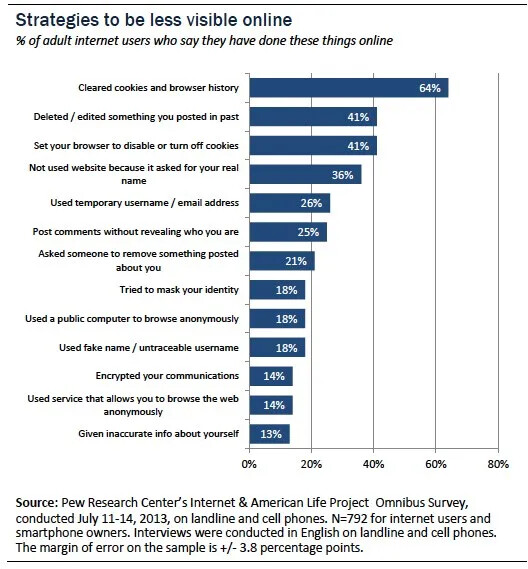
The question of whether people should be allowed to use the internet anonymously was asked of all adults (not just internet users) and 34% of the general public (including 33% of internet users) said they did not believe people should be allowed to use the internet anonymously.
There are noteworthy demographic and political differences in the answers to this question. Those most likely to say that people should have the ability to go online anonymously include: men, those under the age of 65, those who live in urban areas, and liberal Democrats. In addition, those who are employed are more likely than non-workers to believe internet use should be allowed to be anonymous. Across the board, technology users were more likely than non-users to say this: that includes internet users v. non-users, cell users v. non-users, and social media users v. non-users.
Who has taken steps to mask their identity or avoid being observed online
In this survey, 81% of adults are internet users; 90% of adults are cell phone owners; and 53% of adults are smartphone owners. The internet users and smartphone owners were asked a battery of questions about the strategies online Americans might use to hide their identity or otherwise mask them from others who might want to observe their online behavior.
In all, 81% of internet users or smartphone owners said they had employed at least one of the eleven strategies we queried. Many had employed multiple strategies. The average anonymity seeker had used between 3 and 4 of these strategies at one time or another.
The most consistent differences in masking strategies are tied to age. The youngest adults (those ages 18-29) are more likely than their elders to take steps to be hidden online, as the chart below shows. The one activity where the differences did not show up in a stark way involved encrypting email. Internet users of all ages under 65 were equally likely to have done that.
Just some interesting info.
J.
Thank you for understanding, Johann, and for sharing those figures. The tension between privacy and accountability online is real. Anonymity can protect legitimate privacy, but it can also reveal whether our conduct depends upon being seen by others. Scripture reminds us that we remain fully known before God. Interesting material to consider. Shalom, achi.
ashkenazi eyes
famous ashkenazi jews
ashkenazi vs sephardic appearance
ashkenazi jewish beliefs
sephardic jews
where do ashkenazi jews originate from
5 surprising differences between ashkenazi and sephardic
what is ashkenazi jewish
difference between ashkenazi and sephardic dna
sephardic vs ashkenazi
I have a Yiddish Bible brother, looking forward to your contributions, and welcome to the forum.
שלום ברודער-bruder
Johann.