Growth by Affliction

Our Father does not want us to take an affliction lightly. “A reproof enters more into a wise man than a hundred stripes into a fool” (Prov 17:10). But the more you take it to heart the more you gain in holiness; that, so to speak, is the goal.

The Father’s discipline is intended to effect the greatest gain that could possibly be acquired—even to be “partakers of His holiness” (Heb 12:10). This is the only time this phrase is used. The mere thought of partaking of the separateness in which He is, is a great delight and encouragement to the heart. It has very great practical effects.

When any of us have in any degree partaken of His holiness, we become correspondingly sensitive to everything contrary to or inconsistent with it. It is the superior thing which even enables us to refuse the inferior, and this in a wonderful way works all round. It is not that we feel that we are doing anything, but we shrink from the moral atmosphere here, and like to be encased in the armor of light—“hidden with Christ is God” (Col 3:3).

The process is a very interesting one; your divine taste is so advanced that the incongruities in everything here are not only apparent, but their real worthlessness is disclosed. You do not feel that you that you are losing (though you are losing the things here) because you are so assured of the highest and greatest gain.

Three great divine facts or events have occurred, and our faithfulness is provided as we are affected by
them. The first is that Christ has come, has died for our sins and risen. The second is that He has gone to heaven. The third is that the Holy Spirit has come down to be with us and in us. Then there actually is a fourth which is our prospect, even that He is coming to receive us unto Himself in glory.

Now every believer knows something of the first—no salvation otherwise; the second and third test our faithfulness. The Lord Jesus is in heaven. Do we “seek those things which are above, where Christ sitteth on the right hand of God” (Col 3:1)? The Holy Spirit is with us and in us: does He lead and control our hearts absolutely in this scene in the absence of our Lord?

All knowledge of truth is ineffectual when we are not in correspondence with these great unconditional facts, which remain true even when we are not true to them. But when we are, all the truth is in its place in our hearts. You are of special interest to the Lord Jesus. May He fulfill all His good pleasure concerning you, and fit you for His blessed service in a scene where there can be nothing right, because He has been rejected here.

—J B Stoney (1814-1897)

MJS daily online devotional excerpt for April 29

My life is not only in His hands, but He is my very life. “For by Him were all things created . . . and by Him all things consist” (Col. 1:16, 17). He controls and maintains the universe, and we can surely depend upon Him to care for us who share His life.

“We are all of us prone to forget the weighty fact that ‘God trieth the righteous.’ ‘He withdraweth not His eyes from the righteous’ (Ps. 11:5; Job 36:7). We are in His hands, and under His eye continually. We are the objects of His deep, tender, and unchanging love; but we are also the subjects of His wise moral government. His dealings with us are varied. They are sometimes preventive; sometimes corrective; always instructive.

“We may be bent on some course of our own, the end of which would be moral ruin. He intervenes and withdraws us from our purpose. He dashes to fragments our air-castles, dissipates our golden dreams, and interrupts many a darling scheme on which our hearts were bent, and which would have proved to be certain destruction. ‘Lo, all these things worketh God oftentimes with man, to bring back his soul from the pit, to be enlightened with the light of the living’ (Job 33:29, 30).”

Charles Henry Mackintosh (1820-1896)
2 Likes

I think this can be true, but it’s also one of those things that’s easier to see looking back than when you’re in the middle of it.

When you’re going through something hard, it doesn’t always feel like growth. Sometimes it just feels heavy or confusing.

For me, the idea that something good can come out of it is more of a long-term perspective. In the moment, it’s often just about getting through it and trusting that it’s not meaningless, even if I don’t understand it yet.

2 Likes

Here is an interesting post on the benefit of adversity;

Beneficial Adversity

There was an image circulated via email a few days ago with four pictures. The first showed the men on Iwo Jima raising the US flag in WWII. It was titled, “Hard times make strong men”. The next image was of a man working on his car in the 1950s. It was titled, “Strong men make good times”. The third image was of people partying in the 1980s. It was titled, “Good times make weak men”. The last picture was of abandoned houses in Detroit that looked like a demilitarized zone. It was titled, “Weak men make hard times”.

I once worked with a man (a non-custodial parent) who said one of the saddest things I have ever heard, he said, “The laziest person I have ever seen is my son. He never gets up from a video game except to go to the refrigerator.” It is not uncommon for the older generation to comment on the flaws they see in the younger generation. However, this does not automatically mean that these observations are invalid.

By creating a social environment for our children of unending entertainment, subsidized indolence, unrestrained consumerism, offense at every slight (real or imagined), and the cultivation of a critical spirit to contend with that of a movie, restaurant or theater critic, we may have produced a generation of perpetual adolescents with weak character. This may have been done with good intentions, but the result indicates that it might be legitimately called child abuse.

A generation or two ago a wayward child could have been sent to the military where exposure to an adverse environment might have helped him develop the strength of character he was missing. Unfortunately, the military environment has been modified as to not inflict such character improving difficulty. In addition, the military no longer desires to accept those in need of correction.

The bible tells us that the Lord “chastens” those he loves.

Ye have not yet resisted unto blood, wrestling against sin. And ye have quite forgotten the exhortation which speaks to you as to sons: My son, despise not the chastening of the Lord, nor faint when reproved by him; for whom the Lord loves he chastens, and scourges every son whom he receives. Hebrews 12:4-6

There is a saying that the best education in the world comes from the school of hard knocks, the problem is that the tuition is so high. For Christians, we have the option to surrender ourselves to the Lord’s leading in humility and sincerity so that we might avoid the more harsh chastening the Lord might use to get our attention such as getting laid off, finding ourselves in the midst of divorce, or struggling with addiction when we should have already been seeking his leading.

Satan is almost finished using Christians to advance the plan of global collectivism he has been advancing for centuries. As a result, Christians should expect to face increasing hostility and persecution. In addition to finally getting Christians to curtail their love affair with the world, we might find that increasing hostility improves our character by seeking after and clinging to Jesus. This might result in a more clear testimony as Peter tells those about to undergo persecution;

But sanctify the Lord God in your hearts: and be ready always to give an answer to every man that asketh you a reason of the hope that is in you with meekness and fear: 1 Peter 3:15

3 Likes

Hi, and great words to abide by. Thanks for the informative reply!

What great idea for a topic. I see this planet as God’s University of Brotherly Love, And it seems to me that one could not learn what Love is, without suffering being involved.

A small taste of what it is like living without the Lord (Love) and a small taste of living with the Lord (Love), so of course there must be affliction in order for the growth of Love within us.

What was that Jesus said in scripture? Something about a seed can not bear fruit unless it is put into the ground and dies first? Something like that.

1 Like

Hi Brother Ed! I believe we learn and mature the most through our “trials.” Thank God He is always with us in then!!

1 Like

Hi Ell! Good words and very instructional. Thanks for the reply. I’ve learned that whatever the difficulty from little to big, it always is meaningful. It just usually takes time (as you say) to finally learn and mature a little more from them. It’s all about mturing in the Lord Jesus’ “image.”

How have you been Brother?! Good to see you here. That a seed can’t bear fruit without going into the ground and dying first made me rethink death. It must not be as we normally think it is, but more of a, doorway?

Definitely part of the plan!

1 Like

Study the doctrine on santification, it will shed a ton of light and what believers are going through.

J.

1 Like

Hi Jo! I think many still do not understand “sanctification” that well. Every time its used it reflects something already done, like being made holy or “purification” and “consecration.”

The misuse is thinking that it refers to becoming more mature or that there’s still something needed in their salvation, but that’s wrong because we have been given "all things that *pertain unto life and godliness” (2Pe 1:3). Thus, we just need to appropriate everything for use.

Love Utley.

NT HOLINESS / SANCTIFICATION

The NT asserts that when sinners turn to Jesus in repentance and faith (cf. Mark 1:15; Acts 3:16,19; 20:21), they are instantaneously justified and sanctified. This is their new position in Christ. His righteousness has been imputed to them (cf. Gen. 15:6; Romans 4). They are declared right and holy (a forensic act of God).

But the NT also urges believers on to holiness or sanctification. It is both

a theological position in the finished work of Jesus Christ
a call to be Christlike in attitude and actions in daily life. As salvation is a free gift and a cost-everything lifestyle, so too, is sanctification (i.e., Eastern Literature [biblical paradoxes]).
SPECIAL TOPIC: EASTERN LITERATURE (biblical paradoxes)

Initial Justification and Sanctification A Progressive Sanctification, Christlikeness
Acts 26:18
Romans 15:16
1 Corinthians 1:2-3,30; 6:11
2 Thessalonians 2:13
Hebrews 2:11; 10:10,14; 13:12
1 Peter 1:2 Romans 6:19
2 Corinthians 7:1
Ephesians 1:4; 2:10
1 Thessalonians 3:13; 4:3-4,7; 5:2
1 Timothy 2:15
2 Timothy 2:21
1 Peter 1:15-16
Hebrews 12:14

The goal of salvation is not heaven when we die but Christlikeness now (cf. Rom. 8:28-29; 2 Cor. 3:18; 7:1; Gal. 4:19; Eph. 1:4; 4:13; 1 Thess. 3:13; 4:3; 5:23; 2 Thess. 2:13; Titus 2:14; 1 Pet. 1:15), so that those who see our witness may be drawn to Jesus and go to heaven with us! Sanctification, like justification, is…

…a gift and a choice
an INDICATIVE and an IMPERATIVE
a trophy and a race.

J.

Hi Jo! It’s my understanding that “are sanctified” means the same as are holy–set apart. Christians are fully sanctified as they are fully holy unto God (Act 20:32). I don’t see any Scripture that demonstrates we are not completely sanctified, while growing in Christ’s “image” (2Co 3:18, 4:4).

“Being sanctified” (Rom 15:16] means “which are sanctified.”

It sure is and the question before us is, since we all go through the fire do we want to go through the fire on earth with the Lord, the fire of purification, or if those here on earth choose not to go through it now, then they go through it later and it is called Judgment fire which is the fire that destroys.

So you don’t believe in ongoing/progressive sanctification. Got it.

This is a PERFECT PASSIVE PARTICIPLE meaning, “have been and continue to be sanctified by the Holy Spirit.” This may again reflect the tension between Jewish and Gentile believers in the Roman church. Paul stated clearly that the nations (Gentiles) had been and continue to be fully accepted and consecrated by the Holy Spirit (cf. 1Co_6:11). - Utley

Transformation is ongoing

2 Corinthians 3:18 (ESV)
“And we all, with unveiled face, beholding the glory of the Lord, are being transformed (μεταμορφούμεθα, metamorphoumetha) into the same image from one degree of glory to another…”

Present passive - continuous action
“from glory to glory” - unmistakable progression
2. Sanctification is God’s will for present conduct

1 Thessalonians 4:3 (ESV)
“For this is the will of God, your sanctification: that you abstain from sexual immorality…”

Not positional-this is practical holiness in life
3. Ongoing growth commanded

2 Peter 3:18 (ESV)
“But grow (αὐξάνετε, auxanete) in the grace and knowledge of our Lord and Savior Jesus Christ…”

Present imperative - continuous growth
4. Active pursuit of holiness

Hebrews 12:14 (ESV)
“Strive (διώκετε, diōkete) for peace with everyone, and for the holiness without which no one will see the Lord.”

You don’t “strive” for something already fully complete
5. Putting sin to death (ongoing)

Colossians 3:5 (ESV)
“Put to death (νεκρώσατε, nekrōsate) therefore what is earthly in you…”

Continuous mortification of sin
6. Renewal is continuous

Colossians 3:10 (ESV)
“…and have put on the new self, which is being renewed (ἀνακαινούμενον, anakainoumenon) in knowledge after the image of its creator.”

Present passive participle - ongoing renewal
7. Inner renewal day by day

2 Corinthians 4:16 (ESV)
“…our inner self is being renewed day by day.”

Explicit daily progression
8. God actively sanctifies continually

1 Thessalonians 5:23 (ESV)
“Now may the God of peace himself sanctify you completely…”

Prayer for ongoing and increasing sanctification
9. Obedience learned over time

Hebrews 5:8 (ESV)
“Although he was a son, he learned obedience through what he suffered.”

Even Christ’s human experience shows progressive obedience - how much more us
10. Faith produces progressive virtue

2 Peter 1:5–7 (ESV)
“For this very reason, make every effort to supplement your faith with virtue… knowledge… self-control… steadfastness…”

A chain of growth, not a static state

These texts establish that sanctification is…

Not only definitive (already set apart)
But clearly progressive:
Being transformed
Being renewed
Growing
Striving
Putting sin to death

This go unnoticed by most.

J.

1 Like

A synonym for sanctification is “consecration.” Other related terms include “purification” and “salvation.”

Merriam-Webster

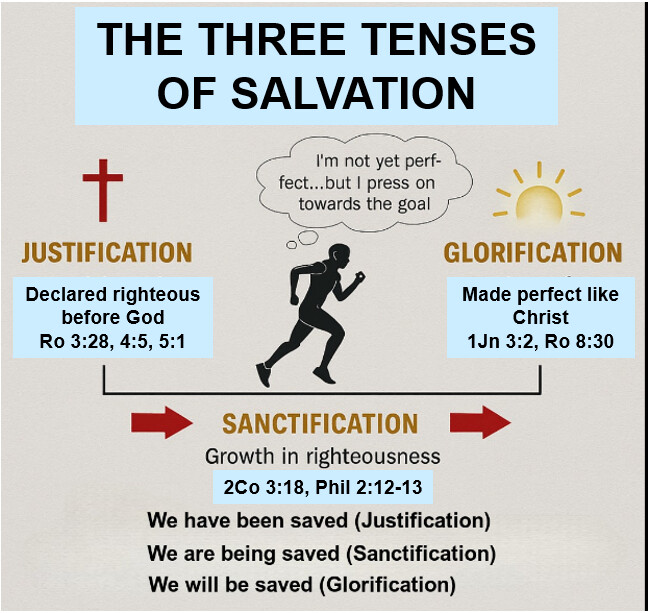
No problem brother, not here to argue. Salvation has three tenses.

The Perfect Tense ExSyn 573–82
The primary uses of the perfect are easy to comprehend, though they are not
insignificant. As Moulton points out, the perfect tense is “the most important,
exegetically, of all the Greek Tenses.”2 The perfect is used less frequently than
the present, aorist, future, or imperfect; when it is used, there is usually a deliberate choice on the part of the writer.
The force of the perfect tense is simply that it describes an event that, completed in the past (we are speaking of the perfect indicative here), has results existing in the present time (i.e., in relation to the time of the speaker). BDF suggest
that the perfect tense “combines in itself, so to speak, the present and the aorist
in that it denotes the continuance of completed action.”3

Shalom.

J.

1 Like

God bless Friend! We just have different understandings.

Salvation in Three Tenses (Titus 3:5) Somebody asked a Christian, “Are you saved?” “In what tense?” was the queer retort of the Christian. “What do you mean?” “Well,” said the Christian, “salvation is in three tenses: it is in the past: ‘Not by works of righteousness which we have done, but according to his mercy he saved us, by the washing of regeneration, and renewing of the Holy Ghost’ (Titus 3:5). Here is salvation in the present: ‘Moreover, brethren, I declare unto you the gospel which I preached unto you, which also ye have received, and … by which also ye are saved.’ The Greek word so\\zesthe is inadequately translated in the King James Version. It should be ‘ye are being saved’ (1 Cor. 15:2). Not only were we saved in the past, but we need salvation continuously. Finally there is salvation in the future: ‘Much more then, being now justified by his blood, we shall be saved from wrath through him’ (Rom. 5:9).” Is your salvation in all three tenses? - AMG Bible Illustrations

Sanctification refers to the lifelong process of growing in practical righteousness, a continuing process. Generally, when you hear someone use the term “sanctification”, they are referring to the present process all believers are experiencing, and this is sometimes referred to as “progressive sanctification” by the theologians. Note also that justification is also known as positional sanctification (indicating that at a point in time, at the moment of salvation by faith, our position changed from in Adam to forevermore in Christ). Finally, note that glorification is also known by the term “perfective sanctification” (when we see Jesus we will be like Him and made perfect!). Although, there are a number of terms which are synonymous, a little study of the chart below should help clear up any points of confusion.

Past tense salvation results in peace with God, whereas present tense salvation or sanctification speaks of the peace of God in one’s heart. Peace with God is the result of one’s legal standing before God (cf 1Cor 1:30), while the peace of God is the result of the work of the Holy Spirit (eg Gal 5:22+; Ro 8:13+). The first is static and never fluctuates, the second changes. The first, every Christian has, the second, every Christian may have, in proportion to the degree they “work out (their) salvation with fear and trembling” (present tense salvation) enabled by God’s grace and empowered by the Holy Spirit.

A W Pink has the following discussion of the “Three Tenses of Salvation”…

How many, for example, would be capable of giving a simple exposition of the following texts, “Who has saved us” (2Ti 1:9-note). “Work out your own salvation with fear and trembling” (Php 2:12-note), “Now is our salvation nearer than when we believed” (Ro 13:11-note). Now those verses do not refer to three different salvations—but to three separate aspects of one and unless we learn to distinguish sharply between them, there can be nothing but confusion and cloudiness in our thinking. Those passages present three distinct phases and stages of salvation—salvation … as an accomplished fact, as a present process, as a future prospect. So many today ignore these distinctions, jumbling them together. Some contend for one and argue against the other two; and vice versa. Some insist they are already saved, and deny that they are now being saved. Some declare that salvation is entirely future, and deny that it is in any sense already accomplished. Both are wrong.

The fact is, that the great majority of professing Christians fail to see that “salvation” is one of the most comprehensive terms in all the Scriptures, including predestination, regeneration, justification, sanctification and glorification. They have far too cramped an idea of the meaning and scope of the word “salvation” (as it is used in the Scriptures), narrowing its range too much, generally confining their thoughts to but a single phase. They suppose “salvation” means no more than the new birth or the forgiveness of sins (See comments on the New Birth in John 3:3). Were one to tell them that salvation is a protracted process, they would view him with suspicion; and if he affirmed that salvation is something awaiting us in the future, they would at once dub him a heretic. Yet they would be the ones to err.
Precept Austin.

J.

1 Like

Do you have trouble comprehending my posts? Here, read this three times and tell me what I mean.

Sanctification is an ongoing process.

Perhaps that is blunt enough for you to get my meaning and not something opposite that you have conjured up.