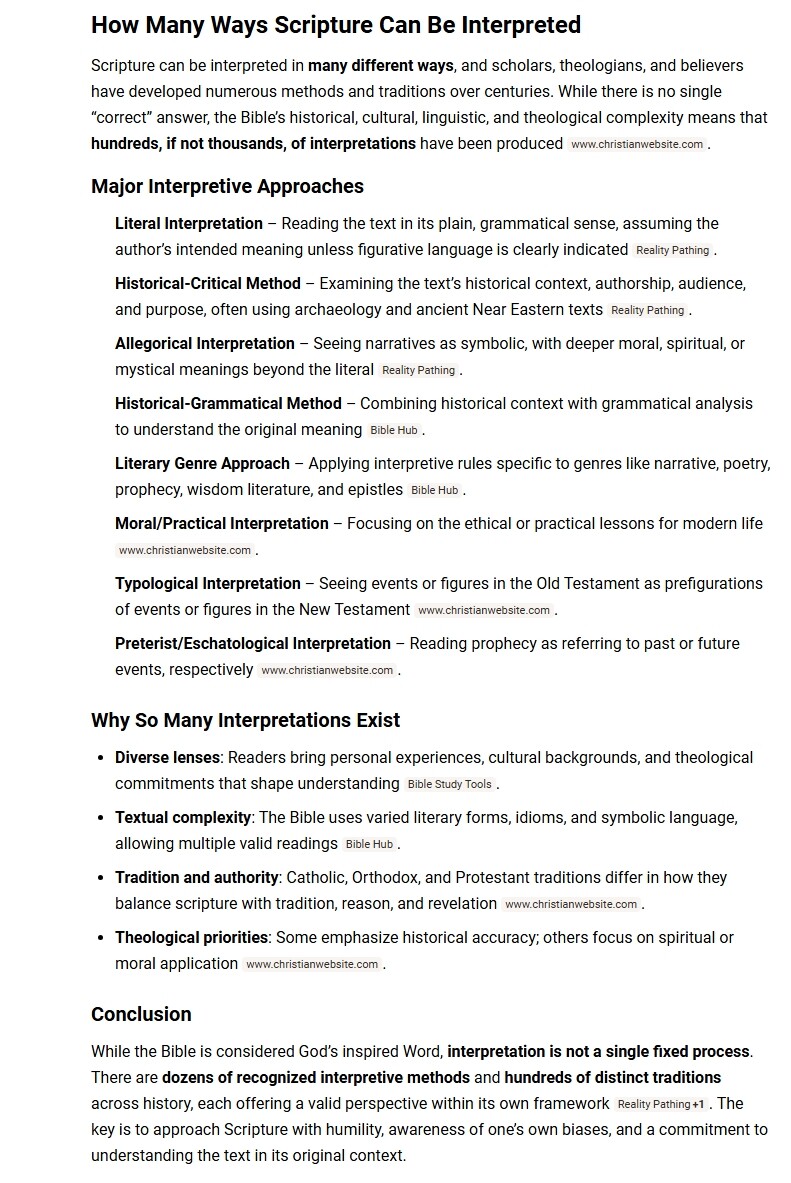
How do we respond when Scripture is misrepresented?
I’m not talking about minor interpretive differences. I mean when verses are pulled out of context to win arguments. When passages about love are weaponized to silence accountability. When passages about judgment are weaponized to justify cruelty. When assumptions get smuggled in as “biblical truth.”
And a lot of people doing it genuinely believe they’re defending God.
I’ve sat in rooms where Scripture was quoted with absolute confidence, and something in me felt off - Not offended, but more grieved like I was watching something sacred being handled carelessly. But then I immediately doubt myself like who am I to question someone who sounds so sure? Who knows the original Greek?
What if I’m wrong?
What does faithful correction even look like, and how can I ensure it’s the truth?
Jesus corrected people, but not everyone, and not always the same way. Paul confronted Peter publicly. But Proverbs talks about answering a fool according to his folly and also not answering him. When do we engage? When do we trust that God can defend His own Word?
And then there’s the emotional layer. It hurts when Scripture is misrepresented, especially when it affects real people. When someone is shamed with verses stripped of context. When someone is dismissed with “the Bible clearly says…” as if that ends all conversation. But I don’t want to become cynical. I don’t want to assume bad faith every time I disagree.
So how do we hold truth fiercely without becoming harsh or self-righteous?
How do we stay humble without staying silent?
I’m not asking for debate tactics either, I really want to approach this topic with grace in all cases.
When you’ve seen Scripture twisted, whether subtly or blatantly, what did you do? What would you do differently now?
Because I don’t want to mishandle the Word while trying to defend it.
I understand. I think faithful correction will always be kind and spoken at the level of the listener. Faithful correction will always take the time to try and understand where that person is coming from and where the two can meet. Sometimes the answer isn’t a string of Bible verses aimed at correcting them, but understanding what’s behind what they had to say. You meet them where they are and not above.
If we think Scripture has been misrepresented, we can state our view of that Scripture in a loving way, but if we meet with resistance or animosity, I would just leave it alone. Then it becomes an argument or the more preferable term-debate. The chance of changing their mind will depend on the person. Most likely it won’t. I don’t really have an answer to your question. I think we have to judge each situation individually by the people involved.
If what’s being said causes you to doubt yourself or question what you believe, then that is a problem. That should never happen, and if it is, then the other person is at fault. The goal is to build each other up and not tear each other down. In that case, I would walk away.
I would truly like to respond to your thoughtful questions, @Shalom, but I do not think I am the right person to do them justice. That said, I genuinely resonate with what you are expressing and appreciate the heart behind it.
I love strong, healthy debates and can direct you to a source I have on “debating” should you wish.
I have found that within Jewish modes of debate, the more rigorous the exchange, the more deeply the Scriptures become fixed in the mind, memorized, internalized, and wrestled with in their proper context, often engaging interpretive layers such as Peshat, Remez, Derash, and Sod within hermeneutical reflection.
Also…
Iron sharpeneth iron[1], yet many withdraw from that kind of engagement rather than embrace it, which is unfortunate.
Barzel (iron) sharpeneth barzel (iron); so one ish sharpeneth another.
Shalom achi.
J.
Iron sharpeneth iron; so a man sharpeneth the countenance of his friend. - KJV Proverbs 27:17 ↩︎
The issue is not disagreement between believers. The issue is authority.
Biblical interpretation begins with what is written, in context, interpreted by the rest of Scripture. Peter gives the boundary plainly: “no prophecy of the scripture is of any private interpretation” ~2 Peter 1:20. That means Scripture is not shaped by personal frameworks, preferences, or systems brought to the text.
When conclusions come from ideas imposed onto Scripture instead of drawn out of Scripture, that stops being interpretation and becomes opinion. Paul warned about this very thing when he said men would become “teachers, having itching ears” and would turn away from the truth unto fables ~2 Timothy 4:3–4.
Our responsibility is not to defend our viewpoints but to submit to the Word. Scripture must explain Scripture. Clear passages govern unclear ones. And no teaching can stand if it contradicts the plain teaching of the gospel already delivered once for all ~Jude 3.
So the goal is not to win arguments or label people. The goal is to refuse to replace God’s Word with human reasoning. “That ye might learn in us not to think of men above that which is written” ~1 Corinthians 4:6.
If something cannot be shown directly from Scripture in its context and confirmed by the whole counsel of God, then it is not biblical doctrine. It is simply a man’s opinion, and believers are called to stand on what is written, not on what men conclude.
How to recognize when Scripture is being mishandled
Before accepting an interpretation, test it by what is written.
1. Does the explanation add ideas the verse itself does not state?
Scripture must be drawn out of the text, not read into it.
“not to think of men above that which is written” ~1 Corinthians 4:6.
2. Is technical language replacing the plain meaning?
Greek or Hebrew can clarify Scripture, but it must never overturn what the passage plainly says.
3. Are outside sources being treated as necessary to understand the Bible?
Scripture declares itself sufficient to equip the believer ~2 Timothy 3:16–17.
4. Is a clear passage being complicated instead of explained?
Jesus corrected this error: “Ye do err, not knowing the scriptures” ~Matthew 22:29.
5. Are word studies being used to reshape doctrine?
Context determines meaning, not word roots alone.
6. Are scholarly tools presented as required for interpretation?
“The entrance of thy words giveth light” ~Psalm 119:130. The Word itself brings understanding.
7. Is the discussion redirected toward emotions instead of Scripture?
Biblical correction answers Scripture with Scripture, not feelings with feelings.
8. Does one verse cancel other clear passages?
Truth never contradicts truth. Scripture interprets Scripture.
9. Is authority subtly shifting from the Bible to expertise?
The Bereans tested teaching by Scripture itself ~Acts 17:11.
10. Does the interpretation depend more on explanation than on the text?
If the conclusion cannot be plainly shown from the passage in context, it is opinion, not doctrine.
The Biblical Standard
The question is never:
“Who sounds more knowledgeable?”
The question is always:
“What is written?”
“All scripture is given by inspiration of God” ~2 Timothy 3:16.
That means Scripture remains the final authority, not systems, credentials, or confidence.
Its why there are hundreds of different religions claiming to be Christian, Jesus started 1 religion not hundreds. Men have twisted Gods truths into oblivion, yet they all claim to be lead by holy spirit. Its sad, no wonder he teaches-FEW will find the road that leads off into life. We as followers of Jesus need to help our fellow man find Gods truth because he requires one to have truth( John 4:22-24)
My painfully simple theory is this: The word of God is a two-edged sword. If you are using it to attack another Christian, you’re in the wrong. If you are defending yourself from an attack, they’re in the wrong. His house has many rooms, not many houses; one body, one flock, one shepherd.
We should all come together in fasting and prayer and let the Holy Spirit bring us into sync.
Great question. I can only tell you my view on this. There are some great answers in this thread. I would start with Peter. Yeah, I know, I’m starting with a hot head. He said this.
“But even if you should suffer for righteousness’ sake, you will be blessed. Have no fear of them, nor be troubled, but in your hearts honor Christ the Lord as holy, always being prepared to make a defense to anyone who asks you for a reason for the hope that is in you; yet do it with gentleness and respect, having a good conscience, so that, when you are slandered, those who revile your good behavior in Christ may be put to shame.” 1 Peter 3:14-16
Why do people get so offended so quickly?
“For the word of God is living and active, sharper than any two-edged sword, piercing to the division of soul and of spirit, of joints and of marrow, and discerning the thoughts and intentions of the heart.” Hebrews 4:12
This is why. This is also why so many try to twist it, ignore it, or attenuate its importance. I have even seen this here. Yes, most of the time it is to ignore, justify, or sadly, even to glorify Sin. I feel, in these situations, we must use the Word to correct the error of the one doing so.
Of course, we should do so lovingly, and we should try our best not to be puffed up in our own knowledge. If someone tells me, the Bible says this is okay, and we need to be okay with it, or whatever, I always think, “Okay, let’s see what they are referring to.” I try to see if maybe I was wrong in my understanding. If I feel that I am correct in what the Bible says, I will try to convince them of their error. I do love this bit of advice.
Sometimes, I do find myself resembling my namesake and being quick with the sword. I will have to keep this in mind. Thanks for that @Bestill
Please be careful with that word, “Religion.” Religion is not salvation. Religion, yes, to some extent, including the fact you pointed out, the Christian Religion, is nothing more than man-made traditions. What did Jesus himself say about Religion?
“Then Pharisees and scribes came to Jesus from Jerusalem and said, “Why do your disciples break the tradition of the elders? For they do not wash their hands when they eat.” He answered them, “And why do you break the commandment of God for the sake of your tradition? For God commanded, ‘Honor your father and your mother,’ and, ‘Whoever reviles father or mother must surely die.’ But you say, ‘If anyone tells his father or his mother, “What you would have gained from me is given to God,” he need not honor his father.’ So for the sake of your tradition, you have made void the word of God. You hypocrites! Well did Isaiah prophesy of you, when he said:
‘This people honors me with their lips,
but their heart is far from me;
in vain do they worship me,
teaching as doctrines the commandments of men.’” Matthew 15:1-9
Teaching for doctrines, the commandments of men. Just because you may be following the traditions of men doesn’t mean you are following God’s Word. Or His teachings. Jesus warns us of false prophets and false religions.
“Beware of false prophets, who come to you in sheep’s clothing but inwardly are ravenous wolves. You will recognize them by their fruits. Are grapes gathered from thornbushes or figs from thistles? So, every healthy tree bears good fruit, but the diseased tree bears bad fruit. A healthy tree cannot bear bad fruit, nor can a diseased tree bear good fruit. Every tree that does not bear good fruit is cut down and thrown into the fire. Thus, you will recognize them by their fruits.” Matthew 7:15-20
Wonder about a religion? First, do they have Jesus? Second, look at what they are doing. Are they going out to feed the hungry, clothe the naked, and give peace to those in need? Are they using the Tithes and Offerings to help others? Is what they are telling you actually IN The Word? Are they producing anything? Are people being saved because of them? That is the sort of thing you should look into before committing to becoming a member of that religion or even that Church.
Jesus is more interested in a relationship. The Disciples did life together. Daily. Not an hour a week. They lived for Jesus. This is the type of relationship Jesus wants to have with us.
Jesus spoke to 7 congregations in Revelation=proof he started 1 religion. All true followers give the best of heart, soul, and strength=24/7-365, not just 1 hour a week. One must be taught by these-Matt 24:45) or they remain in darkness.
The problem is not with Scripture, or how it is handled. Scripture can be interpreted in various ways which may or may not align with what you believe. There are as many views as there are Denominations, and a lot more beyond that.
I think the problem is that we live in a culture where people seek to control and manipulate other people by using a source of Authority. And for Christians, that Authority of choice is Scripture.
We see this behavior on the left, politically, with political correctness taken to extremes. We see this in behavior shaming efforts on social media. And we see this in Christian culture with the use of Scripture.
It is not the behavior outside but the spirit inside the person, and it is a problem where an examination of the heart would be beneficial.
If we practiced respecting boundaries, and the beliefs of others, instead of trying to challenge every view and impose our own views on others, there would be a lot more peace and fewer divisions. But where the fun in that be, am I right?
Everyone loves a good fight. Everyone wants to be right. Everyone wants to be the chosen, but no one wants to be nailed to a cross. Christ certainly didn’t want to suffer, as His time in the garden shows. Remember that prayer to the Father? But someone had to do the hard work of denying themselves so that forgiveness and mercy would come, all so we could demand that people respect Our Authroity… sorry, I mean God’s Authority….Or do I…
At times the real issue is not the words being spoken, but the silence around what ought to be spoken. @anon75384934
DOCTRINAL FRAMEWORK
How We Address Unbelievers
How We Correct Believers
I. ADDRESSING UNBELIEVERS
The Authority Behind the Call
Acts 17:30
Act 17:30 Τοὺς The μὲν indeed οὖν therefore χρόνους times τῆς - ἀγνοίας of ignorance ὑπεριδὼν having overlooked ὁ - Θεὸς God, τὰ - νῦν now παραγγέλλει* He commands τοῖς - ἀνθρώποις men πάντας all πανταχοῦ everywhere μετανοεῖν, to repent,
Act 17:31 καθότι because ἔστησεν He set ἡμέραν a day ἐν in ᾗ which μέλλει He is about κρίνειν to judge τὴν the οἰκουμένην world ἐν in δικαιοσύνῃ, righteousness, ἐν by ἀνδρὶ a man ᾧ whom ὥρισεν, He appointed, πίστιν a guarantee παρασχὼν having provided πᾶσιν to all, ἀναστήσας having raised αὐτὸν Him ἐκ out from νεκρῶν. [the] dead.
Repentance is not optional advice. It is a universal divine command grounded in God’s authority as Creator and Judge.
Matthew 28:18–20 “All power is given unto me in heaven and in earth. Go ye therefore…”
The evangelistic mandate flows from Christ’s universal authority after His resurrection.
The Content of the Message
1 Corinthians 15:3–4
1Co 15:1 Moreover, brethren, I declare to you the gospel which I preached to you, which also you received and in which you stand,
1Co 15:2 by which also you are saved, if you hold fast that word which I preached to you—unless you believed in vain.
1Co 15:3 For I delivered to you first of all that which I also received: that Christ died for our sins according to the Scriptures,
1Co 15:4 and that He was buried, and that He rose again the third day according to the Scriptures,
1Co 15:5 and that He was seen by Cephas, then by the twelve.
1Co 15:6 After that He was seen by over five hundred brethren at once, of whom the greater part remain to the present, but some have fallen asleep.
1Co 15:7 After that He was seen by James, then by all the apostles.
1Co 15:8 Then last of all He was seen by me also, as by one born out of due time. The cross addresses guilt.
The resurrection establishes victory and lordship.
2 Corinthians 5:20
2Co 5:20 Now then, we are ambassadors for Christ, as though God were pleading through us: we implore you on Christ’s behalf, be reconciled to God.
2Co 5:21 For He made Him who knew no sin to be sin for us, that we might become the righteousness of God in Him.
The appeal is reconciliation through substitutionary atonement.
The Condition of the Unbeliever
John 3:18
Joh 3:18 “He who believes in Him is not condemned; but he who does not believe is condemned already, because he has not believed in the name of the only begotten Son of God.
Joh 3:19 And this is the condemnation, that the light has come into the world, and men loved darkness rather than light, because their deeds were evil.
Joh 3:20 For everyone practicing evil hates the light and does not come to the light, lest his deeds should be exposed.
Joh 3:21 But he who does the truth comes to the light, that his deeds may be clearly seen, that they have been done in God.”
Ephesians 2:1 “And you hath he quickened, who were dead in trespasses and sins.”
The issue is spiritual death and condemnation, not merely moral imperfection.
The Posture of the Messenger-Online AND offline.
1 Peter 3:15 “…with meekness and fear.”
Colossians 4:6 “Let your speech be alway with grace…”
2 Timothy 2:24–25 “…gentle unto all men… in meekness instructing those that oppose themselves…”
Evangelism is persuasive proclamation, not ecclesiastical discipline. We call them to Christ, not regulate their conduct as church members.
II. CORRECTING BELIEVERS
The Standard of Correction
2 Timothy 3:16 “…profitable for doctrine, for reproof, for correction…”
Scripture defines error and provides restoration.
The Goal of Correction
Galatians 6:1 “…restore such an one in the spirit of meekness…”
The verb means to mend or repair. The aim is recovery, not humiliation.
James 5:19–20 “…he which converteth the sinner from the error of his way shall save a soul from death…”
Correction is rescue.
The Process of Discipline
Matthew 18:15–17 “If thy brother shall trespass… go and tell him his fault between thee and him alone…”
Private confrontation precedes public exposure.
1 Corinthians 5:12–13 “…do not ye judge them that are within?”
The church judges internal conduct because believers are covenant members.
The Tone of Correction
2 Timothy 4:2 “…reprove, rebuke, exhort with all longsuffering and doctrine.”
Titus 1:13 “…rebuke them sharply, that they may be sound in the faith.”
Firmness is sometimes required, but the objective is doctrinal health.
III. THE THEOLOGICAL CENTER
For unbelievers, the cross is the ground of justification and forgiveness.
For believers, the cross is the pattern of dying to sin.
Romans 6:4 “…like as Christ was raised up from the dead… even so we also should walk in newness of life.”
The resurrection empowers sanctification.
Hebrews 12:6 “For whom the Lord loveth he chasteneth…”
Correction of believers flows from covenant love secured by Christ’s atoning work.
CONCISE DISTINCTION.
Unbelievers are called to repent and believe the gospel of Christ crucified and risen.Believers are corrected by Scripture and disciplined within the church for restoration and holiness.
We proclaim the cross/Jesus Christ to the world.
We apply the cross/Jesus Christ within the church, or online forums.
Not sure where you got that from. This verse kicks off a series of parables about readiness and stewardship. Jesus identifies two specific traits for leadership: being faithful, consistent, and loyal. and being wise, discerning, and practical.
The servant isn’t just “waiting” for the master to return; they have a specific job—feeding the household. In a theological sense, this is often interpreted as spiritual leaders providing “spiritual food,” teaching, and care to the community.
True readiness isn’t about staring at the sky for signs; it’s about being found doing your job well when the moment arrives. This has nothing to do with being taught by an organized religion.
Those are the ones Jesus is with, those are the ones taking the lead in his religion that he appointed, they share spiritual food at the proper time to the domestics.
For any communication to occur there has to be, at the minimum, two engaged parties, one sharing some information (giving), and one purposefully listening (receiving). If you are offering information and no one is listening, (the other party is not interested in what you have to say) then your efforts are mostly in vain, and you are not communicationg.
Before I get forum-opposition to this reality, I openly admit God has called His prophets to “cry-out in the wilderness” and herald a message He knows no one will hear. But those prophets were specifically called, for a specific reason, and were essentially unable to reject the calling (think Jonah). In these cases, the job was unpleasant, the task difficult and costly, and the prophet submitted to God’s calling knowing the outcome could be his own death. Unless you have a specific mandate to correct the errant speaker, signed by God Himself, then your response is largely voluntary, and your motivations are principally of your own making.
A comprehensive response to your question is too large for a forum post, so, in lieu of that, I might offer one simple thing to keep in mind: Be careful to not become a victim of your own faulty assumptions.
The faulty assumption that every error demands correction. A casual reading of the scriptures will assure you that far more errors were righteously left uncorrected than those that were confronted.
The possibly faulty assumption that they’re wrong and you are right. Their understanding may just be a new understanding to you; it actually be an opportunity for your own stretching and growing. Take a beat, and ask God for clarity.
The faulty assumption that you know the motivations of the other party; being certain they are misrepresenting scripture “to silence accountability” or “to justify cruelty”, or “to win arguments” or some other motivation you are projecting on them. You might be right, but you cannot know if you are or not.
The assumption that you are called, or held responsible by God to give a response, to gallantly “right an egregious wrong”. Maybe your felt-need to respond is actually grounded in some of the same errant motivations you are projecting on the other party. Maybe you would be responding from ill, or self-centered motives. Ask God if you are part of the solution, and then wait for an answer.
The erroneous assumption that you are capable to defend God, or defend His word. As if God, or His word need defending, as if the Master needs defended by His disciple, as if God is unable to protect His own truth from miscreants The notion is as silly as a small boy with a sharp stick thinking he could defend a trillionaire from a frivolous lawsuit demanding a few hundred dollars in damages. Imagine!
The erroneous assumption that if you don’t confront this error, the error will grow and do damage. It may, but it is just as likely that your confrontation only fuels the fire of error, foments disunity, grieves The Holy Spirit, and only gives credence to the error by giving it attention; it may fail to testify of the eternal nature and unassailable surety of The Truth. Your excited response may only demonstrate your own lack of confidence.
Surely there is a time to confront error, and to speak The Truth in Love, with gentleness and patience, trusting in the source of Truth to convict hearts and to grow His own church, His way, in His timing. Surely we are all called to know The Truth, to be ready to give a solid answer when asked about the hope that is in us. But, you cannot find a mandate in scripture for every Christian to confront every error whenever and wherever it is found, not without “wresting” scriptures as the Apostle Peter says.
Our collective calling is to testify to our own experience, to tell what Jesus has done and how His work has affected us. Within the body we are to seek unity, peace through patience, learning, sharing, and listening, understanding that we are all in a state of growth, and none of us are finished works. There are times to confront error, but not nearly as many as you might think (IMHO)
am also facing the same issue at church or in Bible Study forum and the problem is everyone wants the become teachers.
Even scripturally in context we expose their fallacies of out of context interpretation, minimal is the impact, even to the forum or church council are ignorant.
Today because of Jesus am able to stand alone without friends believers or unbelievers, and am referred to as Bible fanatic.
Remember Jesus said how Israel treated the true man of GOD, even to the church in Matthew 5:10-12
As to correcting a member in church, approach him personally, point it out, if one listen not, bring two other witnesses, still not, report it to the church.
Good fruitful respond till today never happened to me, same as the man of GOD in the Old, chased, beaten or stoned to death.
After sometime when calamity strikes, they will remember the man of GOD then and build monments, as Jesus Himself declared.
Even to say, that the generation of today are guilty as their fathers, who persecuted these man of GOD.
Moreover Jesus discipled His church, especially the man of GOD, that to forget oneself and carry one’s cross.
But the problem we’re facing besides these word of GOD pertaining to faith, on the contrary is our carnal ‘self’, that tend to get all emotional and respond unwisely.
Means, you need to have a very thick face and a very charm demeanor to approach these people with the word of GOD.