How is loving others the way Jesus loved actually different from just “being nice”?

For me, “being nice” is often about social smoothness, avoiding conflict, keeping things pleasant, not rocking the boat. Loving the way Jesus loved seems deeper and sometimes less comfortable. It includes kindness, but it also includes truth, courage, and willingness to step into messy situations rather than sidestep them.

Niceness tends to protect harmony; Christ-like love tends to protect people. That can mean forgiveness, but it can also mean setting boundaries, confronting harm, or sacrificing convenience. It’s not just tone, it’s intention and cost. Niceness asks, “Will this keep things pleasant?” Love asks, “Will this help this person flourish, even if it’s difficult?”

"Never be cruel, never be cowardly… and never, ever eat pears! Remember… hate is always foolish… and love is always wise. Always try to be nice, but never fail to be kind.”

I think there is a difference between being nice and being kind. It’s a subtle distinction, but a profound one. Most people use the terms interchangeably, but they often come from very different places: niceness is frequently about social friction, while kindness is about character.

Think of it this way: Being nice is a behavior; being kind is a motivation. The Key

Differences Feature Being Nice Being Kind

Primary Goal- To please others or avoid conflict.To do what is best for someone else.

Origin- External (driven by social norms). Internal (driven by empathy/values).

Feelings- Can feel polite, pleasant, or “soft.” Can feel firm, honest, or “tough.”

Boundary- Often lacks boundaries (people-pleasing). Rooted in healthy boundaries.

The “Social Lubricant” vs. The "True Help"Niceness is often the “social lubricant” that keeps things moving smoothly. It’s smiling at someone you don’t like or saying “yes” to a favor you don’t have time for because you don’t want to seem rude. It is often performative.

Kindness is doing the right thing, even if it’s uncomfortable. A kind person might tell you that you have spinach in your teeth or give you difficult feedback on a project. It might not feel “nice” in the moment, but it’s helpful in the long run.

Seeking Approval vs. Seeking Impact. If you are being nice, you might be worried about how you are perceived. You want to be liked. If you are being kind, you are worried about how the other person is doing. You want them to be okay. Kindness can exist without a smile, and it often happens when no one is watching.

The Role of Honesty “Niceness is telling someone what they want to hear. Kindness is telling someone what they need to hear.” Being nice can sometimes lead to “white lies” to spare feelings. Kindness prioritizes the truth because it respects the other person enough to believe they can handle it.

I believe we are called to be kind as children of God, which does include pointing out sins and showing people there is a better way, and His name is Jesus. Jesus was always kind, but sometimes, not so nice.

Peter

1 Like

The bible is practical about living in a closed community as most of the biblical people did.

Proverbs 27: 5.Better is open rebuke
than hidden love.

**6 **Wounds from a friend can be trusted,
but an enemy multiplies kisses.

Loving others means having the best intention as the bases of ones interaction with them.

Jesus showed his love for us in while we Hated him, he died and rose again for us.

The cult of “niceness”

Jesus cleansing the temple shows that love sometimes destroys what is harming people rather than politely tolerating it, because Christ does not negotiate with exploitation or preserve a pleasant religious atmosphere when worship has been corrupted, as seen in John 2:15–16[1], which is not “nice” but is deeply protective of God’s people and God’s holiness.

Jesus publicly rebuking Peter shows that truth takes precedence over sparing someone’s feelings, because allowing false thinking about the cross would have derailed redemption itself, as demonstrated in Matthew 16:23[2], where Christ values alignment with God’s will over interpersonal comfort.

Jesus confronting the Pharisees exposes how niceness can actually shield hypocrisy and harm, since He chooses blunt moral clarity over polite religious dialogue in Matthew 23:27[3], making clear that surface harmony can conceal spiritual death.

Paul confronting Peter publicly demonstrates that love sometimes requires visible correction for the sake of the gospel, because private niceness would have allowed ethnic division to harden inside the church, as recorded in Galatians 2:11[4], showing that unity is protected by truth, not silence.

Nathan rebuking David illustrates that real care confronts powerful people rather than flattering them, since ignoring sin in leadership destroys both the sinner and those they lead, as seen in 2 Samuel 12:7[5], which is pastoral courage, not social diplomacy.

Jesus refusing to soften His teaching even when people walk away shows that truth is not adjusted to maintain a crowd, because He values genuine discipleship over emotional retention, as stated in John 6:66[6], a direct rejection of people-pleasing ministry.

Proverbs explicitly warns that flattering speech, which often passes for niceness, is spiritually dangerous, because it prioritizes approval over honesty, as taught in Proverbs 29:5[7], indicating that pleasant words can quietly entrap rather than help.

Jesus teaching about correction among believers assumes discomfort as a necessary cost of love, because avoiding confrontation allows sin to metastasize, as commanded in Matthew 18:15[8], where restoration begins with honesty, not niceness.

Paul’s description of love in 1 Corinthians explicitly separates it from emotional indulgence or moral tolerance, because love is aligned with truth rather than mere pleasantness, as declared in 1 Corinthians 13:6[9], which means love cannot coexist with silent approval of harm.

Jesus’ post-resurrection commission prioritizes obedience over relational ease, since making disciples requires teaching hard commands rather than cultivating agreeable atmospheres, as stated in Matthew 28:20[10], grounding Christian love in costly faithfulness rather than social comfort.

So Scripture consistently dismantles the idea that being “nice” is virtuous in itself.
Niceness protects moods, reputations, and group equilibrium.
Biblical love protects people, truth, and ultimately their standing before God, even when it creates tension, costs relationships, or exposes sin that everyone would rather leave undisturbed.

The gospel is meant to be offensive not “nice”

J.


  1. And when he had made a scourge of small cords, he drove them all out of the temple, and the sheep, and the oxen; and poured out the changers’ money, and overthrew the tables; And said unto them that sold doves, Take these things hence; make not my Father’s house an house of merchandise. - KJV ↩︎

  2. But he turned, and said unto Peter, Get thee behind me, Satan: thou art an offence unto me: for thou savourest not the things that be of God, but those that be of men. - KJV ↩︎

  3. Woe unto you, scribes and Pharisees, hypocrites! for ye are like unto whited sepulchres, which indeed appear beautiful outward, but are within full of dead men’s bones, and of all uncleanness. - KJV ↩︎

  4. But when Peter was come to Antioch, I withstood him to the face, because he was to be blamed. - KJV ↩︎

  5. And Nathan said to David, Thou art the man. Thus saith the LORD God of Israel, I anointed thee king over Israel, and I delivered thee out of the hand of Saul. - KJV ↩︎

  6. From that time many of his disciples went back, and walked no more with him. - KJV ↩︎

  7. A man that flattereth his neighbour spreadeth a net for his feet. - KJV ↩︎

  8. Moreover if thy brother shall trespass against thee, go and tell him his fault between thee and him alone: if he shall hear thee, thou hast gained thy brother. - KJV ↩︎

  9. Rejoiceth not in iniquity, but rejoiceth in the truth. - KJV ↩︎

  10. Teaching them to observe all things whatsoever I have commanded you: and, lo, I am with you alway, even unto the end of the world. Amen. - KJV ↩︎

This is a timely post since I will face such tomorrow. One of the homeless men I know from volunteer work is in trouble and in the hospital. He has asked that I come see him and I will go tomorrow. The truth is that I don’t want to go. I have the time and its not far, so that’s not the reason. I’m concerned that he might view me as his rescuer or place some other expectation on me. I will need to set boundaries and I will need to be kind. I will listen to his complaints because he needs to vent, but listening is not all that easy. Although he tries to keep it clean, his language is full of swearing, apology and then more swearing. I’m hoping to have the chance to share the gospel again. He’s listened to it once and he needs to hear it again. And really, that is his only hope. Only God can work through what he’s facing and he doesn’t know God.

So I will go and be praying all through it. He seems so far gone, but God has redeemed men worse than him. If you think of it, please pray with me on this.

1 Like

The original meaning of “nice” meant “without thinking”. For example, a retarded person may be “nice” because he is not able to be malicious.

Biblical love is defined as essentially selflessness;

1Co 13:4 Love suffereth long, and is kind; love envieth not; love vaunteth not itself, is not puffed up,
1Co 13:5 doth not behave itself unseemly, seeketh not its own, is not provoked, taketh not account of evil;
1Co 13:6 rejoiceth not in unrighteousness, but rejoiceth with the truth;
1Co 13:7 beareth all things, believeth all things, hopeth all things, endureth all things.

We often think of love as emotional sensations that one falls into or out of. Biblical love is the transition from the selfishness of the flesh to the selfless love of Christ.

Niceness maintains peace. Jesus’ love confronts with life-giving truth. Niceness retreats when tensions rise. Christ-like love advances at any cost. Jesus loved others enough to call sin sin, name-call hypocrites, and demand repentance. Not because He wanted to win an argument, but because He loved them and wanted to save their souls. “Faithful are the wounds of a friend.” ~Prov. 27: 6 Liking people gently coaxes them towards God. Biblical love boldly speaks the truth in love.

Truthful love is not nice, but it is good. Biblical love cuts to the core, but with intention, not malice. Jesus said eternal life is knowing God ~John 17:3. You cannot know God apart from truth. You will not hear truth from someone speaking nicey-nice. That is why the Bible tells us to speak truth in love ~Ephesians 4: 15 and that the Lord disciplines those he loves ~Hebrews 12:6. Niceness guards comfort. Christ-like love pursues holiness, restoration, and eternal good. That love may very well leave dirt on your boots and blood on your hands but it will bring life.

1 Like

Character takes a Lifetime to develop. Remember when Jesus told to the Disciples to be as Crafty as Serpent’s? Being too nice, all of the Time; is not that.

1 Like

Being nice, “I am so sorry to hear that.”

Being loving, “This conversation needs coffee, pie, and ice cream. Let’s get some and really talk it out. “

I’m in. Hazelnut, Cherry, and Cherry Gar… you know, for me thanks.

Peter

Real love can sound gentle or firm, but it’s always aimed at protecting people and honoring God, not just keeping things comfortable.

1 Like

Thank you for your powerful words here @JennyLynne .

J.

Excellent. Ice Cream, Holy Water, and a Cross- So we can properly talk it out, in the Name of Christ Jesus. You know me, @PeterC . I am the kind of guy who will LOVE the Hell right out of you.

The full Scripture is: “Behold, I send you forth as sheep in the midst of wolves: be ye therefore wise as serpents, and harmless as doves” (KJV) Mathew 10:16

And it regards dealing with Wolves, those whose intentions are to devour you. The term for “shrewd” can be replaced with the word, “wise.” The term for “harmless” is interchangeable with “innocent.” And one interpretation of this Scripture is to be mindful, to know or to understand how the Snake or Wolf works in order to avoid any of their traps or snares without losing your own innocence in the process.

This is about self-preservation without losing your identity in Christ.

Christ presents an example of this as He sidesteps the snares of the Pharisee, knowing full well what was in their hearts. While at the same moment, doing what He came to do.

LOVE, as God taught us, is greater than being nice. Because LOVE is not about our human response to uncomfortable conversations, subject matter that we are sensitive to, or sin when it is revealed. And LOVE is not offering surface level affirmations or pat on the back affections when we do not have the answer to give.

LOVE is about the POWER of God working through us to meet another person’s NEED. Which goes far beyond simply sharing the Good News of Christ and ensuring their salvation and then walking away when things get complicated. And I say the Power of God because unless God is informing you and guiding your words and actions, Or, the person themselves knows, understands, and can communicate to you exactly what it is that they need, how would you know?

How would you know what trauma is at the root of their brokenness? How would you know the exact WORD they need to hear, or the affection that they desperately long for that serves their actual NEED and not your own sinful lust or desire to prey on others… Unless God moved through you to get you there above and beyond your own temptation to Sin in order to focus on the well-being of that Other person who matters just as much to God as you do.

Unless the Holy Spirit is Actively Safeguarding your footsteps, and you are purposefully listening to THAT SPIRIT like a Well-Respected Compass that never steers you wrong, especially when the storms of life come in to wreck all sorts of havoc, how could you know the Way to guide another person to safe harbor? When you are instead following your own selfish desires for gain or your own preservation from anything and everything threatening such as having tough uncomfortable conversations. And using such wonderfully, vapid niceties to run away quickly.

Unless God moves through you, you cannot effectively do what God has called us all to do. Especially if you have never even bothered taking a moment to read, study, know, and understand the basic needs required for a person to be well. Because if you do not care about the least of these needs, how could you possibly LOVE enough to care about the Greatest Need of All?

And while other people may Tempt, Seduce, Charm, or Plot against us and our own Well Being, God’s Power sees through it and helps us to dodge it. If we ourselves are moving in that LOVE, POWER, SPIRIT.

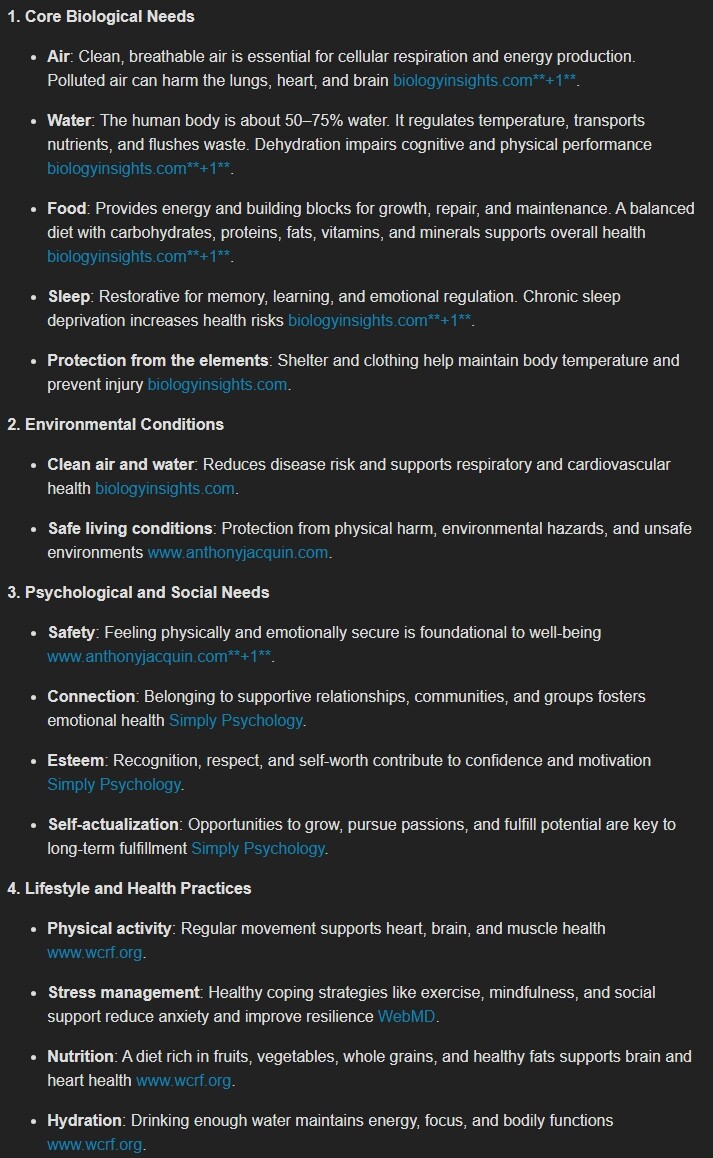
But what is a NEED? Child Development classes can readily answer that through a deep dive into what makes someone a healthy, functioning person in this world. And this is what came up with a simple google:

What Humans Need to Be Well

To be well, humans require a balance of biological necessities, environmental support, and psychological/emotional needs.

In summary, being well means meeting basic survival needs (air, water, food, sleep, safety), maintaining a supportive environment, and nurturing emotional and social connections. Adding healthy habits like regular activity, balanced nutrition, and stress management further enhances physical, mental, and emotional well-being.