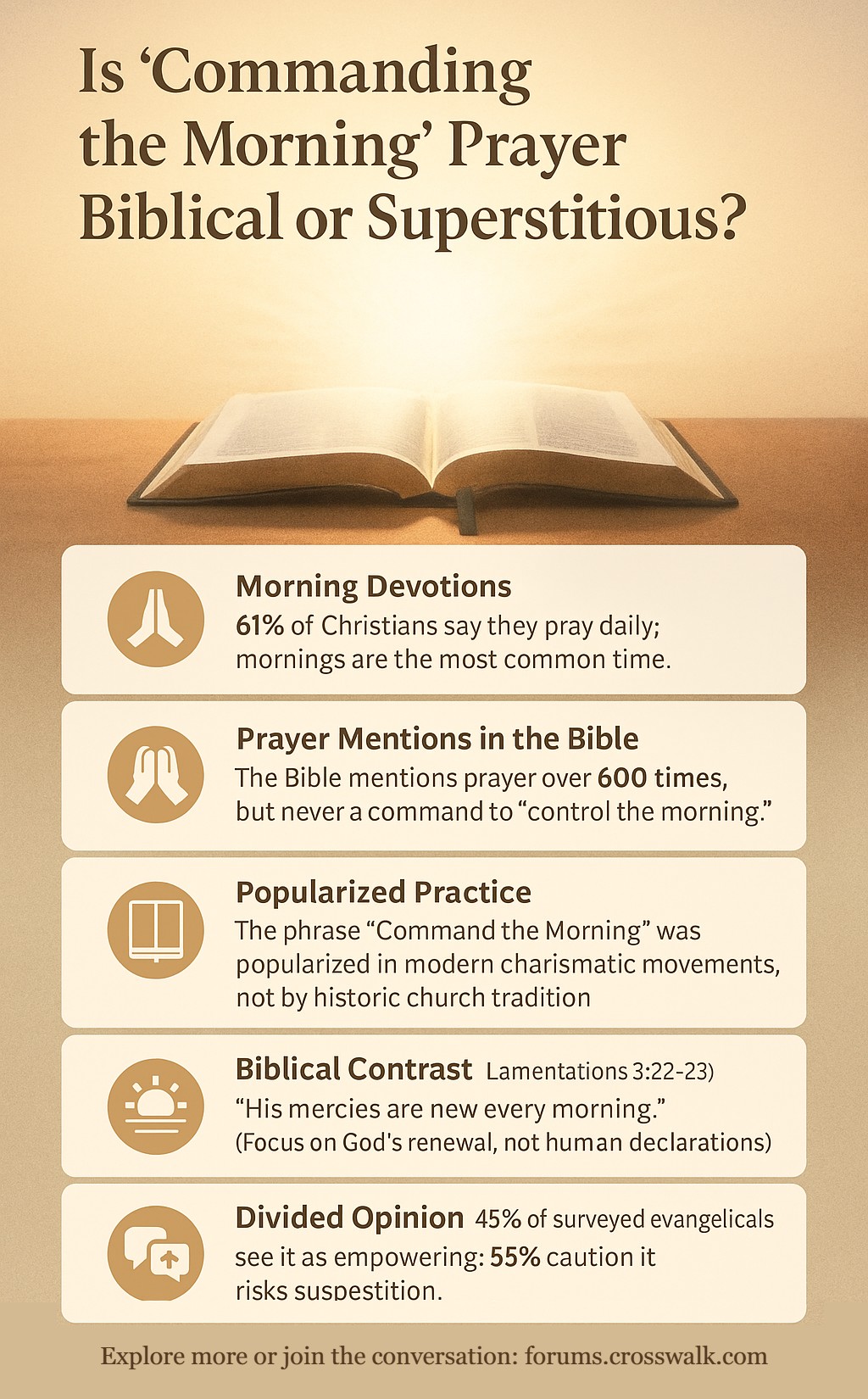
Is ‘Commanding the Morning’ Prayer Biblical or Superstitious?
As Christians reflect on prayer practices that shape daily life, we invite your voice in Crosswalk Forums.
#PrayerLife #BiblicalFaith #DiscerningTruth #christianforums #crosswalkforums #forums #crosswalk #faithcommunity #faithforums
In recent years, many believers have been encouraged to begin each day with what’s often called a “commanding the morning” prayer. The idea is that by speaking declarations over your day—sometimes using strong or even militaristic language—you can set the spiritual atmosphere and determine outcomes before they unfold. Popular books, sermons, and online ministries promote this practice as a way of “taking authority” over your circumstances and claiming blessings in advance.
But this raises important questions: Is this approach grounded in Scripture, or is it a modern invention that leans more toward superstition than faith? The Bible does tell us to pray without ceasing (1 Thessalonians 5:17), to commit our ways to the Lord (Proverbs 16:3), and to seek His mercies new every morning (Lamentations 3:22–23). At the same time, nowhere do we find examples of prophets, apostles, or even Jesus Himself “commanding” the morning in a formulaic way.
For some, this practice feels empowering and faith-filled—a way of actively standing on God’s promises. For others, it seems to risk turning prayer into a ritual of control, where the focus drifts from God’s sovereignty to our own declarations. Is it prayer or is it presumption? Is it a bold expression of faith, or does it drift into a “name-it-and-claim-it” mentality?
Many Christians are caught between the appeal of waking up with intentional prayer and the concern that such practices may subtly replace surrender with superstition. Should our mornings begin with commands, or with humble requests? Should our declarations sound more like us speaking to creation, or like us depending on the Creator?
What do you think—when you hear about “commanding the morning” prayers, do you see them as biblical expressions of faith or as traditions shaped more by culture than by Christ?