In your opinion, which Bible translation is the most accurate and why?
The New Revised Standard Version. The scholarship is far above that if most translations, and it was not translated for a specific audience. The translation used by most colleges and seminaries outside of Pentecostalism or fundamentalism.
There is already a similar topic already up and running.
I’ll agree with Dr. Youngblood (NIV) and Wayne Grudem (ESV), two very well-known Bible translators … the NASB
1 Like
I have used the New American Standard Bible 1995 because it is the most accurate English translation. I am checking the NKJV as this appears to be on the same level As the NASB1995
1 Like
The best Bible translation depends on what you’re looking for. Here’s a video that explains the differences among some of the most common Bible translations: Which Bible Translation Is Best? NIV, ESV, CSB, NLT & More Explained
3 Likes
In a word-for-word translation from the Greek and Hebrew, I prefer the English Standard Version. I used to like the NIV, but recent versions of that translation have tried to fit our culture’s influences concerning pronouns, for example, rather than true translation, too much.
1 Like
Hi,
For the best word for word translation I like the New American Standard Version.
For simply reading, I like the New King James Version.
I grew up on the KJV back in the 1960s,.
I now read the NKJV.
It is the closest to what I grew up with, and its pretty easy reading.
Which ever one you choose, I would advise you to keep a couple of other books close by.
A regular dictionary, as there may be words of which you don’t know the meaning.
I would also recommend a Bible dictionary.
It will help you learn more about a particular person, or place, or object.
For example, God told Jonah to prophesy at Nineveh.
Where was Nineveh?
Maybe that is something we can know but the Bible doesn’t teach.
Knowing this further enhances the account.
Knowing more is rarely a bad thing.
Oh well, I have rambled on enough.
Blessings
2 Likes
Kutsal Kitap is a recent translation (1987, 1994, 2001) that owes more to the Greek, Aramaic, and Hebrew original texts than it does to vernacular translations. So, it ranks pretty close to the top when it comes to accuracy.
(reading the Bible in a new language forces you to slow down and really pay attention!)
1 Like
From my side, I like Young’s Literal translation (YLT)
Translators have to decide between literal accuracy and readability. You can look at an interliner bible on line and see how unreadable a purely literall translation is.
With sites like biblegateway one can read something like 20 different translations comparing both the translation and readabi.ity.
1 Like
A simple answer is Original manuscripts..but translations, we need to think a bit…im going with NASB 2020.
We Don have the manuscript papers, only copies at least a hundred years after the events.
@Joe, why do you recommend a regular dictionary for the meanings of words in the Bible? A regular one gives the ordinary meanings of today’s culture, not the Bible’s meanings.
As an inspired book, it has the meanings that God inspired the prophets and apostles to write. Therefore, we should use a Bible dictionary and/or a Greek or Hebrew lexicon with a version that shows the original language along with a good English translation. Then, a person can get the original words and their meanings.
1 Like
I was only saying it for fun….
We sometimes talk about “word for word” “literal” translations. But I think taking a step back, we should acknowledge that, in a lot of ways, that’s never entirely possible. Sometimes there is a literal word-for-word equivalence between languages. For example the Latin word cattus means “cat”. But other times, and indeed quite often, translation requires making an interpretive choice of trying to find an approximate word or phrase. This becomes even more complicated by idiomatic expressions where even if we can find a word-for-word approximate it may fail to capture the actual meaning as understood within the time, place, culture, and language it was written/used.
In fact, there’s even an Italian expression, “traduttore, traditore” meaning “the translator is a traitor” (literally “translator, traitor”, relying on word play because of similarity between the words). The very act of translation is, in a sense, a betrayal of the source of language because something is almost always lost or missing in translation.
So “most accurate Bible translation” is probably an impossible question to answer objectively. I think it would be fair to say there are better and worse translations, sure; but I don’t think there can ever exist a singular most accurate translation. That simply doesn’t exist. Rather, there are good translations, and we can probably find one or two translations that do one thing very well, and maybe one or two translations that do something else very well–but because of the very nature of translation itself, there will always be something lacking in some way or another.
Personally, I like the ESV and NRSV. I think they are both very excellent translations. Are they the most accurate? Again I don’t think “most accurate” necessarily exists. But the ESV and NRSV are both very good.
I think it is always important to remember that the relationship between Christians and the Bible has always been a relationship that happens in our fellowship. From the beginning of the Church, the primary way people experienced the Bible was in the context of coming together for worship, since Christians continued the liturgical practice inherited from Judaism of reading Scripture out loud. For most of human history, including Christian history, access to books of any kind was near impossible unless one was fortunate enough to be educated, wealthy, and literate. Wealth was important because a book was worth a literal fortune when each copy of a book had to be meticulously written by hand. So the fact that you and I and our neighbor are literally surrounded by books, can just walk down the street and buy a Bible for cheap, but also have literally a near-endless access to the written word digitally through the internet is an astounding change from how things have been throughout the entire history of human civilization.
And, I’d argue, the communal dimension of our encounter and experience with Scripture is vitally important. Because where I, as an individual, may lack–or simply fail to see something in the text of Scripture–that can be balanced by the fact that we are encountering God’s word together; and have faithful pastors–and even lay persons–who have been trained and educated in ways to grasp subtleties and nuances and a greater exposure to the source languages. And, of course, as the Church, we have access to the wealth of wisdom that has been inherited over the last two thousand years so that we aren’t working alone.
So that even if we don’t have “the most accurate translation”, that becomes inconsequential–because we still have access to God’s word, we still have a living and thriving community of faithful Christians both now, and have existed in the many generations before us who have received and heard and lived God’s word in their lives. That makes our experience of Scripture richer, and also balanced–so that it’s not up to me, by myself, to figure out what the Bible means based on my limited knowledge, and my fallible ability to understand what a translator/translation committee means in a translation of a language I don’t know. Rather I get to participate in an ancient and living conversation that stretches back thousands of years.
1 Like
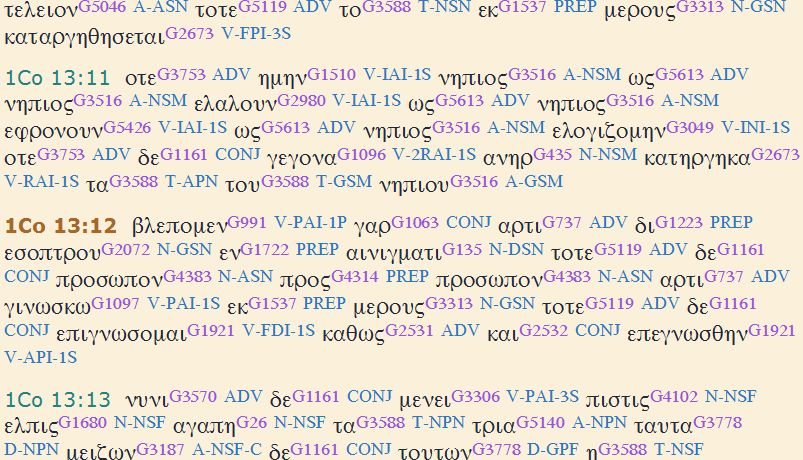
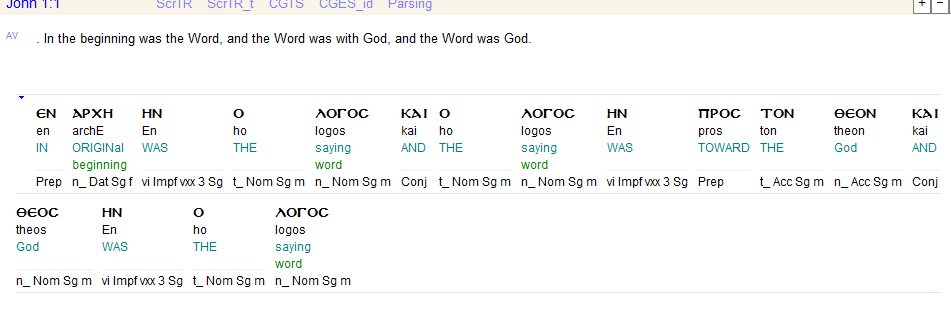
There are greek-english interlinked freely available see:-John3:16 MOUNCE - “For this is how God loved the world: - Bible Gateway
Video on which Bible translation is best:
The most accurate I have found is Young’s Literal Translation (YLT)
I generally use the KJV
Most seminary students are encouraged to consider the NASB. However, it is based on the Critical Text of the Greek and I find the Majority Text to be superior.
I use a computer program (esword) which is free and can easily check on the Greek and Hebrew word definitions as I have questions.
In that case, y’all ever use an interlinear Bible?