Pastoral Thoughts on the Doctrine of Election

Verses “I chose of my own will to believe” free will Arminians blindly fight against.

“ALL that the Father giveth me SHALL COME to me; and him that cometh to me I will in no wise cast out.” John 6:37

Not one will be left behind. If a person does not come to Christ, then they never were given by the Father to the Son.

“No man CAN COME to me, except the Father which hath sent me DRAW him; and I WILL RAISE HIM UP at the last day.” John 6:44.

The one who is drawn will be raised up by Christ at the last day. No exceptions.

“Therefore said I unto you, that NO MAN CAN COME UNTO ME, EXCEPT IT WERE GIVEN UNTO HIM OF MY FATHER.” John 6:65.

Notice what happens in the very next verse after the Lord Jesus teaches the truth of election.

“From that time many of his disciples went back, and walked no more with him.” John 6:66.

“He calleth his own sheep by name, and leadeth them out.” John 10:3

“The good shepherd giveth his life FOR THE SHEEP.” John 10:11

“I lay down my life FOR THE SHEEP.” John 10:15

“And other sheep I HAVE, which are not of this fold: them also I MUST BRING, and THEY SHALL HEAR MY VOICE; and there shall be one fold and one shepherd.” John 10:16

Notice that Jesus says he HAS these other sheep. Not “hopes to have”. And they ARE his sheep BEFORE they hear his voice. They do not become sheep by hearing, but because they already ARE his sheep they hear his voice.

But of others who do not believe He says: “But ye believe not BECAUSE YE ARE NOT OF MY SHEEP.” John 10:26

Notice He does not say, you are not my sheep because you do not believe, as if by believing they would become his sheep. But the very reason they do not believe is BECAUSE they are not his sheep.

“My sheep hear my voice, and I know them, and they follow me. And I give unto them eternal life, and they shall never perish, neither shall any man pluck them out of my hand, My Father WHICH GAVE THEM ME is greater than all; and no man can pluck them out of my Father’s hand.” John 10:27-29

Another reason given in Scripture why SOME CANNOT BELIEVE is because God blinds their eyes and hardens their hearts.

John 12:37-40 “But though he had done so many miracles before them, yet they believed not on him; That the saying of Esaias the prophet might be fulfilled, which he spake, Lord, who hath believed our report? and to whom hath the arm of the Lord been revealed? Therefore THEY COULD NOT BELIEVE, BECAUSE that Esaias said again, HE (God) HATH BLINDED THEIR EYES, AND HARDENED THEIR HEART; THAT THEY SHOULD NOT SEE with their eyes, NOR UNDERSTAND with their heart, AND BE CONVERTED, and I should heal them.”

“Ye have not chosen me, but I have chosen you, and ordained you, that ye should go and bring forth fruit”. John 15:16.

“As thou hast given him power over all flesh, that he should GIVE (not “offer”, not “make possible” but GIVE) eternal life TO AS MANY AS THOU HAST GIVEN HIM.” John 17:2

“I pray for them: I pray not for the world, but for them which thou hast given me; for they are thine.” John 17:9.

“And when the Gentiles heard this, they were glad, and glorified the word of the Lord; AND AS MANY AS WERE ORDAINED TO ETERNAL LIFE BELIEVED.” Acts 13:48.

Romans 9:27 and 11:5-8.

9:27 - Though the number of the children of Israel be as the sand of the sea, A REMNANT SHALL BE SAVED.”

5. "Even so at this present time also there is A REMNANT ACCORDING TO THE ELECTION OF GRACE.

6. And if by grace, then it is no more of works: otherwise grace is no more grace. But if it be of works, then is it no more grace: otherwise work is no more work.

7. What then? Israel hath not obtained that which he seeketh for; BUT THE ELECTION HATH OBTAINED IT, AND THE REST WERE BLINDED

8. (According as it is written, GOD HATH GIVEN THEM THE SPIRIT OF SLUMBER, EYES THAT THEY SHOULD NOT SEE, AND EARS THAT THEY SHOULD NOT HEAR;) even unto this day."

Romans 9:11-16.

11. (For the children being not yet born, neither having done any good or evil, that THE PURPOSE OF GOD ACCORDING TO ELECTION MIGHT STAND, not of works, but of him that calleth)

13. As it is written, Jacob have I loved, but Esau have I hated.

12 It was said unto her, The elder shall serve the younger.

14 What shall we say then? Is there unrighteousness with God? God forbid.

15 For he saith to Moses, I will have mercy on whom I will have mercy, and I will have compassion on whom I will have compassion.

16 So then IT IS NOT OF HIM THAT WILLETH, NOR OF HIM THAT RUNNETH, BUT OF GOD THAT SHEWETH MERCY.

17 For the scripture saith unto Pharaoh, Even for this same purpose have I raised thee up, that I might shew my power in thee, and that my name might be declared throughout all the earth.

18 THEREFORE HATH HE MERCY ON WHOM HE WILL HAVE MERCY, AND WHOM HE WILL HE HARDENETH.

19 Thou wilt say then unto me, Why doth he yet find fault? For who hath resisted his will?

20 Nay but, O man, who art thou that repliest against God? Shall the thing formed say to him that formed it, Why hast thou made me thus?

21 Hath not the potter power over the clay, of the same lump to make one vessel unto honour, and another unto dishonour?

22 What if God, willing to shew his wrath, and to make his power known, endured with much longsuffering THE VESSELS OF WRATH FITTED TO DESTRUCTION:

23 And that he might make known the riches of his glory on THE VESSELS OF MERCY, WHICH HE HAD AFORE PREPARED UNTO GLORY,

24 Even us, whom he hath called, not of the Jews only, but also of the Gentiles?
2 Likes

I was talking with the Lord one night awhile back and He made the remark to me that, while many are called, and few chosen, even fewer respond. This thread made me think again about that what He said.

Welcome to the forums!

I hope you enjoy our company enough to stick around awhile. We would like to get to know you better, so stop on by the Introductions Category and introduce yourself there.

You can go right there by cIicking → Introductions

I agree with all your passages, @brandplucked, but it’s also true that humans are fully responsible for their whole lives, and God is in no way responsible for humans’ sinfulness. Otherwise, you would have fatalism, as if God wills even evil into existence. He only allows or permits it to bring home lessons for his chosen ones. Job 1 and 2 show clearly that God allows Satan to attack believers, but he limits his actions, as he did for Job and his “friends” to learn some lessons.

1 Like

To add brother…

The Bible consistently shows that God offers salvation through Jesus Christ, and individuals have the choice to accept or reject this offer. This is a beautiful demonstration of His love and respect for human free will.

Consider John 3:16, a cornerstone verse**: “For God so loved the world, that he gave his only Son, that whoever believes in him should not perish but have eternal life.”**

The word “whoever” implies an open invitation, and “believes” is an action that requires a conscious decision.

Jesus Himself presented this choice clearly. In John 6:40, He said, “For this is the will of my Father, that everyone who looks on the Son and believes in him should have eternal life, and I will raise him up on the last day.”
The phrase “everyone who looks on the Son and believes” highlights the personal decision involved.

Again in John 12:47-48, Jesus declared, “If anyone hears my words and believes, I am not the one who is judging him. For I did not come to judge the world, but to save the world. Whoever rejects me and does not receive my sayings has a judge; the word that I have spoken will judge him on the last day.”

This directly addresses both acceptance and rejection.

The Apostle Paul also spoke of this choice in Romans 10:9-10: “because, if you confess with your mouth that Jesus is Lord and believe in your heart that God raised him from the dead, you will be saved. For with the heart one believes and is justified, and with the mouth one confesses and is saved.”

Belief and confession are active choices.

In Acts 16:31, when the Philippian jailer asked what he must do to be saved, Paul and Silas replied, “Believe in the Lord Jesus, and you will be saved, you and your household.”

The imperative “Believe” points to a decision.

Jesus also spoke of those who would not come to Him.

In Matthew 11:28, He invites**, “Come to me, all who labor and are heavy laden, and I will give you rest.”** But then in verses 29-30, He contrasts this with a choice not to follow: “Take my yoke upon you, and learn from me, for I am gentle and lowly in heart, and you will find rest for your souls. For my yoke is easy, and my burden is light.”

The invitation implies that one can choose not to come.

Revelation 22:17 offers a final, powerful invitation: “The Spirit and the Bride say, ‘Come.’ And let the one who hears say, ‘Come.’ And let the one who is thirsty come; let the one who desires take the water of life without price.”

The invitation to “come” and to “take” is a call to a voluntary acceptance.
Even in the Old Testament, the principle of choice was present. Deuteronomy 30:19 states, “I call heaven and earth to witness against you today, that I have set before you life and death, blessing and curse. Therefore choose life, that you and your offspring may live.”

This is a clear call to make a deliberate choice.

The concept of free will in accepting Christ is deeply woven into the fabric of God’s redemptive plan. It’s a testament to His love for us and the profound significance of our response to His love.

J.


Hi Johann. You have a lot of things very wrong here. First of all, the Bible never says or teaches that God “offers” salvation. He saves his people, his elect.

You talk a lot about having faith and believing. you tell us: “**The word “whoever” implies an open invitation, and “believes” is an action that requires a conscious decision.”

No, Johann, there is nothing here about an “invitation” or even a choice that we make. You are reading those things into the passage. It is just a statement of fact - whosoever believeth. And Matthew 11:28 is not an “invitation” it is a command. Come unto me. Only those that have ears to hear will hear and be enabled to come.

So here is the question to see how well you know your Bible. Can you answer this two part question and back up your answer with Scripture and not just your personal opinion? The Bible does clearly give the answers to both. Do you know what they are?**
How is it that some people repent and have faith (believe in Christ) and others do not?

This is a two part question.

1. Why do some people not believe or have saving faith?

2. Why do some people believe and repent?

Does the Bible answer this question? Yes, it does. Very clearly. It’s just that many people don’t believe what it says.

”He that hath ears to hear, let him hear.”

God bless.

1 Like

One problem here @brandplucked .

The Calvinist claim that God never “offers” salvation but only irresistibly saves His elect is not consistent with the breadth of biblical testimony. Scripture repeatedly presents salvation as both a divine initiative and a genuine offer to all.

For example, John 3:16 says: “For God so loved the world that He gave His only Son, that whoever believes in Him should not perish but have eternal life.”

The Greek πᾶς ὁ πιστεύων (“everyone who believes”) is an open construction, not restricted to a predetermined subset. It is a universal condition: belief is required, but the invitation is extended to all.

Likewise, Matthew 11:28 is not merely a command but a gracious summons: “Come to me, all who labor and are heavy laden, and I will give you rest.” The imperative δεῦτε (“come”) functions as both command and invitation, and the scope is universal…

-“all.”

Now to the two-part question:

  1. Why do some people not believe or have saving faith?
    Scripture explains that unbelief arises from hardness of heart and refusal to love the truth. John 5:40: “You refuse to come to me that you may have life.”

Acts 7:51: “You always resist the Holy Spirit.”

2 Thessalonians 2:10–12: “They perish because they refused to love the truth and so be saved.”

The responsibility is placed squarely on human rejection, not on God withholding grace.

The Greek verbs (οὐ θέλετε, “you are not willing”; ἀντιπίπτετε, “you resist”) emphasize active refusal, not passive inability.

  1. Why do some people believe and repent?
    Because God graciously draws, enlightens, and enables-but never irresistibly compels. John 6:44 says: “No one can come to me unless the Father who sent me draws him.” The verb ἑλκύσῃ (“draws”) does not mean “force” but “attract, pull toward.”

Compare John 12:32: “I, when I am lifted up from the earth, will draw all people to myself.”

The same verb is used, showing the universal scope of Christ’s drawing. Acts 16:14 illustrates the process: “The Lord opened her heart to pay attention to what was said by Paul.” God initiates, but Lydia still responds in faith. Faith itself is described as a human act:

Romans 10:9–10, “If you confess… and believe… you will be saved.” The verbs (πιστεύσῃ, ὁμολογήσῃ) are subjunctive, conditional upon human response.

So the Bible’s answer is clear:

Some do not believe because they harden their hearts and resist the Spirit.

Others believe because God graciously draws and opens hearts, yet they must respond in faith.

This preserves both divine sovereignty and human responsibility. To put everything into irresistible election, as Calvinism does, is to ignore the plain syntax of passages like John 3:16 and Acts 7:51, where human refusal is explicitly stated. The biblical tension is not solved by erasing one side; it is upheld by affirming both God’s initiative and man’s responsibility.

Believe in the Lord Jesus, and you will be saved, you and your household. (Acts 16:31) This is a direct invitation and promise to those who believe in Jesus. It’s a straightforward call to faith.

Whoever confesses with his mouth that Jesus is Lord and believes in his heart that God raised him from the dead will be saved. (Romans 10:9) This passage outlines the outward confession and inward belief that are central to receiving salvation.

For “everyone who calls on the name of the Lord will be saved.” (Romans 10:13) This verse, quoting Joel, assures us that calling out to the Lord Jesus is the path to salvation.

And this is the testimony, that God gave us eternal life, and this life is in his Son. Whoever has the Son has life; whoever does not have the Son of God does not have life. (1 John 5:11-12) This highlights the absolute necessity of having Jesus in our lives to possess true, eternal life.

Jesus said to her, “I am the resurrection and the life. Whoever believes in me, though he die, yet shall he live.” (John 11:25) Jesus Himself declares His identity as the source of resurrection and life, offering this to all who believe in Him.

For the Son of Man came to seek and to save the lost. (Luke 19:10) This verse reveals Jesus’ very purpose for coming to earth – to find and rescue those who are lost and bring them back to God.

Powerful and filled with hope for the lost.

J.

Hi Johann. No where in the Bible does it say or teach that God “offers” salvation. You just made that up out of your own “natural man” thinking.

God saves.

Matthew 1:21 - “…and thou shalt call his name JESUS; for he SHALL SAVE HIS PEOPLE FROM THEIR SINS.”

“For God HATH not APPOINTED US to wrath, but TO OBTAIN SALVATION by our Lord Jesus Christ, Who DIED FOR US, that, whether we wake or sleep, we should live together with him.” 1 Thessalonians 5:9-10.

“God Who HATH SAVED US, and called us with an holy calling, not according to our works, but ACCORDING TO HIS OWN PURPOSE AND GRACE, WHICH WAS GIVEN US IN CHRIST JESUS BEFORE THE WORLD BEGAN, But is now made manifest by the appearing of our Saviour Jesus Christ, who hath abolished death, and hath brought life and immortality to light through the gospel.” 2 Timothy 1:9-10

Acts 2:47 KJB - “Praising God, and having favour with all the people. AND THE LORD ADDED TO THE CHURCH SUCH AS SHOULD BE SAVED.”

Look at the immediate context. In Acts 2:39 Peter says: “For the promise is unto you, and to your children, and to all that are afar off, EVEN AS MANY AS THE LORD SHALL CALL.”

And in 2:41 we read: “and the same day there WERE ADDED unto them about three thousand souls.”

Psalms 65:4 - “Blessed is the man whom thou choosiest, AND CAUSETH TO APPROACH UNTO THEE”

John 10:16 - “And other sheep I HAVE, which are not of this fold: THEM ALSO I MUST BRING, and they shall hear my voice; and there shall be one fold, and one shepherd.”

John 17:2 - “As thou hast given him power over all flesh, that he should give eternal life TO AS MANY AS THOU HAST GIVEN HIM.”
Acts 13:48 “…AND AS MANY AS WERE ORDAINED TO ETERNAL LIFE BELIEVED.”

And the BIBLICAL reason some do not believe is because they are NOT his sheep.

John 10:26.

Jesus said to the Pharisees “BUT YE BELIEVE NOT, BECAUSE YE ARE NOT OF MY SHEEP, as I said unto you. My sheep hear my voice, and I know them, and they follow me.”

Please notice it does not say “you are not My sheep because you do not believe”, as if by believing they would become His sheep, but rather THE REASON THEY DO NOT BELIEVE IS BECAUSE THEY ARE NOT HIS SHEEP.

Jesus calls His people His sheep even before they hear His voice. John 10:16. “And other sheep I HAVE, which are not of this fold: them also I MUST BRING, and THEY SHALL HEAR MY VOICE; and there shall be one fold and one shepherd.”

The reason true Christians believe the gospel is because God Himself gives us the faith to believe the gospel.

“Looking unto Jesus THE AUTHOR AND FINISHER OF OUR FAITH” - Hebrews 12:2.

Who authored our faith? JESUS did. That is why in the King James Bible it speaks so many times about how we are justified “by THE FAITH OF CHRIST”. If we are a true Christian, born of God and not of the will of the flesh, it is because HE did it and then gave us the faith to believe in what He had already done for us at the cross of Calvary.

That is why it is called “THE FAITH OF GOD’S ELECT” - Titus 1:1

Romans 12:3 “For I say, through the grace given unto me, TO EVERY MAN THAT IS AMONG YOU, not to think of himself more highly than he ought to think, but to think soberly, according as GOD HATH DEALT TO EVERY MAN THE MEASURE OF FAITH.”

The “every man” in the context is the “every man among you” or those who are already Christians. That is whom the apostle Paul was writing to. “To all that be in Rome, beloved of God, called to be saints…I thank God through Jesus Christ for YOU ALL, that your faith is spoken of throughout the whole world.” Romans 1:7-8

Not everyone has faith. 2 Thessalonians 3:2 “for all men have not faith” and obviously there are unbelievers.

If you think you got this faith to believe all on your own, then you are guilty of the very thing Paul cautions us against. You are thinking of yourself more highly than you ought to think.

Philippians 1:29 “For UNTO YOU IT IS GIVEN in the behalf of Christ, not only TO BELIEVE ON HIM, but also to suffer for his sake.”

Did you get that? If you are among those who believe the gospel, it is because IT WAS GIVEN TO YOU TO BELIEVE ON HIM. Words can’t be much clearer than this.

Ephesians 2:8 “For by grace are ye saved through faith; and THAT NOT OF YOURSELVES, IT IS THE GIFT OF GOD.”

Brother @brandplucked

ὁ θέλων λαβέτω - “the one who wills, let him take” (Rev. 22:17).
This is as close to the language of “offering” as the NT gets. Life is set before people to take freely.

Seventh, Scripture issues universal commands to repent.
Acts 17:30: “God… commands all people everywhere to repent.” (παραγγέλλει - “He commands”).
A universal command presupposes a real call addressed to all, not just to a hidden elect.

The conclusion must follow from the data, not from a theological system. The NT may not always use the English word “offer,” but it repeatedly employs verbs such as:

δίδωμι - give

λαμβάνω - receive

δέχομαι - accept

θέλω - will/desire

ἔρχομαι - come

Together these form a coherent semantic field of divine giving and human reception (or refusal). The issue is not whether the English word “offer” appears, but whether the concept is present. And it clearly is.

To deny this is not careful exegesis of the Greek text. It is imposing a theological system that cannot accommodate the plain force of these verbs and the universal scope of God’s commands.

RECEIVE (from 1 Thess. 2:13)

“Receive” shows the necessity of our personal response. It refers

to the message in 1 Thess. 2:13
to the person of Christ in John 1:12
to lifestyle Christlikeness in 1 Thess. 4:1
The gospel focuses around three emphases:

personal relationship (cf. Col. 2:6)
doctrinal truth (cf. 2 Thess. 3:6; 1 Cor. 15:1-4)
lifestyle Christlikeness (cf. Phil.4:9)
The believer must respond to all three for maturity. Mature Christians will daily live godly, self-giving lives for the health and growth of the Body of Christ.

The phrase “received the Word of God” becomes an idiom for “receive the gospel” (“he who hears My word and believes in Him who sent Me,” John 5:24).

dechomaī – Luke 8:13; Acts 8:14; 11:1; 17:11; 1 Thess. 1:16
paralambanō – 1 Thess. 2:13
paradechomai – Mark 4:20
apolambanō – James 1:21
Notice there is both a cognitive element and a volitional element.

The NT has several things connected to the VERB translated “receive.”

The negative things
Rom. 8:15 – not receive (lambanō) the spirit of slavery
1 Cor. 2:14 – the natural man does not receive (apolambanō) the things of the Spirit of God
1 Cor. 2:12 – not receive (lambanō) the spirit of the world
2 Cor. 6:1 – not to receive (apolambanō) the grace of God in vain
2 Thess. 2:10 – they have not received (apolambanō) the love of the truth so as to be saved
The positive things
Acts 1:8 – receive (lambanō) power
Acts 2:33 – receive (lambanō) the Father’s promise
Acts 2:38; 8:15,17,19; 10:47; 19:2 – receive (lambanō) the gift of the Holy Spirit
Acts 10:43; 26:18 – receive (lambanō) forgiveness
Rom. 5:11 – receive (lambanō) reconciliation
Rom. 5:17 – receive (lambanō) the abundance of grace and the gift of righteousness
Rom. 8:15 – receive (lambanō) a spirit of adoption
Gal. 3:14 – receive (lambanō) the promise of the Spirit through faith
Col. 2:6 – receive (paralambanō) Jesus Christ
Heb. 10:36 – receive (komizō) the things promised
Heb. 11:17 – receive (anadechomai) the promises
Heb. 12:28 – receive (paralambanō) a kingdom which cannot be shaken
James 1:21 – receive (apolambanō) the word implanted which is able to save souls
1 Pet. 5:4 – receive (komizō) the unfading crown of glory
1 John 2:27 – received (lambanō) the anointing
Wow, what a range of wonderful things that come with the gospel!

“received. . .accepted” – These synonymous terms describe the need for a human response to the divine gospel offer! Fallen mankind must repent and believe the gospel (cf. Mark 1:15; Acts 3:16,19; 20:21), and continue to repent, believe, and live the gospel.

The former word is a compound term found in John 1:12. The latter means to welcome someone as a guest. In this context, one must welcome the gospel. The NT describes the gospel as both a person and a message.

“the word of God” – Paul’s preaching (the gospel’s message) was revelation inspired by God (cf. 2 Tim. 3:15-17; 1 Pet. 1:23-25; 2 Pet. 1:20-21; 3:15-16). In 1 Thess. 2:13 this does not refer to the Bible, but apostolic proclamation and teaching. The NT records only a selected portion of Jesus’ words and acts by the Apostolic authors.

I have recently thought through ths issue of “receiving” Christ. It is so hard not to think what you have been told all your life by people you love and trust!
There is a rich variety of things believers will/should/should not receive.

Christ ‒ Matt. 10:40; 18:5; Mark 9:37; Luke 9:48,53; John 1:11,12; 5:43; 13:20; Col. 2:5
His messengers ‒ Matt. 10:14,40; Mark 6:11; Luke 9:5; 10:8-10; John 13:20
His teachings
receives but does not last ‒ Matt. 13:20; Mark 4:16; Luke 8:13
teacher of Israel ‒ John 3:10-12
gospel truths ‒ John 12:44-50; 17:8; Acts 2:41; 8:14; 11:1; 17:11; 1 Cor. 15:1; Gal. 1:9; Phil. 4:9; 1 Thess. 1:6; 2:13; 2 Thess. 3:6; Heb. 4:6; 1 John 2:27
the Kingdom of God ‒ Mark 10:15; Luke 18:17
the Holy Spirit ‒ John 7:39; 14:17; 20:22; Acts 1:8; 2:33,38; 8:15-19; 10:47; 19:2; Gal. 3:2
blessings/grace ‒ John 1:16; Rom. 1:5; 5:17; Gal. 3:14; Heb. 4:16; 6:7; 9:15; 1 Pet. 2:10 (Hosea 1:10; 2:23)
answers to prayer ‒ Matt. 7:8; 21:22; Mark 11:24; Luke 11:10; John 16:24; James 1:7; 4:3; 1 John 3:22; 5:15
rewards ‒ Matt. 10:41; 19:29; Mark 10:30; Luke 18:30; John 4:36; 1 Cor. 3:8,14; 4:5; 9:24; 2 Cor. 5:10; Eph. 6:8; Col. 3:24; James 1:12

Shalom.

J.

Hi Johann. You really do not yet see the truth of things. To “receive” something does NOT mean or imply your Arminian “free will choice” theology. You have to read your “free will choice” stuff into these verses and ignore so many others.

“As many as received Him” John 1:12.

What does it mean to “receive Christ” as your Saviour?

Many Christians today seem to think that the Lord Jesus Christ is like a politician hoping for your vote. He presents His case, argues His good points and leaves it up to you to make the final decision as to whether you will “accept or reject” His offer.

Is this a biblical perspective or only the result of the natural, humanistic mindset of man? I too once believed that I had made up my own mind and cast my vote for Jesus; that is, until God began to open up His words to me and show me the truth about Who chose whom and why I had received Christ.

In John 1:11-13 we read: “He came unto his own, and his own received him not. But as many as received him, to them gave he power to become the sons of God, even to them that believe on his name: Which WERE BORN, NOT of blood, NOR of the will of the flesh, NOR OF THE WILL OF MAN, but OF GOD.”

When a “free will choice” advocate reads this verse he focuses on the word “received” and then reads the white spaces and thinks it says “received by their free will choice”. But the text does not say that. They just added it in their thinking.

Notice that those who received him and believed on his name WERE BORN (not “got born”) of God. Regeneration precedes belief or faith.

Unless you ARE born again, you cannot SEE the kingdom of God nor enter into it, as Jesus taught Nicodemus in John chapter 3.

Why do some not receive Him and others do receive Him? The Bible itself gives us the answer in many passages. In this same gospel of John in chapter 3:27 John the Baptist tells us: “A man can receive nothing, except it be given him from heaven”.

The apostle Paul says in I Corinthians 4:7 “For who maketh thee to differ from another? and what hast thou that thou didst not receive? now if thou didst receive it, why dost thou glory, as if thou hadst not received it?”

It is God Himself who makes us differ from another who does not receive Christ. We can only receive what has been given to us, so how can we possibly glory or boast about something that was freely given to us?

If you think that your alleged “free will choice” is involved in your “receiving” anything from the Lord, then you are guilty of doing the very thing this verse warns us against doing - “why dost thou glory (boast, be proud), as if thou hadst not received it?”

Notice the use of the word “receive” in the following verses, and ask yourself just how much a personal decision to either accept or reject is involved.

Matthew 23:14 “Ye shall receive greater damnation”;

2 Corinthians 11:24 “Of the Jews five times received I forty stripes save one.”;

John 7:23 “If a man on the sabbath day receive circumcision”;

James 5:7 “the husbandman waiteth for the precious fruit of the earth, and hath long patience for it, until he receive the early and latter rain.”;

and Hebrews 2:2 “every transgression and disobedience received a just recompense of reward”.

Obviously in all of these examples the person involved had no choice in the matter as to whether he would accept or reject what he received.

We can receive only what is given to us. The Lord Jesus said: “Therefore said I unto you, that no man can come unto me, except it were given unto him of my Father” John 6:65.

Consider these examples of how we receive what is given to us. The Lord answered the disciple’s question about marriage with these words: “All men cannot receive this saying, save they to whom it is given.” Matthew 19:11.

In the parable of the householder who hired labourers, found in Matthew 20:4 the lord said “Go ye also into the vineyard, and whatsoever is right I will GIVE you” and in verse 7 he says again “Go ye also into the vineyard; and whatsoever is right, that ye shall RECEIVE.”

In another parable Christ says: “And unto one he GAVE five talents, to another two, and to another one” yet in the next verse these same servants are described as: “Then he that had RECEIVED the five talents went and traded with the same” Matthew 25:15, 16.

Remember what the forerunner of our Lord said, “A man can receive nothing, except it be given him from heaven.”

Sorry, I have to ask the question that is on the minds of many ready this today. Yes, you are correct. Jesus came and died for our sins. We hear the truth, and we have free will to accept or reject Jesus. So let me keep this as simple as I can.

1- Are you saying that there is no free will?
2- Are you saying Grandma is in hell? Sweet little girl grows, has children, grandchildren, dies. Goes to hell because she was not selected? Not due to her sins or rejection, she never had a chance?
3- What is the point? Why would Jesus come and suffer all He did if some were already chosen and are going to heaven?
4- If I’m chosen, does that mean, no matter what I do, I’m going to heaven?
5- Do you believe there is no sin? If there is an election, then no matter what I do, I will go to heaven, but no matter what Grandma did, she is in hell.

That would be the Jews. Remember this parable?

"And again Jesus spoke to them in parables, saying, 'The kingdom of heaven may be compared to a king who gave a wedding feast for his son, and sent his servants to call those who were invited to the wedding feast, but they would not come. Again, he sent other servants, saying, ‘Tell those who are invited, “See, I have prepared my dinner, my oxen and my fat calves have been slaughtered, and everything is ready. Come to the wedding feast.”’ But they paid no attention and went off, one to his farm, another to his business, while the rest seized his servants, treated them shamefully, and killed them.

The king was angry, and he sent his troops to destroy those murderers and burn their city. Then he said to his servants, ‘The wedding feast is ready, but those invited were not worthy. Go therefore to the main roads and invite to the wedding feast as many as you find.’ And those servants went out into the roads and gathered all whom they found, both bad and good. So the wedding hall was filled with guests. “But when the king came in to look at the guests, he saw there a man who had no wedding garment.” Matthew 22:1-11

Jesus told us He did not come for us. He came for the Jews. As a matter of fact, He was pretty brutal from time to time, calling people Pigs and Dogs. However, since the Jews rejected Him and refused to believe, that is when God opened it up to all.

That does not even make sense.

False teachers. I will stop due to time and space constraints. Would love to hear your answer to the question I posed to you.
Peter

I have no problem with this brother @brandplucked but I don’t read the Scriptures through a Calvinistic lens but as it stands written, Perfect tense.

This is where your position extends beyond what is warranted. YHWH does not seek mechanical conformity as though from “robots”; the framework is fundamentally covenantal in nature. In addition, your approach appears to set aside the paradoxical pairings embedded within Scripture. The offer of salvation is presented as extending to all, not restricted solely to the elect.

It also seems that you are not engaging in genuine dialogue, since dialogue is inherently a two way exchange rather than a one sided presentation of your own interpretation of Scripture, brother, and I find that concerning.

Shalom.

J.

Why I Think Calvinism Is Unbiblical

I am not intending to attack or misrepresent Calvinism but to offer an honest biblical critique of what I see as one of the major pillars in Calvinism. I welcome responses and encourage them to stay on topic and to focus on clear exegesis. However, if a comment or response ignores what I am saying and how I am building my case biblically I probably won’t give it much time.
Links you may be interested in
My video on predestination and election - • Calvinism, Arminianism, Election & Predest…
My video on a non-Calvinist interpretation of Romans 9 - • Prosperity Preachers Debunked: Romans 8:29-39
My video on why God hardens hearts - • Why God Hardens Hearts: Romans 9:17-24

TIME STAMPS donated by Anne L (thank you Anne!)
0:00 - INTRO. Emphasizing: Bible focused discussion, “family” discussion. Explaining the discussion´s structure (Scriptures. Calvinists´ quotes. Proving point that a central pillar of Calvinism is biblically wrong. Questions and Answers session)
2:39 - Topic/Question discussed in this Live Stream: “Is faith a work” - what does the Bible say & does Calvinism teach faith as work
3.38 - PART I: “WHAT DOES THE BIBLE SAY”
Bible verses: Romans 3:20 ff, especially 3:27. 4:1-6; 4:13-16. Galatians 2:16 (minute 10:00), 3:5-6. Key points established: Bible contrasts work with faith, justification by faith vs work-righteousness, one rules out the other
11:53 - Conclusion: “Faith equals grace; faith equals ´no boasting´; faith equals all credit to God
12:13 - “why am I covering this topic?”
13:14 - Re-stating conclusions from Bible verses above
14:16 - PART II: “HOW DOES CALVINISM TREAT FAITH AS WORK”"
14:25 - quote of R.C. Sproul on Monergism & Synergism (important concepts for the Calvinist/Non-Calvinist debate)
17:29 - the relation/ use of M. and S. in regard to salvation
18:03 - Calvinist take on Monergism and how faith when viewed as a free choice based, decision-making act is defined as being synergism. “You did some of the work”
18:29 - first clear disagreement: Bible verses just proved faith is not a work
19:13 - intro to James White´s take on the Monergism/Synergism topic
19:51 - uninterrupted excerpt of James White video statement
20:53- commentary on J. White´s statement; mentioning also classic synergist beliefs such as JWs, Mormons, Islam and Catholicism and their grace plus works bottom-line
22:50 - White´s use of the concept of Synergism in regard to faith (“in believing I´m doing some of the saving”) unbiblical
26:05 - R.C. Sproul junior twofold quote on “Is faith a work”; commentary
28:35 - reformationtheology.com quote on “is faith a work”; commentary
31:55 - going through the online “TULIP test” and why it is misleading
37:56 - going through Calvinists´ answers to Mike´s FB and Twitter account poll:
a) “Do you consider faith to be a work in the sense that it merits anything?”
b) “If not then how can a non-Calvinist position be considered synergism?”
47:35 - PART III: Q&A SESSION (addressing objections from Calvinist audience first)
short comments on Acts 13:48; John 6:44; Peter 2:8
52:40 - responding to reader´s suggestion to have a debate with James White
53:24 - responding to comment “I am a Calvinist and never heard that faith is a work”
54:00 - short comments on Ephesians 2:8; Matthew 16:17
59:40 - on the importance of pastors and teachers handling Scripture verses sincerely (a call for integrity)
1:00:23 - the “dead in trespasses” point and Lazarus analogy
1:02:50 - quick recap of objections
1:03:53 - questions from Non-Calvinist readers
reader´s question: What does sufficiency of Scriptures mean, not mean
1:06:11 - reader´s question: Is Calvinism dangerous
1:07:30 - answering reader´s plead to exegete “the golden chain of redemption” in Rom. 8:28-30
1:08:06 - reader´s question: Do you believe in “once saved, always saved”
1:09:35 - summing up what the video is about when reading another Calvinist asking “Isn´t faith a work when we have the choice to believe or not?”
1:11:17 - “Do I want you to change from Calvinist to Non-Calvinist”
1:11:45 - OUTRO. Topic of next week´s livestream: the “Passion” translation. Appeal to listen to and learn from each other as a healthy Christian thing to do. Mike informing that he won´t be able time-wise to respond to comments apart from the first hours post-stream. Welcoming Calvinists to share opinion. Blessings

Shalom brother.

J..

2:8 “For by grace” Salvation is by the “grace” of God (cf. Eph. 1:3-14). God’s grace is received by faith, but the theological key is divine grace, which always comes first! The character of God is revealed through His mercy (cf. Eph. 2:4-6; also note the number of times “mercy” appears in Romans 9-11). Believers are the trophies of His love. Grace is best defined as the unmerited, undeserved love of God. It flows from God’s nature through Christ and is irrespective of the worth or merit of the one loved. This flows from the fact of humans being made in God’s image.

SPECIAL TOPIC: CHARACTERISTICS OF ISRAEL’S GOD (OT)

SPECIAL TOPIC: YHWH’S ETERNAL REDEMPTIVE PLAN

“you have been saved”
This is a PERFECT PASSIVE PERIPHRASTIC PARTICIPLE which is a repeat of Eph. 2:5 (see note there). Its thrust is that “believers have been and continue to be” saved by God (see SPECIAL TOPIC: GREEK VERB TENSES USED FOR SALVATION).

In the OT the term “save” spoke of “physical deliverance” (cf. James 5:15; see SPECIAL TOPIC: SALVATION IN THE OT). In the NT this meaning has taken on a spiritual dimension. God delivers believers from the results of the fall and gives them eternal life. He restores the image of God (cf. Gen. 1:26-27) and enables fellowship with God again (cf. Gen. 3:8).

SPECIAL TOPIC: THE FALL OF MANKIND

“through faith”

Faith receives God’s free gift in Christ (cf. Rom. 3:22,25; 4:5; 9:30; Gal. 2:16; 3:24; 1 Pet. 1:5). Mankind must respond to God’s offer of grace and forgiveness in Christ (cf. John 1:12; 3:16-17,36; 6:40; 11:25-26; Rom. 10:9-13).

God deals with fallen mankind by means of “covenant.” He always takes the initiative (cf. John 6:44, 65) and sets the agenda and the boundaries (cf. Mark 1:15; Acts 3:16,19; 20:21). He allows fallen mankind to participate in their own salvation by responding to His covenant offer. The mandated response is both initial and continuing faith. It involves faith, repentance, obedience, service, worship, and perseverance.

The term “faith” in the OT is imagery for a stable stance. It came to denote that which is sure, trustworthy, dependable, and faithful. None of these describe even redeemed fallen mankind. It is not mankind’s trustworthiness, or faithfulness, or dependability, but God’s. We trust in His trustworthy promises, not our trustworthiness! Covenant obedience flows from gratitude! The focus has always been on His faithfulness, not the believers’ faith! Faith cannot save anyone. Only grace saves, but it is received by faith. The focus is never on the amount of faith (cf. Matt. 17:20), but on its object (Jesus).

SPECIAL TOPIC: COVENANT

SPECIAL TOPIC: FAITH, BELIEVE, OR TRUST (NT)

SPECIAL TOPIC: BELIEVE, TRUST, FAITH AND FAITHFULLNESS (OT)

“and that”
This is the Greek DEMONSTRATIVE PRONOUN (touto), which is NEUTER in GENDER. The closest NOUNS, “grace” and “faith,” are both FEMININE in GENDER. Therefore, it must refer to the whole process of our salvation through the finished work of Christ.

There is another possibility based on a similar grammatical construction in Phil. 1:28. If this is the case then this ADVERBIAL PHRASE relates to faith, which is also a gift of God’s grace!

Here is the mystery of God’s sovereignty and human free will. Is “faith” a gift from God or a required human response? “Yes”!

“not of yourselves”
This is the first of four phrases which clearly show that salvation is not based on human performance (i.e. Gnosticism):

“not of yourselves,” Eph. 2:8
“gift of God,” Eph. 2:8
“not as a result of works,” Eph. 2:9
“no one may boast,” Eph. 2:9

“the gift of God”
This is the essence of grace-love with no strings attached (cf. Rom. 3:24; 6:23). The paradox of salvation as both a free gift and a mandated covenant response are difficult to grasp. Yet both are true!

Salvation is truly free, yet costs everything. Most biblical doctrines are presented as tension-filled pairs of truths (security vs. perseverance, faith vs. works, God’s sovereignty vs. human free will, predestination vs. human response and transcendence vs. immanence).

SPECIAL TOPIC: EASTERN LITERATURE (biblical paradoxes)

SPECIAL TOPIC: NEW TESTAMENT EVIDENCE FOR ONE’S SALVATION

2:9 “not as a result of works” Salvation is not by merit (cf. Rom. 3:20, 27-28; 9:11, 16; Gal. 2:16; Phil 3:9; 2 Tim. 1:9; Titus 3:5). This is in direct contrast to the Gnostic false teachers.

SPECIAL TOPIC: GNOSTICISM

“so that no one may boast”
Salvation is by God’s grace, not human effort, so there is no room for human glorying (cf. Rom. 3:27; 4:2). If believers boast, let them boast in Christ (cf. 1 Cor. 1:31, which is a quote from Jer. 9:23-24). Believers are what they are by the grace of God, Christ’s work, and the Spirit’s wooing.

Ephesians 2.

@Joanne.1966 feel free to add, if you have time, this is actually addressed to @brandplucked using Bob Utley and believe in free will.

Johann.

1 Like

Hi Peter C. No where in the Bible does it say we have free will to accept or reject his “offer”. You just made that stuff up. You are flat out denying at least two fundamental Bible doctrines by your statements about this alleged “offer” and your sweet little Grandma.

You are denying the doctrine of election which is found all through the Bible and you are denying the depravity of man. The Bible says that by nature we are children of wrath, enemies of God and the natural man hates the light and loves darkness. “There is none that doeth good, no, not one. there is NONE that seeketh after God.” Romans 3.

If God were to leave us all to follow our own desires, will and inclination then we would all be lost and end up in hell and no one would be redeemed or saved.

Explain what verses like these mean if you can. Do you really believe what God’s Book says or not?

In no uncertain terms God tells us in his book that “HE HATH CHOSEN US IN HIM (in Christ) BEFORE THE FOUNDATION OF THE WORLD, that we should be holy and without blame before him in love; HAVING PREDESTINATED US UNTO THE ADOPTION OF CHILDREN by Jesus Christ to himself, ACCORDING TO THE GOOD PLEASURE OF HIS WILL, To the praise of the glory of his grace, wherein he hath made us accepted in the beloved.” Ephesians 1:4-6

“Esaias also crieth concerning Israel, Though the number of the children of Israel be as the sand of the sea, A REMNANT SHALL BE SAVED.” Romans 9:27.

“Even so then at this present time also there is A REMNANT ACCORDING TO THE ELECTION OF GRACE. And if by grace, then is it no more of works: otherwise grace is no more grace. But if it be of works, then it is no more grace: otherwise work is no more work. What then? Israel hath not obtained that which he seeketh for; but THE ELECTION HATH OBTAINED IT, AND THE REST WERE BLINDED ( According as it is written, GOD HATH GIVEN THEM THE SPIRIT OF SLUMBER, EYES THAT THEY SHOULD NOT SEE, AND EARS THAT THEY SHOULD NOT HEAR;) unto this day." Romans 11:5-8

Your “free will” has as much to do with the new birth as it did with your natural birth - nothing.

”those who received him were born, NOT of blood, NOR of the will of the flesh, NOR of the will of man, BUT OF GOD.” John 1:13.

”So then it is NOT of him that willeth, nor of him that runneth, but of God which sheweth mercy.” Romans 9:16.

”He that hath ears to hear, let him hear.”

I’ve lost the point of this thread lol. I couldn’t possibly add anything that would even make sense. Sorry

Joanne

1 Like

No problem @Joanne.1966, this brother is a Calvinist, not that I have anything against Calvinists.

Shalom.

J.

Well @brandplucked

When you answer my questions, I will answer yours. This statement is easy enough to prove you wrong.

But like I said.
Peter

Bro. @Johann

Nice to have your keen eye overseeing this one. I appreciate your posting the topic, and I appreciate your personal perspective as you have recieved it from the Holy Word.

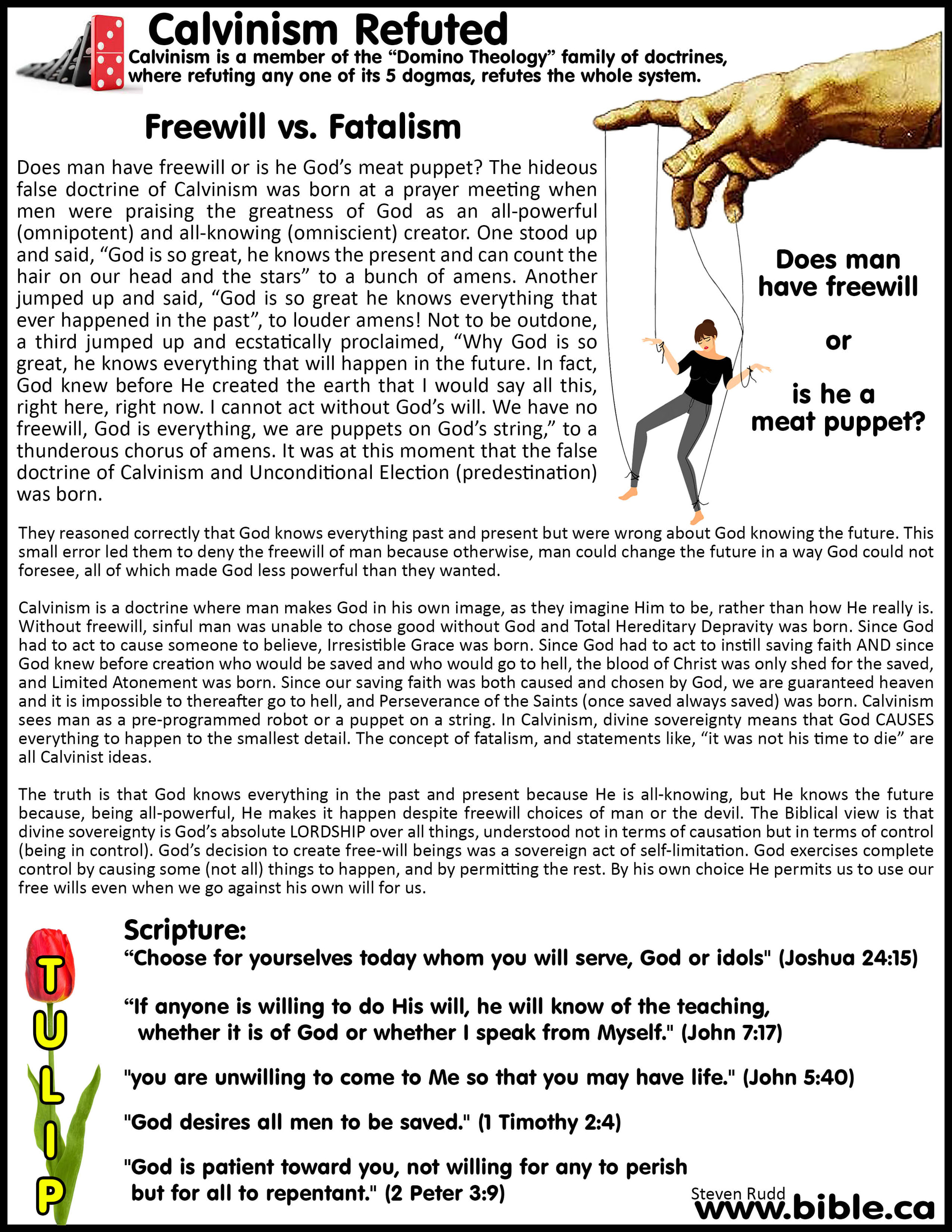
My personal reflection is that determinism lacking grace, i.e (love, joy, peace, patience, kindness, goodness, faithfulness, gentleness, and self-control) does not describe “Calvinism”, but fatalism. From the perspective of one who holds to fatalism, kindness is unnecessary, delicacy is a waste of time, and unfounded accusations are acceptable tools to press a point-of-view. The “means” to persuasion do not matter because the “outcome” is fixed. Fatalism does not describe the gentle methods of our perfect role-model, it does not describe the demeanor of a disciple of Jesus Messiah (IMHO). Still, your point is received and well taken.

KP

1 Like

My post was flagged @KPuff so here is my opinion on fatalism.

Fatalism, properly defined, is the view that outcomes occur independently of means, choices, or intentions. Its defining feature is not simply inevitability, but the irrelevance of human agency. In other words, whether one deliberates or not, the same end obtains. That is what makes it fatalistic.

Now, I agree that classical Calvinism, at least in its careful formulations, avoids that definition by affirming secondary causation. Human choices are real means within the decree, not illusions. So it is fair for Calvinists to reject the label “fatalism” in that strict sense.

However, the move that follows does not hold. Arminianism cannot be called fatalistic, because it explicitly teaches that human choices genuinely affect outcomes. In fact, it is structured to preserve precisely the opposite of fatalism, namely, that choices are contingently decisive.

The argument you’re making seems to rely on foreknowledge. If God infallibly knows the future, then the future is fixed, and if fixed, then freedom is only apparent. But at that point, the discussion has shifted. That is no longer fatalism as defined, but a philosophical question about whether foreknowledge is compatible with libertarian freedom.

Arminians address this by distinguishing certainty from necessity, and foreknowledge from causation. God’s knowing that an event will occur does not cause it, nor does it render it necessary in the sense required for fatalism. The event remains certain, but freely chosen.

So the claim that “Arminians are actually the fatalists” is not a definitional conclusion, but a debated philosophical critique. Fatalism says choices do not matter. Arminianism says they do. Those two positions are not the same.

What’s really being argued here is whether Arminian accounts of foreknowledge successfully preserve freedom, not whether they collapse into fatalism in the proper sense.

This is not addressed to you, but my critique to my “flagged” “Awaiting moderators approval” post.

I am definitely leaning more to Arminian in my theology.

J.