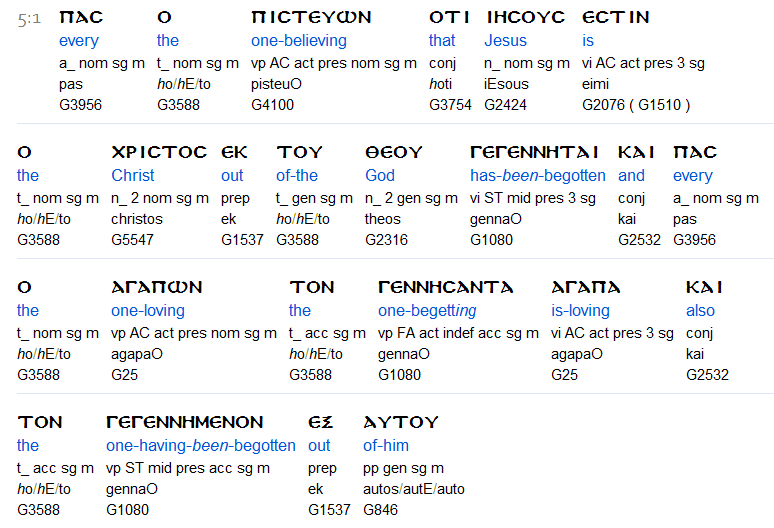
The issue is not whether Scripture commands men to believe, repent, receive Christ, or come to Him. Scripture fully affirms the universal proclamation of the Gospel and the genuine responsibility of every sinner to repent and believe. The real issue is whether fallen man, in his natural state, possesses the moral and spiritual ability to do so apart from sovereign grace. Scripture repeatedly answers that question in the negative.
Jesus Himself declares in John 6:44 (ESV), “No one can come to me unless the Father who sent me draws him.” The Greek is especially important here. Christ does not say “no one may come,” but “no one can come.” The phrase οὐδεὶς δύναται ἐλθεῖν (oudeis dynatai elthein) speaks of ability, not mere permission. Fallen man lacks the ability to come savingly to Christ unless the Father draws him. Furthermore, the verb ἑλκύσῃ (helkysē), translated “draws,” carries the sense of effectual drawing, not mere persuasion. The same term is used elsewhere for drawing a sword (John 18:10) and dragging a net full of fish (John 21:6). Christ is therefore teaching divine enablement, not autonomous free will.
Jesus reinforces this again in John 6:65 (ESV): “This is why I told you that no one can come to me unless it is granted him by the Father.” Once more, the language is one of inability and divine granting. Coming to Christ is something “granted” by the Father. That is fundamentally monergistic.
It is certainly true that “whoever believes” will be saved, but the question remains: why does one person believe while another rejects Christ? Scripture never attributes the decisive difference to man’s independent will. Instead, Acts 13:48 (ESV) states, “And as many as were appointed to eternal life believed.” The grammar is crucial. The participle τεταγμένοι (tetagmenoi), “appointed,” is in the perfect passive form, indicating those who had already been appointed by God to eternal life. The appointment precedes and explains the believing. The text does not say that those who believed were afterward appointed.
Likewise, Philippians 1:29 (ESV) teaches, “For it has been granted to you that for the sake of Christ you should not only believe in him but also suffer for his sake.” Faith itself is described as something “granted” by God. The verb ἐχαρίσθη (echaristhē) comes from χάρις (charis), grace, emphasizing that belief is graciously given rather than autonomously generated.
The synergistic analogy of “accepting an invitation” also fails to account for the biblical doctrine of spiritual death. Paul writes in Ephesians 2:1–5 (ESV), “And you were dead in the trespasses and sins… even when we were dead in our trespasses, made us alive together with Christ.” Scripture does not describe fallen sinners as merely wounded or weakened, but as spiritually dead. Dead men do not cooperate in resurrection. Notice the grammatical structure of the passage: man is passive in death, while God is the active agent who “made us alive.” The entire action originates with God.
Paul further explains the condition of fallen man in Romans 8:7–8 (ESV): “For the mind that is set on the flesh is hostile to God, for it does not submit to God’s law; indeed, it cannot.” Again, the issue is inability. The phrase οὐ δύναται (ou dynatai) means “it is not able.” Fallen humanity is not merely unwilling to submit to God; it lacks the moral capacity to do so apart from grace. Paul then adds, “Those who are in the flesh cannot please God.” Since Hebrews 11:6 teaches that faith pleases God, it follows that those in the flesh cannot produce saving faith from themselves.
Romans 9:16 (ESV) is even more decisive: “So then it depends not on human will or exertion, but on God, who has mercy.” Paul explicitly denies that salvation ultimately rests upon human willing or effort. The Greek construction is emphatic: οὐ τοῦ θέλοντος (ou tou thelontos), “not of the one willing,” nor οὐδὲ τοῦ τρέχοντος (oude tou trechontos), “of the one running,” but entirely upon God who shows mercy. This directly contradicts the synergistic idea that the decisive factor lies in man’s autonomous cooperation with grace.
John 1:12–13 likewise destroys the notion that regeneration originates in human will. After speaking of those who believe in Christ, John immediately explains that they “were born, not of blood nor of the will of the flesh nor of the will of man, but of God.” The apostle explicitly denies three possible human sources for the new birth and attributes it solely to God. The phrase ἀλλ’ ἐκ θεοῦ (all’ ek theou) — “but of God” — is profoundly monergistic.
None of this denies human responsibility. Scripture genuinely commands all people everywhere to repent and believe the Gospel. The external call goes out universally. Yet Scripture also teaches that only those whom God effectually calls will come savingly to Christ. This is why Jesus says in John 10:26 (ESV), “you do not believe because you are not among my sheep.” He does not say they are not His sheep because they failed to believe; rather, their unbelief is explained by the fact that they do not belong to Him.
Therefore, the biblical picture is not that God merely offers salvation while fallen man supplies the decisive response. Rather, God sovereignly raises spiritually dead sinners, grants repentance and faith, gives a new heart, and effectually draws His people to Christ. As Ezekiel 36:26–27 (ESV) declares, “And I will give you a new heart… And I will put my Spirit within you, and cause you to walk in my statutes.”
Shalom.
J.