Pre_maritial sex is not sin according to the bible

Your God explicitly authorized human beings to be bought as pieces of livestock and handed down to children like furniture.

Now let’s look at the verses you used to try and make this system look humane:

First, you quote Exodus 21:16 to say kidnapping a human was punishable by death. You conveniently left out the parallel law in Deuteronomy 24:7, which clarifies that this only applied if someone kidnapped ‘one of his brothers of the people of Israel.’ It was a property law to stop Israelites from stealing from each other. It did not apply to foreigners. In fact, in Numbers 31:18, Moses—acting on God’s orders—commands the Israelite army to slaughter captive women but says, ‘all the young girls who have not known a man intimately, keep alive for yourselves.’ How did those thousands of traumatized, captive young girls end up in Israelite households if not by forced kidnapping?

Second, you quote Deuteronomy 23:15-16 about not returning an escaped slave. Mainstream biblical scholarship and the text itself show this was a law regarding foreign slaves fleeing from neighboring pagan nations into Israel—it was a form of ancient political asylum to weaken enemy states. It did not mean a regular Israelite master couldn’t retrieve his own legal foreign ‘property’ within the borders of Israel.

You claim God put restrictive parameters around a broken human institution to actively mitigate its cruelty. But the truth is, the Torah actively codified, legalized, and endorsed the permanent buying and selling of foreign human beings as property based purely on their nationality. Stop dressing up chattel slavery as an ancient welfare system; the text completely refutes you.

Peter, it is incredibly telling that you told me to re-read Exodus 21:20-21, but then you only quoted verses 26-27 about a tooth. You skipped the actual text of verses 20-21 because those verses completely destroy your argument about ‘human dignity.’

Let’s read what Exodus 21:20-21 actually says: ‘If a man strikes his slave, male or female, with a rod and the slave dies under his hand, he shall be avenged. But if the slave survives a day or two, he is not to be avenged, for the slave is his money.

Read that again, Peter. If a master beats his slave so brutally that the human being takes 48 hours to die of internal bleeding, the master faces zero legal consequences. And what is God’s explicit justification for why the master isn’t punished? ‘For the slave is his money.’ The text literally reduces a dying human being to a piece of financial property. The financial loss of the asset is deemed sufficient punishment for beating a person to death. That isn’t ‘civil tutoring toward dignity’—it is the sickening legal protection of human abuse.

Second, your attempt to use Galatians 3:28 (‘neither slave nor free’) to show that the New Testament abolished this mindset is a massive theological misdirection. Galatians 3:28 is talking about equal access to spiritual salvation, not social liberation.

If the New Covenant was the ultimate ideal meant to undo this cruelty, why does the New Testament explicitly endorse the continuation of slavery?

· Ephesians 6:5: ‘Slaves, obey your earthly masters with respect and fear…’

· 1 Peter 2:18: ‘Slaves, in reverent fear of God submit yourselves to your masters, not only to those who are good and considerate, but also to those who are harsh.

Your ‘unchanging’ God went from telling masters they could beat their slaves to death as long as they survived two days (Old Testament), to telling slaves they just have to quietly endure the abuse of harsh masters in fear of God (New Testament).

You can dress this up in all the theological jargon about ‘covenants’ and ‘dispensations’ you want, Peter. But the historical and textual reality remains undefeated: the Bible, from Exodus to Peter’s own epistles, legalizes, protects, and enforces the right of one human being to own, command, and physically abuse another human being as property. The facts are right there on the page, and no amount of apologetic spin can erase them.

Peter, I appreciate the academic rigor and classical framework here. You’ve given the standard seminary defenses beautifully. But if we are looking strictly at the text and the logic without deflections, those standard answers actually cover up massive internal contradictions.

Your argument relies on forcing Koine Greek into a later systematic theological mold. The text literally reads: ὑμεῖς ἐκ τοῦ πατρὸς τοῦ διαβόλου ἐστὲ (hymeis ek tou patros tou diabolou este).

If John intended to say “your father, the devil,” standard Greek syntax would typically use loose apposition without repeating the definite article in this exact manner, or place “the devil” first. By precisely repeating the article (tou patros tou diabolou), the most natural, unforced grammatical translation is: "You are of the father of the devil.

At the end of the verse, you argue καὶ ὁ πατὴρ αὐτοῦ refers back to the neuter abstract ψεῦδος (falsehood). But αὐτοῦ is a masculine/neuter pronoun. In the immediate structural context, it sits perfectly as a reference to the liar himself—meaning "he is a liar and the father of him [the liar].

You claim this is an isolated Gnostic misreading, but native Greek-speaking Church Fathers like Origen recognized this exact grammatical tension. You are prioritizing systematic harmony over the ambiguous text John actually penned.

Your historical defense of Lex Talionis as a “legal ceiling” to curb tribal blood feuds is accurate anthropologically, but it completely undermines your theology. By framing this law as a necessary, pragmatic concession to a violent, primitive culture, you inadvertently admit that Old Testament morality is culturally relative and evolutionary, not a reflection of a timeless, perfectly holy God.

If Yahweh is an omnipotent, immutable lawgiver capable of decreeing absolute prohibitions like “Do not murder,” He did not need to codify a system of proportional physical mutilation just because humans were tribal. An absolute holy standard would forbid the vengeance entirely, not regulate it.

Your use of da’at (experiential knowledge) to argue Adam and Eve were not “morally infantile” creates an impossible logical paradox. You claim they fully understood the command to obey and the reality of consequences. But how can a being comprehend the moral weight of “disobedience is evil” if they have zero cognitive category or experience of what evil, deception, or death actually is? In the narrative, they had never witnessed a lie, never seen death, and had no framework for a malicious, deceptive entity (the serpent). If a parent tells an innocent child not to press a button because they will die, and a sophisticated adult stranger tells the child to press it, the child lacks the moral architecture to evaluate the stranger’s malice against the parent’s authority. Punishing them—and all of creation—with generational trauma for a choice made in a state of literal innocence describes a structural setup, not a fair test of free will.

Your football recording analogy is a textbook false equivalence that completely collapses under the weight of omnipotence. You didn’t design, engineer, and create the quarterback, the ball, the field, the weather, and every single atom in the stadium. An omniscient, omnipotent Creator looks out into the void before creation and sees that if He speaks “Timeline A” into existence, Jones will commit a crime. If He speaks “Timeline B” into existence, Jones will not. The moment God chooses to hit “Start” on Timeline A, He explicitly fixes Jones’s choices. If God knows with 100% certainty before the universe exists that an event will happen, it is impossible for it to happen any other way. The freedom to choose otherwise is a mathematical and logical illusion. You cannot separate God’s absolute knowledge from His absolute act of creation.

Your defense of the Cross requires God to be subject to a law higher than Himself.

You argue a human judge cannot “wink” at sin without being corrupt because he must uphold the law. But a human judge is bound by a state legislature. God is the legislature. If God is the ultimate sovereign ruler of existence, He is the author of the cosmic framework that demands blood for rectification.

If I break a window in your house, you have the emotional and sovereign right to say, “I forgive you, I will absorb the cost of the damage myself,” without demanding your child be beaten to satisfy the “Law of the Broken Window.” If flawed human beings are capable of absorbing a debt out of pure grace without demanding violent compensation, why is the Almighty Creator incapable of doing the same?

You claim God entered the script to suffer the penalty Himself. But a playwright who writes a tragedy, steps onto the stage, gets shot in Act 3, and then resurrects back into the real world in Act 4 hasn’t actually altered the fact that he deliberately authored a script full of real, uncompensated suffering for the characters who don’t get to leave the stage. The Cross doesn’t solve the problem of the script; it just highlights the horrific nature of the theater God built.

You accuse me of arguing from silence, but your entire counter-argument relies on a textbook linguistic error known as the Root Fallacy—the false assumption that the etymology of a word dictates its exact meaning in every historical context. Pulling modern dictionary definitions that lump hundreds of years of evolving Greek into one box doesn’t change 1st-century historical reality.

The English word “tragedy” comes from the Greek tragōidia, which literally means “goat song.” If a modern event is a tragedy, we don’t look for singing goats. Similarly, while the historical root of porneia stems from commercial prostitution (selling sex), you cannot arbitrarily expand it to mean "any consensual sex outside of a legal marriage certificate.

By quoting modern lexical summaries, you are conflating etymology with 1st-century usage. In the Greco-Roman world, porneia explicitly referred to commercial sex (prostitution), temple cult sex, or severe violations of property rights (adultery and incest). It did not encompass a loving, exclusive, consensual relationship between two free, unmarried adults.

You copy-paste Strong’s Concordance and translations like the NASB as if modern English translations settle ancient cultural definitions. Lexicons list every possible meaning a word accumulated over centuries across classical, Hellenistic, and Koine Greek. They are not theological decrees.

In the ancient Near Eastern and Greco-Roman world, sex between a free, single adult male and a concubine, a slave, or a courtesan (hetaira) was legally and socially normal. It was never classified under a moral or legal umbrella equivalent to modern concepts of "sinful premarital sex.

You tell me not to argue from silence, but the silence of the biblical text on this specific issue is catastrophic for your position. The New Testament writers explicitly and granularly list specific sins—greed, gossip, drunkenness, theft, and extortion. If consensual, loving sex between two single adults was a damnation-worthy offense, the text would simply state: “If two single people sleep together, it is a sin.” It never does. You must read your modern, post-Puritan definitions back into the text to find it there.

You quote 1 Corinthians 6:13 and 6:18 to demand that single people “flee,” but you completely omit the actual, explicit context Paul is addressing.

Paul is not writing a letter to a modern, committed, unmarried couple. He is addressing Corinthian Christian men who were literally visiting pagan temples and brothels to purchase commercial sex from prostitutes (porneia). That is why the word porneia is used—because it literally meant prostitution in that context.

To take a specific 1st-century warning against buying local temple prostitutes and weaponize it against a modern, consensual, exclusive, and loving relationship between two single adults is a massive distortion of the author’s intent.

The Bible condemns exploitation, prostitution, violation of marriage vows (adultery), and sexual violence. It remains entirely silent on consensual sex between single adults because the modern legalistic framework of “premarital sin” you are defending simply did not exist in the ancient mind.

Your sources, please, @anon21586045. You’re a prolific writer, so I’d be interested in seeing where you’re getting your information.

Point me to the sources you’re relying on, and I’ll be happy to engage with them.

J.

Johan, my primary sources are the ancient scriptural texts themselves—including textual variants dating as far back as the Dead Sea Scrolls—rather than modern denominational traditions. My arguments are built on objective historical data, text-critical logic, and the research of independent scholars. I approach all theological frameworks, whether Protestant or otherwise, with healthy skepticism. I don’t adopt a definition simply because it’s traditional or emotionally comfortable; I follow where the primary historical and linguistic evidence actually leads. Same places anyone on this website use as sources.

Give me the links to your sources, @anon21586045. Everything we say should ultimately be tested against Scripture.

If you’re unwilling to disclose the primary sources behind your conclusions, then all of your prolific writing here amounts to little more than hot air.

J.

Your argument is interesting, but it rests on several assertions that need to be demonstrated rather than merely stated.

First, Leviticus 18 is not presented as an exhaustive catalogue of every sexual sin. That is an assumption. The New Testament grounds sexual ethics not merely in Leviticus, but in God’s creational design in Genesis 2:24 (cf. Matthew 19:4–6; 1 Corinthians 6:16–20; Ephesians 5:31).

Second, your treatment of πορνεία (porneia) is lexically indefensible. You assert that it referred only to prostitution, incest, or pagan temple rituals. Can you provide your primary lexical sources? BDAG, Louw-Nida, Thayer, LSJ, and TDNT all recognize that πορνεία has a much broader semantic range, referring generally to unlawful sexual intercourse or sexual immorality. The burden of proof is on you to demonstrate why virtually every major Greek lexicon is mistaken.

Third, Genesis 24:67 does not teach that sexual intercourse creates marriage. The text says Isaac took Rebekah, and she became his wife. It is describing an event, not defining a universal mechanism for marriage. Likewise, 1 Corinthians 6:16 does not say that every sexual union constitutes a marriage. Paul’s very point is the opposite: a believer can become “one flesh” with a prostitute, yet no one would argue Paul is teaching that visiting a prostitute creates a biblical marriage. Paul cites Genesis 2:24 to warn against sexual immorality, not to redefine marriage.

Finally, your conclusion depends on an argument from silence: “Leviticus doesn’t explicitly prohibit X; therefore God permits X.” Scripture simply doesn’t reason that way. Jesus and the apostles repeatedly appeal to the whole counsel of God, not merely to what one chapter does or does not list.

So before we overturn two thousand years of Jewish and Christian interpretation, could you provide the primary lexical, historical, and exegetical sources supporting your conclusions? Assertions are not arguments.

Not the first time I’m asking… @anon21586045.

J.

You want sources and a rigorous defense? Let’s address your points directly using the exact lexicons and texts you just named. You accuse me of making assertions, but you are relying on a theological assumption of what “unlawful” meant in the ancient world.

I completely agree with those lexicons. Porneia absolutely means “unlawful sex.” But you are committing a massive logical leap by assuming that 1st-century people shared your modern, post-Puritan definition of what made sex “unlawful.” Open BDAG to πορνεία. The primary definition given is “unlawful sexual intercourse,” but look at how it specifies the legal context: it anchors it entirely in prostitution, adultery, and incest.

Lets look at the LSJ:The authoritative lexicon for classical and Hellenistic Greek explicitly traces the root of porneia to pernēmi (“to sell”). In everyday Greek, porne is a prostitute, porneion is a brothel.

If porneia means “unlawful sex,” which law makes consensual sex between two unmarried, unbetrothed, free adults unlawful? It is not a violation of Roman law. It is not a violation of Greek law. And as we will see, it is not a violation of the Torah. You are using the word “immorality” as a catch-all, but ancient laws required a specific legal infraction (property violation, prostitution, or incest) for sex to be deemed porneia

You argue that New Testament sexual ethics are grounded in the “one flesh” creational design of Genesis 2:24, claiming this restricts sex strictly to marriage.

If Genesis 2:24 established an absolute, exclusive creational mandate that restricted all legitimate sex to a monogamous marriage certificate, then Abraham, Jacob, David, and Solomon were serial, unrepentant sinners.

God explicitly blessed Abraham’s lineage through Hagar. God explicitly gave David multiple wives and concubines (2 Samuel 12:8). If sex outside of a standard monogamous marriage structure was a violation of “creational design,” God would have condemned these patriarchs for porneia. They were never condemned because ancient biblical law defined legitimate sexual unions by paternity and property rights, not modern legalistic concepts of premarital abstinence.

You claim Paul quotes Genesis 2:24 in 1 Corinthians 6:16 to show that a sexual union with a prostitute doesn’t create a marriage, but rather warns against immorality. Read Paul’s logic carefully. Paul asks: Do you not know that he who unites himself with a prostitute is one with her in body? For it is said, 'The two will become one flesh. Paul is literally stating that physical intercourse is the mechanism that activates the “one flesh” reality of Genesis 2:24. The sin Paul is fighting in Corinth isn’t “premarital sex between a loving couple”; it is the spiritual contamination of taking a body that belongs to Christ and physically bonding it to a commercial prostitute (porne). Paul’s argument works because the physical act itself creates the ultimate cosmic bond, completely independent of a wedding ceremony.

You claim I am arguing from silence because Leviticus 18 is not an exhaustive catalog. Leviticus 18 and 20 are the absolute foundation of holiness and sexual purity codes for the nation of Israel. God is laying down the law for a new nation, explicitly detailing boundary lines: do not uncover the nakedness of your mother, sister, aunt, neighbor’s wife, a menstruating woman, or an animal. It is incredibly granular. If consensual sex between two free, single, unmarried adults was a capital offense or a defiling sin that would vomit them out of the land, it would not be omitted. God didn’t “forget” to list it. It is omitted because in the ancient Near East, an unmarried, unbetrothed woman was under the authority of her father; if a man slept with her, it was a property and financial matter solved by a bride-price or marriage (Exodus 22:16), not a moral crime of defilement or a sin against Yahweh.

Before you accuse me of overturning 2,000 years of tradition, you need to realize that you are viewing 1st-century texts through a modern lens. The primary lexical evidence defines porneia as unlawful sex—and the ancient historical record shows that consensual sex between free, single adults was never legally or scripturally “unlawful.” The burden of proof is on you to find a single biblical text that explicitly states otherwise.

No links, no sources…but you are @anon21586045, apt.

J.

Johann are you going to present any answers to my points or deflect with the same loop of requirements of sources?

The “hot air” here isn’t coming from my arguments; it’s coming from your empty deflections. Come back when you’re ready to actually open a book and debate the data.

@TheGuy

How is it possible that, in such a short space of time, you’ve produced reams of posts in rapid succession, challenging Peter, Bruce, and now me?

Yet throughout all of them, you’ve provided no links, no reference points, and no primary sources to substantiate your claims. Coupled with what appears to be a strong aversion to historic Christianity, that naturally raises questions about where your information is coming from?

What “book” do you want us to open to debate the data?

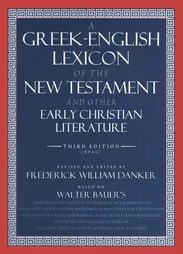
BDAG Lexicon Overview
Described as an “invaluable reference work” (Classical Philology) and “a tool indispensable for the study of early Christian literature” (Religious Studies Review) in its previous edition, this new updated American edition of Walter Bauer’s Wörterbuch zu den Schriften des Neuen Testaments builds on its predecessor’s staggering deposit of extraordinary erudition relating to Greek literature from all periods. Including entries for many more words, the new edition also lists more than 25,000 additional references to classical, intertestamental, early Christian, and modern literature.

A Comprehensive New Testament Lexicon
Perhaps the single most important lexical innovation of Danker’s edition is its inclusion of extended definitions for Greek terms. For instance, a key meaning of episkopos was defined in the second American edition as overseer; Danker defines it as “one who has the responsibility of safeguarding or seeing to it that something is done in the correct way, guardian.” Such extended definitions give a fuller sense of the word in question, which will help avoid both anachronisms and confusion among users of the lexicon who may not be native speakers of English.

Use Your Lexicon Online
Thanks to Frederick W. Danker’s broad knowledge of Greco–Roman literature, as well as papyri and epigraphs, the new BDAG lexicon provides a more panoramic view of the world of Jesus and the New Testament. It incorporates new research, new information, and analyses while rendering translations into contemporary English. What is more, the Logos Bible Software version of this resource offers unprecedented search capabilities customized to this reference work. Can you continue doing Biblical study without the BDAG lexicon online?


Much better than your Gish gallop approach.

J.

.

Okay Johann, so now you have sources. Debate with me and stop deflecting because you can’t debate my points. Use the books you got from the internet and amuse me please because you are boring me now.

What is there TO “debate?” You reject the Scriptures and the crucifixion and resurrection of Yeshua Messiah and His Atonement?

J.

Thank you for making it clear to everyone reading this thread exactly when and where your arguments ran out of gas. If you ever want to actually debate the historical data instead of deflecting, I’ll be right here. If you can provide no meaningful point feel free to leave the debate and topic.

Let’s continue to look directly at the text, the grammar, and the historical data. Your argument relies on an evolutionary model of Israelite religion that forces a modern polytheistic template onto the Hebrew text while ignoring the internal grammar, literary structure, and historical context of Deuteronomy itself.

Here is why the “Yahweh is a subordinate son of El/Elyon” theory fails under scrutiny:

You argue that because Elyon divides the nations in Deuteronomy 32:8 and Yahweh receives Israel in verse 9, they must be two different deities. This ignores the standard poetic feature of synonymous parallelism common in Hebrew literature, where the same entity is referred to by different titles in consecutive lines. More importantly, it completely rips verses 8–9 out of the literary context of Deuteronomy. Just a few verses earlier in the exact same song, the author asks:

“Is this the way you repay Yahweh, you foolish and unwise people? Is he not your Father, your Creator, who made you and formed you?” Deuteronomy 32:6.

The text explicitly identifies Yahweh as the Creator (qanah) and Father. Furthermore, Deuteronomy 4:39 states unequivocally:

“Acknowledge and take to heart this day that Yahweh is God (ha-Elohim) in heaven above and on the earth below. There is no other.”

To claim the author of Deuteronomy believed Yahweh was merely a subordinate, regional tribal god who inherited Israel from a superior deity completely contradicts the foundational thesis of the entire book. Yahweh and Elyon are titles for the same Supreme Being; as Sovereign of the universe, He assigned the nations to the care of His heavenly court (the bney Elohim), but chose Israel as His direct, personal inheritance.

You claim that Mesha’s human sacrifice invoked the actual power of Chemosh to defeat Yahweh’s armies. This is a severe misreading of the phrase “great wrath (qesep gadol) came upon Israel” in 2 Kings 3:27.

In the Old Testament, qesep (wrath) almost exclusively refers to divine displeasure from Yahweh, often brought about when Israel enters into situations involving pagan abominations or ritual pollution. The text does not say “Chemosh’s wrath came upon Israel.”

When the King of Moab sacrificed his son on the wall, the Israelite coalition, terrified of the profound spiritual defilement and the psychological horror of the act, realized they had pushed the campaign into a dark, cursed territory. The “wrath” was the divine consequence of the horrific situation, causing Israel to break off the siege and return home. If the author of Kings believed Chemosh was genuinely more powerful than Yahweh, it would break the entire theological framework of the Deuteronomistic History, which consistently portrays foreign idols as utterly powerless vanities (e.g., Elijah on Mount Carmel).

Your historical argument rests on the idea that because Yahweh has origins associated with the southern desert (Teman/Paran) and El with the north, they must be two different gods that merged.

This conflates geography with identity. In the Ancient Near East, it was incredibly common for a singular deity to be worshipped with different regional epithets or associated with different sacred landscapes. For example, Baal was known as Baal-Zephon (Baal of the North) and Baal-Hermon, yet he was still understood to be the same individual deity.

When Yahweh reveals Himself in the scriptures, He frequently claims the titles of El (like El Shaddai or El Elyon) to show that the generic titles for the “High God” or “Creator” belong properly to Him alone. This isn’t random syncretism; it is a deliberate, polemical claim of absolute exclusivity.

You claim Psalm 82 backfires on me, but it actually proves the exact point of the Divine Council framework. The psalm begins with God (Elohim) judging in the midst of the gods (elohim). If this were a static polytheistic pantheon where all these gods are independent peers, verse 6–7 makes no sense:

“I said, ‘You are gods; you are all sons of the Most High.’ But you will die like mere mortals; you will fall like every other ruler.”

Yahweh strips these lesser spiritual beings of their authority because of their corruption. The psalm ends with: “Rise up, O God, judge the earth, for all the nations are your inheritance.” This is the exact resolution to Deuteronomy 32. The lesser spiritual beings failed to govern the nations justly, so Yahweh strips them of their power and reclaims absolute, direct rule over all the nations Himself.
Peter

I understand that you think you are clever. Nonetheless, you are wrong. You’ve laid out your objections clearly; let’s address each one with the same precision.

You claim that because native Greek speakers like Origen recognized the ambiguity of ὑμεῖς ἐκ τοῦ πατρὸς τοῦ διαβόλου ἐστὲ, the translation “father of the devil” is the most natural. But you are stopping halfway through church history. While Origen noted the Heracleon/Gnostic reading, he and the vast majority of native-Greek-speaking Fathers (including Chrysostom and Cyril of Alexandria) explicitly rejected it because it violates the broader grammar of the sentence.

Let’s look at the pronoun αὐτοῦ at the end of the verse: καὶ ὁ πατὴρ αὐτοῦ (‘and the father of it/him’). If Jesus meant “the father of the devil,” the word ψεῦδος (lie) becomes completely orphaned in the sentence structure. Furthermore, in Koine Greek, when a writer wants to emphasize an attributive relationship, “your father, the devil,” repeating the article with a proper noun or title is a standard, emphatic way to clarify identity (the father, the specific one who is the devil).

The fatal blow to your translation, however, is the very next verse. In John 8:45, Jesus says: “Because I tell the truth, you do not believe me.” The entire contrast is about Truth vs. Falsehood. It is a logical and literary absurdity to claim John sneaked a multi-tiered Gnostic deity into verse 44, only to immediately return to a standard moral critique of lying in verse 45.

You argue that by calling Lex Talionis a pragmatic concession, I am admitting God’s morality is culturally relative. This is a false dilemma. It confuses God’s timeless nature with progressive revelation. God did not codify proportional physical mutilation because His character changed; He met a primitive culture where they were to lead them out of. Jesus explicitly explains this pedagogical method in Matthew 19 when asked about divorce laws: “Moses permitted you to divorce your wives because your hearts were hard. But it was not this way from the beginning.”

A perfectly holy God doesn’t expect a toddler to understand advanced calculus. He introduces a rule that stops the immediate chaos (limiting blood feuds) while pointing toward the ultimate ideal (the Sermon on the Mount: “turn the other cheek”. Lex Talionis wasn’t the final destination of divine morality; it was the guardrail that kept humanity on the road until the final destination arrived.

Your child-and-the-button analogy misses the entire point of the Genesis narrative. You ask how they could comprehend “disobedience is evil” if they had no experience of evil. They didn’t need an experience of evil to understand a boundary. They knew what “Good” was because they were in a direct, intimate relationship with the source of Good. The command wasn’t a complex ethical riddle. It was a simple question of trust: Do you trust the Creator who gave you life, or do you trust the creature who suggests the Creator is holding out on you?

The tragedy of the Fall isn’t that they failed a moral test they weren’t smart enough to pass. The tragedy is that they traded relational trust for autonomous definition. They didn’t just press a button; they chose to decide for themselves what the buttons meant, rejecting God as the ultimate standard of reality.

Your critique of the football analogy is where your logic hits a serious snag. You claim that because God selects “Timeline A” out of all possible timelines, He fixes the choices, making free will an illusion. This assumes God is bound by linear time, that He looks “forward,” makes a choice, and locks it in. But God is transcendent; He is entirely outside of time. To God, all moments of time are a simultaneous “Now.”

God’s act of creation doesn’t force Jones to make a choice. Rather, God’s sovereign decree creates the reality in which Jones’s free choice can genuinely exist. God doesn’t look at Timeline A and say, I will force Jones to do this. He looks at reality and sees Jones freely choosing, and He sustains that reality. The certainty of an event does not equal its necessity. If I know with 100% certainty that you are reading this sentence right now, my knowledge isn’t forcing your eyes to move. You are doing it freely; my knowledge is simply accurate.

Finally, your broken window analogy completely collapses under the weight of cosmic justice. If I break your window, you can forgive me because the window is external to both of us. You absorb the financial cost.

But God is not a third-party bystander who merely owns the universe. He is the moral fabric of reality. Goodness, justice, and truth are not rules written by a state legislature that God has to follow; they are reflections of His very character.

If God simply “winks” at evil and says “no big deal,” He isn’t being gracious. He is denying His own nature. He would be declaring that evil doesn’t matter. The “Law of the Broken Window” isn’t an arbitrary rule God invented; it is the logical reality that sin causes a fracture in existence that must be mended.

Your playwright analogy breaks down because on the Cross, the playwright didn’t just put on a costume, get shot, and wave goodbye. He took the actual, ontological weight of human suffering, death, and separation from God into Himself. He didn’t just change the script; He paid for the theater’s debt out of His own pocket. The Cross is the only place in human thought where God remains completely just, refusing to pretend evil isn’t evil, while remaining completely loving, absorbing the total horror of that evil Himself.
Peter

Peter, I appreciate the prompt response, but your systematic defenses crumble under their own internal contradictions. Let’s address your counter-arguments with the precision they demand.

You claim that my reading of John 8:44 leaves the word ψεῦδος (lie) “orphaned,” but your own syntax fails under scrutiny. In the Greek text, ψεῦδος is a neuter noun. The pronoun that follows it is αὐτοῦ (which can be masculine or neuter). If αὐτοῦ is neuter and refers back to ψεῦδος, the text flows seamlessly: “for he is a liar and the father of it [the lie].”

However, if you force αὐτοῦ to be masculine to refer back to the devil, you create a bizarre syntax where the devil is the father of… the liar?

Furthermore, you are reading church history backward. John wasn’t reacting to 4th-century Nicene orthodoxy; 2nd-century Gnostics like Heracleon used this text precisely because “the father of the devil” is the most direct, unforced literal translation of τοῦ πατρὸς τοῦ διαβόλου. By separating them into two distinct article-noun pairs linked by a genitive, you are forcing John to write like Athanasius rather than letting him speak for himself.

Your use of divine accommodation to explain away Lex Talionis completely surrenders God’s omnipotence and creates a striking double standard. You claim God was a patient teacher who couldn’t give advanced moral laws to a primitive culture.

Yet, according to the text, this same Yahweh had no problem commanding these exact same “toddlers” to execute people for picking up sticks on the Sabbath (Numbers 15) or establishing hyper-complex, exhausting tabernacle rituals.

If Yahweh possessed the moral authority and communicative clarity to codify capital punishment for minor ritual infractions, He certainly had the capacity to command, “Do not gouge out eyes in vengeance.” You are trapped in a contradiction: you claim God was strong enough to codify brutal violence to protect His rituals, but too weak to codify absolute forgiveness until Jesus showed up.

You pivot the Eden narrative from moral knowledge to “relational trust,” arguing that Adam and Eve didn’t need to understand evil—they just needed to trust God. But your defense completely ignores the mechanics of trust. Trust can only be tested fairly if the entity being tested understands the concept of betrayal.

If Adam and Eve had zero cognitive category for deception, malice, or death, then a lie and a truth sounded exactly the same to them. They were cognitively colorblind.

If a parent tells a sheltered child “do not press this button,” and a charismatic stranger says “it’s fine, your parent is lying,” the child lacks the moral architecture to realize that lying is even a possibility. Punishing that child—and their entire lineage—with physical death and eternal damnation because they couldn’t detect a cosmic deception they had never encountered isn’t a fair test of trust; it’s a structural ambush.

Fleeing to classical timelessness (the “Eternal Present”) is a philosophical sleight of hand. Even if God sits outside of time seeing everything as a simultaneous “Now,” the core issue isn’t the chronological order of events; it’s the exhaustiveness of His creative decree.

Before God spoke the universe into existence, the concept of “Timeline A” (where Jones commits a crime) and “Timeline B” (where Jones does not) both existed in His mind. God—and God alone—chose to actualize the specific universe where Jones commits the crime.

Jones cannot choose otherwise, because to do so would mean a mortal human could overwrite God’s eternal, unchangeable vision of reality. If the certainty of the event is 100% locked in from the perspective of the “Eternal Now,” Jones’s freedom is a mathematical fiction. You cannot separate God’s absolute knowledge from His absolute, deliberate act of creation.

Finally, you argue that God cannot “wink” at sin because justice is a reflection of His very nature. But you are still separating God from His own framework. If God is the ultimate reality, who authored the cosmic framework dictating that the only currency capable of mending a moral fracture is the violent shedding of blood? God did. You have invented a cosmic system where the Almighty is trapped by His own violent ledger.

Your defense of the playwright analogy completely ignores the plight of the creations left behind. It does not matter if the playwright steps onto the stage and suffers in Act 3. The playwright still resurrects and goes home to the real world in Act 4. Meanwhile, the tragic characters he deliberately wrote into his script are left on stage to burn forever.

The Cross doesn’t solve the problem of a broken reality; it simply highlights the horrific nature of the theater God chose to build. You have portrayed a God who can compromise His “unchanging nature” to accommodate primitive tribal violence, but refuses to compromise it to offer unconditional, bloodless grace.

You’ve laid out the standard, conservative theological defense well, but it rests entirely on harmonizing text that is fundamentally at war with itself. By treating 1st-millennium BCE West Semitic literature as a uniform document, you are reading modern systematic assumptions back into an ancient, evolving text. Let’s look at the actual evidence.

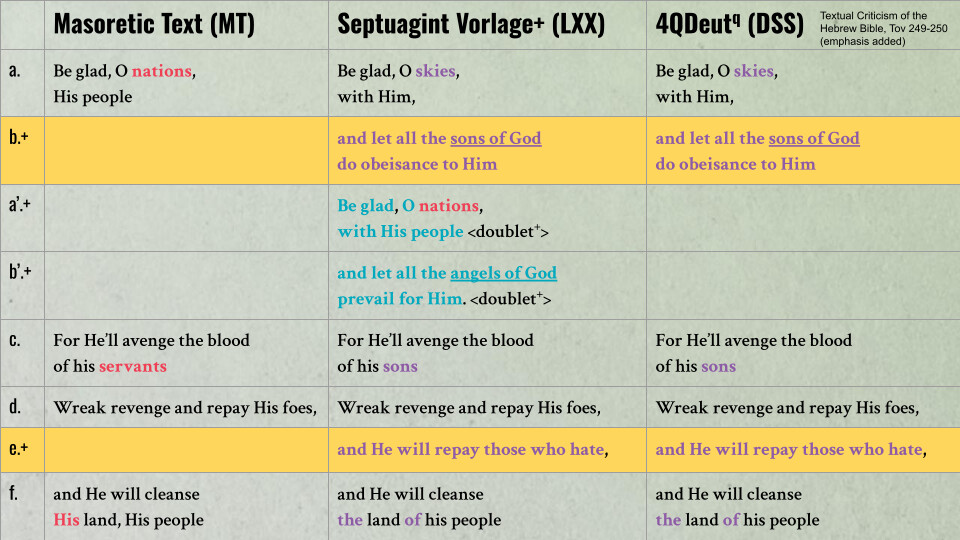
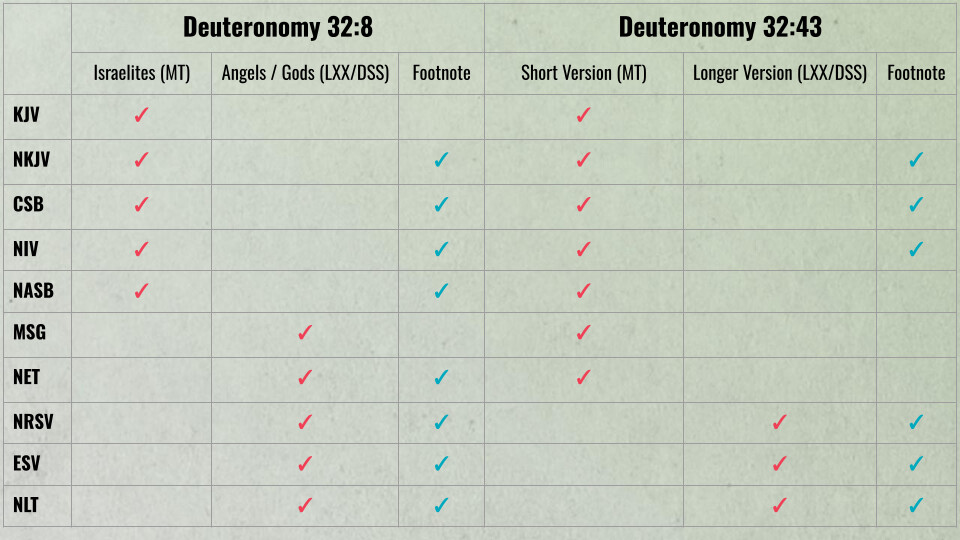
Your appeal to “synonymous parallelism” completely fails here because you are relying on the corrupted Masoretic Text (MT). Scribes altered the phrase “according to the number of the sons of God” (bney Elohim) to “the sons of Israel” (bney Yisrael) precisely because the original polytheistic framework embarrassed them.

The Dead Sea Scrolls (4QDeut^q) and the Septuagint (LXX) preserve the older reading.

This is not “synonymous parallelism.” Elyon acts as the distributor of property, and Yahweh is one of the inheritors. This mirrors the older Canaanite pantheon found at Ugarit, where the high god El and his consort Asherah have 70 divine sons who each rule a nation.

You mention Deuteronomy 32:6 and 4:39 to prove the book is monotheistic. What you are actually witnessing is textual stratification. The older, poetic backbone of Deuteronomy 32 preserves an archaic era where Yahweh was a second-tier son of El. The surrounding prose frames (like chapter 4) represent the later, 7th-century Deuteronomistic redaction that elevated Yahweh to the top spot and merged Him with El. You cannot use the late layers of editorial polish to erase the ancient bones of the text.

Your defense of the qesep gadol (great wrath) in 2 Kings 3:27 is an exceptional piece of theological damage control, but it utterly destroys biblical inerrancy. Let’s trace the narrative logic:

1.In verses 18–19, Yahweh’s prophet Elisha explicitly prophesies: “He will deliver Moab into your hands. You shall conquer every fortified city…”

2.The battle goes exactly as planned until King Mesha offers his firstborn son as a burnt offering to his god, Chemosh, on the city wall.

3.Immediately after this human sacrifice, qesep gadol falls upon Israel, and they are forced to completely retreat, leaving Moab unconquered.

If this “wrath” came from Yahweh because He was disgusted by Israel being near a pagan abomination, then Yahweh’s own prophecy flatly failed. Yahweh promised total victory, but a human sacrifice to a rival god completely halted His armies.

Furthermore, the Mesha Stele (the Moabite monument recording this exact same war from the enemy’s perspective) explicitly states that the Moabite god Chemosh was angry with his land, but saved them through this crisis. The author of Kings is begrudgingly recording a historical reality: in the minds of the ancient combatants, Mesha’s sacrifice successfully invoked the territorial power of Chemosh to drive Yahweh’s coalition out.

You argue that Baal-Zephon is just a regional title for Baal, so Yahweh being associated with the southern desert (Teman/Paran) doesn’t mean He was a separate deity from the northern El.

This is a false equivalence. Baal-Zephon means “Baal of the North Mountain”—it’s a geographical moniker for the same storm god. However, Yahweh and El possess entirely different mythological profiles in early Northwest Semitic records. El is an old, sedentary, patriarchal creator god living at the source of the rivers. Yahweh enters history as a fiery, nomadic, desert storm/war warrior deity from the Midianite/Edomite south.

They didn’t start as the same god with different nicknames; they were distinct deities from different regions with separate cultic profiles. The biblical text itself preserves the memory of this merger in Exodus 6:3: “I appeared to Abraham, Isaac, and Jacob as El Shaddai, but by my name Yahweh I did not make myself known to them.” That is a literal text documenting a theological synthesis.

You claim Psalm 82 resolves Deuteronomy 32 by showing Yahweh stripping lesser spiritual beings of their authority. But look at the text you quoted: “I said, ‘You are gods… But you will die like mere mortals.’”

If these were just human judges (a common apologetic escape hatch), telling them they will “die like mortals” is a pointless truism. This is a courtroom drama where Elohim stands up in the council of El (b’adat-El) and sentences the other national deities to death because they failed to rule their respective nations justly.

The psalm concludes: “Rise up, O God, judge the earth, for all the nations are your inheritance.”

This is the exact moment the cosmic paradigm shifts from henotheism (worshipping one god while acknowledging others) to strict monotheism. Yahweh executes the other sons of El and reclaims the nations He was originally forced to share. Psalm 82 doesn’t defend your timeless, unchanging systematic theology; it is a historical artifact capturing the exact moment Israelite religion evolved by killing off the rest of the pantheon.

I’m beginning to notice a pattern in your reasoning. Am I correct in understanding that you’re appealing to the LXX as a textual variant over against the Masoretic Text?

For example, consider 2 Kings 3:27:

LXX:

“And he took his firstborn son who was to reign after him and offered him as a whole burnt offering upon the wall. And there came great repentance in Israel…”

Masoretic Text:

“Then he took his oldest son who was to reign in his place and offered him as a burnt offering on the wall. And there came great wrath against Israel. And they withdrew from him and returned to their own land.”

2 Kings 7 from Scroll 6Q4 Kings

8 When these lepers came to the outermost part of the camp, they went into one tent, and ate and drink, and carried away silver, gold, and clothing, and went and hid it. Then they came back, and entered into another tent, and carried things from there also, and went and hid them. 9 Then they said to one another, “We aren’t doing right. Today is a day of good news, and we keep silent. If we wait until the morning light, punishment will overtake us. Now therefore come, let’s go and tell the king’s household.”

10 So they came and called to the city gatekeepers; and they told them, “We came to the camp of the Syrians, and, behold, there was no man there, not even a man’s voice, but the horses tied, and the donkeys tied, and the tents as they were.”

[..]

20 It happened like that to him; for the people trampled over him in the gate, and he died, according to the word of the man of God[1].

[1] Only the last letter of the word “God” is in the scroll. The supplied wording is present in some Vulgate manuscripts.

These are significantly different readings. Which edition or recension of the LXX are you using as your primary source, and on what basis do you prefer its reading over the Masoretic Text in cases like this?

I ask because…

The Dead Sea Scrolls preserve only fragmentary portions of Kings, and this verse is not among the surviving text. Therefore, the DSS cannot be appealed to in order to adjudicate between the Masoretic Text (MT) and the Septuagint (LXX) at this point.

So the textual evidence looks like this:

Masoretic Text (MT): “There came great wrath/indignation (קֶצֶף, qeṣep) against Israel.”
Septuagint (LXX): “There came great repentance/remorse (μετάμελος / μετάμελος μεγάλη) in Israel.”
Dead Sea Scrolls: .

This means the LXX’s reading of “repentance” cannot be corroborated by the DSS.

In fact, the Hebrew noun קֶצֶף (qeṣep) overwhelmingly means wrath, anger, indignation, usually divine wrath, though sometimes human anger depending on the context. The LXX translators appear to have interpreted the effect of the event (“the Israelites felt remorse”) rather than translating the Hebrew word literally. Many scholars regard this as an interpretive translation rather than evidence of a different Hebrew Vorlage.

So if someone argues that the LXX should automatically be preferred over the MT here, my response is straightforward:

“What manuscript evidence supports the LXX’s reading? The Dead Sea Scrolls cannot, because they do not preserve this verse. Without Hebrew manuscript support, the LXX’s ‘repentance’ appears to be an interpretive rendering rather than proof of an alternative Hebrew text.”


Correct?

J.

How did the Dead Sea Scrolls do this with that passage, which is not polytheistic in the Hebrew? Exactly what change did they make? I prefer to discuss specifics instead of generalities.

How do you know it was intentional?

I believe, based on several reasons, that God inspired the prophets and apostles to write using their own abilities, styles, and writing to convey to God’s people his truths and history.

2Pe 1:19 And we have the prophetic word more fully confirmed, to which you will do well to pay attention as to a lamp shining in a dark place, until the day dawns and the morning star rises in your hearts,
2Pe 1:20 knowing this first of all, that no prophecy of Scripture comes from someone’s own interpretation.
2Pe 1:21 For no prophecy was ever produced by the will of man, but men spoke from God as they were carried along by the Holy Spirit.