Was Jesus Vegan? Will We Be Vegan in Heaven?

Was Jesus Vegan? Will We Be Vegan in Heaven?

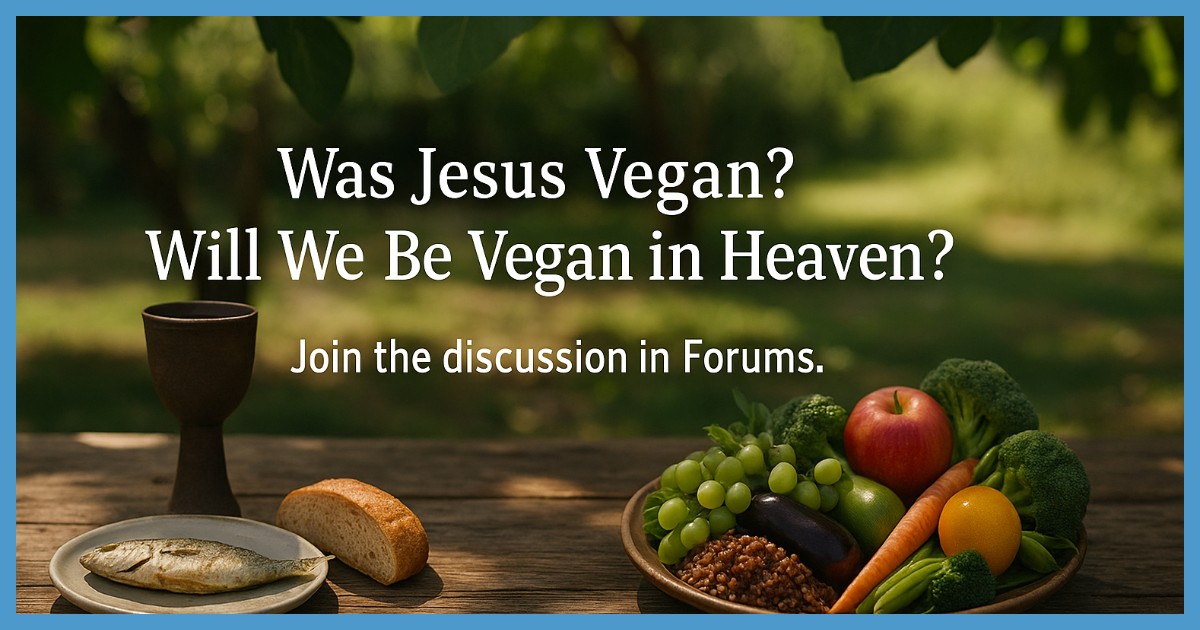
If there’s no more death in heaven, does that mean we’ll all be vegans—and what do we make of Jesus eating fish and lamb on earth?
#JesusAndFood #VeganInHeaven #BiblicalDiet #christianforums #crosswalkforums #forums #crosswalk #faithcommunity #faithforums

While the Bible does record instances of Jesus eating animal products, I’ve seen people still claiming that he was vegan or vegetarian. The Bible seems pretty clear about him eating fish and lamb and other animal products, but this does make me wonder: If there is no more death in heaven, will we all be vegans there? Curious to hear your thoughts!

This article was also helpful:

It doesn’t matter, DaughterOfEve24, because we’ll do whatever God gives us the ability to do, which may not be ever eating at all. Of course, our souls won’t eat after we die when they go to heaven, but on the new earth when heaven comes down to meet it, Jesus talks about a banquet. However, just as when he says that he is the bread of life, he may be saying that he is the source of all that we need to live eternally.

Good points! There definitely is a lot of food and eating-related imagery in the Bible. It reminds me that God values our whole person: mind, soul, AND body.

True, @DaughterOfEve24, according to Paul, our resurrection bodies will be these same bodies that will be restored, protected, and full of God’s glory and Spirit:

Php 3:20 But our citizenship is in heaven, and from it we await a Savior, the Lord Jesus Christ,
Php 3:21 who will transform our lowly body to be like his glorious body, by the power that enables him even to subject all things to himself.

1Co 15:35 But someone will ask, “How are the dead raised? With what kind of body do they come?”
1Co 15:36 You foolish person! What you sow does not come to life unless it dies.
1Co 15:37 And what you sow is not the body that is to be, but a bare kernel, perhaps of wheat or of some other grain.
1Co 15:38 But God gives it a body as he has chosen, and to each kind of seed its own body.
1Co 15:39 For not all flesh is the same, but there is one kind for humans, another for animals, another for birds, and another for fish.
1Co 15:40 There are heavenly bodies and earthly bodies, but the glory of the heavenly is of one kind, and the glory of the earthly is of another.
1Co 15:41 There is one glory of the sun, and another glory of the moon, and another glory of the stars; for star differs from star in glory.
1Co 15:42 So is it with the resurrection of the dead. What is sown is perishable; what is raised is imperishable.
1Co 15:43 It is sown in dishonor; it is raised in glory. It is sown in weakness; it is raised in power.
1Co 15:44 It is sown a natural body; it is raised a spiritual body. If there is a natural body, there is also a spiritual body.

1 Like

Jesus could not have practiced the law perfectly and be a Vegan. Even John ate wild locust.

1 Like

That assumes that God cannot make meat out of nothingness, that He (or we) will have to kill to make meat.
I find that limit on Our Father to be insulting.

Actually, what @DaughterofEve24 asked is a profound question that touches on the heart of Christian anthropology and eschatology.

Consider the sequence of events in salvation history. First, Adam and Eve sinned, thereby introducing corruption, mortality, and the disordered state of creation. As a consequence of this fall, we read in Genesis 3:21 that God made garments of skin for them. This implies that the first death in Scripture occurred when God shed the blood of an animal in order to cover their shame. From that moment onward, death and the need for material sustenance became part of the fallen human condition.

However, in the resurrection and the age to come, our state of existence will be radically transformed. Orthodox theology teaches that while human nature will remain truly human, the mode of its existence will be glorified and incorruptible. Saint Paul describes this in 1 Corinthians 15:42–44, explaining that what is sown perishable will be raised imperishable. Human beings will no longer be subject to death, decay, or the bodily needs that characterize earthly life.

In that renewed state, the life of the resurrected body will be sustained directly by God’s uncreated energies rather than by material food. There will be no death and no corruption, and therefore the consumption of animal flesh will no longer have any meaning. Indeed, the Fathers teach that the resurrected life is one of perfect communion with God, where our delight and sustenance are found in the direct participation in His life. As Christ Himself says, “Man shall not live by bread alone, but by every word that proceeds from the mouth of God” (Matthew 4:4).

2 Likes

I wasn’t trying to imply that this was a limit on God’s abilities or power. I was simply mulling over what eating in heaven will look like since we know there is no more death. I certainly acknowledge that God has the power to do whatever he sees fit and is consistent with his loving and just nature. Of course, anything about heaven is essentially speculation, but it’s still fascinating to think about! I’m sure whatever it is like will be better than our finite minds can now comprehend!

For the resurrection there will be probably new type of food. That being said we may still eat meat.

This passage is from Zachariah 14 and is AFTER the return of Jesus.

**20 **And on that day there shall be inscribed on the bells of the horses, “Holy to the Lord.” And the pots in the house of the Lord shall be as the bowls before the altar. **21 **And every pot in Jerusalem and Judah shall be holy to the Lord of hosts, so that all who sacrifice may come and take of them and boil the meat of the sacrifice in them. And there shall no longer be a trader in the house of the Lord of hosts on that day.

So according to Zechariah there will still be animal sacrifices in Jerusalem by the mortal humans. Will only mortal humans eat the sacrifices? We don’t know.

The prophets often employ sacrificial imagery as a way of describing eschatological holiness in terms familiar to their immediate context. In Zechariah’s vision, the holiness once confined to the Temple expands to encompass all creation — “every pot in Jerusalem and Judah shall be holy to the Lord.” This is symbolic of the complete sanctification of life in the age to come, when divine communion permeates all things. If we consider the broader sequence of salvation history, death and the consumption of animal flesh arose as consequences of the Fall. Genesis 3:21 already suggests that the first death, the slaying of an animal for garments of skin, was a sign of humanity’s new condition of mortality. But in the resurrection, that condition will be abolished. The human body will remain truly human, yet transfigured and incorruptible, as Saint Paul teaches in 1 Corinthians 15:42–44. The mode of life will be changed: the resurrected will no longer depend on perishable sustenance, but will live directly by the uncreated energies of God.
In this glorified state, the notion of sacrificial death or material consumption becomes meaningless. The Fathers describe the life to come as one of unmediated participation in divine life, a mode of existence sustained not by material food but by the Word of God Himself, as Christ declares in Matthew 4:4. The Eucharist, in this sense, prefigures that eternal nourishment, where the faithful already taste the powers of the age to come. Thus, Zechariah’s prophetic imagery should not be read as evidence for literal sacrifices in the eschaton but as a symbolic anticipation of a world wholly sanctified by divine presence. It reflects the ultimate transformation of creation, where all things become vessels of holiness and communion in the eternal Kingdom of God.

Hmm that’s interesting. I was not familiar with that passage in Zachariah. I am inclined to agree with @Samuel_23, though, that this prophecy is more symbolic and that death and animal sacrifices were the result of the Fall.

This also brings to mind Romans 12:1:

“I appeal to you therefore, brothers, by the mercies of God, to present your bodies as a living sacrifice, holy and acceptable to God, which is your spiritual worship.”

So sacrifices do still and will still continue, but in the spiritual sense.

1 Like

In Isaiah’s wonderful vision of the renewal of all things, the Prophet speaks of a man who dies at a 100 years old will be said to have died very young. However, we know that in the resurrection and in the life of the Age to Come, death will be no more. Nobody will die of old age–nobody will die, and nobody will grow old; for in the resurrection the body is made incorruptible. The word St. Paul uses in 1 Corinthians 15 that is translated as “corruptible” is a Greek word that means “able to decay”, our bodies in this present condition are weak, we get sick, we grow old, we often might hear the statement that we start dying the moment we are born. Death is so prevalent right now that it infects even our ordinary condition of bodily existence–I get sick, as I age my body weakens, tires out, I’m in my 40’s now and my back often hurts for seemingly no reason at all on some days. I can’t run like I could as a child, when I get down pet my dog it hurts a little bit more to get back up than it did just 10 years ago.

So when Isaiah says a man of 100 who dies, the point isn’t that people will still age and die in the Age to Come; the point isn’t to say that people will merely have an elongated lifespan. Isaiah is speaking to the flourishing of not just human life, but of the cooperation and peace that will exist between all creatures (the lion will eat straw like an ox, the child will play near a viper’s den without fear), elsewhere Isaiah when speaking of this grand future glory speaks of a leopard laying down with a lamb. This is a world without competition, a world without violence–even the ordinary violence of nature, of the predator tracking down its prey, won’t exist in this good world that is going to come.

But we get the fullness of this revelation later, in the resurrection what was sown mortal is raised immortal; what was sown corruptible is raised incorruptible; what was sown in weakness is raised gloriously. When, in the Last, God makes all things new He wipes away every tear, there is no death, no disease, no harm.

We should not imagine that in the Age to Come there will be a restoration of animal sacrifices. A return to animal sacrifice is a deeply disturbing thought as it renders Christ’s work incomplete or inefficient. The point of the whole sacrificial system was as a shadow which points toward Christ–we are not going to go backward toward the shadow when we already have the substance. In the same way that the Tabernacle/Temple were the shadow that pointed toward Christ and His Church: God never intended to dwell in a house built by human hands, rather the point is the fullness of God present in His creation–the whole universe is to proclaim the glory of God, and human beings were created in God’s Image to bear and reflect God’s goodness. So when we behold St. John’s vision of the heavenly city descending upon the earth–in the union of Heaven and Earth–we read there is no Temple, because God is with us, “The Lord God Almighty and the Lamb are its Temple”, “He will be their God and they will be His people”.

We will not regress to slaughter bulls and doves, but the Prophet Zechariah speaks of healing and restoration, and it is presented and pictured in ways which the ancient people to whom he spoke could comprehend. This has begun already, for

“Then the survivors from all the nations that have attacked Jerusalem will go up year after year to worship the King, the LORD Almighty, and to celebrate the Festival of Tabernacles.” - Zechariah 14:16

The point is that those who were formerly enemies are restored. This has begun, already, in Christ–where Jew and Gentile are reconciled as one new people (Ephesians 2:11-22). Recall another prophecy from Isaiah (Isaiah 19:19-25) where Egypt and Assyria (the two most notorious enemy nations of Israel in the time of Isaiah) are reconciled, Egypt and Assyria will be peoples who worship the God of Israel. Now consider: The Gospel went forth from Jerusalem, and spread out, among those who took to the Gospel were the Egyptians and the Assyrians, the Name of God is known, and honored, among those nations who in ancient times opposed God’s People, but who through the Gospel have become God’s People. For all who are in Christ are God’s People.

When, at the consummation of this present age and God makes all things new, the fullness of all that has been spoken about shall find its fill. God will be all in all.

There will be no killing, no harm shall come to God’s good creation. Even lions and leopards shall dwell in peace with lambs and goat-kids. This world, as we know it now, full of death and violence shall be a distant memory; God shall make all things new.
1 Like

Completely agree. Imagine if there’s a heavenly steak buffet in Heaven. Our God is a God of wonders after all

3 Likes

Absolutely! I believe whatever we need for joy, peace, and fulfillment of our true purpose as human beings as God created us will be present in heaven.