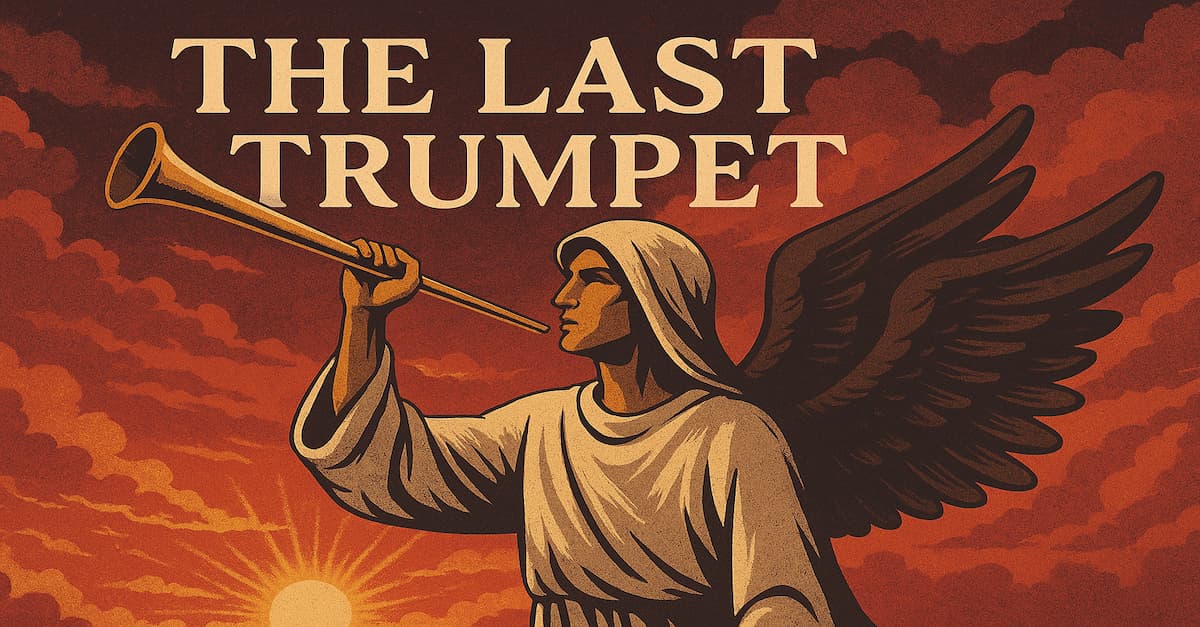
We see trumpets throughout the Bible and they are clearly significant, or at least symbols that signify that significant things are about to happen.
But what about the last trumpet?
With all the buzz today about the end times and the rapture, digging more into this topic has also raised the question of whether the last trumpet in Revelation is the same one Paul talks about in 1 Cor. 15:
“Listen, I tell you a mystery: We will not all sleep, but we will all be changed—in a flash, in the twinkling of an eye, at the last trumpet. For the trumpet will sound, the dead will be raised imperishable, and we will be changed.”
A lot of people have interpreted that passage as talking about the rapture, but is that accurate and actually scripturally supported?
Is there more than one last trumpet?
Or, like many end times topics, is focusing on these trumpets missing the forest for the trees??
1cor 15:**50 **I declare to you, brothers and sisters, that flesh and blood cannot inherit the kingdom of God, nor does the perishable inherit the imperishable. **51 **Listen, I tell you a mystery: We will not all sleep, but we will all be changed— **52 **in a flash, in the twinkling of an eye, at the last trumpet. For the trumpet will sound, the dead will be raised imperishable, and we will be changed. **53 **For the perishable must clothe itself with the imperishable, and the mortal with immortality. **54 **When the perishable has been clothed with the imperishable, and the mortal with immortality, then the saying that is written will come true: “Death has been swallowed up in victory.”
The last trumpet is just that, the last time a trumpet will be heard on earth, when Gods angel blows it to raise the dead, to announce the return of Jesus and to usher in the end of this world and the final judgement.
There is a lot of hot air written about the return of Jesus.
All we really need to know is he is coming back. How it happens, what happens etc etc will be seen as it happens.
No one is going to march up to God and demand to know why x, y, and z events did or didn’t happen, we will be far to involved in the wonder of heaven.
We can definitely get lost in speculation. But here’s maybe a slightly different take: I’m not fully convinced that the “last trumpet” Paul mentions in 1 Corinthians 15has to be the same one as the seventh trumpet in Revelation.
Paul wrote 1 Corinthians decades before John received the Revelation vision, and his focus was the resurrection of believers, not end-time judgments. It’s possible that “the last trumpet” in Paul’s letter referred to something his readers already understood…maybe the final trumpet call signaling the gathering of God’s people (as in Numbers 10 or Matthew 24:31), not necessarily the seventh trumpet judgment John later describes.
In other words, maybe Paul’s “last trumpet” isn’t about chronology at all, but culmination — the moment when all of God’s promises reach their fulfillment. If that’s true, then trying to match up trumpets between books might be missing the point: the sound itself symbolizes the completion of God’s redemptive work.
So maybe the “last trumpet” isn’t a timeline marker but a victory signal…the sound announcing that death and decay have finally been silenced.
Curious what others think …could it be more about meaning than sequence?
The last trumpet (shofar actually) refers to the final shofar blast at the end of the Day of Atonement (Yom Kippur) after a series of blasts on Yom Teruah (day of blowing the shofar) which is now commonly called Rosh HaShannah (head of the year) There were 30+ blasts in each of the 3 services making the total near 100.