Interesting. Excellent way to put it Corlove13
1 Like
Hey Johann. All the same, at differing times, completing differing jobs, if you will. I gave you the scripture for the reasons I believe they are the same, yet three persons, again, if you will. I guess entities may be the word. Since Jesus, the flesh of God, was a person. Yet the Holy Spirit is spirit, and God, well, is God. Jesus needed to be flesh to be scarified for flesh. Remember, Jesus also claims to be God, so was He a liar? He said He would come back and dwell in believers. Is that incorrect?
Either way,
“But what does it say? “The word is near you, in your mouth and in your heart” (that is, the word of faith that we proclaim); because, if you confess with your mouth that Jesus is Lord and believe in your heart that God raised him from the dead, you will be saved.” Romans 10:8-9
Also:
“First of all, then, I urge that supplications, prayers, intercessions, and thanksgivings be made for all people, for kings and all who are in high positions, that we may lead a peaceful and quiet life, godly and dignified in every way.
This is good, and it is pleasing in the sight of God our Savior, who desires all people to be saved and to come to the knowledge of the truth. For there is one God, and there is one mediator between God and men, the man Christ Jesus, who gave himself as a ransom for all, which is the testimony given at the proper time.” 1 Timothy 2:1-6
Believe in the Trinity, or three separate beings, in the long run, as long as you believe in and accept Jesus, you will meet Him at the proper time. I choose to believe as Jesus claimed, He is God.
God bless,
PC
What you’re describing sounds a lot like Modalism, sometimes called Sabellianism. It’s an old idea from the early centuries of the church that tried to explain the Trinity by saying God is one Person who simply appears in different “modes” or roles, first as the Father, then as the Son, then as the Holy Spirit.
The example you gave, about a man being first a child, then a husband, then a father, fits that way of thinking perfectly. It shows one person who changes roles over time. That’s what Modalism teaches: one God showing up in different ways rather than three distinct Persons existing together.
The problem is that this view doesn’t match what Scripture shows about the Father, Son, and Spirit being distinct yet one. For example, at Jesus’ baptism in ~Matthew 3:16–17, the Son is baptized, the Spirit descends like a dove, and the Father speaks from heaven, all at the same time. In ~John 14:16–17 Jesus says He will ask the Father to send the Spirit, which again shows three Persons acting together, not one Person changing roles.
The early church rejected Modalism because it flattened those real relationships within the Godhead. In Christian belief, the Father, Son, and Spirit are not just titles or phases. They are three coexisting Persons who share the same divine nature and have always existed in that unity.
J.
1 Like
I did not apply this to what you term as modalism. I was responding to Nerd’s post in regards to how there can be a difference between the Holyghost and Holy Spirit without denying the doctrine of the Trinity.
My example was not to deny God has expressed himself in 3 distinct persons. So why you picked that out of what I wrote only you can answer.
The Example was to show TNerd that in the third person of the “Trinity” that a transformation can take place, like as child to man. In that context, what remains the same? And on the flip side what is different?
Sense I assume you know what remains the same, then what is different between the same child transforming as Man? Another words the child is now a man. Is He 2 people?  But the child has transformed in different ways. Hence my thought in How the Holyghost might differ from HolySpirit.
When you say, “I wasn’t denying the Trinity’s three persons,” that’s good and right, but your example of a child becoming a man actually describes one person changing through time, not three distinct persons sharing one essence (ousia). The Trinity is not one divine person transforming or evolving, but one divine essence existing eternally as Father, Son, and Holy Spirit, all active at once (~Matthew 28:19, ~John 14:16–17). So while you affirm the three, your analogy ends up implying sequential manifestation rather than eternal coexistence, which sounds more like Modalism than the historic faith. Correct?
Then you said your example was to show that in the third Person a “transformation” could take place, like a child growing into adulthood. The issue is that divine persons don’t transform**. The Greek verb metamorphoō (to be transformed) applies to creatures, not to God.** The Spirit (pneuma hagion) doesn’t grow or develop, because God is immutable. In Hebrew thought the verb malah carries the sense of permanence or unchangeableness, which is exactly what God affirms of Himself in ~Malachi 3:6: “I, the LORD, do not change.”
To speak of the Spirit “transforming” is to describe temporal process, and that cannot belong to an eternal Being who is perfect in essence.
When you ask, “What remains the same and what is different?” it makes sense in human experience, a person remains human but changes in maturity. Yet in divine ontology, nothing matures or evolves. The Spirit doesn’t become something new; rather, His operations are experienced differently across redemptive history. Before Pentecost He was active with God’s people; after Pentecost He dwells in them (~John 7:39). So what changes is not His nature, but our experience of His presence.
You asked further, “Since you know what stays the same, what is different between the child and the man?” The difference, in your example, is growth. The child becomes what he was not yet. But that cannot apply to God. The Hebrew verb hayah (to be) in God’s name “Ehyeh Asher Ehyeh” (~Exodus 3:14) expresses self-existence and unchangeable being. God does not “become.” He eternally is. That means the Holy Spirit, being God, cannot transform without denying His divine immutability.
When you said, “The child is now a man. Is he two people?”-no, of course not. It’s one person at two stages. But that is exactly why the analogy breaks down for the Trinity. The Father, Son, and Spirit are not one person moving through stages of existence; they are three coeternal Persons sharing one divine essence, working in perfect unity yet distinct in role and relation (~John 14:26, ~1 Corinthians 12:4–6). The Spirit is not the “grown” version of the Son, nor does He replace the Father.
Finally, when you wondered how the “Holy Ghost” might differ from the “Holy Spirit,” there’s no theological difference at all. Both are translations of the same Greek phrase pneuma hagion or hagion pneuma. “Ghost” is simply older English from the King James tradition; “Spirit” is modern usage. Scripture makes no distinction between them.
So, the main issue is that your example uses a human growth process to describe an eternal relationship within the Godhead. That creates a false analogy. The triune life of God is not developmental but eternal communion. The Holy Spirit-pneuma hagion, who proceeds (ekporeuetai) from the Father and is sent by the Son (~John 15:26)-is the same eternal Person who was present at creation (~Genesis 1:2), active in the prophets, and indwelling the Church today. He doesn’t change. The only transformation is in us, as He conforms (metamorphoō) believers into the image of Christ (~2 Corinthians 3:18).
Would you say your intention was to describe the Spirit’s operations as different in time, or His nature as transformed? Because that’s the key question, if it’s the former, we agree. If it’s the latter, then it needs to be rethought, since Scripture never speaks of God as one who becomes.
Shalom.
J.
With the above said- taking into account my surface level concept of God taking the form of man. Meaning sense I am not the creator and I have finite understanding, I can only begin at the concept itself.
From a couple of readings by others saw a difference between HG and HS.
And looking at the passage noted earlier I am making my first case to see if it can be proven : John 7
**38 **He that believeth on me, as the scripture hath said, out of his belly shall flow rivers of living water.
39 (But this spake he of the Spirit, which they that believe on him should receive: for the Holy Ghost was not yet given; because that Jesus was not yet glorified.)
The Case of: “The Before the Resurrection*(spirit)* and After the Resurrection*(ghost)*”
And then there is the question of What is the nature of these terms.
For example: Hypothetically speaking can HolySpirit be: the Spirit of the Holy? That which proceeds from, a specific power?
Likewise Holyghost- the ghost of the Holy, that which proceeds from, another specific power.
Or does scripture speak of only one power that has no specific goals?
So right here let me add this passage and from this post begin to see what we gather from the word to prove or disprove the CASE: BR/AR
But ye are not in the flesh, but in the Spirit, if so be that the Spirit of God dwell in you. Now if any man have not the Spirit of Christ, he is none of his.”
Notes to self
Note: life← vs. →what you do with that life
Note: knowledge of the way ←vs–> walking in the way…
Note: The Spirit of God is mental action- the Spirit of Christ is the power of the mental action in physical action
I doubt you read what I wrote
I’m only going to speak to the first paragraph…for I dont want to get into theological debate about the trinity and go off topic.
My point was never to describe the trinity at all…read it again.
Yes I did, you need to reread what is written.
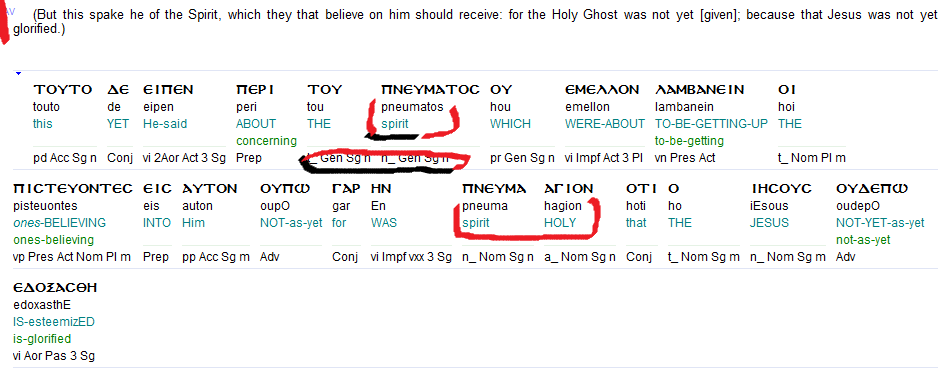
Joh 7:39 Now this he said about the spirit, whom those who put faith in him were to receive, for as yet the spirit had not been given, because Jesus was not yet glorified.
Joh 7:39 But He was speaking here of the Spirit, Whom those who believed (trusted, had faith) in Him were afterward to receive. For the [Holy] Spirit had not yet been given, because Jesus was not yet glorified (raised to honor).
Joh 7:39 Now δὲ He said εἶπεν this τοῦτο concerning περὶ the τοῦ Spirit, Πνεύματος whom οὗ those οἱ having believed πιστεύσαντες in εἰς Him αὐτόν· were about ἔμελλον to receive; λαμβάνειν for γὰρ [the] Spirit Πνεῦμα, was ἦν not yet [given], οὔπω because ὅτι Jesus Ἰησοῦς {was} not yet οὐδέπω glorified. ἐδοξάσθη.
Joh 7:39 But this he said about the Ruach Hakodesh which the ones having emunah (faith) in him were about to receive, for the Ruach Hakodesh had not yet been given, because he had not yet received kavod. [YOEL 2:28 (3:1)]
Case closed, you are way too argumentative @Corlove13
J.
Then you said your example was to show that in the third Person a “transformation” could take place, like a child growing into adulthood. The issue is that divine persons don’t transform**. The Greek verb metamorphoō (to be transformed) applies to creatures, not to God.** The Spirit (pneuma hagion) doesn’t grow or develop, because God is immutable. In Hebrew thought the verb malah carries the sense of permanence or unchangeableness, which is exactly what God affirms of Himself in ~Malachi 3:6: “I, the LORD, do not change.”
That would just mean He could have the ability to transform anytime. The unchangeable is that → HE always had the ability…
See how you can take one off the subject..cherry picking.
No thanks..you are super green…and I can see these little comments that have nothing to do with the topic..going on and on…waste of my time
You can’t prove a case not understanding how language is used. I’m not the one arguing in the way you are. Your arguement lacks depth….
What you see is what you believe…without understanding the history and culture of language. I think it would be smarter to have an open mind and look at scholars who have done indepth studies and how words surrounding play a role in understanding.
Being open means you can come to a conclusion…There is obviously a difference.
My goal is to find what scripture support or do not support the Case.
So now it’s time to block you, for the sake of not carrying on what is fruitless to this thread
I respect that you value historical and linguistic context, I do too. But appealing to “language and culture” as a vague authority doesn’t replace actually showing from the text what it means. You say I “can’t prove a case” because I don’t understand language, yet you haven’t demonstrated from either the Hebrew or Greek text how your interpretation stands. Claiming depth is not the same as providing it.
The issue isn’t who is more open-minded, but who allows Scripture to define its own boundaries. The apostles interpreted Scripture within the very linguistic and cultural setting it was written. When Paul speaks of Christ “becoming a curse for us” (~Galatians 3:13), he uses ginomai for “becoming,” not metamorphoō for “transforming.” That single linguistic point dismantles your claim that divine persons “transform.” Language matters most when we let the inspired words speak for themselves, not when we use cultural generalities to blur their meaning.
You said your goal is to find what Scripture supports or not, and that’s exactly what I’m doing, examining the verbs, the syntax, the theological flow from Genesis to Revelation. The Spirit is described as pneuma hagion consistently, with no indication of transformation or development. If we both care about language, then let’s stay with what the text actually says, not with analogies that collapse into philosophical speculation.
Blocking may end the conversation, but it doesn’t resolve the truth. If the discussion has become fruitless, it’s not because Scripture is unclear, but because willingness to wrestle with the text has stopped. Truth doesn’t depend on how open or closed one’s mind feels, it depends on whether one submits to what the Word of God actually reveals.
You have a blessed day.
J.
respect that you value historical and linguistic context, I do too. But appealing to “language and culture” as a vague authority doesn’t replace actually showing from the text what it means.
Speaking of “vague authorities”With the many meanings spirit has you cannot use just Greek, Hebrew etc. to prove a case. Context is important. Nor can you view through “dogma creeds” doctrines that limits God and understanding. I said you are  green because you don’t take in context, culture, word usage, patterns or much less anything else. You cannot have an open mind because its closed to a dogma creed. Which is why you said you read what I said yet couldn’t see what I was saying.
You say I “can’t prove a case” because I don’t understand language, yet you haven’t demonstrated from either the Hebrew or Greek text how your interpretation stands.
Nor was I trying to, context alone shows there is something different.** You know, that which you fail to look at.**
Claiming depth is not the same as providing it.
No one claimed depth, I said, you don’t have any. For those reasons mentioned in the first paragraph.
The issue isn’t who is more open-minded, but
No one is really trying to compare but show where you lack
who allows Scripture to define its own boundaries.
That’s all good if you used other 
 tools. For example, words can have more than one meaning.
The apostles interpreted Scripture within the very linguistic and cultural setting it was written.
You made no point, we didn’t live in their time and your one example doesn’t correspond to it.
When Paul speaks of Christ “becoming a curse for us” (~Galatians 3:13), he uses **ginomai for “**becoming,” not metamorphoō for “transforming.”
Lol, How does that matter, for when a caterpillar becomes a butterfly it transforms, meaning changes. The caterpillar no longer looks like butterfly  .
.
I don’t have to be a Theologian to say your eisegesis seeks to force this scripture to agree with you, when it actually turns around and agrees with me. As proven in huge font. Nor does Paul have to say what he is not pointing out.
That single linguistic point dismantles your claim that divine persons “transform.”
Well you’ve been proven !dramatically! wrong.
Language matters most when we let the inspired words speak for themselves,
Well just look what happen when you did that above…what a mess we weave when we practice to deceive.
If language spoke for itself then we would not need to interpret meaning. Language changes with culture, historical meanings can be lost, (etc) and look what you just did when you used language spoken “ by Paul” YOU applied it wrongly.
not when we use cultural generalities to blur their meaning.
Who said anything about generalities- of course culture plays a role in interpreting the meaning of scriptures. Sorry, but understanding the culture of the day will help understanding not blur it.
You said your goal is to find what Scripture supports or not, and that’s exactly what I’m doing, examining the verbs, the syntax, the theological flow from Genesis to Revelation.
No, the way you apply what you do is green. (read first paragraph)
The Spirit is described as pneuma hagion consistently, with no indication of transformation or development.
Not true…what happens when you see the reverse from pneuma hagion→hagion pneuma or when the difinite article is left out, or when the writer uses a Captial letter for spirit instead of lower case, etcetera etcetera. But don’t forget about context, history, culture and other things we might fail to miss;.like those who receive revelation, who have spiritual gifts, testimonies and experiences.
If we both care about language, then let’s stay with what the text actually says,
Sorry, but your ideals on language without the use of pattern, history, culture, revelation and such and not to mention how you use it  , Is not how we “both care” about it. I am not closed minded and trying to limit Scripture to dogmatic creeds.
not with analogies that collapse into philosophical speculation.
That’s only what you’ve done and I would not call that the use of logic in practice.
Blocking may end the conversation,
Look at all the little conundrums I have to respond to that take from the subject because of the 


but it doesn’t resolve the truth.
The whole ideal is to get there and you have not showed you can be of much help.
If the discussion has become fruitless, it’s not because Scripture is unclear, but because willingness to wrestle with the text has stopped.
It’s not the discussion by itself, it’s the ones that go off subject, I am having with you, at this very moment.
Truth doesn’t depend on how open or closed one’s mind feels, it depends on whether one submits to what the Word of God actually reveals.
Truth is Truth on its own. Getting an understanding on the other hand, depending on what the subject entails, will not come by reading the original unless you are an expert in language; which will include culture, history, metaphors, poetry, patterns, background, context, and I am sure much more.
But let’s not forget the puzzles that are revealed to those God has revealed it to.
So if it’s revealed it’s not because we forget context and the other tools and avenues that derive meaning.
You have a blessed day.
Will do..same to you
Was there a difference between Jesus’s Earthly body and His resurrected body?
Was it different different because it had new, glorified qualities, such as being able to appear and disappear at will, a state that may have been described as a foretaste of future glorified bodies.
On power
Jesus was the first man that completely defeated death…
Hence my question- can one give out a power that they are not part with?
For example: Can a fan that is fueled by cold air give out  heat. Not unless it has an angle on both cold and heat. Hence, my thought, sense Jesus was the first from heaven to become man and resurrect…He has taken on resurrected power…Before He physically died did He posses resurrecting bodily power if He had yet to rise?
Another Example: Have you ever heard a person tell you what they would do with a situation they had never been in. Maybe how they would have handled a troubled child they never had daily interaction with. In those cases we “consider the source”. As the saying goes: A bald head man can’t tell you how to grow hair.
So my thought is: can one give out a power that they themselves have not taken on or become part with?
Use or nonuse of Article with Holy Spirit
Here is the conclusion from an article of research written by Steve Swartz “ The Bible translator”
“5.0 Conclusion
Two questions have been addressed in this article. As to the first question
concerning the presence of the Greek article with pneuma, the following
can be said. The presence of the article at the first mention of pneuma
within a particular context signifies a definite and theological reference to
the Holy Spirit perceived as Person. Other, non-initial articular references
mayor may not be in reference to the Holy Spirit as Person. Some of these
subsequent articular references can be explained in terms of anaphora, and
this anaphora could in some instances be in reference to previous mentions
of the Holy Spirit perceived as God-given Power. Then the article’ssignificance must be determined by other means such as attendant verbs
and/or prepositions.
The absence of the article usually signifies the writer’s intent to speak
of Holy Spirit as God-given Power rather than the Holy Spirit as Person.
This rule is, of course, to be tempered wherever an underlying Hebrew
genitive construct can be detected.
Time and space limitations have prevented me from taking a
comprehensive look at every occurrence of verbs and prepositions with
pneuma in expressing the activity of the Holy Spirit in the New Testament.
Further study is certainly called for. It was also impossible to fully consider
the use of the article with other strictly abstract terms such as those for
“truth,” “love” and “grace.”
As to the second question posed at the beginning of this article,
it is doubtful that any English translation will deviate greatly from the
traditional conventions in regards to the handling of (to) pneuma (hagion)
as “the Holy Spirit.” Despite some 500 years of English translation history
and nearly 2,000 years of doctrinal development concerning the Holy Spirit,
it is to be wondered if at least some of the current wrangling over the
Holy Spirit and the charismata might have been avoided if the English
translations had reflected on occasion some of the nuances of the article
with pneuma.
The possibility of greater flexibility, and perhaps accuracy, in
translation is open for those working in minority languages worldwide.
How this affects the Warlpiri translation yet remains to be seen as we
attempt to balance exegetical accuracy with Church/Mission acceptance
and mother-tongue-speaker usage. ”
This video… I have to listen to again..Just where All the research was leading…to
Baptizing in the Name of the Father, Son, and Holyghost….was to make disciples…people ready to do the work…..
Check out this video from this search, video of the difference between the holy ghost and holy spirit The Difference between the HOLY GHOST, HOLY SPIRIT & THE ...
So the video as I watched it had too many holes.
All I could really take from it was the Holy Spirit needs to come over you…Which I would narrow down to saying when one preaches or teaches we need to make sure God’s presence is with us.
But I’m going to watch it several times to understand what lens He is viewing it from. Then get back to research. Until then 
I can assist you, but you have blocked me @Corlove13 and this “greenhorn” is not THAT green.
J.
You see Johann, you already have your mind made up. I like coming to answers with my friends together. It can be engaging. Not just accepting things I’ve never looked into and getting only information that proves my leaning.
Its good to look into things we have accepted to be true…never having looked into.
So I might be the odd ball, but I’d rather be one that knows what I believe, why I believe it, and why I dont believe it.
Our minds SHOULD already be made up when it comes to the question you have raised here, because the answer was given already a long time ago.
The only reason you are trying to make a distinction between Holy Spirit and Holy Ghost is because the language you speak is English. This simply isn’t an issue in any other language. If you spoke French yo’d only know le Saint-Esprit, if your language was Hungarian you’d only know
a Szentlélek.
But because English has this bizarre quality of being a chimeric language where we have redundant vocabulary, we are able to speak of “the Holy Spirit” and “the Holy Ghost”; terms which are 100% equivalent, referring to and meaning exactly the same thing.
Your question is like trying to say there is a difference between cow meat and beef. Beef is cow meat. The only reason we say “cow” and “beef” is because when the Normans conquered England the Anglo-Saxon farmers continued to use Anglo-Saxon words for animals (“cow”) while the French ruling class used French words (“beef”).
What’s the difference between a cat and a feline? Nothing. Cat and feline mean the same thing. Cats are felines, felines are cats. Two words to mean the same thing.
Do we want a people to have freedom or liberty? Again, they mean the same thing: freedom (Anglo-Saxon) and liberty (French)
In Anglo-Saxon the word is freodom, literally “free” + “dom”, "the state or condition of being free”; in Noman French liberté from Latin libertas, “liber” = “free”, libertas → liberty = “the state or condition of being free”.
You have been explained these very basic facts already. You choose to ignore it and insist on your own creative opinion.
If I told you that “liberty” is actually the power to check out books at a library, I’d be wrong. No matter how many times I repeat it, I’d still be wrong.
This isn’t a matter of opinion or debate.
The earth is round.
Gravity pulls objects towards the center of mass.
Water is wet.
The Holy Spirit is the Holy Ghost
The Holy Ghost is the Holy Spirit.
One and the Same.
Not opinion, not debate, just pure inarguable fact.
1 Like