TCC, you’re still conflating two different issues.
I have no objection to bringing Jeremiah 18 into the discussion. The question is whether Paul is using Jeremiah 18 in the same way Jeremiah used it. Context determines meaning, not simply shared imagery.
In Jeremiah 18, the issue is God’s dealings with nations in history, and the emphasis is on repentance and temporal judgment. In Romans 9, Paul is answering a completely different question. Has God’s Word failed? (9:6). His answer begins with God’s sovereign choice of Isaac over Ishmael, Jacob over Esau before they were born, then God’s mercy toward Moses and hardening of Pharaoh, before arriving at the Potter and the clay. Paul’s application is driven by God’s purpose according to election, not by Jeremiah 18.
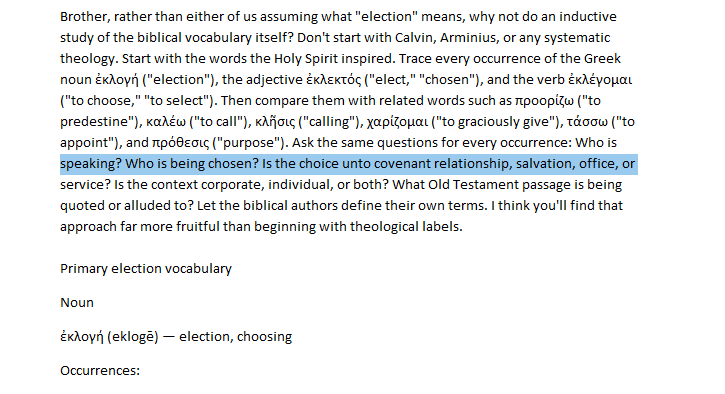
Notice what you keep doing. Instead of following Paul’s argument from verses 6–24, you jump to another passage and let it redefine Romans 9. That’s backwards. Let Paul establish his own argument first. Only then should we ask how Jeremiah 18 informs it.
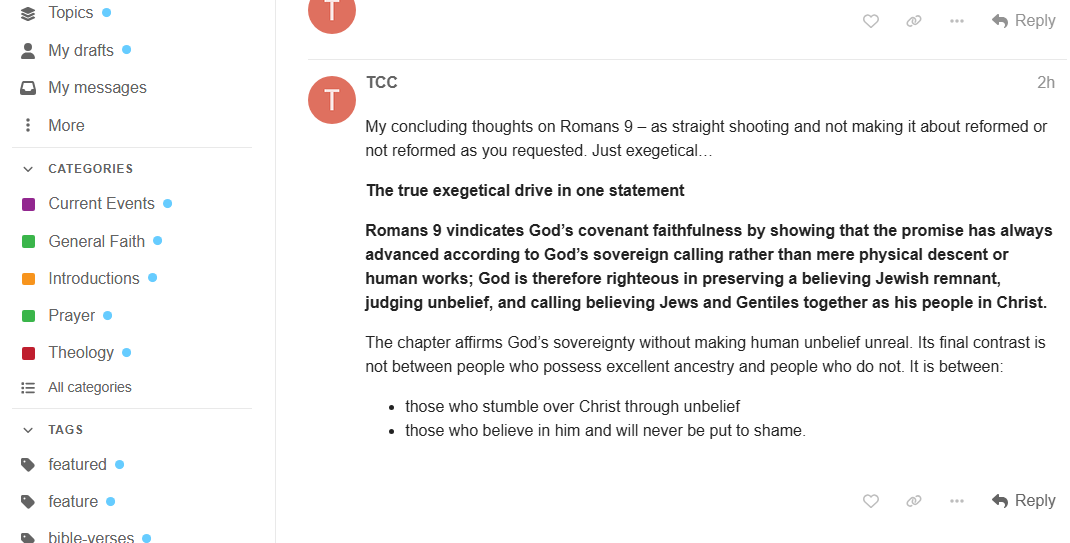
You also say the end of Romans 9 is the controlling idea. I disagree because Paul himself doesn’t structure the chapter that way. Verses 30–33 explain why Israel stumbled. They do not erase or reinterpret everything Paul has already established about God’s sovereign purpose, mercy, hardening, and election. Paul’s conclusion must be read in light of his argument, not his argument in light of his conclusion.
You say I don’t answer your questions, but look at what is actually happening. The discussion keeps jumping from one passage to another, Paul’s argument is constantly being rearranged, and texts are being interpreted outside of the flow of his reasoning.
As Miles Coverdale wisely said.
“It shall greatly help ye to understand Scripture, if thou mark not only what is spoken or written, but of whom, and to whom, with what words, at what time, where, to what intent, with what circumstances, considering what goeth before and what followeth after.”
That is precisely the issue here. Instead of allowing Paul’s argument to unfold from Romans 9:6 through Romans 11, you repeatedly jump to isolated texts or Old Testament parallels and then use them to redefine Paul’s own argument. That is not following the context. It is replacing Paul’s context with another.
This is why I keep insisting that we stay with Paul’s flow of thought. His conclusions cannot be understood apart from what goes before, nor can what goes before be reinterpreted solely by what follows. Scripture interprets Scripture, but it never permits us to dismantle an author’s own line of reasoning.
The result is that this has become less of a discussion about what Paul actually says and more of an adversarial caricature of the Reformed reading of Scripture. If we’re serious about exegesis, then let’s do what Coverdale urged over 450 years ago: follow the inspired author’s argument from beginning to end, paying careful attention to what goes before and what follows after.
J.