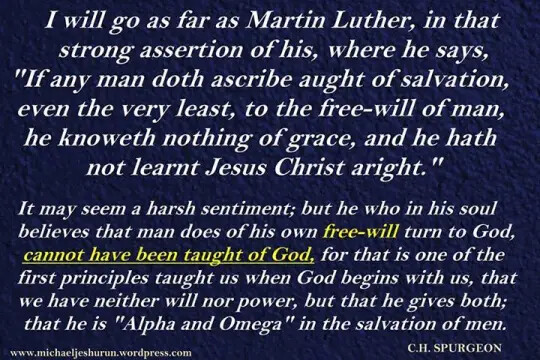
What Would Martin Luther Say to “Free Will”?
Those who promote the free will of natural man will often, in their defense, offer up various passages from Scripture which declare to man what he MUST DO to be saved. The following is how Luther responded to such arguments:
“If thou art willing’ is a verb in the subjunctive mood, which asserts nothing…a conditional statement which asserts nothing indicatively.” “if thou art willing”, “if thou hear”, “if thou do” declare, not man’s ability, but his duty. The commandments are not given inappropriately or pointlessly; but in order that through them the proud, blind man may learn the plague of his impotence, should he try to do as he is commanded.
How is it that as soon as you get hold of a single imperative verb you infer an indicative meaning, as though the moment a thing is commanded it is done, or can be done? Does it follow from: ‘turn ye’ that therefore you can turn? Does it follow from “‘Love the Lord thy God with all thy heart’ (Deut 6.5) that therefore you can love with all your heart? What do arguments of this kind prove, but the ‘free-will’ does not need the grace of God, but can do all things by its own power. By the law is the knowledge of sin’ [Rom 3:20], so the word of grace comes only to those who are distressed by a sense of sin and tempted to despair. Imperative or hypothetical passages, or wishes of Jesus, by which is signified, not what we can do, or do do…but what we OUGHT TO DO, and what is required of us, so that our impotence may be made known to us and the knowledge of sin may be given to us.
As to why some are touched by the law and others not, so that some receive and others scorn the offer of grace…this is the hidden will of God, Who, according to His own counsel, ordains such persons as He wills to receive and partake of the mercy preached and offered … If man has lost his freedom, and is forced to serve sin, and cannot will good, what conclusion can more justly be drawn concerning him, than that he sins and wills evil necessarily?
…If any man doth ascribe of salvation, even the very least, to the free will of man, he knoweth nothing of grace, and he hath not learnt Jesus Christ aright!”
[From Luther’s De Servo Arbitrio or ‘The Bondage of the Will’]
Why did the Reformers vehemently oppose the notion of free will, and what linguistic and theological evidence did they employ to substantiate their position?
If Scripture employs the subjunctive mood, as in εἰ θέλεις (“if you are willing”) or εἰ ἀκούεις (“if you hear”), does this not indicate a conditional statement about duty rather than an assertion of human capability, given that the subjunctive, by definition, expresses possibility or contingency rather than actuality?
When encountering imperative verbs such as ἀγαπάω (“love,” Deut 6:5) or ἐπιστρέψατε (“turn,” Joel 2:12), why would one assume that the command itself implies the ability to fulfill it, when the imperative form primarily signifies obligation rather than capacity?
How does the apostolic declaration that “through the law comes the knowledge of sin” (διὰ νόμου γινώσκω τὴν ἁμαρτίαν, Rom 3:20) support the Reformation view that commands serve to reveal human impotence rather than human potential?
If Paul states that “no one does good, not even one” (οὐκ ἔστιν ὁ ποιῶν τὸ ἀγαθόν, οὐδὲ εἷς, Rom 3:12), and that the natural man is “enslaved to sin” (δουλεία τῆς ἁμαρτίας, Rom 6:6), what logical foundation remains for asserting that unaided human will can choose righteousness?
Given that Luther argues imperative passages signify “not what we can do, but what we ought to do,” does this not align with the Reformation principle that the law functions as a mirror (speculum) to expose sin rather than to empower the sinner?
If the reception of grace is determined by God’s hidden will (τὸ κρυπτὸν τοῦ θεοῦ), as Luther contends, how can the doctrine of free will be reconciled with the biblical teaching on divine election and human depravity?
Luther asserts that to ascribe even the smallest part of salvation to free will demonstrates ignorance of grace. Does this not fundamentally undermine the synergistic position, which presupposes human cooperation in the work of salvation?
If, as Luther maintains, fallen man cannot will good (οὐ δύναται θέλειν τὸ ἀγαθόν), then what remains of the free will argument except a will that is free only to sin, and thus not free at all in the true sense?
The Call to Self-Denial and Cross-Bearing
Matthew 16:24 (ἀπαρνήσασθε, λάβετε, ἀκολουθείτω)
“If anyone would come after me, let him deny himself (ἀπαρνήσασθε), take up his cross (λάβετε τὸν σταυρὸν αὐτοῦ), and follow me (ἀκολουθείτω μοι).”
Rejection. Most prefer comfort over self-denial. The rich young ruler (Matt 19:22) turned away from this command, and multitudes still do (Matt 7:14).
The Command to Love Enemies
Matthew 5:44 (ἀγαπάτε, εὐλογει̃τε, προσεύχεσθε)
“Love your enemies (ἀγαπάτε τοὺς ἐχθροὺς ὑμῶν) and pray for (προσεύχεσθε) those who persecute you.”
Rejection**. Natural human instinct is retaliation (Matt 5:38–39). Even many Christians ignore this, justifying vengeance or indifference.**
The Great Commission
Matthew 28:19–20 (πορευθέντες, μαθητεύσατε, βαπτίζοντες, διδάσκοντες)
“Go therefore and make disciples (μαθητεύσατε) of all nations, baptizing (βαπτίζοντες) them… teaching (διδάσκοντες) them to observe all that I have commanded you.”
Rejection: The majority of believers do not actively disciple others. Surveys show most Christians never share the gospel, let alone teach obedience to Christ’s commands.
The Demand for Radical Generosity
Matthew 19:21 (πώλησον, δός, δεῦρο, ἀκολούθει)
“If you would be perfect, go, sell (πώλησον) what you possess and give (δός) to the poor… and come, follow me (δεῦρο, ἀκολούθει μοι).”
Rejection. The rich young ruler went away sorrowful (Matt 19:22). Most modern believers rationalize this command as “only for that man,” ignoring its principle of sacrificial generosity.
The Imperative to Repent and Believe
Mark 1:15 (μετανοεῖτε, πιστεύετε)
“The time is fulfilled… repent (μετανοεῖτε) and believe (πιστεύετε) in the gospel.”
Rejection. Jesus Himself lamented that most refuse to repent (Matt 11:20–24). The gospel call is universally rejected by the natural heart (John 12:37; Rom 3:11).
The Command to Forgive Unconditionally
Matthew 6:14–15 (ἀφήσετε, ἀφεθήσεται)
“If you forgive (ἀφήσετε) others their trespasses, your heavenly Father will also forgive you; but if you do not forgive (μὴ ἀφῆτε), neither will your Father forgive your trespasses.”
Rejection. Bitterness and unforgiveness are rampant even among churchgoers. Many treat this as optional, yet Jesus ties God’s forgiveness of us to our forgiveness of others.
The Call to Abide in Christ
John 15:4 (μένετε)
“Abide (μένετε) in me, and I in you… for apart from me you can do nothing.”
Rejection. Most believers drift from daily dependence on Christ, relying instead on self-effort or worldly solutions. The imperative to abide is ignored in favor of autonomy.
The Command Against Anxiety
Matthew 6:25, 31 (μὴ μεριμνᾶτε)
“Do not be anxious (μὴ μεριμνᾶτε) about your life… but seek first the kingdom of God.”
Rejection. Anxiety disorders are epidemic, even among Christians. The command is dismissed as unrealistic rather than obeyed through trust in God’s provision.
The Call to Be Perfect
Matthew 5:48 (ἔσεσθε τέλειοι)
“You therefore must be perfect (ἔσεσθε τέλειοι), as your heavenly Father is perfect.”
Rejection: The natural response is despair or dismissal, either “I can’t do that” or “That’s not literal.” Yet Jesus commands it, exposing our need for His righteousness (Rom 3:23).
The Imperative to Enter the Narrow Gate
Matthew 7:13–14 (εἰσέλθατε, ζητεῖτε)
“Enter (εἰσέλθατε) by the narrow gate… for the gate is wide and the way is easy that leads to destruction, and those who enter by it are many.”
Rejection. The majority choose the broad way. Even many who call themselves Christians reject the narrow path of obedience to Christ’s commands.
Theological Significance:
These imperatives reveal two truths:
Human inability: The natural man cannot obey these commands (Rom 8:7–8; John 6:44), proving the Reformation doctrine of bondage of the will (Luther, De Servo Arbitrio).
Divine purpose: Christ’s commands expose sin (Rom 3:20) and drive us to grace (Gal 3:24). Rejection of imperatives proves our need for a Savior, not our ability to save ourselves.
Luther’s logic is tightly bound to how he reads the Apostle Paul, particularly the book of Romans. His argument relies on a few key biblical concepts. Luther’s brilliant linguistic point is that a command from God does not imply the human ability to perform it.
When God says, “Turn to me” Ezekiel 18:30 or “Love the Lord your God with all your heart” Deuteronomy 6:5, Luther argues these are laws meant to show us our baseline failure. He points directly to Romans 3:20: “Through the law we become conscious of our sin.”
In Luther’s view, the commandments are a spiritual mirror. They show us how high the bar is so that we realize we are utterly paralyzed and unable to jump over it on our own. Luther argues that if human beings have even a tiny shred of free will left to choose God on their own, then salvation is no longer 100% by grace. If you contribute 1% of the effort by “choosing” God, you have something to boast about.
He bases this on passages like Ephesians 2:8-9:
" For by grace you have been saved through faith. And this is not your own doing; it is the gift of God, not a result of works, so that no one may boast."
To Luther, the unregenerate human will is totally enslaved to self and sin until God unilaterally changes the heart John 6:44.
“No one can come to me unless the Father who sent me draws him. And I will raise him up on the last day.”
I still see it that his view strips away human responsibility and makes God the author of who gets saved and who gets damned. God’s invitations are sincere, implying a real choice. For example, Joshua 24:15: “Choose for yourselves this day whom you will serve.” Or Revelation 3:20, where Jesus stands at the door and knocks, waiting for the individual to open it.
I believe and have said that these verses indicate God wants everyone to be saved, such as 1 Timothy 2:4 “who wants all people to be saved and to come to a knowledge of the truth” and 2 Peter 3:9 “not wanting anyone to perish, but everyone to come to repentance”. If Luther is right about God’s “hidden will” choosing only some, these verses become contradictory.
Is Luther’s quote biblical? I believe that Luther’s view is an extreme interpretation that undermines human accountability and the universal love of God. Luther himself considered The Bondage of the Will to be one of his most important works because, to him, if you don’t understand that your will is bound, you can never truly appreciate the sheer magnitude of God’s grace. I would argue the opposite. Free Will shows it even more.
Peter
I did not know this was continued until after I responded. Sorry. But passages like these, and more like it, are 100 percent true. Without Jesus. Let me try this. Anything you place in the forefront of your life. Anything that you serve IS your god, lord, and master.
“Jesus answered them, “Truly, truly, I say to you, everyone who commits sin is a slave to sin.” John 8:34
Here is the thing. You do not have to go out and look for this god. You are born into its religion. You are born into the flesh, and therefore you are born into sin.
“Behold, I was brought forth in iniquity, and in sin did my mother conceive me.” Psalms 51:5
This is just the reality. Since Adam gave all domination over to the devil,
“Surely there is not a righteous man on earth who does good and never sins.” Ecclesiastes 7:20
And we know because the Word tells us so.
" For the wages of sin is death, but the free gift of God is eternal life in Christ Jesus our Lord." Romans 6:23
Jesus came to give us a choice.
“Do you not know that if you present yourselves to anyone as obedient slaves, you are slaves of the one whom you obey, either of sin, which leads to death, or of obedience, which leads to righteousness?” Romans 6:16
Even though you were born into Sin and are a Slave to Sin, and without Jesus, make no mistake about it.
“For all have sinned and fall short of the glory of God,” Romans 3:23
Who? ALL Who? All. Jesus came to free you from Sin.
“So if the Son sets you free, you will be free indeed.” John 8:36
You cannot free yourself. You cannot change who you are. If you are not serving God, you are serving Sin. If you are walking in the flesh, you cannot serve God.
“For those who live according to the flesh set their minds on the things of the flesh, but those who live according to the Spirit set their minds on the things of the Spirit. For to set the mind on the flesh is death, but to set the mind on the Spirit is life and peace. For the mind that is set on the flesh is hostile to God, for it does not submit to God’s law; indeed, it cannot. Those who are in the flesh cannot please God.” Romans 8:5-8
It really is so simple. You choose to accept God’s Grace and the Sacrifice of Jesus. You choose to stop thinking fleshly or worldly and start learning who God is. Learning what He says about this or that. What the truth really is. Thinking spiritually.
“You, however, are not in the flesh but in the Spirit, if in fact, the Spirit of God dwells in you. Anyone who does not have the Spirit of Christ does not belong to him. But if Christ is in you, although the body is dead because of sin, the Spirit is life because of righteousness. If the Spirit of him who raised Jesus from the dead dwells in you, he who raised Christ Jesus from the dead will also give life to your mortal bodies through his Spirit who dwells in you.” Romans 8:9-11
You must choose. Who do you serve? First, you have to accept Him. Then, and only then, you must choose. Oh, you can continue to sin. You can think, and sadly some do, that being saved is a license to sin. This is not the Truth at all. James warns us of this.
“So whoever knows the right thing to do and fails to do it, for him it is sin.” James 4:17
Peter gives us this very stern warning.
" For if, after they have escaped the defilements of the world through the knowledge of our Lord and Savior Jesus Christ, they are again entangled in them and overcome, the last state has become worse for them than the first. For it would have been better for them never to have known the way of righteousness than after knowing it to turn back from the holy commandment delivered to them." 2 Peter 2:20-21
As in all things, the choice is yours. You choose who you serve. Choose to serve God. Have God as your only God, Lord, and Master. There is only one true one. He is the great “I Am.” There is nothing better, bigger, or more important.
Peter
I appreciate your pastoral heart, PeterC. May I ask, though, would you say that salvation is synergistic?
If you say yes…
A. In classical Christian theology, salvation is not synergistic, it is monergistic. This means God alone saves; human effort does not contribute to or cooperate with grace to achieve salvation (Ephesians 2:8–9).
B. Synergism, by contrast, implies a cooperative effort between God and humans, which most Reformation traditions reject as incompatible with grace alone (sola gratia).
Are we in agreement here? And which view or position do you hold?
The Condition of Man’s Will: Dead, Not Just Weak
You quote verses where God commands choice, but Scripture also declares what we are apart from grace:
“No one seeks for God. All have turned aside; together they have become worthless; no one does good, not even one.” (Romans 3:10–12)
“The natural person does not accept the things of the Spirit of God, for they are folly to him, and he is not able to understand them because they are spiritually discerned.” (1 Corinthians 2:14)
“No one can come to me unless the Father who sent me draws him.” (John 6:44)
“This is why I told you that no one can come to me unless it is granted him by the Father.” (John 6:65)
If man were merely sick, he might reach for the physician. But Scripture calls us dead in trespasses (Ephesians 2:1–5). A corpse does not cooperate with resurrection. Synergism assumes we have a spark of spiritual life to fan into flame, but Scripture says we are dark, blind, and hostile to God (Romans 8:7–8).
God’s Sovereignty in Salvation: He Chooses, We Receive
“He chose us in him before the foundation of the world… having predestined us for adoption as sons through Jesus Christ.” (Ephesians 1:4–5)
“For by grace you have been saved through faith. And this is not your own doing; it is the gift of God, not a result of works, so that no one may boast.” (Ephesians 2:8–9)
“I will have mercy on whom I have mercy, and I will have compassion on whom I have compassion… So then it depends not on human will or exertion, but on God, who has mercy.” (Romans 9:15–16)
Notice, faith itself is a gift (Ephesians 2:8–9). If faith were our contribution, we’d have grounds to boast. But salvation is monergistic, God works in us both to will and to work for His good pleasure (Philippians 2:13). Even our willing is His gift.
The Two Wills of God: Solving the “Contradiction”
You ask- If God wants all to be saved (1 Timothy 2:4; 2 Peter 3:9), how can He also choose only some? This is the classic distinction between God’s preceptive will (what He commands) and His decretive will (what He ordains).
Preceptive Will (Moral Law): God commands all men to repent (Acts 17:30). He desires their salvation in the sense that He takes no pleasure in the death of the wicked (Ezekiel 33:11). This is His revealed will, what we are to obey.
Decretive Will (Sovereign Plan): Yet He ordains that only the elect will repent (Acts 13:48). This is His hidden will, what He has determined to come to pass.
Luther puts it plainly in The Bondage of the Will:
“God’s will is not always the same as His revealed word. For He willed the death of His Son, yet He did not reveal this will in His word, but rather the opposite, that He would save Him. So too, He wills the damnation of the wicked, yet He does not reveal this will, but rather His will to save all.”
Calvin adds:
“God’s will is one, but our understanding of it is manifold. For sometimes He commands what He does not will to be done, and sometimes He wills what He does not command.”
This is not contradiction, it’s the depth of God’s wisdom (Romans 11:33–36). He sincerely invites all (Isaiah 55:1; Matthew 11:28), yet effectually calls His own (John 10:26–27).
Human Responsibility: Real, Not Hypothetical
You fear monergism removes responsibility. But Scripture holds men accountable precisely because they reject what they could not accept apart from grace:
“You refuse to come to me that you may have life.” (John 5:40)
“O Jerusalem, Jerusalem… how often would I have gathered your children together as a hen gathers her brood under her wings, and you were not willing!” (Matthew 23:37)
Their unwillingness is real, culpable, and justly judged. God’s sovereignty does not negate human responsibility, it establishes it. We are clay, but we are accountable clay (Romans 9:20–21).
The Synergist’s Dilemma: Grace or Works?
If salvation depends on our cooperation, then…
Grace is no longer grace (Romans 11:6: “If by grace, then it is no longer on the basis of works; otherwise grace would no longer be grace.”)
Boasting becomes possible (Ephesians 2:9).
Christ’s work is insufficient, for then the deciding factor is our choice, not His cross.
The Canons of Dort (1.3) state:
“Man, by the fall, did not lose his humanity, but became a sinner… so that he is neither willing nor able to return to God, to reform his depraved nature, or to dispose himself to reformation.”
Westminster Confession of Faith (9.3):
“Man, by his fall into a state of sin, hath wholly lost all ability of will to any spiritual good accompanying salvation; so as a natural man, being altogether averse from that good, and dead in sin, is not able, by his own strength, to convert himself, or to prepare himself thereunto.”
God commands faith. And God gives faith. That is the glory of the gospel: salvation is of the Lord (Jonah 2:9).
Would you consider this, If your view is true, then at the final judgment, the saved could say, “Lord, I chose You.” But Scripture says, “You did not choose me, but I chose you” (John 15:16).
Who will possess all people to be saved, and to arrive to the knowledge of the truth.
KJV Who will have all men to be saved, and to come unto the knowledge of the truth.
Notes & Key Terms
Translator Notes
The verb thelei (‘desires, wills, wants’) has been debated for centuries: does God’s desire necessarily produce its result? We render the Greek without imposing either universalist or particularist frameworks. The phrase epignōsis alētheias (‘full knowledge of the truth’) implies not mere information but deep, experiential understanding. Salvation and knowledge are paired — being saved involves knowing truth.
Latin Vulgate (Jerome, 382-405 CE)
“Who wishes all men to be saved and to come to the knowledge of the truth”
Omnes homines vult salvos fieri (who wishes all men to be saved) - this verse became the central proof-text in the Western predestination debate. If God wills all to be saved, how can predestination be true? Augustine, Aquinas, Calvin, and the Jansenists all offered different readings of ‘all’ and ‘wills’ to reconcile this verse with their predestination theology.
Joseph Smith Translation (Footnotes)theological
God’s desire that all men be saved — scope qualified
The KJV ‘Who will have all men to be saved, and to come unto the knowledge of the truth’ is used in debates about universal vs. particular atonement. The JST footnote revises this to introduce conditions or qualifications consistent with Restoration free-agency soteriology.
In other words, the classical Arminian soteriology.
Take note…
Romans 9:16
“So then it is not of him that willeth, nor of him that runneth, but of God that sheweth mercy.”
Ephesians 2:8–9
"For by grace are ye saved through faith; and that not of yourselves: it is the gift of God:
Not of works, lest any man should boast."
John 6:37
“All that the Father giveth me shall come to me; and him that cometh to me I will in no wise cast out.”
John 6:44
“No man can come to me, except the Father which hath sent me draw him: and I will raise him up at the last day.”
John 1:12–13
"But as many as received him, to them gave he power to become the sons of God, even to them that believe on his name:
Which were born, not of blood, nor of the will of the flesh, nor of the will of man, but of God."
1 Corinthians 1:29–31
"That no flesh should glory in his presence.
But of him are ye in Christ Jesus, who of God is made unto us wisdom, and righteousness, and sanctification, and redemption:
That, according as it is written, He that glorieth, let him glory in the Lord."
Rom 3:9 What, then, does this mean? Are we Jews any better off? Not at all! For we have already accused everyone, both Jews and Greeks, of being under the power of sin.
Rom 3:10 As it is written, "Not even one person is righteous.
Rom 3:11 No one understands. No one searches for God.
Rom 3:12 All have turned away. They have become completely worthless. No one shows kindness, not even one person!
Rom 3:13 Their throats are open graves. With their tongues they deceive. The venom of poisonous snakes is under their lips.
Rom 3:14 Their mouths are full of cursing and bitterness.
Rom 3:15 They run swiftly to shed blood.
Rom 3:16 Ruin and misery characterize their lives.
Rom 3:17 They have not learned the path to peace.
Rom 3:18 They don’t fear God.
Rom 3:19 Now we know that whatever the Law says applies to those who are under the Law, so that every mouth may be silenced and the whole world held accountable to God.
Rom 3:20 Therefore, God will not justify any human being by means of the actions prescribed by the Law, for through the Law comes the full knowledge of sin.
Here again is shown that all mankind are under the guilt of sin, as a burden; and under the government and dominion of sin, as enslaved to it, to work wickedness. This is made plain by several passages of Scripture from the Old Testament, which describe the corrupt and depraved state of all men, till grace restrain or change them. Great as our advantages are, these texts describe multitudes who call themselves Christians. Their principles and conduct prove that there is no fear of God before their eyes. And where no fear of God is, no good is to be looked for.
Rom_3:11-12. There is none righteous, no, not one: there is none that understandeth, there is none that seeketh after God. They are all gone out of the way, they are together become unprofitable; there is none that doeth good, no, not one.
This is the character of all unregenerate men. It is a true description of the whole race of mankind, whether Jews or Gentiles. In their natural state, “there is non righteous . . . there is none that seeketh after God . . . there is none that doeth good, no, not one.”
Rom_3:13. Their throat is an open sepulcher; with their tongues they have used deceit; the poison of asps is under their lips:
Paul does not use flattering words, as those preachers do who prate about the dignity of human nature. Man was a noble creature when he was made in the image of God; but sin blotted out all his dignity.
Rom_3:14-19. Whose mouth is full of cursing and bitterness; their feet are swift to shed blood: destruction and misery are in their ways: and the way of peace have they not known: there is no fear of God before their eyes. Now we know that what things soever the law saith, it saith to them who are under the law:
The Jews are comprehended here, for they are specially “under the law.” The whole chosen seed of Israel, highly privileged as they were, are described in these terrible words that we have been reading, which Paul quoted from their own sacred Books.
Rom_3:19. That every mouth may be stopped, and all the world may become guilty before God.
That is the true condition of the whole world, “guilty before God.” This is the right attitude for the whole human race, to stand with its finger on its lip, having nothing to say as to why it should not be condemned.
Spurgeon.
Both positions have deep roots, distinct biblical defenses, and completely different ways of looking at how God’s grace interacts with human free will. We have to look at the specific sets of texts each side uses to anchor its worldview.
Monergism is the defining feature of classical Reformed (Calvinist) theology, though it also has roots in the writings of Augustine. The core argument is that human beings are so fundamentally damaged by sin, a state often called “total depravity,” that we are spiritually dead and completely incapable of choosing God on our own. Therefore, God must first regenerate a person’s heart before they can even exercise faith.
Ephesians 2:8–9:
" For by grace you have been saved through faith. And this is not your own doing; it is the gift of God, not a result of works, so that no one may boast."
You argue that if human cooperation is a deciding factor, salvation is no longer purely by grace, and humans have a reason to boast.
“So then it depends not on human will or exertion, but on God, who has mercy.” Romans 9:16
You are saying that if salvation is a joint venture, then the ultimate deciding factor in whether someone goes to heaven or hell isn’t God’s grace, but the human choice to cooperate. To you and other monergists, this compromises the absolute sovereignty of God and makes human free will the final arbiter of salvation.
I do believe in Synergism. It is vital to note that orthodox Christian synergism does not teach that humans can save themselves or that we “earn” salvation through good works. Instead, it teaches that God’s grace always comes first (prevenient grace), restoring enough human free will so that a person can either accept or reject God’s invitation.
“Now therefore fear the LORD and serve him in sincerity and in faithfulness. Put away the gods that your fathers served beyond the River and in Egypt, and serve the LORD. And if it is evil in your eyes to serve the LORD, choose this day whom you will serve, whether the gods your fathers served in the region beyond the River, or the gods of the Amorites in whose land you dwell. But as for me and my house, we will serve the LORD.” Joshua 24:14-15
The frequent biblical commands to “choose,” “repent,” and “believe” imply that humans possess the genuine capacity to respond or refuse.
“Working together with him, then, we appeal to you not to receive the grace of God in vain.” 2 Corinthians 6:1
How about this one?
“Behold, I stand at the door and knock. If anyone hears my voice and opens the door, I will come in to him and eat with him, and he with me.” Revelation 3:20
The action of opening the door is explicitly placed on the human listener. If monergism is true, critics argue it makes God’s invitations insincere to those who are not chosen, and it turns human beings into robots rather than relational image-bearers. For a synergist, love requires a choice; therefore, genuine faith must involve a free human response to God’s initiating grace.
The reason this debate has lasted for centuries is that both positions are highly feasible depending on which biblical themes you prioritize. If your primary theological framework emphasizes the absolute sovereignty, glory, and all-powerful nature of God, then monergism feels like the most faithful reading of Scripture.
If your framework emphasizes God’s universal desire for relationship and genuine human moral responsibility, then synergism feels like the most natural fit for the text. This is what I believe.
Peter
Thank you for sharing your perspective Peter. I think the passages you’ve cited need to be interpreted in their immediate context rather than assumed to address the doctrine of regeneration.
Joshua 24:14–15 was spoken to Israel, God’s covenant people who had already experienced His redeeming grace from Egypt (Josh. 24:1–13). Joshua is calling the covenant community to covenant faithfulness, not teaching that fallen sinners possess the innate moral ability to regenerate themselves.
2 Corinthians 6:1is explicitly addressed to believers (“we appeal to you”), urging Christians not to receive God’s grace in vain in their sanctification and ministry. It is not discussing how an unregenerate sinner is born again.
Revelation 3:20 is addressed to the church in Laodicea (Rev. 3:14), not to unbelievers. Christ is calling a lukewarm church to repentance and restored fellowship, not describing the mechanics of regeneration.
Using this verse as an evangelistic proof text for synergism overlooks its intended audience.
The repeated biblical commands to repent, believe, choose, obey, and persevere do not necessarily imply that fallen humanity possesses the moral ability to do so apart from God’s regenerating grace. Scripture frequently commands what fallen man cannot accomplish in his own strength. For example…
“You therefore must be perfect” (Matt. 5:48).
“Love the Lord your God with all your heart” (Deut. 6:5).
“Be holy, for I am holy” (1 Pet. 1:16).
These commands reveal both God’s righteous standard and our dependence upon His grace.
The Reformed position fully affirms human responsibility while also affirming human inability because of sin. Jesus says, “No one can come to Me unless the Father who sent Me draws him” (John 6:44), and again, “No one can come to Me unless it is granted him by the Father” (John 6:65). Paul teaches that the natural man does not accept the things of the Spirit (1 Cor. 2:14), that we were dead in trespasses and sins (Eph. 2:1–5), and that faith itself is God’s gift (Eph. 2:8–9; Phil. 1:29).
Regarding the word “synergy” itself, the Greek verb συνεργέω (synergeō) means “to work together” or “to cooperate.” It appears several times in the New Testament, but never in the sense of man cooperating with God in causing his own regeneration.
Examples include:
Mark 16:20 – The Lord worked together with the apostles.
Romans 8:28 – God works all things together for good.
1 Corinthians 16:16 – Fellow workers in ministry.
2 Corinthians 6:1 – Paul and his companions working together with God in ministry.
James 2:22 – Abraham’s faith was working together with his works.
Likewise, the noun συνεργός (synergos) (“fellow worker”) occurs many times (e.g., Rom. 16:3, 9, 21; 1 Cor. 3:9; Phil. 2:25; Col. 4:11; Philem. 1, 24), always referring to fellow workers in ministry, not to sinners cooperating with God to bring about the new birth.
So while Scripture certainly teaches cooperation in sanctification and Christian service, it never uses the synerg- word group to describe regeneration. Rather, the new birth is consistently attributed to God’s sovereign action (John 1:12–13; John 3:3–8; Eph. 2:4–5; Titus 3:5; James 1:18; 1 Pet. 1:3).
Therefore, the real question is not whether Christians cooperate with God, they certainly do in sanctification, but whether spiritually dead sinners contribute to the cause of their regeneration. On that point, Scripture consistently gives all the glory to God.
Brother, this is not ultimately about Calvinism versus Arminianism. The question is. What do the Scriptures teach?
I’ve shared several passages that explicitly attribute our regeneration to God alone. Scripture consistently presents God as the cause of the new birth, not ourselves. Our responsibility is to believe and repent, but even our coming to Christ is because God first gives life and draws us to His Son.
So rather than beginning with a theological system, let’s allow the clear teaching of Scripture to shape our theology.
As you can see, Scripture nowhere teaches synergism in the sense that fallen sinners cooperate with God in bringing about their own regeneration. Rather, the consistent testimony of Scripture is that the new birth is the sovereign work of God alone, while those whom He regenerates are then called to repent, believe, and walk in obedience.
This verse is often read as an evangelistic appeal to non-believers, but in context Christ is addressing a church he stands outside the door of a community that bears his name. The image may draw on Song of Solomon 5:2 ('I slept but my heart was awake. A sound! My beloved is knocking’). The meal (deipnēsō, ‘I will dine/eat the evening meal’) suggests intimate fellowship, table fellowship in the ancient world signified deep personal relationship. The reciprocity is striking: ‘I with him and he with me’ (met’ autou kai autos met’ emou) - a shared meal where both host and guest give and receive.
20 Behold, I stand at the door, and knock: if any man hear my voice, and open the door, I will come in to him, and will sup with him, and he with me.
Ver. 20. Behold, I stand] Christ stands, he doth not sit; now while a man is standing he is going. Christ is but a while with men in the opportunities of grace; he will not always wait their leisure. The Church sought him (when once gone) with many a heavy heart, Cant. iii.
And knock] By the hammer of my word and hand of my Spirit.
And open the door, &c.] sc. By teachableness and obedience. This is not spoken of the first act of conversion ( quae gratuita est et inopinata), but of the consequences of it; in which man, who being dead hath been made alive, ought to co-operate with God’s grace.
Trapp
First, Revelation 3:20 is addressed to the church in Laodicea (Rev. 3:14–22), not to unbelievers. Christ is calling a lukewarm church to repentance and restored fellowship, not explaining how an unregenerate sinner is born again. To use this verse as a proof text for synergistic regeneration is to take it out of its context.
Second, monergism does not deny that people make real choices. It teaches that, because of our fallen nature, no one will willingly come to Christ unless God first changes the heart. Jesus Himself says, “No one can come to Me unless the Father who sent Me draws him” (John 6:44), and again, “No one can come to Me unless it is granted him by the Father” (John 6:65). Our choices are real, but they are governed by our nature. Until God gives a new heart, sinners freely choose according to their sinful nature rather than Christ (John 3:19; Rom. 8:7–8).
Third, God’s invitations are entirely sincere. Scripture affirms both God’s genuine call to repent and man’s inability apart from grace. The fact that sinners cannot come because they love darkness does not make God’s command insincere; it reveals the depth of human depravity and our desperate need for God’s sovereign grace.
Finally, your “robot” objection misrepresents the Reformed position. Monergism does not teach that God forces unwilling people into His kingdom. Rather, He graciously changes the heart so that those who were unwilling become willing. As God promised, “I will give you a new heart… and I will cause you to walk in My statutes” (Ezek. 36:26–27). When God regenerates a sinner, that person comes to Christ willingly and joyfully because his heart has been made alive (Ps. 110:3; John 6:37).
The issue, then, is not whether we choose Christ, we certainly do. The question is what enables that choice? Scripture consistently answers: God’s sovereign grace in regeneration precedes and produces our faith, not the other way around (John 1:12–13; Eph. 2:1–5; Titus 3:5; James 1:18; 1 Pet. 1:3).
I genuinely appreciate your contributions and the time you’ve taken to engage with the Scriptures. I’m more than willing to continue this dialogue as we seek to understand what God’s Word teaches.
The term prevenient grace itself is not found in Scripture, nor do I see a passage that explicitly teaches God gives every person a measure of grace that neutralizes the effects of the fall, leaving the final decision to man’s autonomous will.
Instead, the Scriptures consistently describe the unregenerate as dead in trespasses and sins (Eph. 2:1–5), unable to submit to God (Rom. 8:7–8), unable to receive the things of the Spirit (1 Cor. 2:14), and unable to come to Christ unless the Father draws him (John 6:44, 65). These texts speak of inability, not merely unwillingness.
When Scripture speaks of the new birth, God is always the active agent.We are “born… of God” (John 1:12–13), born of the Spirit (John 3:3–8), saved “by the washing of regeneration and renewal of the Holy Spirit” (Titus 3:5), brought forth by God’s own will (James 1:18), and caused to be born again according to His great mercy (1 Pet. 1:3).
I certainly agree that God calls all people to repent and believe, and that everyone who comes to Christ comes willingly. But I do not see Scripture teaching that the decisive factor is whether man cooperates with a universal prevenient grace. Rather, I see Scripture teaching that God’s regenerating grace is effectual, it changes the heart, grants repentance and faith, and brings the sinner willingly to Christ (Ezek. 36:26–27; John 6:37; Acts 16:14; Phil. 1:29).
So the issue isn’t whether grace comes first, we both affirm that. The question is whether grace merely makes salvation possible, or whether it actually accomplishes what God intends.
From my reading of Scripture, regeneration is not a cooperative work between God and man, but the sovereign work of God that gives rise to faith and repentance.
Many people say that Reformed theology denies free will. That is not true. What Reformed theology denies in accordance with Scripture is the autonomous will, a will not subject to divine sovereignty. We remain free to do what we want even after the fall, but apart from divine grace, we want only to sin. As believers, we have been renewed by God so that we are able to choose good. Let us ask Him to strengthen us to do so in all our decisions.
@adelphos with respect, simply calling it “the same old propaganda” doesn’t actually engage with the biblical arguments that have been presented.
Whether Desiderius Erasmus, Martin Luther, or anyone else has argued the point is secondary. Our ultimate authority is not Erasmus, Luther, Calvin, or Arminius, it is the Word of God.
If you believe the passages I’ve presented have been misunderstood, then let’s examine them together in their context. Show from Scripture where regeneration is said to be a cooperative act between God and fallen man. I’m happy to have that discussion.
Let’s keep the thread centered on what the Scriptures teach rather than dismissing one another’s position with labels.
To consider that God willed commandments to be done, and yet did not give any freedom whatsoever to choose that, is actually not sane in any sense, not in the sense of the Scripture, not according to the sound reason. But when the understanding was closed by the false dogmas, it is pretty hard to see the truth.
Of course a man is born not into the love of God above all and to the neighbour as himself, but yet even from the childhood it is clear that there is something with the baby which is not demonic, for otherwise babies would be as to all the aspects just little devils and satans. But due to the influence from the Lord, from the angels, the babies has that external innocence, in which there is a goodness of the angels. So, the beginnings of the will and understanding, as the faculties given from the Lord, receive those initiual external states. It is a long story.
But in the adult age, when a man becomes a rational ,a man is standing before the choice, whether to follow the Lord or not. If he makes the right choice, then he or she is regenerated, and eventually saved. The point of regeneration is the putting away of the old evils loves, and putting on the new loves, thus moving from the love of self and the world to the true love to the Lord and the neighbour. That is is a process.
Those loves of self above God and to the world above the neighbour are not good in themselves, they are essentially devilish loves, and not the freedom. But the Lrod inflowing into men constantly, particularly, gives them the ability to choose between that which appears to be the freedom, but is slavery to evil, thus, to remain in that slavery, or, otherwise, to choose the new spirtual freedom, which belongs to the love to the Lord and toward the neighbour.
Thus if a man, due to that inflow from the Lord, makes the right choice, in that initial freedom, flowing from the Lord, but being perceived by a man as if it were his own freedom, then he can gradually come into the true freedom, or the freedom itself. But if he does not excercies his faculty of freedom and rationality, and does not make the right choice, he remains enslaved to his evils loves.
So, there is the freedom itself which is the freedom of regeneration, which is essentially a freedom similar to that in which the angels are. There is also that which at times appears to the natural man to be freedom, and which is just the desire to remain in the evils, but eventually even in this life this shows to be the slavery to hell. And there is a freedom of choosing/will, which pertain to the intellectual and related willful part of man, to the capacities of understanding and will that are given by the Lord to a man, so that he can be a man, and not a robot, machine. And it is that, so to say, intermediate freedom, which is also essentially flowing from the Lord, but can be used by a man as if it were his own (not unlike the very life, which appears to man to be his property, while in fact it is also flowing from the Lord, and gives the man ability to exist, be it in the heaven, hell or in the world).
So, when it is only the inclinations of men from birth to evils of every kind that are taken into account, but not the influence from the Lord, which can be used by man’s as his own, to make the choice, then it is indeed appears that a man is such a slave that he cannot even make a free choice, but is like the Lot’s wife, has to await so kind of influx, and until then is like a stock, or a stone. What can be more insane? One can make a make a choosing, yet attributing all the good to the Lord, and act without any feeling of any influx, and yet attributing all the good to the Lord. And that without the freedom of choice/choosing/will, which appears to man entirely as his own, he would not be a man.
Thank you for your response. However, my primary interest is in engaging with the biblical text. As a general principle, I do not usually respond to arguments that are not supported by Scripture, since I believe our conclusions should arise from careful exegesis rather than assertions alone. If you would like to discuss the relevant passages, I would be glad to continue the conversation.
Brother, you’ve presented a philosophical model of free will, but I don’t see where Scripture explicitly teaches it.
The issue isn’t whether humans make real choices, we all affirm that. The issue is what fallen man is able to choose apart from regenerating grace.
Scripture says we are dead in sin (Eph. 2:1–5), cannot submit to God (Rom. 8:7–8), cannot receive the things of the Spirit (1 Cor. 2:14), and cannot come to Christ unless the Father grants and draws him (John 6:44, 65). The biblical problem is not merely a lack of opportunity but a moral inability caused by our sinful nature.
You argue that God’s commands imply innate human ability, but Scripture never makes that connection. God’s commands reveal our duty, not necessarily our ability. The Law itself commanded perfect obedience, yet no sinner could fulfill it (Rom. 3:19–20; Gal. 3:21–24).
The decisive question is this: Can you point to a passage that explicitly teaches that regeneration begins with man’s autonomous choice rather than God’s sovereign act? The passages on the new birth consistently make God the active cause (John 1:13; John 3:3–8; Titus 3:5; James 1:18; 1 Pet. 1:3).
Do all of us have a free will? No – but we are free moral agents. There’s a big difference.
If the 21st century church voted on their consensus concerning man’s participation in salvation, the overwhelming majority would state that every person has a free will and exercises that will when the Gospel is offered to them. But the question must be asked for clarification, “What exactly, according to the majority voters, is a free will?”
They mean to say that people, before salvation, have the capacity, in and of themselves, to choose whether or not Christ may save them. They believe that people are able to accept or reject the Gospel according to their own choice, and either side of this choice, whether to follow Christ or not, is available to them by nature. These lost people, they say, have the ability to think about, and then decide, whether or not they want to follow the Gospel of Jesus Christ.
Does the Bible agree with those who believe in free-will advocacy that a man or woman is able, in and of themselves, to freely choose whether or not to be saved? This is the heart of the question.
Many will say that the Bible is not clear, since the debate about this has been manifest for 1500 years. However, the manifestation of controversy in no way justified the statement that there has been any real in-depth debate for 1500 years. The fact that false teachers arise to stir up controversy is by no means a warrant to assert the truth of their claims. Their appearance on the scene of church history has only inflamed the truth to stand forth that much more. For we know that the Bible teaches a clear and precise answer on this issue which we can stand on in the truth, and know with certainty.
Every man is a free moral agent. This I must state at the outset. Free-will theists who insist that Calvinists do not believe that men are free moral agents, simply do not know Calvinism.
They have believed a caricature. So at the outset, and right from the beginning, I desire to state in no uncertain terms that men are free, and they have wills which are connected vitally to their moral makeup.
In saying this, it must be qualified. The free-will theists (those who believe God gave everyone a free will to choose as they see fit, whether good or evil) forget one of the most important doctrines of the Scripture, and all the logical necessities which come out of that Bible doctrine. What I am speaking of is the doctrine of sin, and the affects sin have had on the human race. Genesis 6:5 states, “the Lord saw that the wickedness of man as great in the earth and every intent and thought of his heart was only evil continually.”
This is a very explicit verse, and quite important. We are sinners, and our sin captivates our mind totally. That is why the doctrine of sin, properly understood, is called Total Depravity; meaning, man is totally affected in all parts of his mind, emotions and spirit, by the Fall of Adam. It does not mean that we are utterly depraved, or as bad as we can be. Rather it means we are totally affected in every faculty of our being.
So, then, the question arises, if in our natures we are always sinful, how then could we have the capacity to choose something that we already detest? How many of your next door neighbors are exuberantly waiting for you to come over and tell them they “are sinners who are on their way to hell unless they repent and believe in Jesus?” I would imagine that no one likes that. The Bible tells us that people hate that kind of talk. How many people on the street want to hear about Jesus? They detest it and will even persecute you for telling them such things.
Some one may say, “I don’t understand? Why would I, or anyone, detest the Gospel-its good news?!” But that is the whole point. If you have not detested the Gospel, then it may be that you simply do not really know the Gospel. The Gospel, being good news, is detestable to us because we are evil and our desires are evil.
We do have wills, but our wills are always captivated and controlled by what we desire to do. For instance: I am sitting in this chair right now because I choose to sit here to be able to work on writing this short article. If I did not want to write this tract I would not be doing so. But because my desire to write this tract is stronger than any other desire I have at this present time, that is what I do. If my desire was to eat lunch, I would go and eat lunch, but since I already have eaten lunch, my desire is not to eat but to write. This may all seem trivial since I am not speaking of salvation.