Which Bible Should You Use?

My devotional reading Bible at this point in my life is Kutsal Kitap, the Turkish translation. Why? Well, the Soviet Union looked invincible, until it winced, and collapsed overnight. Islam could fall just as quickly – and a billion of our neighbors will want answers. The best time to begin studying Arabic, Farsi, Turkish, or Malay is 10 years ago. The second-best time is today.

Every time you read God’s Word for the first time again (in a new language), you see things you never noticed before. I don’t know if the same is true if you read a new translation in your native language.

Hi, I think whatever Bible works for you.

In sincerity, one still has to look up alot that may not add up.

I myself use the KJV…

It is there where I saw ghost an Spirit differently.
It is there where Galatians 2:16 we see there is a difference between faith in Jesus, and faith of Jesus.

So using Most Bibles one still are likely to look up terms and how their used in passages, or define a particular word.

I

I believe the Tyndale Bible Commentary and the NET Bible (with translators’ notes available online) could be helpful here, especially since the terms ‘ghost’ and ‘spirit’ are often used synonymously.

Faith
Its use with PREPOSITIONS
eis means “into.” This unique construction emphasizes believers putting their trust/faith in Jesus (i.e., His person, His works, His teachings, His death and resurrection)
into His name (John 1:12; 2:23; 3:18; 1 John 5:13; see SPECIAL TOPIC: THE NAME OF THE LORD [NT])
into Him (John 2:11; 3:15,18; 4:39; 6:40; 7:5,31,39,48; 8:30; 9:36; 10:42; 11:45,48; 12:37,42; Matt. 18:6; Acts 10:43; Phil. 1:29; 1 Pet. 1:8)
into Me (John 6:35; 7:38; 11:25,26; 12:44,46; 14:1,12; 16:9; 17:20)
into the Son (John 3:36; 9:35; 1 John 5:10; see SPECIAL TOPIC: SON OF GOD)
into Jesus (John 12:11; Acts 19:4; Gal. 2:16)
into Light (John 12:36)
into God (John 14:1)

ev means “in” as in John 3:15; Mark 1:15; Acts 5:14

epi means “in” or “upon,” as in Matt. 27:42; Acts 9:42; 11:17; 16:31; 22:19; Rom. 4:5,24; 9:33; 10:11; 1 Tim. 1:16; 1 Pet. 2:6
the DATIVE CASE with no PREPOSITION as in John 4:50; Gal. 3:6; Acts 18:8; 27:25; 1 John 3:23; 5:10

hoti, which means “believe that,” gives content as to what to believe
Jesus is the Holy One of God (John 6:69)
Jesus is the I Am (John 8:24)
Jesus is in the Father and the Father is in Him (John 10:38)
Jesus is the Messiah (John 11:27; 20:31; see SPECIAL TOPIC: MESSIAH)
Jesus is the Son of God (John 11:27; 20:31)
Jesus was sent by the Father (John 11:42; 17:8,21)
Jesus is one with the Father (John 14:10-11)
Jesus came from the Father (John 16:27,30)
Jesus identified Himself in the covenant name of the Father, “I Am” (John 8:24; 13:19; see SPECIAL TOPIC: NAMES FOR DEITY, D, and SPECIAL TOPIC: “THE NAME” OF YHWH)
We will live with Him (Rom. 6:8)
Jesus died and rose again (1 Thess. 4:14)

Johann.

My “workhorse”

And Utley is a must have.

Johann.

Theology Nerd: GREAT, GREAT POST. One of the best that I have ever read! :heart:

Hi, I am truly convinced that language loses meaning over time.

I use net.bible.org classic version
And as you might see one word can have so many meanings…should that be?

So regardless of the 5 definitions we may get from that one word we still must choose based on context and overall understanding of how that same word is used in other passages.
And not just that but through experience.

And Maybe that is what I’m a stickler about. I may give some examples later. But just in case you are interested..I just found this Board on the subject. And some of the views go along with mine.

https://puritanboard.com/threads/what-is-the-significant-difference-between-the-nt-translation-holy-ghost-vs-holy-spirit.93141/

1 Like

I don’t know about that:
Tyndale Bible [1534]
Iesus then full of the holy goost returnyd fro Iordan and was caryed of ye sprete into wildernes

No problem, if you are comfortable with Holy Ghost, that’s fine.

Latin Vulgate:
Iesus autem plenus Spiritu Sancto regressus est a Iordane: et agebatur in Spiritu in desertum.
— Vulgate (Luke 4:1)

Spiritu Sancto = πνεύματος ἁγίου
agebatur in Spiritu = ἤγετο ἐν τῷ πνεύματι
desertum = ἐρήμῳ

The Latin “Spiritu Sancto” mirrors the Greek “πνεύματος ἁγίου” exactly. Tyndale’s “holy goost” is simply the English form used in his time for the same phrase. The Latin “agebatur” (imperfect passive of ago) matches Greek ἤγετο (imperfect passive of ἄγω).

Patristic Witness: Irenaeus of Lyons
Against Heresies, Book III. Chapter 18.1:

Et Dominus Spiritus plenus est, secundum quod dicit Esaias: Spiritus Domini super me, propter quod unxit me; evangelizare pauperibus misit me…
— Irenaeus, Adversus Haereses 3.18.1

Translation:
“And the Lord is full of the Spirit, according to what Isaiah says: ‘The Spirit of the Lord is upon Me, because He has anointed Me; He has sent Me to preach the gospel to the poor…’”

Irenaeus affirms the Spirit-filled humanity of Christ and connects Luke 4:1 with Isaiah 61:1, exactly as Luke himself does later in Luke 4:18.

This continuity confirms that “Spirit” and “Ghost” in these texts both derive from πνεῦμα, and refer to the divine personal agent, not a mere force.

The Greek verb ἤγετο (imperfect passive) emphasizes Christ’s continual leading by the Holy Spirit in the wilderness.

Tyndale’s “was caryed of the sprete” is faithful to this, using “goost/sprete” for πνεῦμα as Middle English equivalents.

The same Greek word πνεῦμα underlies “Spirit” and “Ghost” — the difference is entirely translational and diachronic, not theological.

Latin, Greek, and Patristic sources affirm the continuity: Spiritus Sanctus = πνεῦμα ἅγιον = holy goost/spirit.

Johann.

I like the NASB 95. Not so keen on the 2020 updates.
I also use NKJV (what our congregation uses) , the Tree of Life version, and a few others.
In OT only, I sometimes use Artscroll’s Stone Edition and the JPS.

Which bible app is your workhorse?

1 Like

E-Sword brother. And Utley, ever heard of him?

J.

The thing about English is that it’s a weird chimera of a language. English has a Germanic mother and a Latin step-father. When the Angles, Saxons, and Jutes invaded Britain in the 6th century they brought their Germanic tongue to the island, and the Romano-Britons (no longer under a centralized Roman structure) were assumed into the emerging Anglo-Saxon kingdoms of south-eastern Britain; in the west the Welsh retained their Celtic language and traditions, and the same is true of the Cornish and some others, and also the Picts of the north. The mission of St. Augustine of Canterbury to convert the Anglo-Saxons (the Romano-Britons were already Christians) resulted eventually in the earliest “England” largely as various Anglo-Saxon kingdoms rose and fell and grew and shrank. Almost as soon, however as “England” emerged under a unified banner new invaders, Vikings showed up, introducing some Norse words to the Anglo-Saxons. But the most important historical event is the Norman Invasion, which resulted in an England that was stratified between a Norman French ruling class and an Anglo-Saxon lower class. As such English has inherited both linguistic streams. It can be seen in such examples as we call cows cows, but the meat of cows is called beef. Cow is Anglo-Saxon, beef is Norman. It means the English language is filled with linguistic redundancy. We speak of righteousness (Germanic) and justice (Latin); we speak of love (Germanic) and charity (Latin); we speak of kingdoms (Germanic) and realms (Latin); of men (Germanic) and humanity (Latin).

This means that we speak of the Holy Ghost/Spirit; ghost (Germanic) and spirit (Latin). We can speak of something as holy (Germanic) and sacred (Latin).

As English continues to evolve, we sometimes keep both, sometimes keep one and less the other; and even where words are essentially synonyms sometimes we end up having slightly different nuances and connotations to words. We almost exclusively use “ghost” in modern English to refer to the departed soul or spirit of a human person, ghosts are (in common English usage) the lingering specter and soul of a person–so we tell “ghost stories” spooky stories of monsters and scary things that go bump in the night because in superstition and pop-culture “ghosts” are spooky lingering haunting spirits of the dead. Where “spirit” has a far more widespread and multitudinous meanings depending on use-case and context. We can speak of “the spirit of the age”, a translation of the German zeitgeist, to speak of the general sense of a time period, the goings-on, the attitudes, the prevailing sentiments and values of a time and place. But we can also speak of “the human spirit” which could mean the literal human soul, the literal pneuma or psyche of a human being in a metaphysical sense; or it can mean something far more abstract–the general feel of what it means to be human–human nature, human drives and ambitions. We can speak of “spirits” which could be used to describe demons/fallen angels, or folklore beings of varying numinous or quasi-numinous quality from a variety of folk spiritual traditions (nymphs and naiads of Greek mythology for example, the kami or “gods” of Japanese Shinto, various totem or animistic spirits of a wide range of indigenous religious and spiritual traditions around the globe); or it could be used to speak of a “ghost” in the spooky-scary way. Spirit has a widespread use, where ghost tends to be more limited. And yet “Holy Ghost” has been retained seemingly much longer, though “Holy Spirit” is certainly favorable in most modern Christian circles with “Holy Ghost” often having a bit of an archaic feel that we don’t typically see or use in our every day Christian language. Though we’ll see it in older English translations of Christian texts, older English translations, more traditional-sounding wordings of prayers and Christian doctrinal and confessional literature.

So, for example, when I (a Lutheran) look at the Lutheran Confessions I’ll read:

For neither you nor I could ever know anything of Christ, or believe on Him, and obtain Him for our Lord, unless it were offered to us and granted to our hearts by the Holy Ghost through the preaching of the Gospel. (Large Catechism, Section II, Article III)

This reflects a more traditional and archaic use; as most English-speaking Lutherans say “Holy Spirit” in our every day common speech. In our Scripture readings, in our prayers. With our liturgies often blending traditional word choices with contemporary (one can find “thee” and “thou” still sprinkled about).

And so we get this complicated weird language we call English, and I think comparing English to a chimera is fairly apt–English is weird.

1 Like

Nope, I am an old worshiper-new to digging deeper. Still have the signed NIV gifted by a Michigan exgf in the 1990s! Referencing is faster for my aging eyes with the adjustible fonts :nerd_face:

1 Like

What’s truly astonishing is this—almost no one has heard of Utley, even though the entire software is available completely free. No cost at all. It comes with massive fonts, thousands of MP3s and videos, and it’s packed with tools for anyone who seriously wants to go deep into the Word, including Hebrew, Greek, and the LXX.

Johann.

Shalom brother.

1 Like

Just thinking about this, your whole views can change about traditionally held Ideals.

For example some hold that you are Justified once..
then you move into sanctification..then Finally in the End, Glorification.

Yet..if you fall into sin, are you still considered to be in Christ? And if not wouldn’t you have to Start all over again?

Or would you need to repent, if the Spirit still resides in you does it leave, or turn its back on you?

Well Abraham may not have fallen into sin..When his wife gave her maid servant to him and they agreed that was how God expected them to have a child. For we never see Him rebuked for this. Yet in another place we see Him justified more than once..Not because of what He shouldn’t have done, but for what He did.

So if we argue with previous doctrine that suggest we are only Justified once..Tradition would lose.
Seeing Abraham was Justified more than once.

Which brings me to the KHv in Galatians 2:16

16 Knowing that a man is not justified by the works of the law, but by the faith of Jesus Christ, even we have believed in Jesus Christ, that we might be justified by the faith of Christ, and not by the works of the law: for by the works of the law shall no flesh be justified.

I read this and I see it more as a system of government. Israel shows us that governened by what they can do in and on their own natural abilities, their flesh doesn’t sustain, because of it’s weakness. And the Answer is the New System that governs; To summerize some of my interpretations of the above scripture:

We believe Jesus is :prince:;the messiah. (a) That we might be Justified by His Faithfulness, For He lives for ever to interceed on our behalf.

OR

Even we believed in Him(b)that we might be Justified by his faith. His belief that God is in controll.

OR

Even we believed who He is, that by/through His Spirit we can be Justified by his type of faith, belief acted on based off a relationship with His father who is Love.

So if Justification takes place more than once that passage would be added to scripture for explanitory reasons.

And it also goes along with the scriptures that says: if we walk by the Spirit we have fellowship with one another and the blood of Jesus Christ cleanses us from all unrighteousness. (Don’t Quote off my head)

So what happens when you stop walking? That opens up a can of worms for traditional teaching that says you are Justified only once. If you need to repent then it would seem to me you must be Justified again.

To me the finding of Gal 2:16 in the kjv, showed me that under His Name, or Kingship He rules over us.. We can asked for repentance, and forgiveness under His governing power…
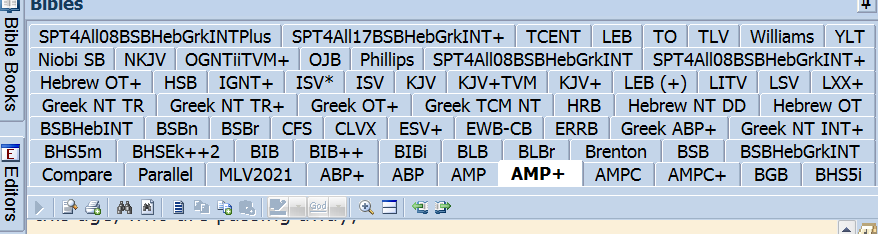
Ive been using net.bible.org classic for years When it actually read to you..but they changed its format..but if you put classic after it..It will come up on the net.

But what came up wasn’t it.. opps
But I’ll looking into Utley.

Careful—Utley is not for the fainthearted. He will challenge you. His work is not a typical commentary, but more of a guided deep-dive through the text. Still, you have the Ruach haKodesh, and with Him, your study will be a joy, not a burden.

Johann.

1 Like

Well for myself I believe I am 95% sure there was a difference in those terms..

Aren’t there also spirits that proceed from God.

Spirit of/from God

I believe Holy Ghost is in reference to power, Maybe power that is activated when one is moving in full faith with no doubt. - I didn’t get that by myself. Although I’m sure it is in alignment with many scriptures.
Like the one you presented.
My thought is if we are taking our substence from Christ, we are in him, then when we move like He did..we are sure to experience Him through our vessels. Are we not apart of His body?

@Corlove13

The verbs for justification in the NT are overwhelmingly in the aorist or perfect tense passive voice, indicating that justification is:

A completed act at the moment of true faith

Passive, received by grace, not achieved

Judicial, not transformational

Irreversible, unless one later abandons faith

Scripture presents justification as once, not many times. Repeated repentance restores fellowship and joy, not the verdict itself (Psalm 51:12).

Shalom.

Johann.

There are some VERY interesting findings coming out of current research on the Dead Sra scrolls using AI.

Here is a link: AI Just Aged the Dead Sea Scrolls—Big Time - NewsBreak