You addressed your post to me, but I’m not sure why.
The last comment wasn’t intentional, must of hit the wrong reply arrow. 
The Old Covenant is passed away. That’s why there is no obligation for Christians to observe the Sabbath, or have a Tabernacle/Temple (Christ and His Church are the Temple of God), or observe the Jewish feast days (Christ Himself is the Lamb of God who takes away the sins of the world). Etc.
But the Law, itself, isn’t “obsolete”, it is fulfilled.
I’m a Lutheran, so the way I’m going to approach this subject is though the lens of Lutheran theology, namely the notion of the Three Uses of the Law.
In the Lutheran Confessions there is the idea of the Three Uses of the Law, in brief these are:
- To curb evil through threats of outward punishments.
- To act as a mirror that reveals our sinful unrighteousness and inability to be righteous before God.
- To provide instruction on how the Faithful are to live their lives.
The first use of the Law would is about recognizing that a lawless world is chaotic and dangerous, and we need the framework of lawful order to keep ourselves, our families, and our neighbors safe. E.g. Murder is evil.
The second use of the Law is about how the Law reveals God’s justice/righteousness and, by stark contrast, we aren’t just/righteous–we are sinful and evil. Thus Jesus says that even if we harbor anger in our heart against someone we violate the commandment “Do not murder”, for we commit murder in our heart through anger and resentment; or why Jesus says that to even look upon someone else with lust is to commit adultery. We are, in our hearts, opposed to God, set at enmity against God because we are entirely sinful and unable to do a single thing in order to justify ourselves before God–and by justify I mean the literal sense of being just or righteous before God. The Law, therefore, justly condemns you, me, and every single person as sinful: guilty. The true irony in this, in fact, is that the harder we try to be righteous by the Law, the more sinful we find ourselves–the more deeply we understand what the commandment says, the more we discover we have failed to keep it. So that we find ourselves that which is sinful beyond measure–even in our most noble attempts to be good, we fail spectacularly. Therefore there is none who is just, not even one; for all have sinned and fallen short of God’s glory.
The third use means that, for those of us who have faith, that we have a blueprint for how we ought to conduct ourselves in the world. It’s not about our having righteousness before God, but rather righteousness toward our neighbor. So the commandment about the Sabbath does not mean that I, a Gentile and a Christian, am under obligation to observe the Sabbath in the way that a Jewish person under the Old Covenant was to observe it; I still learn from the commandment that it is good and right that there be rest from labor and to set aside time for what is sacred; more importantly that I recognize the need and good of others being able to rest. Thus a Christian employer ought to value the need for rest for his/her employees, this is how a Christian lives out their vocation as an employer, as just one example. To exploit others, even other creatures (recall that even beasts of burden were to be given rest), through harsh unyielding labor is wickedness. The Christian, therefore, is tasked by God to living a godly life, to love others and to seek out the good for our neighbor that they should flourish and thrive. We are under no obligation to observe the literal Sabbath, but we are obligated to live lives of holiness, charity, and kindness. In this way the commandment to remember the Sabbath becomes for us the importance and sacred goodness of rest, especially in regard to our treatment of others.
So it’s not about the Law being obsolete, but made full; and how the Law is used, when preached properly, for good order, to reveal sinfulness and drive us to repentance, and to guide us in lives of godliness and holiness.
1 Like
Well done @TheologyNerd
Brother, the way you’ve put it is close, but let me tighten it with what Scripture actually says. The Old Covenant is indeed set aside. Hebrews 8:13 says that by calling the covenant “new,” God has made the first “obsolete” (παλαιόω, palaiōō, to make old, worn out). Paul speaks of the “ministry of death, carved in letters on stone” as fading away in contrast to the glory of the Spirit (2 Corinthians 3:7–11). That is why Christians are not bound to temple, sacrifices, or feasts. Christ Himself is the Passover Lamb (1 Corinthians 5:7), Christ is the true Temple (John 2:19–21), and all the shadows find their telos (τέλος, end-goal, Romans 10:4) in Him.
But notice this: Jesus says in Matthew 5:17, “I did not come to abolish (καταλύω, katalyō, tear down) the Law or the Prophets, but to fulfill (πληρόω, plēroō, bring to fullness).” So the Law is not destroyed, it is fulfilled. Fulfilled means its purpose has reached completion in Christ. The ceremonies and shadows are finished, but the Law’s voice still speaks.
This is where the Lutheran framework of the three uses of the Law clarifies.
First use, the curb: the Law restrains outward sin, reminding us that murder is evil and societies must punish it (Romans 13:3–4).
Second use, the mirror: the Law exposes our guilt. Romans 3:20 says, “Through the Law comes knowledge (ἐπίγνωσις, epignōsis) of sin.” Jesus deepens this in Matthew 5:21–28, showing anger is murder of the heart and lust is adultery of the heart. The harder we try to justify ourselves by the Law, the more guilty we become. The Law slays us all and drives us to the cross, for “all have sinned and fall short (ὑστεροῦνται, husteroūntai) of the glory of God” (Romans 3:23).
Third use, the guide: for the believer, the Law shows how to live toward neighbor. Not to earn righteousness before God, but to walk in holiness. Take the Sabbath. Paul says, “Let no one pass judgment on you… with regard to a festival or a Sabbath” (Colossians 2:16–17). We are not bound to Jewish observance, but we still learn that God values rest, worship, and mercy. Deuteronomy 5:14 even commanded rest for servants and animals, which shows God’s heart for justice and compassion. So the Law guides the Christian employer not to exploit workers, but to act in love.
The point is this: the Old Covenant is gone, but the Law is fulfilled in Christ. Fulfilled does not mean erased, it means completed and reoriented. It curbs evil, condemns sin, and guides believers. Most importantly, it drives us again and again to the cross, where Christ bore the curse of the Law (Galatians 3:13), so that clothed in His righteousness we now live by the Spirit (Romans 8:4).
J.
2 Likes
Here is a nugget of info. to consider. 
So, in New Testament times it was not the Torah of Moses but rather Halakhah, Jewish Law, that formed the basis of the Jewish religion that the common, everyday Jewish people practiced; the religion we now call Judaism. Knowledge of the Biblical Torah was the province of the Temple and Priesthood, but for the Jewish people it was entirely secondary to following the accepted norms of Jewish society that were enforced in the synagogues by means of Halakhah. But, there was no single, standard Halakhah for all Jews to follow in unity, thus there were endless arguments and debates among Jewish Sages and Rabbis and we witness some of these especially between the Pharisees and Jesus.
I’t has been mentioned earlier that Jewish Law went by several names; unfortunately for us it often was merely called The Law or law for short, and we find that shortened term used especially by Paul, the student of Gamaliel. And yet the term The Law could (and did at times) refer to the Law of Moses (the Biblical Law) as well. In fact, I propose that many times that we find Paul speaking of the Law, he is not at all thinking of the Laws of Moses (The Bible), but rather of Halakhah, Jewish Law, the Jewish tradition-based code of conduct taught in the synagogue, which had been the foundation of Jewish society for at least 200 years by Paul’s day, and likely a few decades longer.
This understanding then compels us to read.
For instance, in Acts 24:14 Paul says that he believes everything that is written in the Law and the Prophets. This phrase (the Law and the Prophets) exactly mirrors what Christ said in Matthew 5:17 when he said not to think that He came to abolish the Law and the Prophets. The Law and the Prophets are 2 of the 3 divisions of the Hebrew Bible…the Old Testament; the 3rd is called The Writings. So, we need to take the words “the Law and the Prophets” as a well known and common Hebrew phrase that means the Old Testament. Therefore, clearly Paul and Yeshua are, in this case, speaking of Holy Scripture: the Torah Law of Moses and not Jewish Law, Halakhah.
But now let’s take another example of Paul and his use of the word law. In a famous quote that is often to used by some to claim that the Law of Moses has been abrogated, we read this in Galatians:
ESV Galatians 5:1-3 For freedom Christ has set us free; stand firm therefore, and do not submit again to a yoke of slavery. 2 Look: I, Paul, say to you that if you accept circumcision, Christ will be of no advantage to you. 3 I testify again to every man who accepts circumcision that he is obligated to keep the whole law.
This passage has always been contentious because nowhere in Jewish history have Jews ever thought of the Biblical Law of Moses as “a yoke of slavery”; rather this is but institutional defamation of the Old Testament by Christianity. And certainly, God the Father didn’t devise the Biblical Law to be a yoke of slavery and Yeshua never characterized it in such a way. The context is this: the people who Paul is thinking of are gentiles. And he says that if a gentile accepts circumcision (and in doing so they are formally converting to Judaism), then he must follow the “whole Law”. But what “law” is Paul talking about here? The context the “whole Law” that a former gentile must obey after having a circumcision (becoming a Jew) is Halakhah, Jewish Law; the rules and regulations that undergirds all of common Jewish society. Paul never says or implies that God demands that a gentile who becomes a Jew must obey all Jewish Law, because neither the Father nor the Son ever valid the authority of Jewish law…of Halachah…which is a manmade system. Rather it is that if one becomes a Jew, thereby taking on the societal obligation of the religion of Judaism, If one asked a Pharisee a theological question, or inquired about a proper behavior or the right way to observe a holy day (such as Shabbat), that Pharisee would usually not consult or quote the Biblical Torah. Rather he would tell you to do thus and so, because that is how it has always been done. He would say that Sages from long ago decided this matter, and it has been handed down this way for a long time. So, the proof of the right thing to do is that it has been done that way since time immemorial. And by New Testament times the requirements of Halakhah had indeed become burdensome, at times confusing and conflicting, and was a constant cause for dissention and debate among the various sects of Judaism who competed for members. Often these traditions and rulings of Jewish Law resembled nothing like what the Scriptures commanded. Yeshua had this to say about Halakhah:
CJB Mark 7:5-8 5 The pharisees and the Torah-teachers asked him, “Why don’t your disciples live in accordance with the Tradition of the Elders, but instead eat with ritually unclean hands?” 6 Jesus. answered them, "Jesus was right when he prophesied about you hypocrites- as it is written, ‘These people honor me with their lips, but their hearts are far away from me. 7 Their worship of me is useless, because they teach man-made rules as if they were doctrines.’ 8 "You depart from God’s command and hold onto human tradition.
The Pharisees were numerous, they were the leaders of the synagogues, and so they were the leaders of the masses. When we understand that Halakhah was the unquestioned basis of Jewish society in New Testament times, then when we listen to Paul and to Jesus, we learn that Christ did not set mankind free from the Laws of God, He set us free from the Laws of Man: Halakhah. Let,s say this another way: in New Testament times Jewish society as a rule did NOT look to the Biblical Torah of Moses for its direction; rather it looked to Halakhah…Jewish Law formulated from centuries of traditions and customs.
1 Like
@Steppingstone
Here is another nugget…
You make some very compelling points in your little treatise. I read it with great interest, and found it instructional. I could not help notice a modern parallel to your ancient Jewish insights – modern Christianity. I even thought (just to make the point) of copying your work and replacing the places where you point out Jewish excessive-reliance on customs and traditions with modern Christian parallels. I thought about it, but decided to just offer an explanation instead.
The Church today, like Israel of the past, is God’s representative voice on the earth among lost and sin-laden mankind. Yet there is no single unified voice to the world among those who fly the Christian banner. Without question, our message of good-news and salvation is diluted by our strict devotion to our customs and traditions. (some estimate the number of Christian factions to be around 45,000) I know you and I can do little to stem this situation we find ourselves in any more than the adherents of first-century Judaism could do to unify their voice, even within their own country. The bible reveals some sectarianism among the ancient Jews, Pharisee, Sadducee, Zealot, etc., which stubbornly adheared to their own customs and traditions, and thus promoted division and a disunified voice amongst the first-century leaders of Jewish thought and doctrine. We suffer the same disunity today. Although most, if not all Christian traditions claim they are an accurate expression of the Bible, they surely can’t all be. Most, if not all Christian traditions have used The Bible as their starting point, but have developed their liturgical distinctives and cultural practices from various extra-biblical sources and pressures. These practices (customs and traditions), over the years, become sacrosanct in the minds of the sectarian leadership, who bring corrective pressures against those in “their flock” who disregard them, or speak out against them in any way, even to the point of disfellowship, or worse.
The fact that we find ourselves in the very same situation the first-century Jew found himself in, and the fact that we have found no means of escape from it causes me to sympathize with their situation, and to more deeply sympathize with the difficulty of bringing a New Covenant message of “Good News” to bear against it. Paul’s ministry (and the ministry of all the apostles) was tantamount to walking into any of our congregations, from meetings of 10 to gatherings of thousands, and announcing a radical realignment strategy for our relationship with our creator. A “New Covenant” with God that no longer relies, or even needs to observe all the customs and practices our church has been protecting for possibly hundreds of years. It is mind-boggling to consider.
I am wondering, from your erudite point of view, if you have considered this parallel, and, if so, what are your thoughts?
KP
1 Like
re: “Most importantly, it drives us again and again to the cross, where Christ bore the curse of the Law…”
What was the curse that the Messiah bore that would otherwise have to be borne by us?
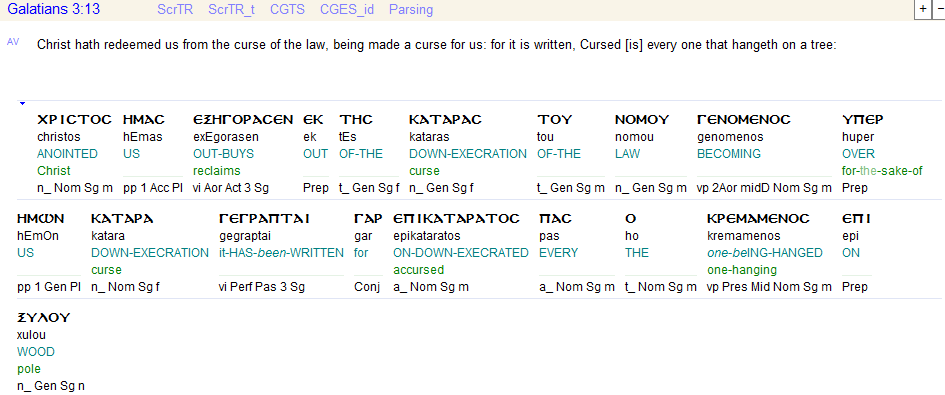
In Galatians 3:13, the apostle Paul writes, “Christ redeemed us from the curse of the law by becoming a curse for us—for it is written, ‘Cursed is everyone who is hanged on a tree’” (ESV). The phrase becoming a curse for us summarizes what Jesus did on the cross. His was more than a physical death; there was a spiritual dimension to what He did, and that is why His sacrifice is significant for our salvation.
Disobedience to God’s moral law places a curse on the one who disobeys. In the Old Testament, God made a covenant with Israel and gave them rules to obey. If they obeyed His laws, they would receive blessings. If they disobeyed His law, they would receive a curse. Deuteronomy 27:26 says, “Cursed is anyone who does not uphold the words of this law by carrying them out.” A curse was God’s righteous judgment against sin, disobedience, and rebellion. The “curse of the law” mentioned in Galatians 3:13 was upon us all, for we have all broken God’s moral law (Romans 3:10, 23).
The New Testament picks up Deuteronomy 27:26 and applies it to humanity as a whole: “All who rely on the works of the law are under a curse, as it is written ‘Cursed is everyone who does not continue to do everything written in the Book of the Law’” (Galatians 3:10) Because no one can perfectly obey the law, everyone is under the curse of the law.
The situation seemed hopeless, until Jesus graciously became a curse for us. In other words, Jesus suffered the penalty meant for us. Galatians 3:13 in the NLT says, “When he was hung on the cross, he took upon himself the curse for our wrongdoing.” Jesus was sinless, but He willingly took the curse of sin when He hanged on the cross and died. The blood He shed was the payment for our iniquities. Jesus went to that cross because He loved us; He died in our place by suffering the consequence of our sins.
Paul alludes to Deuteronomy 21:23, which says that “a hanged man is cursed by God” (ESV). As Jesus became a curse for us, He was being treated as if He were accursed (see Isaiah 53:4). The one who had no sin was regarded as if He were full of sin. The only Holy One was handled as if He were the most unholy. “God made him who had no sin to be sin for us, so that in him we might become the righteousness of God” (2 Corinthians 5:21).
The doctrine of substitutionary atonement—that Jesus died as a substitute for sinners—is clearly taught in the fact that Jesus became a curse for us. The same doctrine is prefigured in the Old Testament. In Leviticus 16, a goat was symbolically burdened with the people’s sins and then sent away into the wilderness. The goat was regarded as carrying the sins of the people away. Jesus was the perfect and final scapegoat. He bore our sin and, in doing so, took the curse we deserved. He, in fact, became a curse for us.
On the cross, Jesus experienced excruciating physical torment (Isaiah 53:5). He also experienced spiritual torment, bearing the weight of our sins and transgressions. In Matthew 27:46, Jesus cried loudly, “My God, my God, why have you forsaken me?” We deserved the punishment, but Jesus took it for us.
Jesus became a curse for us to free us from the power of sin and death. In Romans 6:6, Paul writes, “We know that our old self was crucified with him so that the body ruled by sin might be done away with, that we should no longer be slaves to sin.” In other words, by becoming a curse for us, Jesus freed us from the dominion of sin as well as the penalty of sin. The curse is lifted, and the promises of God are available to us by grace through faith in Christ.
J.
But your comments didn’t actually say what the punishment was that the Messiah experienced that we would have to experience had He not experienced it.
Actually, @rstrats, the Scriptures do answer your question, but I’d rather hear from you what you think the curse was that the Messiah nasaʾ-ed.
Right now, most of my posts are still “awaiting approval.”
J.
Is this a sincere question @rstrats ? Tell you what, you explain to me what the curse was that Messiah carried, and then we take it from there.
Or, would you like me to exegete this wonderful passage for you?
Isa 53:1 Who has believed our message?N1 And to whom has the arm of Jehovah been revealed?
Isa 53:2 For he grew up before himN2 like a young plant, and like a root out of parched ground; he had no form or majesty that we should look at him, and no beauty that we should desire him.
Isa 53:3 He was despised and rejectedN3 by men; a man of pains,N4 and acquainted with grief;N5 and as one from whom men hide their faces he was despised, and we esteemed him not.
Isa 53:4 Surely he has borne our griefs and carried our sorrows; yet we esteemed him stricken, smitten by God, and afflicted.
Isa 53:5 But he was pierced for our transgressions; he was crushed for our errors;N6 upon him was the chastisement for our peace, and with his wounds we are healed.
Isa 53:6 All we like sheep have gone astray; we have turned, every one, to his own way; and Jehovah has laid on him the error of us all.
Isa 53:7 He was oppressed, and he was afflicted, yet he opened not his mouth; like a lamb that is led to the slaughter, and like a sheep that before its shearers is silent, so he opened not his mouth.
Isa 53:8 By oppression and judgment he was taken away; and as for his generation, who considered that he was cut off out of the land of the living, stricken for the transgression of my people?
Isa 53:9 And he madeN7 his grave with the wicked and with a rich man in his death, although he had done no violence, and there was no deceit in his mouth.
Isa 53:10 Yet it was the will of Jehovah to crush him; he has put him to grief; when his soul makes a guilt offering,N8 he shall see his offspring; he shall prolong his days; the will of Jehovah shall prosper in his hand.
Isa 53:11 Out of the trouble of his soul he shall seeN9 and be satisfied; by means of his knowledge the righteous one, my servant, will bring a righteous standing to many people, and he shall bear their errors.
Isa 53:12 Therefore I will divide him a portion with the many, and he shall divide the spoil with the strong, because he poured out his soul to death and was numbered with the transgressors; yet he bore the sin of many, and makes intercession for the transgressors.
|Verse|Verb (transliterated)|Stem/Aspect|
|53:1|galah|Niphal|
|53:2|yaʿaleh|Qal|
|53:2|yihyeh|Qal|
|53:2|nirʾeh|Niphal|
|53:3|nibzeh|Niphal|
|53:3|chadal|Qal|
|53:3|histir|Hiphil|
|53:3|nibzeh|Niphal|
|53:3|chashavnu-hu|Qal|
|53:4|nasaʾ|Qal|
|53:4|saval|Qal|
|53:4|chashavnu-hu|Qal|
|53:4|nagaʿ|Qal|
|53:4|nakah|Hiphil|
|53:4|ʿanah|Pual|
|53:5|mecholal|Pual|
|53:5|medukkaʾ|Pual|
|53:5|hayah|Qal|
|53:5|nirpaʾ|Niphal|
|53:6|taʿinu|Qal|
|53:6|panah|Qal|
|53:6|hipgiaʿ|Hiphil|
|53:7|niggash|Niphal|
|53:7|naʿaneh|Niphal|
|53:7|pataḥ|Qal|
|53:7|yaviʾ|Hiphil|
|53:7|yiptaḥ|Qal|
|53:8|nigzar|Niphal|
|53:8|nagaʿ|Qal|
|53:8|hikkah|Hiphil|
|53:8|natan|Qal|
|53:9|natan|Qal|
|53:9|ʿasah|Qal|
|53:9|nimtsaʾ|Niphal|
|53:10|ḥafets|Qal|
|53:10|dakaʾ|Piel|
|53:10|heḥeli|Hiphil|
|53:10|tasim|Qal|
|53:10|yirʾeh|Qal|
|53:10|yaʾarikh|Hiphil|
|53:11|yirʾeh|Qal|
|53:11|yisbaʿ|Qal|
|53:11|yatsdiq|Hiphil|
|53:11|yisbol|Qal|
|53:12|achalēq|Piel|
|53:12|yaḥaloq|Qal|
|53:12|heʿerah|Hiphil|
|53:12|nimnah|Niphal|
|53:12|nasaʾ|Qal|
|53:12|pagaʿ|Qal|
From my updated ASV.
J.
1 Like
Johann,
re: "Is this a sincere question @rstrats ? "
Absolutely!
re: “Tell you what, you explain to me what the curse was that Messiah carried, and then we take it from there.”
If I knew that I wouldn’t have needed to ask the question. That’s why I asked you what the curse was that the Messiah bore that would otherwise have to be borne by us?
That’s a fair and honest question, and Scripture actually speaks very clearly about what “the curse” was that Messiah carried. The key text is in ~Galatians 3:13–14, where Paul writes, “Christ redeemed us from the curse of the Law by becoming a curse for us, for it is written, ‘Cursed is everyone who hangs on a tree,’ so that the blessing of Abraham might come to the Gentiles in Christ Jesus, so that we might receive the promise of the Spirit through faith.”
Here Paul quotes ~Deuteronomy 21:23, where the Hebrew verb qalal means “to curse, to treat as worthless or despised.” In the ancient context, a man executed and hung on a tree was publicly marked as rejected by God. The hanging was a visible sign that the man’s sin had brought covenantal judgment. In that sense, Paul says Jesus “became a curse,” not because He had sinned, but because He voluntarily bore the judicial penalty of sin on behalf of others.
So what was that curse? The curse of the Law was death under divine judgment. In ~Genesis 3:17–19, the word arar (to curse) describes God’s pronouncement of death and corruption upon creation because of Adam’s sin. That curse brought separation from God, toil, suffering, and ultimately mortality, what Paul later called “the wages of sin” (~Romans 6:23). Under the Mosaic covenant, the same pattern repeats: blessing for obedience, cursing for disobedience (~Deuteronomy 27–28). The ultimate curse in that list is separation from God and death under His wrath.
Messiah bore that curse in full. ~Isaiah 53 explains it prophetically: “He was pierced for our transgressions, He was crushed for our iniquities; the punishment that brought us peace was upon Him, and by His stripes we are healed.” The Hebrew verb nasaʾ means “to lift, to carry, to bear.”
Isa 53:5 But he was pierced [Yeshayah 51:9; Zecharyah 12:10 Sukkah 52a, Tehillim 22:17 Targum Hashivim] for our transgressions, he was bruised mei’avonoteinu (for our iniquities); the musar (chastisement) (that brought us shalom [Yeshayah 54:10] was upon him [Moshiach]; and at the cost of his (Moshiach’s) chaburah (stripes, lacerations) we are healed.
Isaiah uses it repeatedly for the Servant “bearing” sin, meaning He took the full weight of covenant-breaking guilt and its consequences.
At the cross, Jesus fulfilled that imagery. The Greek verb phero (to bear) and anaphero (to bear up) in ~1 Peter 2:24 describe how He “bore our sins in His body on the tree.”
1Pe 2:24 Moshiach, who himself NASAH (bore, carried away, Isa 53:4, 12) ES PEYSHA’EINU (our transgressions, our sins YESHAYAH 53:5,8,12) in geviyyato [BERESHIS 47:18; YESHAYAH 53:5] on HAETZ [DEVARIM 21:23] that, having become niftarim (deceased ones) to chattoteinu, we might become Kol Chai (all living) to Tzidkanut (Righteousness); UVACHAVURATO NIRPA LANU ("by whose wounds you were healed” YESHAYAH 53:5).
OJB.
The “tree” links back to the Deuteronomic curse, showing that His crucifixion was not a random death but the exact fulfillment of covenant judgment.
So the “curse” Messiah carried was the covenantal and cosmic penalty for human sin, alienation from God, wrath, death, and all that flows from rebellion. He took upon Himself the full consequence of our guilt so that we might stand under His blessing. As Paul puts it, “He made Him who knew no sin to be sin for us, so that we might become the righteousness of God in Him” (~2 Corinthians 5:21).
If Messiah had not carried that curse, we would remain under it still, condemned by the Law’s righteous demands, spiritually dead, and separated from God. But because He bore it, the curse is lifted, and the blessing of Abraham, the righteousness that comes by faith, is poured out upon all who believe. The cross was not just a symbol of suffering; it was the point at which the curse was exhausted and the blessing released.
J.
1 Like
Matthew 5:17-20 17 "Don’t think that I have come to abolish the Torah or the Prophets. I have come not to abolish but to complete. 18 Yes indeed! I tell you that until heaven and earth pass away, not so much as a yud or a stroke will pass from the Torah- not until everything that must happen has happened. 19 So whoever disobeys the least of these mitzvot and teaches others to do so will be called the least in the Kingdom of Heaven. But whoever obeys them and so teaches will be called great in the Kingdom of Heaven. 20 For I tell you that unless your righteousness is far greater than that of the Torah-teachers and P’rushim, you will certainly not enter the Kingdom of Heaven!
As Cal Thomas suggested; that America had lost its moral compass on account of departing from any kind of objective moral standard, then the answer to his correct assessment is to reestablish our moral compass. And the way to do that is to obey Yeshua by reestablishing the Law of Moses as that objective standard. Subjectivity this has never worked either in the Church or in our national government. At the same time, it was the Church that introduced the idea of a subjective morality, falsely claiming a biblical basis. Therefore, before any nation can adopt the Law of Moses as its moral code, the Church must advocate for it.
1st century Jewish culture (Yeshua’s era) often struggled with the Law just as we do (or at least as we should), because by that time at least 12 centuries had passed since Moses was given it at Mt. Sinai. Yeshua’s culture and their circumstances looked nothing like the ancient Israelite culture and their oppressive circumstances in Egypt, or of their 40-year journey in the wilderness, or in the early days of the Israelites in Canaan. How are we, then, so far removed from the event, to discern the spirit of the Law so that we can obey its many commandments? It begins with being devoted to the 2 foundational principles of the Law that Jesus emphasized: to love God with all our mind, soul and being; and second, to love our neighbor as ourselves. Upon that foundation was erected the 10 Commandments which outlined the basic rules of how to love God and love our fellow man. And then upon those 10 Commandments were built roughly 600 case examples of what each Commandment looked like in application in the lives of God worshippers, and what consequences were to be expected in our disobedience to them. But looking to the Bible instead of to the many varying manmade Church doctrines that each organization thinks loving God and loving our fellow man amounts to, is critical.
By taking the time to study the Law of Moses in its context and culture, and to then draw a mental picture of it as more or less the Believer’s Constitution, then we can (with some effort and prayer and the work of the Holy Spirit within us) transcend time and culture and bring obedience to the Law of Moses into the 21st century and beyond, thereby obeying Christ as He instructed. Only then will we have a true, objective moral code to live by.
Following the Law of Moses by no means says we are to reject modern technology, or our wonderful comforts, or world realities, or medical advances and return to an ancient way of life and living. Rather, we are to look to the overall Divine Paradigm set down by the Law and follow it…to the letter where still possible, but in the spirit of it, always. We must continually be seeking out the principle and the spirit behind each and every law of God; and then applying it in that way to our human circumstances which, by nature, are nearly infinite in their possibilities. The Law of Moses is not a living document that changes over time in lockstep with societal wants and desires. It is permanent and applicable to all human societies. Can some laws like the biblical kosher diet, observing the Sabbath and the biblical feasts, refusing to lie or murder, and viewing sex as sacred be directly obeyed in our time? Of course. And therefore, they should be. Other laws like regulations against intercropping or mixing materials in fabrics can be observed by understanding the spirit (the paradigm) of those laws rather than attempting to operate within the precise letter of them.
In the end, the Law of Moses and God’s free gift of grace through Yeshua are not two different paths to the same end. Nor is there one moral law code for Jews and another for gentiles, nor has the older (the Law of Moses) been replaced with a newer (the Law of Love). The New Covenant prophesied in Jeremiah 31 didn’t create a new faith, nor did it void the Law as the creators of the Constantinian Church claimed it did. Rather it enabled us to have a deeper devotion to the Law. Faith and trust in God are, and always were, the only means to redemption. Redemption through Christ and continuance of the Law are not mutually exclusive nor are they opposed to one another; instead, they are to work hand in glove in the lives of Believers for the sake of righteousness.
(Credit for the above is from one of many of Tom Bradford’s theological and inspired teachings)
God’s love, Mercy and Grace was magnificently shown to us by giving us the Law of Moses.
So, you’re saying that the curse is to be separated from the Father for 3 days and 3 nights, i.e., the time the Messiah spent in the “heart of the earth”?
When did Messiah became a curse for us? And what was the curse @rstrats ?
J.
Johann,
re: “When did Messiah became a curse for us?”
Apparently when He was put on the cross.
re: “And what was the curse…?
Again, I don’t know. That’s what I’m asking you.
The curse that the Messiah bore is rooted in the covenantal curse pronounced in the Mosaic Law upon those who transgress God’s commandments. Scripture presents Christ’s death on the cross as the moment in which He voluntarily took upon Himself the judicial curse that belonged to sinners, thereby redeeming His people through His substitutionary suffering. The cross is therefore not merely an execution but the place where the covenant curse fell upon the sin-bearer, and the resurrection demonstrates that the curse has been exhausted and overcome.
The foundation for this idea lies in the covenantal sanctions described in the Torah. When Israel broke the covenant, the law declared that the violator came under God’s curse. A specific expression of this curse appears in the law concerning execution.
Deuteronomy 21:23[1]
In the Hebrew text the phrase “cursed by God” is קִלְלַת אֱלֹהִים (qillath ʾĕlōhîm) meaning one under divine curse. The Septuagint renders the phrase κεκατηραμένος ὑπὸ θεοῦ, meaning “one accursed by God.” The idea is that a person publicly exposed on a tree represents someone placed under covenant judgment.
The New Testament explicitly applies this legal category to the crucifixion of Christ. Paul interprets the death of Jesus as the moment when He assumed the curse belonging to law-breakers.
Galatians 3:13[2]
Here Paul quotes directly from Deuteronomy and interprets the cross as the locus where Christ bore the covenant curse in the place of sinners. The phrase “became a curse” uses κατάρα (katara) meaning curse or divine judgment.
The reason this was necessary is that humanity stands condemned under the law because of sin. Scripture teaches that the law pronounces a curse upon those who fail to keep its commands perfectly.
Galatians 3:10[3]
Thus the curse Messiah bore is the judicial consequence of human sin before God’s law. It includes several dimensions described throughout Scripture.
First, it involves bearing sin itself, meaning the guilt of sinners placed upon the Messiah.
Isaiah 53:6[4]
Second, it involves enduring divine judgment, meaning the penalty required by God’s justice.
Isaiah 53:5[5]
Third, it involves being treated as the sin-bearer, though personally sinless.
2 Corinthians 5:21[6]
The crucifixion therefore represents the moment when the Messiah stood in the legal place of sinners, bearing the covenant curse that the law pronounced. Yet the narrative does not end at the cross. The resurrection is the divine vindication of the Son and the proof that the curse has been exhausted.
Acts 2:24[7]
Through the cross the curse of the law is borne by Christ, and through the resurrection the power of death is broken. Thus the Messiah bears the curse so that those united to Him may receive blessing instead of condemnation, fulfilling the promise that the blessing of Abraham would come to the nations through Him.
You agree @rstrats ?
J.
His body shall not remain all night on the tree, but you shall bury him the same day, for a hanged man is cursed by God. You shall not defile your land that the LORD your God is giving you for an inheritance. - ESV ↩︎
Christ redeemed us from the curse of the law by becoming a curse for us—for it is written “Cursed is everyone who is hanged on a tree.” - ESV ↩︎
For all who rely on works of the law are under a curse; for it is written “Cursed be everyone who does not abide by all things written in the Book of the Law, and do them.” - ESV ↩︎
All we like sheep have gone astray; we have turned—every one—to his own way; and the LORD has laid on him the iniquity of us all. - ESV ↩︎
But he was pierced for our transgressions; he was crushed for our iniquities; upon him was the chastisement that brought us peace, and with his wounds we are healed. - ESV ↩︎
For our sake he made him to be sin who knew no sin, so that in him we might become the righteousness of God. - ESV ↩︎
God raised him up, loosing the pangs of death, because it was not possible for him to be held by it. - ESV ↩︎
re: “You agree…?
No, not if you think that your comments say what the curse actually consists of. Exactly what was the curse that was placed on the Messiah that would otherwise have to be placed on us?
The “curse” that the Messiah bore refers to the divine judgment and penalty that belonged to sinners under the law, the judicial consequence of human sin, which He took upon Himself on the cross. Scripture presents this as Christ standing in the legal place of humanity, enduring what the law required for sin, though He was personally sinless.
The foundation is the Mosaic declaration that lawbreakers are under a curse:
Deuteronomy 21:23[1]
Paul explicitly applies this to Jesus:
Galatians 3:13[2]
The curse encompasses several dimensions:
Bearing sin itself – the guilt of humanity placed upon Him:
Isaiah 53:6[3]
Enduring God’s righteous judgment – the penalty required for transgressions:
Isaiah 53:5[4]
Being treated as a sinner though sinless – substitutionary identification with humanity:
2 Corinthians 5:21[5]
The cross is therefore the moment and place where the covenant curse fell on Christ instead of sinners, satisfying the law’s demand for justice. The resurrection shows that the curse is exhausted and Christ’s victory is complete:
Acts 2:24[6]
In short, the curse Messiah bore is the full weight of humanity’s sin, guilt, and the law’s penalty, which He endured voluntarily, so that all who are united to Him would receive blessing and forgiveness instead of condemnation.
You now know what the curse was and is, our sins, breaking YHWH’ commandments, do you have this forgiveness @rstrats ?
J.
His body shall not remain all night on the tree, but you shall bury him the same day, for a hanged man is cursed by God. You shall not defile your land that the LORD your God is giving you for an inheritance. - ESV ↩︎
Christ redeemed us from the curse of the law by becoming a curse for us—for it is written “Cursed is everyone who is hanged on a tree.” - ESV ↩︎
All we like sheep have gone astray; we have turned—every one—to his own way; and the LORD has laid on him the iniquity of us all. - ESV ↩︎
But he was pierced for our transgressions; he was crushed for our iniquities; upon him was the chastisement that brought us peace, and with his wounds we are healed. - ESV ↩︎
For our sake he made him to be sin who knew no sin, so that in him we might become the righteousness of God. - ESV ↩︎
God raised him up, loosing the pangs of death, because it was not possible for him to be held by it. - ESV ↩︎