Again, I haven’t seen where they have.
OK, let’s try it a different way:
What is the penalty/price/payment/punishment for sinning?
Only a one sentence answer is necessary.
Again, I haven’t seen where they have.
OK, let’s try it a different way:
What is the penalty/price/payment/punishment for sinning?
Only a one sentence answer is necessary.
Why a “once sentence answer?”
J.
Because as I said, that is all that is needed.
rstrats, what would be your one sentence answer?  you must have one, because it seems like you’re not satisfied with any of the answers that have been provided thus far.
Without researching, 10 commandments/ law of the conscience outside of Christ, but in Christ freedom.
Walking by flesh <------------------------->walking by spirit
If one lives by the Spirit they will not fullfill the lust of the flesh.
One in Christ is not under the Law…
One question @Corlove13
…the question of whether the moral law is abrogated for the believer requires careful lexical and canonical analysis, because Scripture distinguishes between the law as covenant administration and the moral will of God expressed within that law. When the biblical data are examined closely the conclusion is that the Mosaic covenant as a legal administration is fulfilled and no longer binding as covenant law, yet the moral will of God revealed in the law is not abolished but fulfilled and internalized in the believer through Christ and the Spirit.
The first point concerns the New Testament declaration that believers are not under the Mosaic law as a covenant system.
“For sin will have no dominion over you, since you are not under law but under grace.”[1]
The phrase ὑπὸ νόμον (hypo nomon) means “under the jurisdiction or dominion of the law.” Paul’s argument in ~Romans 6 concerns covenantal authority. Believers are no longer under the law as the governing covenant that defines their standing before God. Instead they stand under grace, meaning justification and life come through union with Christ.
This is further clarified when Paul explains that believers have died to the law through Christ’s body.
“Likewise, my brothers, you also have died to the law through the body of Christ.”[2]
The verb ἐθανατώθητε (ethanatōthēte) is an aorist passive meaning “you were put to death,” indicating a definitive covenantal transition through union with Christ’s death and resurrection.
However the second point is equally crucial. Scripture explicitly denies that the moral content of the law is abolished.
“Do we then overthrow the law by this faith? By no means On the contrary we uphold the law.”[3]
The Greek verb καταργοῦμεν (katargoumen) means “to nullify or render inoperative.” Paul emphatically denies that faith cancels the law’s moral validity.
Jesus Himself addressed the same issue directly.
“Do not think that I have come to abolish the Law or the Prophets I have not come to abolish them but to fulfill them.”[4]
The verb καταλῦσαι (katalysai) means “to dismantle or destroy,” while πληρῶσαι (plērōsai) means “to bring to completion or fullness.” Christ fulfills the law by accomplishing its redemptive purpose and revealing its true intent.
The third point concerns the prophetic promise that the moral law would be internalized in the new covenant.
“For this is the covenant that I will make with the house of Israel after those days declares the Lord I will put my laws into their minds and write them on their hearts.”[5]
The Greek word νόμους (nomous) translates the Hebrew תּוֹרָה (tôrāh) meaning instruction or law. The promise does not abolish God’s law but relocates it from external tablets to the internal life of the believer.
The fourth point is that the New Testament repeatedly summarizes the continuing moral will of God through the law of love, which encapsulates the ethical core of the commandments.
“For the whole law is fulfilled in one word You shall love your neighbor as yourself.”[6]
Here the verb πεπλήρωται (peplērōtai) from πληρόω indicates that love brings the law to its intended completion rather than replacing it.
Paul therefore describes the Christian ethical framework as “the law of Christ.”
“Bear one another’s burdens and so fulfill the law of Christ.”[7]
The expression νόμον τοῦ Χριστοῦ (nomon tou Christou) refers to the moral will of God as revealed and embodied in Christ and applied through the Spirit.
Thus when we synthesize the biblical data we arrive at several precise conclusions.
The Mosaic covenant law as a legal administration governing Israel is no longer binding upon believers because it has been fulfilled in Christ.
The believer is therefore not justified or condemned by the law.
However the moral will of God expressed in the commandments is not abolished but fulfilled and internalized through the Spirit.
Christian obedience arises not from covenantal legal obligation but from transformation through union with Christ.
This dynamic is summarized in Paul’s description of the new covenant life.
“For God has done what the law weakened by the flesh could not do.”[8]
The purpose of this redemptive work is immediately explained.
“In order that the righteous requirement of the law might be fulfilled in us who walk not according to the flesh but according to the Spirit.”[9]
You agree?
J.
I think you answered it right there: While we are not under it as to our direct abilities trying to keep it.
We see that Jesus has kept it.
So how do we uphold it? Obedience to His Spirit/word; living by it.
Another words the law is fullfilled when we walk in His Spirit/word/ teachings/commands/ principles
Another words when you are walking in the way of life the law is naturally upheld.
For who Can go directly North and Directly South at the same time.
For aspects of Love are , it seeks not its own, holds no records of wrong, doesn’t covet.
Thereby, if you seek not your own but the well being of others, you are not cheating, lying, stealing and so forth.
Hence the law is naturally upheld by those who walk not after the flesh but the Spirit.
So where is the Law in Christ?
Romans 8:2[1]
Law of Sin and Death
~Romans 8:2
Romans 7:23[2]
Law of Sin
~Romans 7:23, 25
Law of the Mind
~Romans 7:23
Law of God
~Romans 7:22, 25
Law of Christ
~Galatians 6:2
Law of Faith
~Romans 3:27
Law of Works
~Romans 3:27
Law of Righteousness
~Romans 9:31
Law of Love (implicit formulation)
~Romans 13:8–10
~Galatians 5:14
Law as Pedagogue (functional category)
~Galatians 3:24
Law of the Spirit of life
• Law of sin and death
• Law of sin
• Law of the mind
• Law of God
• Law of Christ
• Law of faith
• Law of works
• Law of righteousness
What to do @Corlove13 ? Help me out here.
J.
I see a whole bunch of scriptures but what is your question? I thought the thread was talking about the law of Moses under the Covenant God made with Israel.
What to do …Trust Jesus!
OH!! Was Moshe under the law?
J.
Steppingstone,
re: “rstrats, what would be your one sentence answer? you must have one, because it seems like you’re not satisfied with any of the answers that have been provided thus far.”
Well, one might be:
“Being tortured 24/7 for eternally in the lake of fire.”
Another could be:
“Being annihilated.”
Other than maybe defining “tortured” or “annihilated” no further explanation is necessary.
Ok, that’s not what I would have expected. ???
Here is one of My favorite Teachers: AI
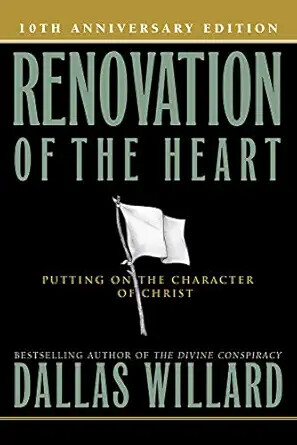
Dallas Willard defines the “law written on the heart” (from the new covenant) as the internal transformation where God’s requirements become a natural desire rather than an external obligation. It represents an internal revolution of the spirit where the will and motivations align with God’s intentions, shifting obedience from strained effort to a joyful, natural expression of a renewed heart.
Key Aspects of Willard’s View:
Essentially, Willard argues that under the new covenant, God changes our deepest motivations, so that the divine law is no longer something we must “obey” from the outside, but something we are from the inside.
Do you have a link on this @Corlove13 ?
As Christians, we know that we are new creations in Jesus. So we try to act differently, hoping this will make us more like Him. But changing our outward behavior doesn’t change our hearts. Only by God’s grace can we be transformed internally. Renovation of the Heart lays a biblical foundation for understanding what best-selling author Dallas Willard calls the “transformation of the spirit”―a divine process that “brings every element in our being, working from inside out, into harmony with the will of God.”
This fresh approach to spiritual growth explains the biblical reasons why Christians need to undergo change in six aspects of life: thought, feeling, will, body, social context, and soul. Willard also outlines a general pattern of transformation in each area, not as a sterile formula but as a practical process that you can follow without the guilt or perfectionism so many Christians wrestle with.
Don’t settle for complacency. Accept the challenge Renovation of the Heart offers to become an intentional apprentice of Jesus Christ, changing daily as you walk with Him.
Available only on Amazon.
J.
Corlove13,
re: “Dallas Willard defines the ‘law written on the heart’ (from the new covenant) as the internal transformation where God’s requirements become a natural desire rather than an external obligation.”
So, regardless of the motivation His requirements remain the same.
Rom_8:2 “the law of the Spirit of life. . . the law of sin and of death” This could refer to
NASB, NRSV,
NJB “has set you free”
NKJV, TEV “had made me free”
Rom_8:2-3 are the theological message of Romans 6. There are several different pronouns which appear in the ancient Greek texts
The Law was incapable of providing deliverance (cf. Gal_3:21). On the contrary, it only provided condemnation, death, and curse (cf. Galatians 3)!
“weak as it was through the flesh” This is Paul’s basic argument of Romans 7. The Law of God is good and holy, but sinful, fallen, rebellious mankind cannot perform its requirements. Paul, unlike the rabbis, emphasized the consequences of Genesis 3. Most rabbis attribute the instigation of evil into the world at Genesis 6.
J.
re: “The Law of God is good and holy, but sinful, fallen, rebellious mankind cannot perform its requirements.”
So, are the requirements still in force? Yes or no?
Yes, absolutely still in force.
J.
So, that answers the OP’s question.
What is the purpose of the Mosaic law @rstrats ?
Moral Law (Ten Commandments) Reveals God’s moral standards and human sinfulness.
Civil Law (ordinances) Governs Israel’s social and national life.
Ceremonial Law (priesthood, sacrifices, feasts) Provides a system of worship pointing to Christ.
J.