Why do you think sincere Christians sometimes reach different conclusions on secondary biblical topics?

Christians across many denominations agree on the core of the Gospel, yet they sometimes interpret other passages differently.

Why do you think God allows faithful believers who love Scripture to arrive at different conclusions on some topics? What can we learn from that?

1 Like

I really must admit, you ask some really good questions, @ellenvera. It is one of the most striking realities of the Christian faith. Two people can possess the same high view of Scripture, pray for the same Holy Spirit guidance, study the same verses, and yet walk away with completely different conclusions on major topics, such as church government, end-times theology, or the mechanics of salvation.

If God desired absolute uniformity in every minor theological detail, He certainly could have written Scripture as a rigid, bulleted systematic theology textbook. Instead, He gave us a collection of narratives, poetry, prophecy, and letters spanning thousands of years.

From a biblical and theological perspective, there are several profound reasons why God might allow this, and crucial lessons it is meant to teach us. Historically, theologians have divided doctrines into categories often called “primary” or the core essentials of the Gospel, and “secondary” or “tertiary” or disputed matters.

On the essentials, the nature of God, the deity of Christ, salvation by grace through faith, Scripture is remarkably clear (perspicuous).

On peripheral issues, Scripture often leaves room for interpretation. This structure suggests God intentionally prioritized a unified focus on the Person of Jesus over a uniform agreement on every operational detail.

No one reads Scripture in a vacuum. We all bring our cultural backgrounds, language constraints, personal experiences, and historical contexts to the text. God chose to communicate through human language and history, meaning our finite minds are always attempting to grasp an infinite God. Differences in conclusions often reveal the vastness of God’s truth, which cannot be neatly captured by any single human system of thought.

The existence of these differences isn’t a flaw in the design of the Church; it is a feature that serves a deep spiritual purpose.

If every faithful study of Scripture yielded the same answers, it would be incredibly easy to become arrogant in our own intellect. Encountering a fellow believer who loves God, knows the Bible inside and out, and genuinely disagrees with us forces us to check our pride. It reminds us of Paul’s words in 1 Corinthians 13:12:

" For now we see in a mirror dimly, but then face to face. Now I know in part; then I shall know fully, even as I have been fully known."

Jesus stated that the world would know His disciples by their love for one another (John 13:35), not by their 100% agreement on a theological grid. Agreeing with people who think exactly like you requires zero supernatural grace. Loving, honoring, and sharing a communion table with someone who holds a different view on a non-essential doctrine requires the actual fruit of the Holy Spirit.

Iron sharpens iron (Proverbs 27:17). When faithful believers disagree, it drives both sides deeper into the text. It forces us to ask: Why do I believe what I believe? Have I misread this context? Disagreement prevents the Church from falling into intellectual laziness. It demands that we dig into the historical, linguistic, and contextual roots of Scripture rather than settling for superficial proof-texting.
Peter

This is a question that has occupied faithful, careful readers of Scripture for centuries, and I think it deserves a thoughtful answer rather than a simple one.

Why God may allow this diversity
Scripture itself seems to anticipate this reality. Paul tells the Corinthians, “For now we see through a glass, darkly… now I know in part” (1 Corinthians 13:12), acknowledging that even mature believers possess only partial understanding this side of eternity. This suggests that incomplete knowledge is not a failure of faith but simply the condition of finite creatures encountering an infinite God.

At the same time, Scripture is unambiguous about what matters most. Paul reminds the Corinthians that he delivered to them “first of all” the truth that Christ died for our sins, was buried, and rose again according to the Scriptures (1 Corinthians 15:3-4). This primacy is telling, the resurrection and the gospel are treated as bedrock, while many other matters are addressed with less repetition and less force throughout the New Testament.

There also seems to be a purpose behind the church’s diversity of gifts and emphases. Paul describes the church as one body with many members, each with differing functions, “that there should be no division in the body, but that the members should have the same care one for another” (1 Corinthians 12:25). It is not difficult to extend this principle to traditions and denominations, each may steward a particular emphasis (God’s sovereignty, human responsibility, the nature of the sacraments) that serves the wider body, even though no single tradition possesses the whole picture in isolation.

Finally, Scripture suggests that wrestling with difficult matters is itself spiritually formative. James writes that the trying of faith “worketh patience” and that this patience has “her perfect work” in maturing the believer (James 1:3-4). Working through disagreement with humility and care may be part of how God matures both individuals and the church corporately, rather than a problem to be eliminated.
What this teaches us
A few principles follow from this:

Hold the center firmly, and the periphery humbly. Paul instructs Timothy to guard “that which is committed to thy trust” (1 Timothy 6:20) regarding sound doctrine, yet elsewhere counsels patience and gentleness toward those who differ (2 Timothy 2:24-25). Conviction on the gospel and charity on secondary matters are not in tension, Scripture asks for both.

Differing conclusions need not signal disobedience. Romans 14 addresses believers who disagreed sharply over dietary practices and holy days, and Paul’s counsel is not that one side must capitulate, but that “each one should be fully convinced in his own mind” (Romans 14:5) and that neither should judge the other harshly.

Unity does not require uniformity. Jesus prays in John 17 that His followers “may be one” (John 17:21), and this oneness is rooted in shared love and shared mission, not identical conclusions on every secondary doctrine.

This reality guards against pride. “Now we see through a glass, darkly” (1 Corinthians 13:12) is a humbling word for every tradition. If sincere, Spirit-filled believers across centuries and cultures have studied the same Scriptures and arrived at different conclusions on secondary matters, it should caution any of us against assuming we alone have arrived at a flawless .understanding.

Now that being said…

Hope this is helpful.

J.

1 Like

As Christians, there are certain things we all believe and it’s our belief and trust in those things that make us Christians. You are talking about secondary things that don’t touch on the core beliefs. I’m not sure, but I think those core beliefs are shared in the Apostle’s Creed.

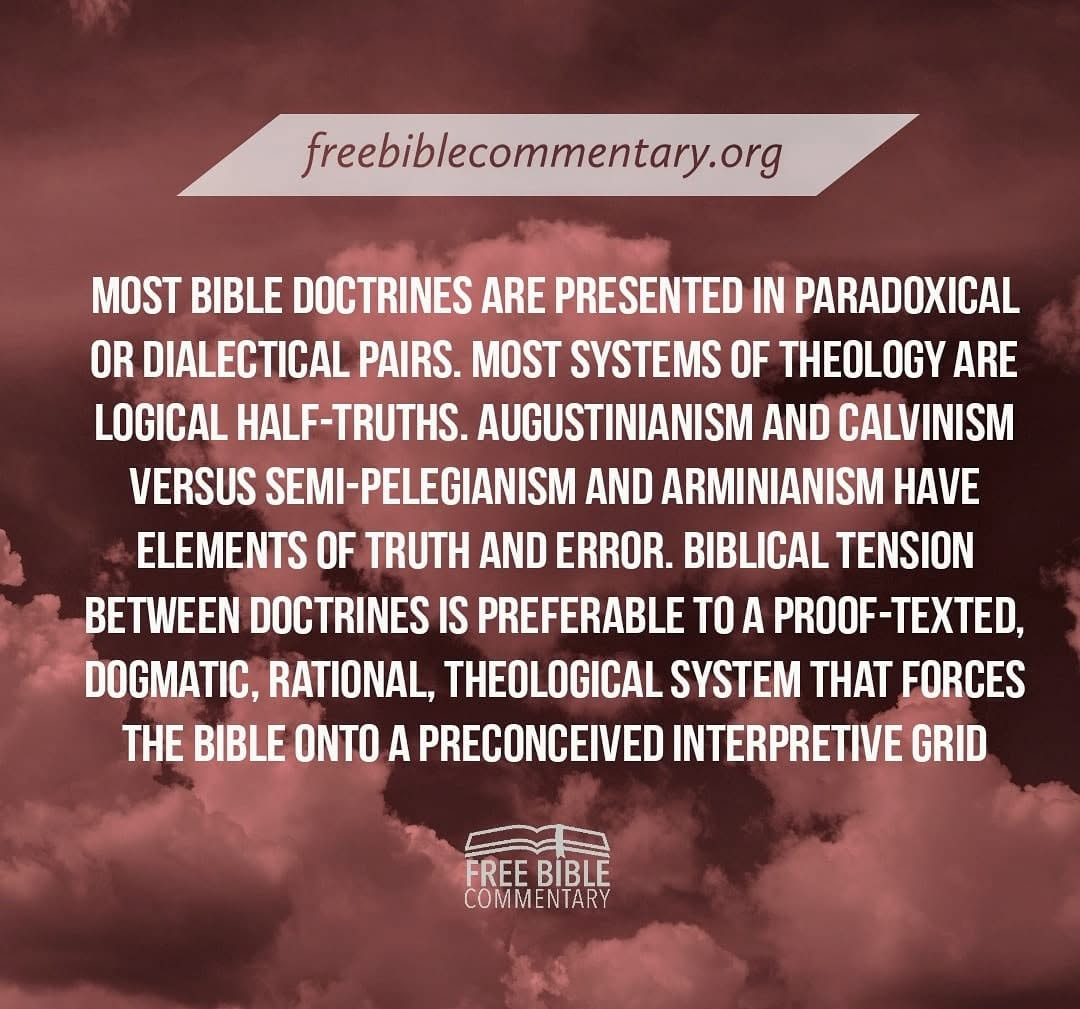
Sometimes there is more than one way of looking at it and both are correct. They don’t contradict each other, but compliment each other. A passage can be taken literally and yet there’s also a deeper meaning behind it and both views are correct.
The Word of God is living and powerful. It’s not a flat dogma we adhere to because the Word leaps off the page and into the heart. Like the gifts of the Spirit, the Word may speak to me in a different way than it speaks to you, but it is the same Word.
The Word can be literal and symbolic of something else at the same time. Both are correct and to learn of someone else’s view brings added understanding of what God is saying.
None of us have it down pat. None of us fully comprehend our God, but we know what He has given us to know, and what He’s given is enough.
Paul just talked about this in 1 Cor 8:9-13. Paul knows he’s at liberty to eat food that’s been offered to an idol. His conscious is free and clear regarding this. His brother however believes it would be a sin to do so. Who is right?
The answer is that it doesn’t matter who is right. Paul, as the stronger brother is called to put aside his freedom for the sake of the weaker brother. What we eat and where we eat is not a core issue, so let’s not make it one. The core issue here is not to use our freedom to cause another person to violate what they believe. The main thing is that we have a responsibility to the family of God.

1 Like

Doctrine is “a set of ideas or beliefs that are taught or believed to be true.” Biblical doctrine refers to teachings that align with the revealed Word of God, the Bible. False doctrine is any idea that adds to, takes away from, contradicts, or nullifies the doctrine given in God’s Word. For example, any teaching about Jesus that denies His virgin birth is a false doctrine, because it contradicts the clear teaching of Scripture (Matthew 1:18).

As early as the first century AD, false doctrine was already infiltrating the church, and many of the letters in the New Testament were written to address those errors (Galatians 1:6–9; Colossians 2:20–23; Titus 1:10–11). Paul exhorted his protégé Timothy to guard against those who were peddling heresies and confusing the flock: “If anyone advocates a different doctrine and does not agree with sound words, those of our Lord Jesus Christ, and with the doctrine conforming to godliness, he is conceited and understands nothing” (1 Timothy 6:3–4).

As followers of Christ, we have no excuse for remaining ignorant of theology because we have the “whole counsel of God” (Acts 20:27) available to us, the Bible is complete. As we “study to show ourselves approved unto God” (2 Timothy 2:15), we are less likely to be taken in by smooth talkers and false prophets. When we know God’s Word, “we are no longer to be children, tossed here and there by waves and carried about by every wind of doctrine, by the trickery of men, by craftiness in deceitful scheming” (Ephesians 4:14).

It is important to point out the difference between false doctrine and denominational disagreements.

Different congregational groups see secondary issues in Scripture differently. These differences are not always due to false doctrine on anyone’s part. Church policies, governmental decisions, style of worship, etc., are all open for discussion, since they are not directly addressed in Scripture. Even those issues that are addressed in Scripture are often debated by equally sincere disciples of Christ. Differences in interpretation or practice do not necessarily qualify as false doctrine, nor should they divide the Body of Christ (1 Corinthians 1:10).

False doctrine is that which opposes some fundamental truth or that which is necessary for salvation. The following are some examples of false doctrine:

The erasing of hell. The Bible describes hell as a real place of eternal torment, the destination for every unregenerate soul (Revelation 20:15; 2 Thessalonians 1:8). A denial of hell directly contradicts Jesus’ own words (Matthew 10:28; 25:46) and is therefore a false doctrine.

The idea that there are “many paths to God.” This philosophy has become popular recently under the guise of tolerance. This false doctrine claims that, since God is love, He will accept any religious effort as long as the practitioner is sincere. Such relativism flies in the face of the entire Bible and effectively eliminates any need for the Son of God to take on flesh and be crucified for us (Jeremiah 12:17; John 3:15–18). It also contradicts Jesus’ direct words that He is the only way to God (John 14:6).

Any teaching that redefines the person of Jesus Christ. Doctrine that denies the deity of Christ, the virgin birth, His sinless nature, His actual death, or His physical resurrection is false doctrine. A group’s errant Christology readily identifies it as a sect or cult that may claim to be Christian but is actually teaching false doctrine. Even many mainline denominations have begun the rapid slide into apostasy by declaring that they no longer hold to a literal interpretation of Scripture or the deity of Christ. First John 4:1–3 makes it clear that a denial of biblical Christology is “anti-Christ.” Jesus described false teachers within the church as “wolves in sheep’s clothing” (Matthew 7:15).

Teaching that adds human religious works to Christ’s finished work on the cross as necessary ingredients for salvation. This teaching may pay lip service to salvation by faith alone but insists that a religious ritual (such as water baptism) is salvific. Some groups even legislate hairstyles, clothing options, and food consumption. Romans 11:6 warns against attempts to mix grace with works. Ephesians 2:8–9 says we are saved by the grace of God, through faith, and nothing we do can add to or take away from it. Galatians 1:6–9 pronounces a curse on anyone who changes the good news of salvation by grace.

The teaching that presents grace as a license to sin. Sometimes called “easy-believism,” this false doctrine implies that all one must do for right standing with God is to believe the facts about Jesus, pray a prayer at some point, and then resume control of one’s life with the assurance of heaven at the end. Paul dealt with this thinking in Romans 6. In Matthew 7:21–23, Jesus warned those who adopt this doctrine that they did not know Him at all. Second Corinthians 5:17 states that those who are “in Christ” become “new creatures.” That transformation, in response to a believer’s faith in Christ, changes the outward behaviors. To know and love Christ is to obey Him (Luke 6:46).

Satan has been confusing and perverting the Word of God since the Garden of Eden (Genesis 3:1–4; Matthew 4:6). False teachers, the servants of Satan, try to appear as “servants of righteousness” (2 Corinthians 11:15), but they will be known by their fruits (Matthew 7:16). A charlatan promoting false doctrine will show signs of pride, greed, and rebellion (see Jude 1:11) and will often promote or engage in sexual immorality (2 Peter 2:14; Revelation 2:20).

Per kind favor of…

J.
1 Like