To put it simply: there are those who believe in His existence, and then there are true believers. Given this, Can someone believe but not be saved?
Even the demons believe, and tremble! James 2:19
4 Likes
Faith, as St. Paul uses it over and over again, isn’t what we might call “mere belief”. It’s not subscribing to a set of theological tenets. Faith is perhaps better understood in this sense as trust. When we read that it is by grace that we are saved, through faith; the faith being spoken about is trust in Christ. It’s deeply relational, and I think Dr. Luther puts it best when he describes faith as “a bold trust in God’s grace”. A good analogy of faith is the infant that clings to its mother; the infant has an intimate trust that its mother cares for him/her; the infant clings, trusts, relies, and is comforted in the reality of its mothers care and love.
This isn’t to say that adherence to the truth is unimportant (of course it is!). But it isn’t having the “right beliefs” that saves us; it’s that we are brought into a new and transformed relationship with God through Christ, by the power of God’s grace–it is a new life, a covenantal relationship, which depends upon, trusts, clings to Christ. The reason why believing true things is so important isn’t because we’re saved by believing the right things–but rather that truth nourishes, encourages, feeds, and sustains faith; whereas heresy robs us of faith; it sows injury, it injures how we see God and we cease to behold God through faith in Christ, and have a distorted vision of who God is, a distorted vision of Christ, a distorted view of what it means to live and walk by faith. That’s danger of false teaching, it moves us away from faith rather than brings us deeper into faith.
We can see, in many cases in Scripture, where “mere belief” is not what is the point. In Matthew ch. 7 the Lord speaks of those who will say on the Last Day, “Lord, Lord” but He will say to them, “I never knew you”. Those described as saying “Lord, Lord” wouldn’t say “Lord, Lord” if they did not, on some level “believe”; they are even described as appealing to the works they did for Jesus, and in Jesus’ name, “Did we not prophesy in Your name?”. There is a double-whammy of condemnation: Mere belief, and appealing to our good works aren’t what truly matters. Rather it’s the faith in Christ that works through love that matters (see e.g. Galatians 5:6). On the Last Day when we stand before Christ who comes as Judge of the quick and the dead, the Lord isn’t going to give us a theology quiz to pass. And appealing to all our good works won’t mean anything either.
Do we trust in Christ? Then we should hear when He says, “I was hungry” and “I was thirsty” and “I was naked” and “I was sick” and “I was in prison” and “I was a stranger”. Not because we trust in our works–but because faith cannot help but do good works. This should stir in us two things:
-
To recognize that before the Law we are wretched sinners who must confess our sins, repent, and recognize that before the Holy God we are most unholy and can offer nothing good. Like a beggar with an empty hand, we come before God with nothing.
-
That God is infinitely compassionate and loving, His mercy is never-ceasing, and out of His abundance He freely gives of Himself to us; so that our empty hand receives what God so freely and wonderfully gives. And the one who receives such wondrous gifts is moved to share and imitate that same boundless mercy.
This is why it is so important to properly preach Law and Gospel; and to recognize that the Law is Law and the Gospel is Gospel. The Law cannot justify, but the Law does show us our own nakedness and wretchedness; not because God intends to be cruel, but because God is holy and He created us to be holy–and yet we are not holy. So when I hear the commandment “Love the Lord your God … and love your neighbor as yourself” the result is two-fold: I have failed to love God and I have failed to love my neighbor, “Lord have mercy on me, a sinner”; and secondly that I must, indeed, love God and love my neighbor. I have failed, and the Law still tells me to do it. So I must do it. Because I have failed, the Law cannot save me; but because the Law is holy, I know I must also be holy for God is holy.
The Gospel is not like the Law. The Gospel is kindness and comfort for the wretched sinner. So when I pray, “Lord, have mercy on me a sinner” it is the Gospel that tells me that God is, indeed, truly merciful, He has shown me mercy: The mercy of His Son who suffered and died for me. For truly God so loved the world that He gave His only-begotten Son that whoever trusts in Him should not perish, but have life everlasting. Christ died for me, wretch and sinner, and therefore even where sin abounds, grace super-abounds.
So the Law drives us to our knees, and the Gospel is God meeting us on our knees as loving Abba–Father–who embraces us in Christ, who clothes us with His only-begotten Son, and breathes His Spirit in us making us new, adopting us as sons. And the Law remains, no longer condemning the one who is in Christ Jesus (For there is now no condemnation for those in Christ Jesus), saying be holy, for I the LORD am holy. In our failure we are not destroyed, in God’s grace we are being saved, and we are now invited to walk and live a new life, defined not by the old Adam who is bound by death; but the new Man–Christ–who is risen from the dead.
1 Like
one is not saved by believing in God, as Bestill said. even demons believe in God and they are not saved.
It is believe/faith in Jesus that saves.
“Now there was a day when the sons of God came to present themselves before the LORD, and Satan also came among them.” Job 1
“Again, there was a day when the sons of God came to present themselves before the LORD, and Satan also came among them to present himself before the LORD. And the LORD said to Satan, “From where have you come?” Satan answered the LORD and said, “From going to and fro on the earth, and from walking up and down on it.” Job 2:1-2
Yes, Satan not only knows God is real. He has seen and spoken to Him face to face.
“Then he showed me Joshua the high priest standing before the angel of the Lord, and Satan standing at his right hand to accuse him. And the Lord said to Satan, “The Lord rebuke you, O Satan! The Lord who has chosen Jerusalem rebuke you! Isn’t this a brand plucked from the fire?” Zechariah 3:1-2
Here is something else to think about. Satan also knows the Bible. He can quote it, or misquote it, word for word. He was there when it was written. So only your faith in Jesus can actually save you. Not knowing there is a God. Not even just knowing the Word. But Jesus the Christ only.
Peter
2 Likes
Yes, see Muslims, and other world relgions, for unless they have Jesus as Savior and Lord, no salvation
So its not about believing in God, but believing that Jesus died on the cross for our sins?
Yes. The Bible clearly distinguishes between mere belief in God and saving faith in Christ. Just believing that God exists, acknowledging His reality intellectually, is not the same as trusting in Him for salvation
J.
2 Likes
Israel…was informed to move from law to faith.
They believed in God but many did not receive Christ.
Now what about the cosmic Christ?
Since you refuse to “work” with Scripture…
The Cosmic Christ or the Universal Christ is a false concept of Christ being mystically in all things. It is supposedly based on Colossians 1:15–17, which states, “He is the image of the invisible God, the firstborn over all creation. For by Him all things were created: things in heaven and on earth, visible and invisible, whether thrones or powers or rulers or authorities; all things were created by Him and for Him. He is before all things, and Him all things hold together.” John 1:1–3 is also referenced in relation to this concept: “In the beginning was the Word, and the Word was with God, and the Word was God. He was with God in the beginning. Through Him all things were made; without Him nothing was made that has been made.”
Using these passages and others, advocates of the Cosmic Christ concept take a mystical view of the cosmos as showing the power, goodness, and concern of Christ for His creation. In light of its mystical and esoteric characteristics, a concise and clear definition of the Cosmic Christ or Universal Christ is hard to formulate. Generally, it seems the idea is that Christ is deeply concerned with the redemption and renewal of the cosmos and that this concern is equal to His concern for the glory of God and the salvation of mankind.
We can rightly assume that Jesus is very much involved in the sustaining and redemption of all of creation. Colossians 1:20 states that Christ will “reconcile to Himself all things, whether things on earth or things in heaven, by making peace through his blood, shed on the cross.” And Romans 8:21 says that “the creation itself will be liberated from its bondage to decay and brought into the glorious freedom of the children of God.” Thus, we can agree that Christ is the Creator, Sustainer, and Redeemer of the entire cosmos. Christ is deeply concerned with the entire creation.
However, it seems that advocates of the Cosmic Christ idea do not view the creation as being in bondage to brokenness and sin as a result of the fall (Genesis 3); rather, they believe that, in connecting with the Cosmic Christ, one will see the value and beauty in all things. Mankind itself is beautiful and wonderful because Christ is in all things. Embracing the Universal Christ concept leads to an over-emphasis on Christ sustaining and being in all things and to a de-emphasis of the brokenness of all things and the sin of mankind. Advocates of the Cosmic Christ see Christ as manifested in other religions, just in different terms and persons. Thus, the biblical gospel and the need for forgiveness are disregarded.
Another emphasis that comes from the Cosmic Christ concept is a deification of the cosmos. Rocks, trees, oceans, and all other parts of the cosmos are considered to be divine. In this way, the Cosmic Christ is close to pantheism, the idea that God is all things.
Despite being used as proof texts for the Cosmic Christ concept, Colossians 1 and John 1 are not emphasizing the oneness and beauty of all things in creation; rather, those passages teach the need of all things, starting with mankind, for redemption and renewal due to sin and brokenness. The idea that connecting with the Cosmic Christ will lead one to see the beauty and goodness inherent in all men runs counter to the teaching of the Bible (see Romans 3:10–18). In both John 1 and Colossians 1, the emphasis of Christ being the Creator and Sustainer of all things is to declare mankind’s accountability to Christ, not to lower Christ to the level of the cosmos. Jesus Christ is far above all things in the cosmos, as stated in Colossians 1:16–17.
In summary, the concept of the Cosmic or Universal Christ is a profound misunderstanding of the biblical view of Christ. It emphasizes the oneness of all things. The entire cosmos is good and beautiful. Sin and brokenness are not a problem. Christ is simply present and sustaining all things, but He is not the judge of all things and preeminent over all creation. Forgiveness is not needed. The man Jesus Christ is not the exclusive Savior, but Christ is present and working in all religions, just under different names.
The concept of the Cosmic Christ or Universal Christ is unbiblical and is in no sense compatible with a Christian worldview.
What is the Cosmic Christ / Universal Christ? | GotQuestions.org.
J.
2 Likes
It is about believing, and acceptinng His sacridifce for you. Only through Him can you get to heaven. There is no other way.
Peter
2 Likes
There is no such thing. As @Johann Pointed out.
Peter
2 Likes
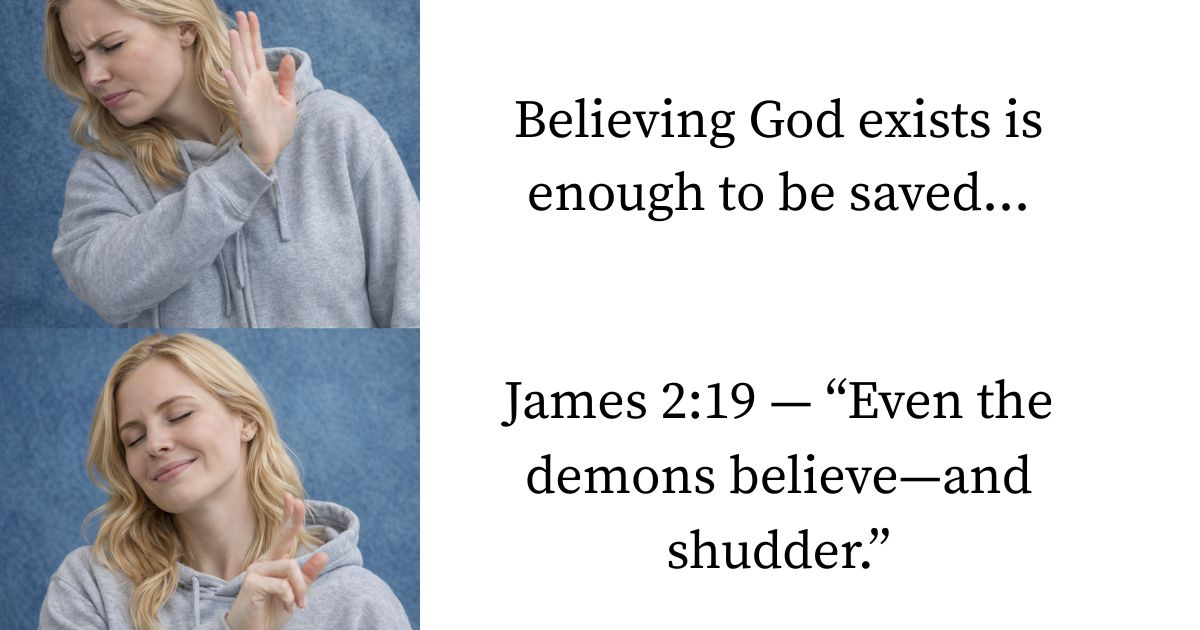
In James 2:19, we see that the demons believe “mental assent” that “there is one God,” but they do not believe in/have faith in/trust in Jesus Christ for salvation. In other words, the demons do not believe in the Lord Jesus Christ (Acts 16:31) and are not saved. Their trust and reliance are in Satan (and not in Jesus) as demonstrated by their rebellion in heaven and continuous evil works. There is a difference between mere “mental assent” belief (as the demons have) and saving belief in Christ, which the demons do not have, and only genuine believers do have.
1 Like
Here is my take. I believe demons have more faith than most Christians, at least in the sense that they recognize who Christ is, acknowledge His authority, and tremble, while many who claim His name remain unmoved by the cross and unchanged by the resurrection.
J.
3 Likes
Dallas Willard explains the “cosmic Christ” as the divine, universal reality of Jesus, not just a historical figure, whose incarnation was a universe-altering event bringing reconciliation, making God’s rule (the Kingdom of God) accessible to all, and inviting people into a transformative, eternal life through apprenticeship and spiritual formation. For Willard, Jesus isn’t merely a good teacher, but the very embodiment of God’s presence in the world, opening doors for profound spiritual transformation and participation in His eternal kingdom.
Key Aspects of Willard’s Cosmic Christ:
- Cosmic Event: The incarnation wasn’t just about Jesus entering human history but a grand, cosmic event that reconciled the universe to God, touching all of creation.
- God in Flesh: Jesus is God entering the world of matter and flesh, a personal inhabitation that makes God truly present and accessible.
- The Kingdom Now: Christ’s life, death, and resurrection inaugurate the Kingdom of God, a present reality of God’s rule and care that we can live within now.
- Reconciliation & Redemption: Through Jesus, God offers a redemptive way out of human disobedience, bridging the gap between humanity and the divine.
- Invitation to Apprenticeship: The gospel invites us to be apprentices of Jesus, learning to live by His word and embody His character, leading to inner transformation.
- Spiritual Formation: Becoming Christ-like is a process of inner transformation by the Holy Spirit, changing our character and will, so we naturally do what Jesus would do.
- Eternal Life: By engaging with the cosmic Christ, we move from a limited earthly life to participating in an eternal existence, a life of abundant spiritual reality.
Just curious. No argument or criticism. What about after? Does this view entertain Heaven, and what is that like according to this POV?
Peter
I read the question wrong the first part…my phone only showed part so I assumed the other part.
Well Depends How this is meant.
Believe in God how?
Question: Can one believe in God but not believe in his son.
Once the knowledge has been given of the knowledge of God in the face of Jesus where one grasp it- then I believe men are without excuse.
One then can’t get to the father but through the son.
If they reject the Son they dont believe in the Father.
Now on the other hand, one believes the Father but has not heard of the son. Yet they believe the father with the knowledge of how they think they should serve Him- then it is God who judges the heart. People then are judge by what they know.
Sense God is His word to believe in God would be to believe His word. Yet in my opinion now, I believe to believe in God is to trust who He is. Hence, trust and obey His word.
Someone can believe in God for a million dollars, does that mean they believe He is the creator?
I think believing there is a God, might be contary to believing in God.
For its one’s theology about God that matters. Can one argue that not everyone receives the same knowledge about God?
Adam and Eve did not sin against God until they had knowledge of God’s command. The only sin that cant be forgiven is blaspheming against the Holyghost.
But would it be a sin against God if you had no knowledge of the true God?
So what is my conclusion 
I believe you are believing or unbelieving when we use the term " in". So by that token you believe in God you are saved because this belief means to trust in.
There is no middle ground we believing, or not believing.
Not believing not saved, believing saved
Receiving the Spirit based on believing who He is one might say seals the deal. However if knowledge has been corrupted and people believe all there is to salvation is receiving the Spirit…then they may soon be seeking what will fullfill their inner void. Because I believe people have a true need built in them for true purpose. Without being caught up in God’s purposes where is Life?
I asked the question believing Somebody who might be familiar with those terms might have a perspective. And you are right not to be criticized.
It makes me ignore the words of people that might want to bring me out of my peace because they assume because a term is not in the bible that it has no meaning from the Bible.
People should feel safe amongst believers.
So thank you
As for my own thoughts I was hoping to understand a little better myself. But I think it’s about the word in and out of time. Like passing through the kingdom because you were caught up in something that is in the kingdom. Hence, Peter’s right of His perception, that God is no respecter of persons that anyone who does right is accetable to Him.
How does or what way can God lighten everyones heart that comes into the world?
He doesn’t. He gives us free will. He sends people into our lives to tell us about Him and His plan for salvation. Then it is up to the individual to accept or reject.
Petter