I hear you @timf but I find your explanation a bit problematic in the sense that-
Many claim that the Greek word aion simply means an age, as if it referred to a limited period that may come to an end. However, Scripture itself defines the word’s range by the actions, verbs, and contrasts attached to it. When aion or its adjective aionios describes God, life, or punishment, the context consistently expresses unending duration rather than a temporary phase.
In Matthew 25 verse 46 (LEB), Jesus says, “And these will go away (apeleusontai) into eternal punishment (kolasin aionion), but the righteous into eternal life (zōēn aionion).” The verb apeleusontai means “they will depart” and describes a final, completed movement. The same adjective aionion modifies both punishment and life, and the parallel structure leaves no linguistic room for one being temporal while the other is permanent. The force of the verbs and nouns together shows the permanence of both destinies.
In John 3 verse 16 (LEB), “For in this way God loved (ēgapēsen) the world, so that he gave (edōken) his one and only Son, in order that everyone who believes (pisteuōn) in him will not perish (mē apolētai), but will have (echē) eternal life (zōēn aionion).” The verbs of action and possession, loved, gave, believes, will not perish, will have, carry future, continual, and enduring sense. The object of that possession is zōēn aionion, life belonging to the eternal order. Nothing in this construction implies temporary existence.
Paul uses the same term in Romans 16 verse 26 (LEB), calling God Himself “the eternal God (tou aioniou theou).” Here aioniou cannot mean limited, since it describes God’s own nature.
To call God an “age-long God” would contradict every other description of His unchanging being. The Greek participle phanerōthentos (“having been revealed”) in the same verse shows that this eternal God actively revealed His plan within time but remains Himself outside it.
In Hebrews 9 verse 12 (LEB), “He entered (eisēlthen) once for all into the holy places, not by the blood of goats and calves, but by his own blood, and so obtained (heuramenos) eternal redemption (lutrōsin aionian).” The verb heuramenos means having obtained or secured permanently. The redemption that Christ obtained is called aionian, and since His priestly work is said to be “once for all” (ephapax), the eternal result cannot end with any coming “age.”
In 2 Thessalonians 1 verse 9 (LEB), “Such people will pay the penalty (dikēn tisousin) of eternal destruction (olethron aionion) away from the presence of the Lord.” The verb tisousin means “they will pay” and indicates ongoing consequence, not an age-limited period. The same adjective aionion modifies destruction, just as it modifies life in John 3 verse 16.
In Hebrews 13 verse 20 (LEB), “Now may the God of peace, who brought up (anagagōn) from the dead our Lord Jesus, the great shepherd of the sheep, by the blood of the eternal covenant (diathēkēs aiōniou), equip you.” The verb anagagōn is aorist participle, showing divine action completed in history, yet the covenant is called aionios, meaning the agreement’s validity is without termination.
The Hebrew foundation for this concept appears in Daniel 12 verse 2 (LEB), “And many from those sleeping in the dusty ground will awake (yāqîṣū), some to everlasting life (leḥayyē olām), and others to disgrace and everlasting contempt.” The verb yāqîṣū means “they will awake,” a future resurrection act, and the noun phrase ḥayyē olām means “life everlasting.” The same olām describes both outcomes. Thus, the Hebrew and Greek parallel each other precisely in duration and meaning.
When Paul describes God’s invisible attributes in Romans 1 verse 20 (LEB) he says, “For his invisible attributes, both his eternal power (aïdios autou dynamis) and divine nature, have been clearly seen (kathoratai) since the creation of the world.” The verb kathoratai is present passive and means “are clearly perceived,” indicating ongoing visibility of what is eternal. The adjective aidios means everlasting by essence, confirming that God’s eternal nature is inherently endless.
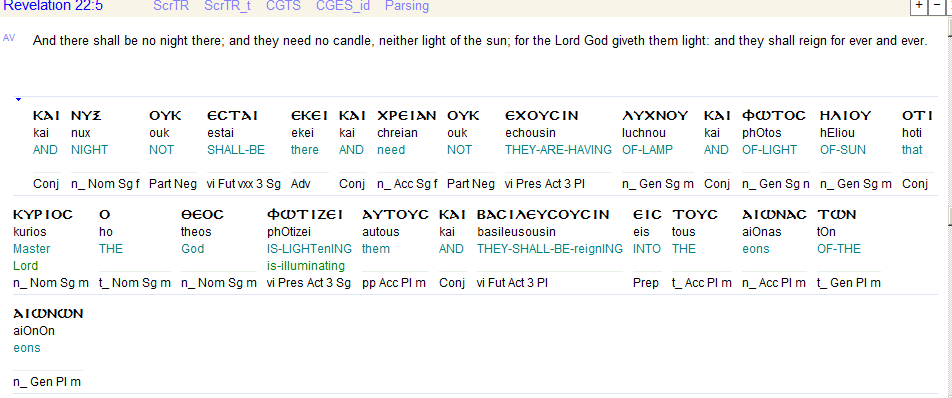
In Revelation 22 verse 5 (LEB), “And night will not exist any longer, and they will have no need for the light of a lamp or the light of the sun, because the Lord God will give light (phōtisei) to them, and they will reign (basileusousin) forever and ever (eis tous aiōnas tōn aiōnōn).”
Both verbs are future active, He will give light, they will reign, and the phrase “forever and ever” literally means “unto the ages of the ages,” the strongest expression in Greek for infinity without end.
The cumulative evidence shows that aion and aionios may describe a segment of time in some secular Greek uses, but in Scripture, where the verbs and objects concern God, life, redemption, covenant, or punishment, the sense is unending. The duration is as eternal as God Himself. The verbs connected to these terms express completed or continuous actions that do not imply any closure or expiration.
Are we in agreement brother?
J.