Some teachers on social platforms frame their ideas as “new revelation.” Scripture also warns about being carried by every wind of teaching. How do you personally draw the line between being closed-minded vs being discerning? What is the practical test you use to evaluate whether something is actually rooted in Scripture rather than novelty?
A strong question, and one every believer must wrestle with if they intend to remain both teachable and anchored. The line between discernment and closed-mindedness is not drawn by emotion or preference, but by revelation already given, the canon of Scripture. Revelation is complete in Christ Jesus, for as Hebrews 1:1–2 says, “God, having spoken long ago to the fathers in the prophets in many portions and in many ways, has in these last days spoken to us in His Son.” The Greek perfect participle lalēsas (having spoken) shows a completed action with ongoing effect, meaning God has definitively spoken, and that voice now abides in the written Word that testifies to the Son.
Any claim of “new revelation” must therefore pass a double test. First, it must align with what is graphō (written) - never adding, never contradicting, never redefining what was already “once for all delivered to the saints” (Jude 3). Second, it must exalt Christ crucified and risen, not the supposed seer. The Spirit’s ministry, according to John 16:14, is to “glorify Me,” Jesus says, not to glorify human novelty.
Practically, I use this test: does the teaching emerge from exegesis or from imagination? When I trace its roots back to the text, grammar, syntax, context, covenant flow, does it stand under Scripture or does it force Scripture to stand under it? The Bereans modeled this in Acts 17:11 when they anakrinontes (examined closely) the Scriptures daily to see if what Paul said was true. Even the apostle’s words were tested, not out of unbelief, but out of reverence for the truth.
Being closed-minded is refusing correction when the text proves you wrong; being discerning is refusing deception when emotion or eloquence tries to overrule the text. The heart posture must remain humble, the mind alert, the Scripture supreme. God’s Word is not a playground for innovation but a battlefield for fidelity. Truth is not progressive; it is preserved, guarded, and proclaimed.
J.
2 Likes
Noone on Earth brings new revelation, that isn’t already revealed through the Word of God (Jesus Christ), which is fullest revelation given to man. Through the moving and operation of the Holy Ghost, I Pray what we say here (with Scriptural backing) brings the truth of these Revelations, truth by truth, or precept upon precept, to the heart of the hearer. Lay what we say before the feet of Jesus (Word of God) and compare, the Bible is Always truth, so if they don’t match, we need to reevaluate our stance. What we say or do here will have lasting impact upon the believer and sinner alike. We most certainly have freedom of speech, but any true christian will weigh what they say against the Word of God and if they don’t agree God is not in error, and we need to pray for understanding. Those that have more meat of the Word can help those who are struggling, if done with humility, peace and love.
1 Like
Discernment does not mean closing your mind. It means yielding your mind to the Word of God that he has already given. Scripture says the believer is “thoroughly equipped for every good work” by the Word that is God-breathed ~2 Timothy 3:16 through 17. If the Word thoroughly equips us, then anything purporting to be a “new revelation” is automatically suspect, because God says not to go beyond what is written ~1 Corinthians 4:6. The practical test is simple. Measure every teaching by the clear, consistent testimony of Scripture in its full context. Jesus said His sheep know His voice ~John 10: 27, and His voice never contradicts the Word He spoke by the Spirit through the prophets and apostles. The Spirit of truth will not teach anything that departs from the Scriptures He inspired ~John 16:13. Paul said, even if an angel preached another message, it is a false gospel ~Galatians 1:8. So the line is this. If a teaching cannot be grounded in the plain meaning of Scripture, confirmed across the whole counsel of God’s Word, it is not from God. Novelty is not truth. Truth is what God already revealed.
1 Like
you make some strong points, but the way you frame this shifts the authority from Scripture itself to the method used to analyze it. The danger is subtle. You take a biblical truth, that revelation is complete in Christ, but then you wrap it in layers of Greek terms and academic structure that Scripture never requires believers to use in order to discern truth.
The Bible gives the test in far simpler terms. God tells us not to go beyond what is written ~1 Corinthians 4:6. God warns that anyone who adds to His Word is in error ~Proverbs 30:6. Paul said even if an angel brings a different message, it must be rejected ~Galatians 1:8. None of this depends on advanced linguistic analysis. The standard is the written Word itself.
Your reply leans heavily on grammar and Greek terminology as if that is the necessary filter. But Scripture says the believer is already thoroughly equipped by the God breathed Word ~2 Timothy 3:16 through 17. The Bereans did not test Paul’s message by Greek syntax. They examined the Scriptures they had and compared his words to the written text ~Acts 17:11. That is the model God gives.
Discernment is not about mastering academic tools. It is about submitting every teaching to the plain meaning of Scripture in context, letting Scripture interpret Scripture. When method becomes the focus, the authority shifts away from the Word toward the interpreter.
So the line is simple. If the teaching cannot be shown clearly in the Scriptures themselves, in context and confirmed across the whole counsel of God’s Word, it does not carry the authority of God. The Word stands on its own. The Spirit uses that Word to guide God’s people, not the complexity of our analysis.
Interesting @bdavidc.
And I agree completely that Scripture alone is the final authority, theopneustos (God-breathed) and sufficient for doctrine, reproof, correction, and training in righteousness (~2 Timothy 3:16–17). But Scripture itself commands believers to handle that Word accurately. Paul charged Timothy, “Be diligent to present yourself approved to God, a worker who does not need to be ashamed, rightly handling the word of truth” (~2 Timothy 2:15). The Greek verb orthotomounta (to cut straight) means to interpret with precision. Accuracy is not academic arrogance; it is obedience.
The Bereans did not rely on rabbinic tradition but they did engage in textual discernment. They “examined the Scriptures daily to see whether these things were so” (~Acts 17:11). The verb anakrinontes (examining carefully) means to investigate by close questioning, the same term used in legal inquiry. And that is precisely what contextual study is, honest examination of meaning as the Spirit inspired it.
Even Christ Himself grounded interpretation in grammar and tense. In ~Matthew 22:31–32, when refuting the Sadducees about resurrection, He said, “Have you not read what was spoken to you by God, ‘I am the God of Abraham…’?” His entire argument hung on the present tense of I am. The Lord used syntax to reveal doctrine. If Jesus treated a verb tense as inspired, then linguistic attention is reverence, not distraction.
Likewise, Paul built arguments on single words. In ~Galatians 3:16 he writes, “It does not say ‘and to seeds,’ as referring to many, but as of one, ‘and to your Seed,’ who is Christ.” Paul exegeted the Hebrew singular zera‘ to prove Messiah’s identity. That is not “academic method”; that is Spirit-led precision with language.
You cited ~1 Corinthians 4:6 about not going beyond what is written. Great! But Paul there refers to human boasting and rivalries, not to forbidding careful study of Scripture’s inspired languages.
The command is against adding revelation, not against understanding revelation rightly. Similarly, ~Proverbs 30:6 warns against adding words, not against clarifying meaning. When Nehemiah’s Levites “read from the book of the Law of God, translating and giving the sense so that they understood the reading” (~Nehemiah 8:8), they were doing exactly what contextual and linguistic study does, making sure God’s people understood His Word accurately.
The Spirit indeed teaches believers directly, yet He does so through the very words He inspired. “Holy men of God spoke as they were moved by the Holy Spirit” (~2 Peter 1:21). To honor the Spirit is to handle His words carefully. The Hebrew prophets, apostles, and Christ Himself drew doctrine from the exact words, tenses, and grammar God chose. That is why Jesus said, “Until heaven and earth pass away, not one jot or tittle shall pass from the Law until all is fulfilled” (~Matthew 5:18). If every stroke of the text matters, then studying how it was written is part of revering it.
The issue is not Greek or Hebrew study versus spiritual simplicity; the issue is whether we honor the Word enough to seek its God-intended meaning. The Spirit uses study and submission together. “Consider what I say, for the Lord will give you understanding in all things” (~2 Timothy 2:7). Paul joins human diligence (consider) with divine illumination (the Lord will give understanding).
So, yes, the Word stands on its own authority, but precision in language, context, and grammar is how we obey the command to handle it faithfully. The goal is not complexity but clarity, not academic pride but reverence for every Word that proceeds from the mouth of God (~Matthew 4:4).
True discernment honors both the Spirit who inspired the text and the text He inspired, never separating one from the other.
This has been the way I have studied the Scriptures for as long as I can remember, and Paul specifically exhorted Timothy to study and rightly handle the word of truth (~2 Timothy 2:15). Until now, you are the only one I have encountered who seems to have an issue with this approach. I share what I have freely received, not to display intellect or pride, but to build up and strengthen the body of Christ Jesus.
Shalom Achi.
J.
When hearing something unfamiliar or even in opposition to what one currently believes, the best thing to do is hold it in a sort of mental quarantine. As additional information is sought, it can move the proposition either closer to acceptance or closer to rejection. The key is how well it is supported by scripture.
1 Like
Of course, that only works if the Bible is unerring. If the Bible has not been tweaked, adjusted, or put together incorrectly in some way shape and form. And if the original text ia translated correctly.
For instance, when the Red Sea Scrolls were found this past century, a number of inconsistancies were found between the King James Version and the older versions found in the Red Sea Scriptures. Subtle but evident. Your Bibles tend to note these differences.
Not to mention, the Bible itself in Jeremiah warns us that the Scribes have lied. And the Gosepl warns us that the enemy sows weeds where God sows truth… so…
I choose to follow Christ and His teachings as an example. LOVE is the Law. That is my personal compass. The rest, grain of salt.
The Word of God is that Word given to us by God. But what is that Word? Christ. Christ is the Way. He points true North.
Hello Ellenvera,
I agree that if it is not in here {Holding up the Bible} or contrary to what is in here, it is a lie.
“All Scripture is breathed out by God and profitable for teaching, for reproof, for correction, and for training in righteousness,“ 2 Timothy 3:16
“For no prophecy was ever produced by the will of man, but men spoke from God as they were carried along by the Holy Spirit.“ 2 Peter 1:21
Also, this warning from Paul
“For if someone comes and proclaims another Jesus than the one we proclaimed, or if you receive a different spirit from the one you received, or if you accept a different gospel from the one you accepted, you put up with it readily enough.“ 2 Corinthians 11:4
The name and claim it, Prosperity Gospel, no hell gospel, the Bible is not important gospel. Other ways to heaven. These are all false gospels. This is why it is so important to read God’s Word for yourself. For if you know the truth, you will not fall for the lies.
Peter
2 Likes
I truly am sad to hear you say this Tillman.
There is no proof whatsoever of this claim. As a matter of fact, we see that the Bible is accurate, going back to the oldest text we have found. The whole it was changed argument has been proven false and used for the sole purpose of justifying sin.
You cannot follow Jesus if you reject the Word of God, because Jesus IS the Word of God. The whole Bible is about Him. Old and New Testament.
Peter
1 Like
I will explain this matter directly to ensure everyone understands the problem. Your wish to study has never been the source of my concern. Every believer must handle Scripture with care according to 2 Timothy 2:15. The multiple instances where I have encountered this problem stem from attempts to alter the established meaning of God’s revealed words.
God’s Word interprets itself. The Spirit does not modify the revelations which He provided. The Bible states that no prophecy in Scripture exists for personal interpretation according to 2 Peter 1:20. The process of altering Scripture to match a predetermined conclusion violates God’s established commandments.
The Bereans evaluated teachings through Scripture comparison rather than through modifying Scripture to support their arguments according to Acts 17:11**. Jesus rebuked the Sadducees because they rejected the interpretations God had already provided. Jesus declared to them that their mistake stemmed from their lack of understanding about Scripture and God’s divine power (Matthew 22:29).**
The discussion centers on text modification rather than grammatical analysis or Greek language or contextual understanding. The process involves modifying the actual words which appear in the text. The Bible teaches believers to avoid adding new content to God’s revealed words. The Bible warns people against adding to His words because God will punish them and reveal their deception (Proverbs 30:6).
Study is good. Precision is good. The process of interpretation becomes problematic when it distorts the original text instead of following its established meaning. The problem I have been addressing involves this specific issue.
Your dedication to learning is not what I doubt. The problem I face occurs when people modify the original meaning God provided. The Word of God must maintain its original meaning which God revealed instead of becoming what humans decide to change it into.
That is why I’ve spoken up.
You said you share what you have ‘freely received,’ but what you’re presenting is not in the Scriptures. The Spirit does not reveal new meanings or new doctrines outside the Word He inspired. Scripture says the faith was once for all delivered ~Jude 1:3, that we must not go beyond what is written ~1 Corinthians 4:6, and that we must not add to His words ~Proverbs 30:6. If the meaning you present cannot be found in the written Word, then whatever you ‘received’ did not come from the Holy Spirit.
Scripture does not treat itself as something shaky or uncertain. It speaks as the Word of God, not as a human project.
“Every word of God is pure” ~Proverbs 30:5
“The words of the Lord are pure words” ~Psalm 12:6
“The Scripture cannot be broken” ~John 10:35
“All Scripture is God breathed” ~2 Timothy 3:16
The oldest lie in the Bible starts with casting doubt on what God said.
“Has God indeed said” ~Genesis 3:1.
That is still the strategy today.
When Jeremiah rebukes scribes, he is exposing the false teachers of that day, not saying God failed to preserve His Word. God corrects liars. He does not lose His revelation. Jesus Himself quoted the written Scriptures as final authority when He said, “It is written” ~Matthew 4:4. If the text were unreliable, He would not have grounded truth on it.
You said your compass is love. Scripture tells us what love actually is.
“This is the love of God, that we keep His commandments” ~1 John 5:3.
Love does not replace the Word. Love fulfills what the Word commands ~Romans 13:10.
Christ is the Word made flesh ~John 1:14, but He never taught anyone to follow feelings instead of Scripture. He prayed,
“Sanctify them by the truth. Your Word is truth” ~John 17:17.
The Bible is not the problem. Doubting it is.
If I should ask you in what manner do you study the Scriptures, what would your answer be @bdavidc ? KJV-onlyist?
-
spoudazō (σπουδάζω) - “to be diligent, zealous, eager, make every effort”
• Primary verse: ~2 Timothy 2:15 “Be diligent (spoudason) to present yourself approved to God, a worker who does not need to be ashamed, rightly dividing the word of truth.”
• Also in ~Ephesians 4:3, ~2 Peter 1:10, ~Hebrews 4:11.
• Carries the sense of energetic pursuit of truth and accuracy. -
manthanō (μανθάνω) - “to learn, to gain knowledge by use and practice”
• Seen in ~Matthew 11:29 “Learn (mathete) from Me.”
• Connected to the word mathētēs (disciple), meaning “learner.”
• Study in Scripture is not detached analysis but learning from Christ through obedience. -
zēteō (ζητέω) - “to seek, to search out, to investigate earnestly”
• Used in ~John 5:39 “You search (eraunate) the Scriptures because you think in them you have eternal life, yet these are they which testify of Me.”
• Related form ekzēteō (“to search out fully”) in ~Acts 17:27 and ~Hebrews 11:6, emphasizing intense pursuit of truth. -
anakrinō (ἀνακρίνω) - “to examine, to investigate, to discern critically”
• Used in ~Acts 17:11 of the Bereans: “They examined (anakrinontes) the Scriptures daily.”
• Also in ~1 Corinthians 2:15 “The spiritual person judges (anakrinei) all things.”
• Reflects analytical discernment grounded in Scripture. -
dokimazō (δοκιμάζω) -“to test, prove, scrutinize to determine genuineness”
• Appears in ~Romans 12:2 “By testing (dokimazein) you may discern what is the will of God.”
• In ~1 Thessalonians 5:21 “Test all things; hold fast what is good.”
• A core word for critical evaluation of teaching and doctrine. -
logizomai (λογίζομαι) - “to reckon, reason, calculate, deliberate”
• Used in ~Romans 4 and ~Philippians 4:8.
• It carries mental engagement, rational meditation, and disciplined thought in the Word. -
dialegomai (διαλέγομαι) - “to reason, to discuss, to dialogue in argumentation”
• In ~Acts 17:2 “Paul reasoned (dielegeto) with them from the Scriptures.”
• Also ~Acts 19:8-9 and ~Hebrews 12:5.
• It expresses careful, logical presentation of biblical truth in debate or teaching. -
apologia (ἀπολογία) - “a defense, a reasoned argument, an answer”
• Used in ~1 Peter 3:15 “Always be ready to make a defense (apologian) to anyone who asks you for a reason for the hope that is in you.”
• Related to apologeomai (“to speak in defense”) in ~Acts 22:1 and ~2 Timothy 4:16.
• Foundational for the discipline of apologetics, reasoned defense of the faith through Scripture. -
katanoeō (κατανοέω) - “to observe carefully, to consider attentively, to perceive with the mind”
• Used in ~Hebrews 3:1 “Consider (katanoēsate) Jesus, the Apostle and High Priest of our confession.”
• Emphasizes reflective and observant contemplation of God’s truth. -
meletao (μελετάω) - “to meditate, to practice, to care for continually”
• In ~1 Timothy 4:15 “Meditate (meleta) on these things; give yourself wholly to them.”
• Also ~Psalm 1:2 in the LXX “In His law he meditates (meleta) day and night.”
• The heart-dimension of study, dwelling on the Word until it shapes the life. -
suniēmi (συνίημι) - “to understand, to bring together mentally, to perceive meaning”
• Used in ~Matthew 13:13-15 “Seeing they do not see, and hearing they do not hear, nor do they understand (suniōsin).”
• Denotes comprehension through reflection and Spirit-guided insight. -
epistamai (ἐπίσταμαι) - “to know, to be acquainted with, to be skilled in”
• Found in ~Acts 18:25 “He was mighty in the Scriptures.”
• Implies practiced knowledge born of consistent handling of God’s Word. -
darash (דָּרַשׁ) - Hebrew verb “to seek, inquire, examine, study”
• In ~Ezra 7:10 “Ezra had set his heart to study (darash) the law of the Lord and to do it.”
• Central Old Testament term for serious engagement with Torah, leading to obedience. -
bin (בִּין) - Hebrew verb “to discern, to understand, to perceive with intelligence”
• In ~Proverbs 2:2 “Apply your heart to understanding (binah).”
• Carries both cognitive and moral dimensions, knowing to obey.
15**. hagah (הָגָה)** - “to meditate, to mutter, to muse aloud”
• Used in ~Psalm 1:2 “In His law he meditates (yēhgeh) day and night.”
• The word pictures one murmuring Scripture quietly in reflection, the biblical foundation of meditation.
Together these words portray study not as a sterile academic process but as spiritual diligence, disciplined reasoning, meditation, and defense of truth under the illumination of the Spirit. From darash in Ezra to spoudazō in Timothy, the biblical picture of study is worshipful labor, mind and heart bowed before the Author of truth, testing, reasoning, defending, meditating, and applying what has been once for all delivered to the saints.
And YOU show me my error.!
J.
You’ve asked me this same question before, and the answer has not changed. I study Scripture the way Scripture commands. Not through traditions, not through systems, and not through your attempts to bury simple obedience under piles of Greek words. You listed a dictionary of terms, but the Bible is clear without all of that. God calls us to believe His Word, obey His Word, and rightly divide His Word. That is all.
The issue is not how many Greek verbs someone can stack together. The issue is whether a person actually submits to the authority of the Word. Scripture says “Be diligent to present yourself approved to God, rightly dividing the word of truth” ~2 Timothy 2:15. It also says the Scriptures are understood by those who obey, not by those who argue for argument’s sake ~John 7:17. The Bereans examined the Scriptures daily, and they did it to confirm the truth, not to play word-games ~Acts 17:11.
What you are doing is exactly what the Pharisees did. They used endless technical arguments to avoid the plain meaning of the Word. Jesus said they “searched the Scriptures” but refused to come to Him in truth ~John 5:39 through 40. They had knowledge but no submission. That is the danger you are walking in. You are not using Greek to illuminate Scripture. You are using it to challenge anyone who will not bow to your interpretations. That is pride, not study.
If you want to know how I study, here it is as plainly as I can say it:
I read the Word.
I believe the Word.
I obey the Word.
I test everything by the Word.
I refuse to twist the Word to fit manmade ideas.
I let Scripture interpret Scripture.
That is the biblical method. And since you asked me to show your error, here it is. You are elevating analysis above obedience. You are elevating complexity above clarity. You are elevating your system above the simple authority of God’s Word. But Scripture says “The unfolding of Your words gives light” ~Psalm 119:130. Not the unfolding of endless Greek glossaries.
If you want to handle Scripture rightly, stop trying to impress people with study methods and start submitting to what God already said. Every one of your Greek words collapses if you do not humble yourself before the plain truth of the text. That is where the real error is.
You are not going to stop me from studying and rightly dividing the Word of Truth, for Scripture commands, “Be diligent to present yourself approved to God, a worker who does not need to be ashamed, rightly handling the word of truth” ~2 Timothy 2:15. Your criticism reveals not spiritual discernment but the absence of the fruit of the Spirit, for “the fruit of the Spirit is love, joy, peace, patience, kindness, goodness, faithfulness, gentleness, self-control” ~Galatians 5:22-23. The Lord warns against unrighteous judgment, for Jesus said, “Do not judge according to appearance, but judge with righteous judgment” ~John 7:24, and again, “With the measure you use, it will be measured to you” ~Matthew 7:2.
This place is for edification, not for slander or strife, since “the servant of the Lord must not be quarrelsome but kind to all, able to teach, patient when wronged” ~2 Timothy 2:24. You do not know my life or heart, and only God “searches all hearts and understands every intent of the thoughts” ~1 Chronicles 28:9. If you truly believe I lead others astray or misinterpret Scripture, then follow the order of decency Scripture prescribes, “Let all things be done for edification” ~1 Corinthians 14:26, the elders in the assembly, for “everything should be done decently and in order” ~1 Corinthians 14:40.
As for me, I will continue to examine the Scriptures daily like the Bereans, “to see whether these things are so” ~Acts 17:11, standing firm that “we can do nothing against the truth, but only for the truth” ~2 Corinthians 13:8.
Report me to the Administrators since your heart is not in the right place.
This from Got Questions
Exegesis means “exposition or explanation.” Biblical exegesis involves the examination of a particular text of scripture in order to properly interpret it. Exegesis is a part of the process of hermeneutics, the science of interpretation. A person who practices exegesis is called an exegete.
Good biblical exegesis is actually commanded in scripture. “Study [be diligent] to show thyself approved unto God, a workman that needeth not to be ashamed, rightly dividing the word of truth” (2 Timothy 2:15). According to this verse, we must handle the Word of God properly, through diligent study. If we don’t, we have reason to be ashamed.
There are some basic principles of good exegesis which serious students of the Bible will follow:
- The Grammatical Principle. The Bible was written in human language, and language has a certain structure and follows certain rules. Therefore, we must interpret the Bible in a manner consistent with the basic rules of language.
Usually, the exegete starts his examination of a passage by defining the words in it. Definitions are basic to understanding the passage as a whole, and it is important that the words be defined according to their original intent and not according to modern usage. To ensure accuracy, the exegete uses a precise English translation and Greek and Hebrew dictionaries.
Next, the exegete examines the syntax, or the grammatical relationships of the words in the passage. He finds parallels, he determines which ideas are primary and which are subordinate, and he discovers actions, subjects, and their modifiers. He may even diagram a verse or two.
- The Literal Principle. We assume that each word in a passage has a normal, literal meaning, unless there is good reason to view it as a figure of speech. The exegete does not go out of his way to spiritualize or allegorize. Words mean what words mean.
So, if the Bible mentions a “horse,” it means “a horse.” When the Bible speaks of the Promised Land, it means a literal land given to Israel and should not be interpreted as a reference to heaven.
- The Historical Principle. As time passes, culture changes, points of view change, language changes. We must guard against interpreting scripture according to how our culture views things; we must always place scripture in its historical context.
The diligent Bible student will consider the geography, the customs, the current events, and even the politics of the time when a passage was written. An understanding of ancient Jewish culture can greatly aid an understanding of scripture. To do his research, the exegete will use Bible dictionaries, commentaries, and books on history.
-
The Synthesis Principle. The best interpreter of scripture is scripture itself. We must examine a passage in relation to its immediate context (the verses surrounding it), its wider context (the book it’s found in), and its complete context (the Bible as a whole). The Bible does not contradict itself. Any theological statement in one verse can and should be harmonized with theological statements in other parts of scripture. Good Bible interpretation relates any one passage to the total content of scripture.
-
The Practical Principle. Once we’ve properly examined the passage to understand its meaning, we have the responsibility to apply it to our own lives. To “rightly divide the word of truth” is more than an intellectual exercise; it is a life-changing event.
J.
Your assessment of me is mistaken, @bdavidc.
Brother, your accusation betrays a misunderstanding of what true obedience to Scripture looks like. You confuse zeal for the text with submission to its language, but obedience begins with understanding what God actually said, not what an English rendering centuries later appears to say. Paul commanded Timothy, “Be diligent to present yourself approved to God, a worker who does not need to be ashamed, rightly handling the word of truth” ~2 Timothy 2:15. The Spirit chose that verb orthotomeo, to cut straight, to interpret accurately,
Exegesis is not rebellion, it is reverence. It is the act of drawing meaning out of the text (exēgeomai), not forcing meaning into it. Jesus Himself performed exegesis when “He explained to them in all the Scriptures the things concerning Himself” ~Luke 24:27. The apostles did not quote a King James Bible. They opened scrolls in Hebrew and Greek. When Philip met the Ethiopian, he did not say, “Just read it in your preferred version,” he explained the text of Isaiah and “preached Jesus to him” ~Acts 8:35. That is exegesis, Spirit-filled, contextual explanation from the inspired language, not idolatry of a translation.
The KJV is a historical witness, not the original voice. It was translated from imperfect manuscripts by fallible men. To elevate it as untouchable is to make a human work equal to divine inspiration, and that borders on bibliolatry. The Scriptures were breathed out in Hebrew, Aramaic, and Greek, and to handle them faithfully we must return to that breath, not enshrine one English version as sacred. God did not inspire 17th-century English; He inspired His prophets and apostles.
You quote Psalm 119:130 as if “the unfolding of Your words gives light” supports ignoring the languages, but the Hebrew verb patah means to open, to reveal, to draw out meaning. That is precisely what exegesis does, it opens the Word until the light breaks through. Refusing to unfold the text because of fear of scholarship is not humility, it is neglect. The Bereans were commended not for blind trust but because “they examined the Scriptures daily to see whether these things were so” ~Acts 17:11. They tested every claim, even apostolic ones. That is not pride, that is spiritual nobility.
Brother, the plain truth of the text cannot be known by appealing to tradition alone. The Pharisees also claimed to guard God’s Word, yet Jesus told them, “You err because you do not know the Scriptures nor the power of God” ~Matthew 22:29. The issue was not lack of zeal but lack of understanding.
You can quote verses all day from the KJV, but if your interpretation ignores the inspired Greek and Hebrew, you are not defending Scripture, you are defending a translation.
Exegesis humbles the mind under the text’s grammar, syntax, and context. It is not meant to impress men but to silence them before the voice of God. You call that pride, yet it is the very obedience Paul practiced, the diligence Ezra showed, and the method Jesus Himself modeled. “They read from the book, from the Law of God, translating to give the sense, so that they understood the reading” ~Nehemiah 8:8. That is the pattern. That is obedience.
So let us be clear. You can cling to the KJV if you wish, but do not confuse tradition with inspiration. The Word of God is perfect in its original breath, not in any single English form. Exegesis does not weaken faith; it protects it from error. And if you truly believe in the authority of Scripture, then you will not fear the very languages the Spirit used to give it.
This is my last response to you.
 Tissue?
Honesty is the best policy. Truth must be unbiased. Having faith that something is true is not the same as actually knowing it is true.
And the Truth is, the Bible has changed over time. Case in point. In Luke 9 51-56 it reads:
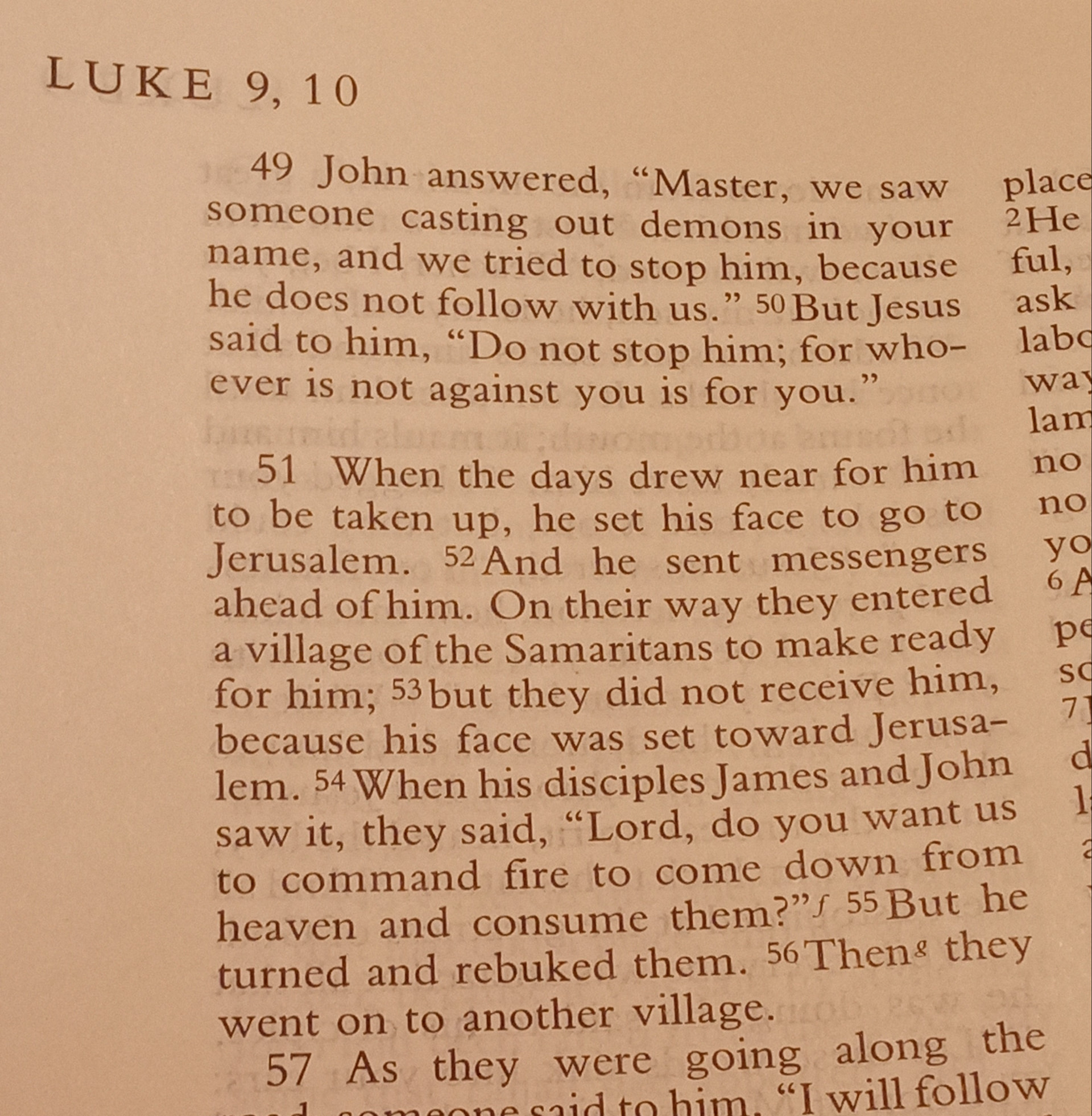
And the footnote reads:
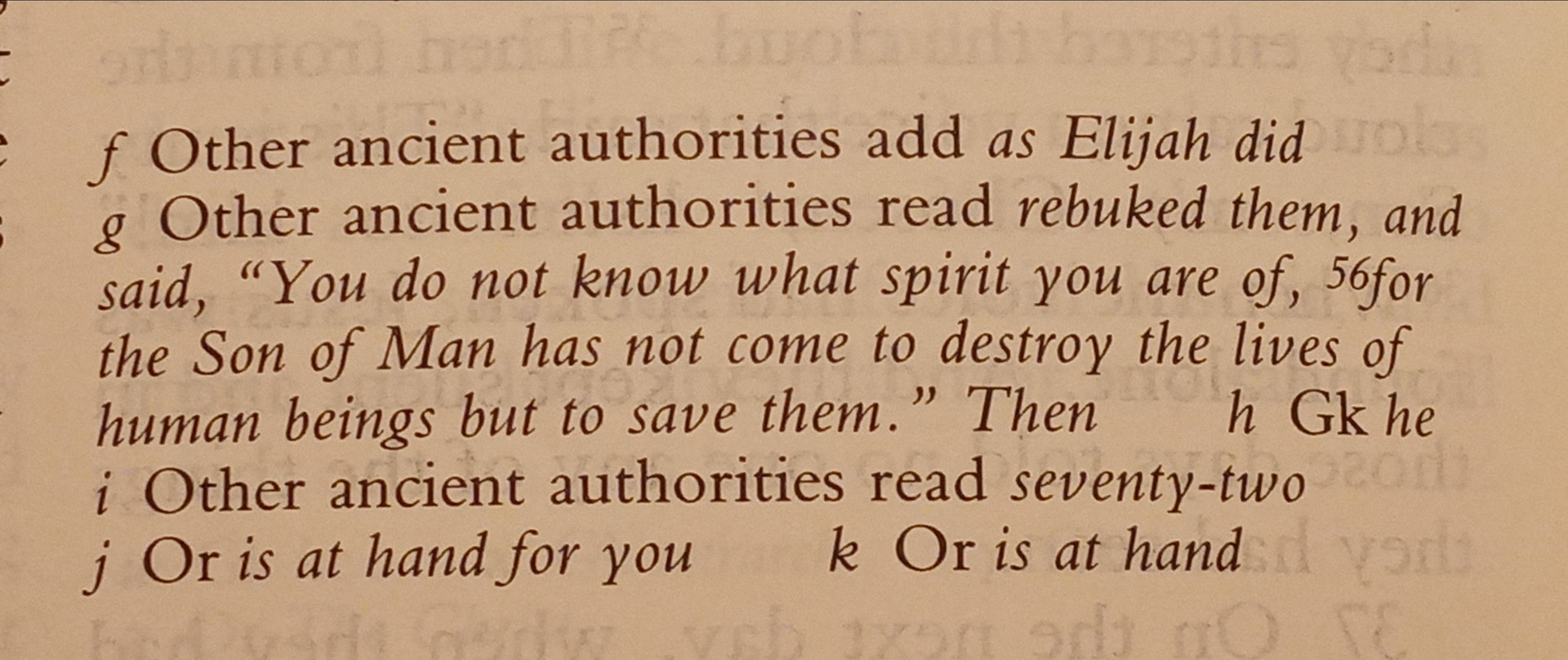
There have also been acusations that the Church altered the Old Testament’s interpretations to more align with Christian belief which is why Jewish Scriptures may read just a bit differently in certain places.
TrustWorthy Behavior does not rewrite the history of what happened. It moves forward from it.
I have Faith in God despite those who have tried to manipulate my Faith. And that speaks more of God’s Faithfulness and LOVE than my own.
And, btw, I have been honest about where I stand in all of my posts. I don’t change because people don’t like what they see. Public opinion does not decide who I am. I do. And as Christ said, I Am Who I Am. None of you decide who I will be.
You keep leaning on outside sources to justify your interpretations. You quote GotQuestions, definitions, and human explanations of “principles,” yet you avoid proving your doctrines from Scripture itself in context. Scripture never tells us to settle a doctrinal dispute with man’s explanations. Scripture tells us the opposite: “Do not go beyond what is written” ~1 Corinthians 4:6. If the text cannot support your view by itself, then the view is wrong. Period.
The fruit of the Spirit is not a shield to hide behind when someone challenges your handling of God’s Word. The same Bible that lists the fruit of the Spirit also commands believers to test every teaching, correct error, and stand for truth. Jesus said, “Judge with righteous judgment” ~John 7:24. Righteous judgment is not based on tone or personality. It is judging whether what is being said lines up with Scripture. The fruit of the Spirit does not cancel discernment. It creates discernment.
The Spirit who gives love, joy, and peace is the same Spirit who leads believers into all truth ~John 16:13. He never leads anyone to misinterpret Scripture or to resist correction from Scripture. Love “does not rejoice in wrongdoing, but rejoices in the truth” ~1 Corinthians 13:6. Gentleness is part of the fruit, but so is faithfulness. Faithfulness means standing on what is written even when it confronts our own ideas. When someone twists Scripture, the Spirit produces believers who stand firm, not believers who stay silent.
This is why Paul told Titus that elders must “refute those who contradict” ~Titus 1:9, and why he told Timothy to “reprove, rebuke, exhort” ~2 Timothy 4:2. That is not unfruitful. That is obedience. The correction being brought to you is not personal, it is not about appearance, and it is not unrighteous judgment. It is believers weighing your claims against the text. And when your claims do not match the text, Scripture commands believers to stand for the truth. The fruit of the Spirit does not resist correction. It produces the humility to receive it and the boldness to give it.
You keep quoting verses about judgment and the fruit of the Spirit, but you ignore the issue that started this. You consistently alter the meaning of Scripture. That is not discernment and it is not “rightly dividing.” Scripture warns that twisting the Word is dangerous. Peter said some “distort” the Scriptures “to their own destruction” ~2 Peter 3:16.
You say you “study like a Berean,” but the Bereans tested everything against the Scriptures, not against personal definitions or imaginative interpretations. They did not reshape the text to fit their views. They surrendered to what was written ~Acts 17:11.
Scripture also tells us exactly what righteous judgment looks like. It is not emotional pushback, self-defense, or appealing to spiritual language. Jesus said, “Judge with righteous judgment” ~John 7:24, which means judgment rooted in the truth of God’s Word, not in how someone feels about being corrected.
You appeal to ~2 Timothy 2:24 about not being quarrelsome, but you keep entering threads to push interpretations that have already been shown from Scripture to be false. Peace does not mean letting error go unchallenged. Scripture commands believers to “contend for the faith” ~Jude 3 and to correct those who oppose sound doctrine ~Titus 1:9.
You said, “Report me to the administrators.” The issue is not reporting. The issue is truth. When your handling of Scripture is repeatedly shown to contradict what is written, correction is not optional. It is biblical. Paul told Timothy to “reprove, rebuke, and exhort with all patience and teaching” ~2 Timothy 4:2.
This is not about your motives or your personal life. It is about the accuracy of what you teach. Scripture says teachers will be judged more strictly ~James 3:1.
If you believe the correction is wrong, then answer it from Scripture itself. Not from definitions. Not from commentaries. Not from accusations about tone. Show, from the text and in context, that your interpretation is what God actually said.
Until then, only one thing matters: “We can do nothing against the truth but only for the truth” ~2 Corinthians 13:8.
The verses you quote don’t give you authority over anyone here, and they don’t place your interpretations above correction. Scripture never says, “If someone challenges your teaching, claim they don’t know your heart.” Scripture says the exact opposite: every teaching must be tested by the Word.
“Test everything; hold fast what is good” ~1 Thessalonians 5:21.
You say this place is for edification. Edification happens when Scripture is handled faithfully, not when someone teaches something and then treats correction as strife. Paul told Timothy to be kind, but he also told him to “correct those who oppose sound doctrine” ~Titus 1:9. Correction is not strife. Avoiding correction is.
You appeal to 1 Chronicles 28:9 about God knowing the heart, but that has nothing to do with evaluating teaching. God knows your heart. The church evaluates your doctrine. That is why Scripture says, “Let the others weigh what is said” ~1 Corinthians 14:29. Not your motives. Your words.
You appeal to “decently and in order” ~1 Corinthians 14:40, but that verse is about orderly worship, not shutting down correction. Order in the church includes testing every message against Scripture, not assuming the speaker is right. The Bereans were called noble because they examined Paul’s teaching daily to see if it was true ~Acts 17:11. If the Bereans examined Paul, you can certainly be examined.
You quote verses about patience and gentleness, but you skip the rest. That same passage says the Lord’s servant corrects those in error so they “may come to their senses” ~2 Timothy 2:25. Scripture does not command silence in the face of false interpretation. It commands correction.
So let’s keep it simple and biblical. If you believe your view is correct, show it from Scripture in context. If not, quoting verses about kindness will not protect a faulty interpretation. Edification happens when truth is upheld, not when someone tries to elevate their position above being examined by the Word.
Stand on the Word and let the Word speak. That is the order Scripture commands.
Cease from that envious spirit and examine yourself, for “where envy and strife exist, there is confusion and every evil work” ~James 3:16. I do not claim authority over anyone here, nor do you possess authority over me, for “each one will give account of himself to God” ~Romans 14:12. You see yet do not perceive, for “the god of this age has blinded the minds of the unbelieving” ~2 Corinthians 4:4, and you project faults outward rather than humbling yourself under the Word.
This is not Facebook or X or any shallow arena of self-display. This is Crosswalk, a fellowship meant for edification, not accusation, and I am thankful to be a member among those who seek truth in Christ.
So I say as our Lord said, “Get behind Me, Satan, you are not mindful of the things of God, but the things of men” ~Matthew 16:23. Do not follow, do not provoke, do not stalk, for “let none of you suffer as a busybody in other men’s matters” ~1 Peter 4:15. You cite Scripture, yet you neglect the imperatives that bind us all, to love, to be gentle, to restore, to forgive. “Be kind to one another, tenderhearted, forgiving one another, even as God in Christ forgave you” ~Ephesians 4:32.
To put it plainly, your spirit mirrors the “accuser of the brethren” ~Revelation 12:10, not the intercessor of the saints. Therefore, I end this exchange here, entrusting the matter to the Lord who judges righteously.
Shalom.
J.