@Johann I asked a question it had nothing to do with shifting anything. I acknowledge that a statement @Gospel had made, made sence to me but my question was before this statement and had nothing to do with anything you guys were discussing my brother. My question is about something that was pointed out yesterday to me and i was trying to confirm that what i understood was correct or not.
1 Like
Indeed, Jesus laid down his own life for us, and he was made alive again by the power of God
Praise Jehovah
@Johann it is not a trick question my brother. I am willing to learn about jehovah’s witness, but i am more willing to know the truth. Am i correct or not my friend and brother in Christ?
I am not online all the time @paulhinkle as I also have other things to do.
At the moment see where I can find a Wuest Bible.
J.
I would suggest gnostic-lite. But I understand your view is different than Gnostics and appreciate the clarification. If Jesus did not rise His flesh, then why an empty grave? If He sacrificed it, then did the plot revealed in scripture suggesting his disciples stole his body in the night have merit? What ever was lain in the tomb, rose from it. It would be a glorified version of it. But it was the same body no one can find that came out of that tomb, no?
1 Like
Jehovah did not allow the physical body of Jesus to decay into dust as did the bodies of Moses and David, men who foreshadowed Christ. (De 34:5, 6; Ac 2:27; 13:35, 36) In order for Jesus to be “the last Adam” (1Co 15:45) and to be “a corresponding ransom” for all mankind (1Ti 2:5, 6; Mt 20:28), his fleshly body had to be a real human body. It had to be perfect, for it was to be presented to Jehovah God as the purchase price to buy back what Adam had lost. (Heb 9:14; 1Pe 1:18, 19) No imperfect descendant of Adam could provide the needed ransom price. (Ps 49:7-9)
For this reason, Jesus was not conceived in the normal manner. Instead, as he said to his Father, apparently when presenting himself for baptism: “You [Jehovah] prepared a body for me,” that is, Jesus’ perfect human body that would be given in sacrifice. (Heb 10:5) When the disciples went to Jesus’ tomb, they discovered that Jesus’ body had disappeared, but they found the linen cloths with which his body had been wrapped.
Jehovah apparently disposed of the fleshly body of his beloved Son before it began to decay.—Lu 24:3-6; Joh 20:2-9.
For in him dwelleth all the fulness of the Godhead bodily (hoti en autōi katoikei pān to plērōma tēs theotētos sōmatikōs). In this sentence, given as the reason (hoti, because) for the preceding claim for Christ as the measure of human knowledge Paul states the heart of his message about the Person of Christ.
There dwells (at home) in Christ not one or more aspects of the Godhead (the very essence of God, from theos, deitas) and not to be confused with theiotes in Rom_1:20 (from theios, the quality of God, divinitas), here only in N.T. as theiotēs only in Rom_1:20.
The distinction is observed in Lucian and Plutarch. Theiotēs occurs in the papyri and inscriptions. Paul here asserts that “all the plērōma of the Godhead,” not just certain aspects, dwells in Christ and in bodily form (sōmatikōs, late and rare adverb, in Plutarch, inscription, here only in N.T.), dwells now in Christ in his glorified humanity (Php_2:9-11), “the body of his glory” (tōi sōmati tēs doxēs).
The fulness of the God-head was in Christ before the Incarnation (Jhn_1:1, Jhn_1:18; Php_2:6), during the Incarnation (Jhn_1:14, Jhn_1:18; 1Jn_1:1-3).
It was the Son of God who came in the likeness of men (Php_2:7). Paul here disposes of the Docetic theory that Jesus had no human body as well as the Cerinthian separation between the man Jesus and the aeon Christ.
He asserts plainly the deity and the humanity of Jesus Christ in corporeal form.
“Docetism denies Christ came in the flesh; JW theology denies that the flesh which was crucified was raised. Both break the biblical continuity between incarnation, cross, and resurrection.”
Col 2:8 See to it that no one carries you off as spoil or makes you yourselves captive by his so-called philosophy and intellectualism and vain deceit (idle fancies and plain nonsense), following human tradition (men’s ideas of the material rather than the spiritual world), just crude notions following the rudimentary and elemental teachings of the universe and disregarding [the teachings of] Christ (the Messiah).
Col 2:9 For in Him the whole fullness of Deity (the Godhead) continues to dwell in bodily form [giving complete expression of the divine nature].
AMP.
Also brother @TCC
Bodily - σωματικῶς sōmatikōs. This word also is found nowhere else in the New Testament, though the adjective bodily - σωματικὸς sōmatikos - occurs twice; Luk_3:22, “in a bodily shape;” and 1Ti_4:8, “for bodily exercise profiteth little.” The word means, “having a bodily appearance, instead of existing or appearing in a spiritual form;” and the fair sense of the phrase is, that the fullness of the divine nature became incarnate, and was indwelling in the body of the Redeemer. It does not meet the case to say, as Crellius does, that the “whole divine will was in him,” for the word θεότη theotē - “godhead” - does not mean the will of God; and it is as certainly true that the inspired prophets were under the control of the divine will, as that the Saviour was. Nor can it mean, as Socinus supposes, that the fulness of divine knowledge dwelt in him, for this is not the proper meaning of the word (θεότης theotēs) “godhead;” nor can it mean, for the same reason, that a fullness of divine gifts was intrusted to him. The language is such as would be obviously employed on the supposition that God became incarnate, and appeared in human form; and there is no other idea which it so naturally expresses, nor is there any other which it can be made to express without a forced construction. The meaning is, that it was not anyone attribute of the Deity that became incarnate in the Saviour; that he was not merely endowed with the knowledge, or the power, or the wisdom of God; but that the whole Deity thus became incarnate, and appeared in human form; compare Joh_14:9; Joh_1:18. No language could, therefore, more clearly demonstrate the divinity of Christ. Of what mere man - of what angel, could it be used?
Barnes.
Glad you are still here!
J.
1 Like
Actually a better translation would be it is in him that all the fullness of the divine quality dwells bodily.
The context shows that having this “divine quality” does not make Jesus Christ equal to God Almighty, as some claim. In the preceding chapter, Paul states: “God was pleased to have all fullness to dwell in him,” that is, in Christ. (Col 1:19) So the Father is the one who caused Christ to have “the fullness of the divine quality.” At Col 1:15, Paul says that Jesus “is the image of the invisible God,” not God himself. Col 1:19-22 describes the reconciliation that God brings about through Christ, and Col 2:12 shows that God raised him from the dead. Furthermore, Paul later says that “Christ is seated at the right hand of God.” (Col 3:1)
These statements show that possession of this “fullness” does not make Jesus Christ identical with God, the Almighty.
Anyway, what is this “divine quality” that Paul is talking about? It includes all the excelling qualities of Jesus’ heavenly Father and God, and these also dwell in Christ. The Greek word (the·oʹtes ), which occurs only here in the Christian Greek Scriptures, is derived from the Greek word for “god,” the·osʹ, but is different in meaning. Many lexicons give such definitions as “divine character; divine nature; divinity.”
The term was used by ancient Greek writers to describe a quality or condition that could be obtained or lost as a result of one’s behavior. Obviously, then, such a term was applied to created beings and not exclusively to the almighty and eternal God, Jehovah. So there is solid basis for rendering the·oʹtes to refer to a divine quality rather than to Almighty God himself.
I see that you mentionned Philippians 2:7 by the way, which would contradict your statement that Jesus Christ was deity while on earth.
The verse says that he emptied himself of his deity. When you empy a swimming pool, there is no water left.
Hence Jesus was a man while he walked the earth. A perfect man in the likeness of Adam. He was not embued with divinity.
His divine nature was restored at his resurrection, afterwhich he was exalted at the right hand of Jehovah God.
1 Like
Actually @Gospel…
First, Colossians 2:9. The term Paul uses is θεότης (theotēs), not θειότης (theiotēs). That distinction is decisive.
Col 2:9 For ὅτι in ἐν Him αὐτῷ all πᾶν the τὸ fullness πλήρωμα of the τῆς Deity Θεότητος dwells κατοικεῖ bodily. σωματικῶς,
θειότης refers to “divine qualities” or attributes (as in ~Romans 1:20), but θεότης refers to the very essence of deity. The standard lexicon (BDAG) defines it as “deity, Godhead.”
Colossians 2:9[1]
Notice the structure.
πᾶν τὸ πλήρωμα - “the whole fullness”
τῆς θεότητος - “of deity” (genitive of content)
κατοικεῖ - “dwells” (present, continuous)
σωματικῶς - “bodily”
Paul is not saying Christ possesses divine-like qualities. He is saying that the entirety of what God is, dwells in Christ in embodied form. This is ontological, not adjectival.
This is reinforced in ~Colossians 1:19, where “all the fullness” (πᾶν τὸ πλήρωμα) is said to dwell in Him. The language is absolute, not partial or derived.
Second, Colossians 1:15, “image of the invisible God.” The term εἰκών (eikōn) does not mean a lesser copy. In Greek usage, it denotes visible manifestation with correspondence to reality. This is why Hebrews uses similar conceptual language:
Hebrews 1:3[2]
An image, in this sense, reveals perfectly because it shares in what it represents. Christ makes the invisible God visible, not as a reduced being, but as the full self-disclosure of God.
Third, the resurrection texts. You are correct that Scripture says the Father raised the Son (~Acts 2:32), but that is not the whole witness. Jesus also speaks of His own agency:
John 2:19[3]
And Paul includes the Spirit:
~Romans 8:11
So the resurrection is not evidence of inferiority, but a unified divine act. Different persons are described as acting, yet the act is one. That reflects distinction of persons, not inequality of nature.
Fourth, being seated at the right hand of God (~Colossians 3:1). In biblical idiom, the “right hand” is the position of shared rule and authority, drawn from ~Psalm 110:1. It is not a statement about lesser essence, but about enthronement.
Fifth, Philippians 2:7. The verb ἐκένωσεν (ekenōsen) must be read with its participles:
Philippians 2:7[4]
The grammar explains the emptying. He empties Himself by taking, not by subtracting.
There is no indication that He ceased to possess deity. Rather, He assumes humanity and lives in the condition of a servant. The “emptying” is functional and incarnational, not ontological.
Finally, the idea that Christ’s deity was “restored” at the resurrection is not found in the text. The New Testament consistently presents His divine identity as continuous:
John 8:58[5]
Colossians 1:16–17[6]
The resurrection does not change His nature. It vindicates and unveils what He eternally is.
So to summarize the exegetical points for you.
θεότης refers to deity itself, not “divine quality”
εἰκών denotes true manifestation, not inferiority
The resurrection is a unified divine act, not proof of inequality
The “right hand” signifies enthroned authority, not lesser nature
ἐκένωσεν describes addition of humanity, not loss of deity
Christ’s divine nature is continuous, not restored
J.
For in him the whole fullness of deity dwells bodily. - ESV ↩︎
He is the radiance of the glory of God and the exact imprint of his nature. - ESV ↩︎
Destroy this temple, and in three days I will raise it up. - ESV ↩︎
but emptied himself, by taking the form of a servant, being born in the likeness of men. - ESV ↩︎
Before Abraham was, I am. - ESV ↩︎
For by him all things were created… and in him all things hold together. - ESV ↩︎
Actually, Liddell and Scott’s Greek-English Lexicon defines the·o´tes in basically the same way it does thei·o´tes, as meaning “divinity, divine nature.” (P. 792) The Syriac Peshitta and the Latin Vulgate render this word as “divinity.” Thus, here too, there is a solid basis for rendering thei·o´tes as referring to quality, not personality.
A consideration of the context of Colossians 2:9 clearly shows that having “divinity,” or “divine nature,” does not make Christ the same as God the Almighty. In the preceding chapter, Paul says: “God saw good for all fullness to dwell in him.” (Col 1:19) Thus, all fullness dwells in Christ because it “pleased the Father” (KJ, Dy), because it was “by God’s own choice.” (NE) So the fullness of “divinity” that dwells in Christ is his as a result of a decision made by the Father. Further showing that having such “fullness” does not make Christ the same person as Almighty God is the fact that Paul later speaks of Christ as being “seated at the right hand of God.”-Col 3:1.
Considering the immediate context of Colossians 2:9, it is noted that in verse 8, Christians are warned against being misled by those who advocate philosophy and human tradition. They are also told that “carefully concealed in [Christ] are all the treasures of wisdom and of knowledge,” and they are urged to “go on walking in union with him, rooted and being built up in him and being stabilized in the faith.” (Col 2:3, 6, 7) In addition, verses 13 to 15 explain that they are made alive through faith, being released from the Law covenant. Paul’s argument, therefore, is that Christians do not need the Law (which was removed by means of Christ) or human philosophy and tradition. They have all they need, a precious “fullness,” in Christ.
Moreover, Philippians 2:7 says Jesus “emptied Himself” (NASB, NWT, RSV, ASV, and others read the same) or “divested himself” (Murdock) to become a man. (Termed the “Kenosis Event,” from the Greek word meaning “empty.”) He emptied himself of divine nature to become a man born from a woman, ontologically lower than angels. (John 1:14; Galatians 4:4; Hebrews 2:7, 9)
Additionally, Hebrews 2:17 informs us that Jesus was obliged to become like us in all respects (except for sin). (Luke 1:35; Hebrews 4:15; 1 Peter 2:22) He had no two simultaneous natures, he was born. Thus, the end product (a man born from a woman), shows what was emptied or discarded: everything he was before (divine nature as a spirit person). Doesn’t that make sense?
You mention John 8:58 on the subject of continuous divinity, but this verse has nothing to do with his nature on earth. Here, the Jewish leaders complaint that Jesus was too young to have seen Abraham, and Jesus answered:
“The absolute truth is that I was in existence before Abraham was ever born!” (New Living Translation)
That is the point of his answer: he had seen Abraham because he existed even before Abraham.
I don’t know why you mentionned Colossians 1:16-17, this verse is about Jesus’ pre-existence in Heaven just like John 8:58. It says nothing of his nature on earth.
You appeal to Liddell and Scott’s lexicon and claim theotēs (Colossians 2:9) simply means “divinity” or “divine quality,” but this is misleading. The distinction between theotēs (θεότης) and theiotēs (θειότης) is crucial. Theiotēs refers to divine attributes or qualities (Romans 1:20), but Paul deliberately uses theotēs in Colossians 2:9 to denote the very essence of deity. Standard lexicons such as BDAG define theotēs as “deity, Godhead,” not merely “divine nature.” The Syriac and Latin renderings you cite are interpretive, but the Greek text itself is unambiguous: Paul is affirming that the fullness of God’s very being dwells bodily in Christ. This is not a transferable “quality” but the ontological reality of deity.
You then argue that because Colossians 1:19 says “God was pleased to have all fullness dwell in Him,” this means the Father granted Christ qualities by decision. But the text does not say Christ was given mere attributes; it says “all the fullness” (pan to plērōma) dwells in Him. The verb katoikeō (“to dwell”) implies permanent residence, not temporary bestowal. Paul’s point is that the fullness of God’s own nature resides in Christ, not that He was loaned qualities. Being “seated at the right hand of God” (Col 3:1) does not imply inferiority of essence, but exaltation of authority. Psalm 110:1 and Acts 2:33 show that the right hand is the position of divine rule, not proof of lesser nature.
You also claim the context of Colossians 2 is about rejecting philosophy and the Law, and therefore “fullness” is only about sufficiency. But Paul’s argument is precisely that Christ is sufficient because He is fully God. Verse 9 grounds the exhortation: believers are complete in Him because He embodies the fullness of deity. If Christ were merely a created being with borrowed qualities, Paul’s argument collapses. The sufficiency of Christ depends on His divine essence.
Finally, you appeal to Philippians 2:7 and the “Kenosis” to argue Jesus emptied Himself of deity. But the Greek verb ekenōsen means “to empty, pour out,” and Paul explains how: “taking the form of a servant, being made in the likeness of men.” He did not empty Himself of deity, but of His privileges and visible glory. He veiled His majesty to live as a servant. John 1:14 says “the Word became flesh,” not “ceased to be God.” Your analogy of an emptied pool is false; Christ did not divest Himself of His divine nature, He added humanity. Hebrews 2:9 says He was “made lower than the angels” in status, not in essence. At the resurrection His glory was unveiled, but His deity was never lost.
Php 2:7 but ἀλλὰ emptied ἐκένωσεν Himself, ἑαυτὸν having taken λαβών, [the] form μορφὴν of a servant, δούλου having been made γενόμενος· in ἐν [the] likeness ὁμοιώματι of men. ἀνθρώπων
The form of a servant (morphēn doulou). He took the characteristic attributes (morphēn as in Php_2:6) of a slave. His humanity was as real as his deity.
In the likeness of men (en homoiōmati anthrōpōn). It was a likeness, but a real likeness (Kennedy), no mere phantom humanity as the Docetic Gnostics held. Note the difference in tense between huparchōn (eternal existence in the morphē of God) and genomenos (second aorist middle participle of ginomai, becoming, definite entrance in time upon his humanity).
The more you post, the more others can see your errors brother.
J.
Let’s look at the dictionary definitions of the Greek word θεότης, theotes, used by Paul in Colossians 2:9:
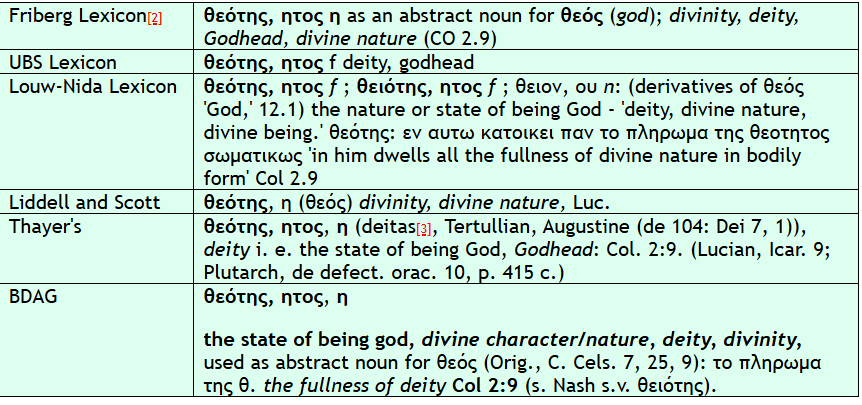
Thus, lexicons give expressions such as: divinity, deity, godhead, divine nature, divine being. But what do these expressions mean? An examination of some English dictionaries reveals that the meanings of these words is considerably broader than some Trinitarians would like them to be.
To demonstrate this, let’s look at the English terms that various English Bibles use to translate the Greek word θεότης, theotes in this verse:
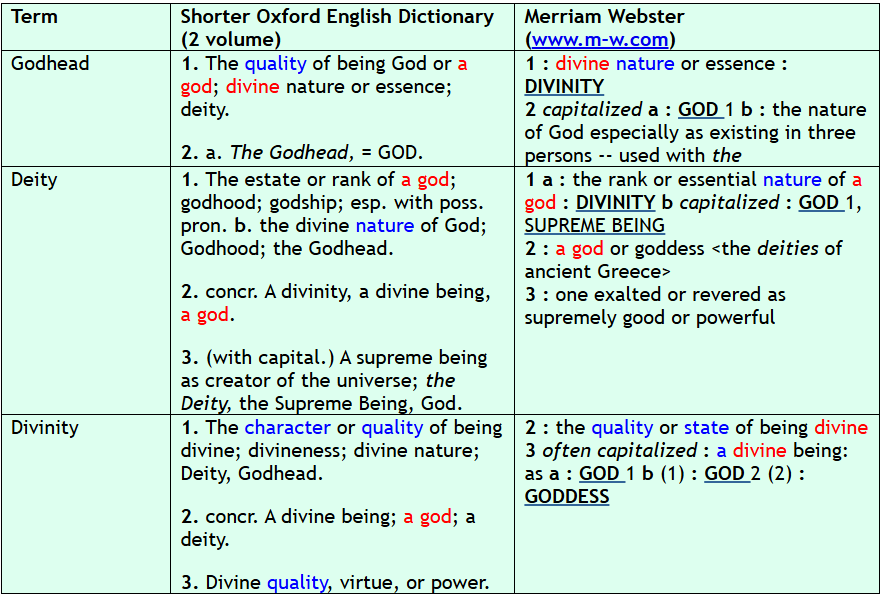
Straight away, two things should be apparent: Firstly, none of the above-mentioned words - Godhead, deity, divinity - necessarily mean that Christ is Almighty God. True, they could all be interpreted to mean that. But, then again, they can all be used to mean having the nature of a god rather than Almighty God. Secondly, all of these terms refer first and foremost to character, quality, state, nature and then, by extension, to identity.
Jesus is called “the last Adam” (1 Corinthians 15:45), for he willingly sacrificed what Adam lost through his disobedience, perfect human life. This perfectly demonstrates that Jesus was only human nature, for after sacrificing himself to match what Adam willfully lost, he had to be resurrected to life. If Jesus’ divine nature was still intact, then Jesus never really sacrificed his life (which would not have matched with what Adam lost anyway) and he would not need to be resurrected by his Father, as he could have just revitalized his dead body, or materialized a new human body, much like angels had done prior (Genesis 18:2; 19:1, 12; Joshua 5:13, 14 [likely Michael the archangel]; Judges 13:3, 6; Hebrews 13:2).
The more you post, the more others can see your errors.
1 Like
You conflate theiotēs and theotēs, ignoring Paul’s deliberate lexical distinction.
You treat “fullness dwelling” as a temporary gift, when the Greek demands permanent indwelling.
You misread the kenosis as loss of deity, when Paul describes it as veiling deity in servanthood.
For in him dwelleth all the fulness of the Godhead bodily (hoti en autōi katoikei pān to plērōma tēs theotētos sōmatikōs). In this sentence, given as the reason (hoti, because) for the preceding claim for Christ as the measure of human knowledge Paul states the heart of his message about the Person of Christ. There dwells (at home) in Christ not one or more aspects of the Godhead (the very essence of God, from theos, deitas) and not to be confused with theiotes in Rom_1:20 (from theios, the quality of God, divinitas), here only in N.T. as theiotēs only in Rom_1:20. The distinction is observed in Lucian and Plutarch. Theiotēs occurs in the papyri and inscriptions. Paul here asserts that “all the plērōma of the Godhead,” not just certain aspects, dwells in Christ and in bodily form (sōmatikōs, late and rare adverb, in Plutarch, inscription, here only in N.T.), dwells now in Christ in his glorified humanity (Php_2:9-11), “the body of his glory” (tōi sōmati tēs doxēs). The fulness of the God-head was in Christ before the Incarnation (Jhn_1:1, Jhn_1:18; Php_2:6), during the Incarnation (Jhn_1:14, Jhn_1:18; 1Jn_1:1-3). It was the Son of God who came in the likeness of men (Php_2:7). Paul here disposes of the Docetic theory that Jesus had no human body as well as the Cerinthian separation between the man Jesus and the aeon Christ. He asserts plainly the deity and the humanity of Jesus Christ in corporeal form.
Godhead. Gr. theotētos (S# G2320, only here). J. H. Thayer gives the definition “deity. i.e. the state of being God, Godhead” (Lexicon, p. 288b). Trench states “St. Paul is declaring that in the Son there dwells all the fulness of absolute Godhead… He was, and is, absolute and perfect God…” (Synonyms, sec. 2, p. 8). Bengel states “not merely the Divine attributes, but the Divine Nature itself.” Alford states “theotēs, the abstract of theos, must not be confounded with theiotēs, the abstract of theios, divine, which occurs in Rom_1:20,”
- Theotes , rendered “Deity”, and used of Christ. Occurs only in Col_2:9, and has relation to the Godhead personally ; while
- Theiotes , rendered “Deity” also, is Deity in the abstract . Occurs only in Rom_1:20.
- Theios , rendered “Divine”, and is used of Christ. Occurs only in 2Pe_1:3; 2Pe_1:4; and, with the Article, in Act_17:29, where it is rendered “Godhead”. Gr. = that which [is] Divine.
whole fullness of deity – The Greek word (theotês) stands here alone in the N.T. It is as strong as possible – Deity. The very nature of God is fully present in Christ.
dwells bodily – Jesus Christ is God incarnate; God dwelling among men in the flesh, Immanuel.
dwell – κατοικέω,katoikeō, G2730; Dwell, settle, inhabit, (not sojourn).
ῆς θεότητος, “of the Godhead” or “of deity.”
Here only in the Greek Bible, as κυαθότης, τραπεζότης (both coined by Plato) = the abstract quality of a cup, and of a table, so θεότης = the abstract quality of God, that which makes God what He is and without which He would cease to be God.
Had St Paul used θειότης in our passage he would have seemed to the Colossians to include all lower forms of divinity, and to exclude the highest and, as we know, the only real form—Deity.
For in him dwelleth - That is, this was the great and central doctrine that was to be maintained about Christ, that all the fulness of the Godhead dwelt in him**. Every system which denied this was a denial of the doctrine which they had been taught; and against every thing that would go to undermine this; they were especially to be on their guard. Almost all heresy has been begun by some form of the denial of the great central truth of the incarnation of the Son of God.**
Taken together, these errors [of yours] strip Colossians 2:9 of its force. Paul’s actual claim is that Jesus Christ embodies the fullness of deity bodily, making Him the sufficient and sovereign Lord over all. That is not fatalism, nor borrowed qualities - it is the heart of Christian confession.
J.
1 Like
You argue that if Paul wanted to say Christ was full of the divine quality, he would have used the word theiotes rather than theotes. The word theiotes is derived from theios , meaning divine. Thus Thayer’s Lexicon comments that θεότης deity differs from θειότης divinity, as essence differs from quality or attribute".
However, θεότης, like most nouns ending in -της, is an abstract noun. Scholar Dan Wallace makes the following comment about abstract nouns:
“Abstract nouns by their very nature focus on a quality. However, when such a noun is articular, that quality is “tightened up,” as it were, defined more closely, distinguished from other notions.” ( Greek Grammar Beyond the Basics , page 226.)
The function of nouns ending in -tes, then, is to show a quality, just as words ending in -ship, -ness, or -hood in English show quality, not identity. Both theotes and theiotes are abstract nouns and, as such, focus on qualities. Theotes focuses on the quality of that which is theos, and theiotes focuses on the quality of that which is theios. Since theios, divine, basically means pertaining to God or to a god, then it is unsurprising that lexicons give similar definitions for theotes and theiotes, Liddell and Scott’s Lexicon, for instance, giving virtually identical definitions for both words.
The Greek word theiotes is used in Romans 1:20. The New World Translation renders this word as ‘godship’. Although most lexicons prefer the rendering ‘divinity’ for theiotes, it should be noted that the word ‘godship’ is defined by Merriam Webster Unabridged Online Dictionary as “the rank, character or personality of a god”, thus making it very close in meaning to the terms divinity and deity, as defined in the lexicons referred to above.
At the same time, the cited lexicons consistently overlap in meaning—“divinity,” “divine nature,” “deity,” and “godhead”—indicating that the distinction is not as rigid or mutually exclusive as claimed. The argument being made is about semantic range, not denial of lexical distinction: both words can describe what it means to possess the nature or qualities of God. Therefore, rather than ignoring Paul’s choice, the text acknowledges it while showing that its theological implications are broader than a strict, technical separation would suggest.
We need to consider, not only whether the English expression divine quality means the same as theotes, but also whether it is as specific as its Greek equivalent. This second point is important, because when critics object to the rendering ‘divine quality’, it is usually not because they deny that Christ is full of the divine quality. What they do object to is that, in their view, the rendering ‘divine quality’ understates the meaning of theotes, in other words fails to show that Jesus is completely God.
For this discussion, I have assumed that the genitive here in the expression fullness of the Godhead / Deity / divinity is a genitive of content. In other words, it indicates the quantity or amount of theotes that is present in Christ (namely, all of it). While I am persuaded that this is the correct understanding, and our discussion has therefore focused on the meaning of theotes, it must be remembered that the genitive case in Greek has many different shades of meaning. Since Colossians 1:19 says that Christ has plerotes (fullness) by God’s own decision, it might well be possible for someone to construct a case for a genitive of source, i.e. “the fullness that comes from the Deity.”
So is “divine quality” a correct translation for theotes? A look at the above lexicons shows beyond any doubt that it is. BDAG uses the expression “divine character”, which means basically the same as “divine quality”. “Divinity” - a term used by Friberg, Liddell and Scott’s Lexicon and BDAG, is defined by the Shorter Oxford as “the character or quality of being divine”. This, too, shows the legitimacy of the rendering ‘divine quality’.
In fact, as shown above, all three terms frequently used to translate θεοτης have dictionary definitions that include the words ‘divine’ and ‘quality’ or one of its synonyms. Thus, although none of the above-cited lexicons use the precise expression “divine quality”, critics are splitting hairs when they reject the reading as inaccurate. (Mark McFall, in his article, “An analysis of The Kingdom Interlinear Translation of the Watchtower Society - “Theotes” in Col 2:9 and “Theiotes” in Rom 1:20” acknowledges that: “some scholars accept theotes as meaning divinity which could convey the rendering ‘divine quality’”).
Scholar H. S. Nash says of the Vulgate’s use of divinitas : “The Vulgate gives divinitas as the equivalent of θεότης in Col 2:9; and from Tertullian down to Aquinas it is always so quoted. If that fact stood alone, it might not have much weight. It could then be fairly urged that the earlier text of the Vulgate was the work of translators, who, knowing Greek only in the rough, slurred over a fine distinction, like that between θειότης and θεότης, and, furthermore, when once the Vulgate had intrenched itself in liturgical use and popular reverence, it was next to an impossibility to change it. The fact, however, that the Greeks themselves did not know the tradition, knocks the bottom out of that argument.”
In him all the fullness of deity lives. The present tense in this verse (“lives”) is significant. Again, as was stated in the note on 1:19, this is not a temporary dwelling, but a permanent one. Paul’s point is polemical against the idea that the fullness of God dwells anywhere else, as the Gnostics believed, except in Christ alone. At the incarnation, the second person of the Trinity assumed humanity, and is forever the God-man.
For in him dwelleth all the fulness of the Godhead bodily ( οτ εν αυτω κατοικε παν το πληρωμα της θεοτητος σωματικως ). In this sentence, given as the reason ( οτ, because) for the preceding claim for Christ as the measure of human knowledge Paul states the heart of his message about the Person of Christ. There dwells (at home) in Christ not one or more aspects of the Godhead (the very εσσενχε of God, from θεοσ, δειτας ) and not to be confused with θειοτες in Ro 1:20 (from θειος, the
quality of God, divinitas), here only in N.T. as θειοτης only in Ro 1:20.
In Greek Grammar Beyond the Basics (1996), Wallace explains:
“θεότης refers to the essence of deity — the very state of being God. θεῖότης, by contrast, refers to divine attributes. Paul’s choice of θεότης in Col 2:9 is deliberate: he is affirming that all the fullness of deity itself dwells bodily in Christ.”
He adds that θεότης is “the strongest term available for the concept of Godhead” and that Colossians 2:9 is “one of the clearest affirmations of Christ’s ontological deity in the NT.”
Wallace’s writings on Christology and Greek grammar are available on his official site: Daniel B. Wallace – Exegesis
And here…
The Error of “Quality vs. Identity”
Your argues that nouns ending in -tēs only show “quality, not identity.” While it is true that -tēs creates abstract nouns, Wallace argues that the nature of the quality depends on the root word.
Theiotes (from theios): Focuses on the qualities of a divine being (divinity/attributes).
Theotes (from theos): Focuses on the state of being God (deity/essence).
Wallace specifically addresses this on page 272 (not 226) of Greek Grammar Beyond the Basics. He notes that while they are both abstract, they are not interchangeable. He argues that theotēs is the “state of being God,” which implies ontological identity, not just a set of attributes.
Table of Contents
God Is:
The Trinity
A proper definition of the Trinity:
The Deity of The Lord Jesus
Fullness of the Godhead
Evidences of The Deity of The Lord Jesus
Christ Possesses the Attributes of DEITY
Christ Performs the Work of DEITY
Christ is Given the Titles of DEITY
Jesus Claimed to Be God
The Apostles Claimed that Jesus Is God
The Granville Sharp rule (TSKS construction) states:
Christologically Significant Texts
Messianic Proof of Christ’s Deity
Attributes:
Eternality of Christ
Omnipresence
Omniscience
Omnipotence
Immutability
All attributes of DEITY belong to Christ
I rest my case.
J.
C. S. Lewis was correct when he said that the only options available concerning the Person of Christ were:
He was a liar, a lunatic, or Lord. Considering the enormous claims that Christ made, it would be impossible simply to designate Him a “good teacher.”
He claimed to be much more than a teacher.
The incarnation did not subtract deity; it added humanity.[5]
Evidences of The Deity of The Lord Jesus
Christ Possesses the Attributes of DEITY
-
Omnipresence (Matt. 18:20; 28:20; John 1:50)
-
Omniscience (Matt. 16:21; Luke 6:8; John 2:24, 25; 6:64; 21:17)
-
Omnipotence (Matt. 28:18; Phil. 3:21; John 10:18; Lk 4:36; 9:1; 10:19; Mk 4:41)
-
Eternality (John 8:58; 17:5; Isa. 9:6; Mic. 5:2; Heb 13:8)
-
Immutability (Heb. 1:10,11-12; 13:8)
-
All attributes of DEITY belong to Christ (Col. 2:9)
Christ Performs the Work of DEITY
-
Creation (John 1:3, 10; Col. 1:16; Heb. 1:2)
-
Preservation (Col. 1:17; Heb. 1:3)
-
Forgiveness of sins (Mat 9:6; Mark 2:5; Luke 5:24; Col. 3:13)
-
Power to raise the dead (John 5:21; 11:43)
-
Judgment of the world (John 5:22, 27; 2 Cor. 5:10)
Christ is Given the Titles of DEITY
-
Son of God (Jn 5:18; Matt. 26:63,64; Mark 1:1; John 10:36)
-
Son of man (Dan. 7:13; Mark 2:10)
-
God (John 1:1, 18; 20:28; Heb. 1:8; Is 7:14; Mt 1:23; Matt. 16:16)
Jesus Claimed to Be God
-
By accepting worship (Matt. 28:9-10; John 9:1,38)
-
By identifying himself with God in context of monotheism (John 10:30).
-
By explicit claims (John 8:58)
The Apostles Claimed that Jesus Is God
Apostolic assertions for Christ’s DEITY can be found in John 1:1; Colossians 1:19; 2:9; Hebrews 1:8, Romans 9:5 and Titus 2:13.[6]
The Granville Sharp rule (TSKS construction) states:
If two
(1) singular,
(2) personal,
(3) non-proper nouns (substantives)
(4) of the same case
(5) are connected by καί and
(6) the article precedes the first substantive
(7) and is not repeated before the second substantive,
then the second substantive always refers to the same person that is expressed or described by the first substantive.
In other words, if ALL the conditions are met, then the first and second substantives describe the same person.
Note: Many problems arise if ALL limitations are not observed
This is known as the “TSKS construction” (“The”-Substantive-Καί-Substantive.)
Christologically Significant Texts
Granville Sharp believed that several christologically significant texts involved the TSKS construction. However, several of these involved dubious textual variants (e.g., Acts 20:28; Jude 4), and others had proper names (Eph 5:5; 2 Thess 1:12; 1 Tim 5:21; 2 Tim 4:1).
This leaves two passages, Titus 2:13 and 2 Pet 1:1.
Titus 2:13 τοῦ μεγάλου θεοῦ καὶ σωτῆρος ἡμῶν Ἰησοῦ Χριστοῦ
“Titus 2:13 τοῦ μεγάλου θεοῦ καὶ σωτῆρος ἡμῶν Ἰησοῦ Χριστοῦ”
our great God and Savior, Jesus Christ
It has frequently been alleged that θεός is a proper name and, hence, that Sharp’s rule cannot apply to constructions in which it is employed. We have already argued that θεός is not a proper name in Greek. We simply wish to point out here that in the TSKS construction θεός is used over a dozen times in the NT (e.g., Luke 20:37; John 20:27; Rom 15:6; 2 Cor 1:3; Gal 1:4; Jas 1:27) and always (if we exclude the christologically significant texts) in reference to one person. This phenomenon is not true of any other proper name in said construction (every instance involving true proper names always points to two individuals). Since that argument carries no weight, there is no good reason to reject Titus 2:13 as an explicit affirmation of the deity of Christ.
2 Pet 1:1 τοῦ θεοῦ ἡμῶν καὶ σωτῆρος, Ἰησοῦ Χριστοῦ
“2 Pet 1:1 τοῦ θεοῦ ἡμῶν καὶ σωτῆρος, Ἰησοῦ Χριστοῦ”
our God and Savior, Jesus Christ
Some grammarians have objected that since ἡμῶν is connected with θεοῦ, two persons are in view. The pronoun seems to “bracket” the noun, effectively isolating the trailing noun. However in 2 Peter 1: 11 of this same chapter (as well as in 2 Peter 2:20 and 2 Peter 3:18), the author writes τοῦ κυρίου ἡμῶν καὶ σωτῆρος, Ἰησοῦ Χριστοῦ, an expression which refers to one person, Jesus Christ: “Why refuse to apply the same rule to (2 Peter 1:1 CSB), that all admit … to be true of 2 Peter 1:11 [not to mention 1 Peter 2:20 and 2 Peter 3:18]?” Further, more than half of the NT texts that fit Sharp’s rule involve some intervening word between the two substantives. Several of them have an intervening possessive pronoun or other gen. modifier. Yet, in all of these constructions only one person is clearly in view.61 In all such instances the intervening term had no effect on breaking the construction. This being the case, there is no good reason for rejecting 2 Peter 1:1 as an explicit affirmation of the deity of Christ.[4]
Messianic Proof of Christ’s Deity
- The Old Testament says “Messiah is God.”
Isaiah 7:14: Immanuel
Isaiah 9:6: Mighty God
Isaiah 40:10: LORD God
Daniel 7:13–28: Ancient of Days
Micah 5:2: From Everlasting
Zechariah 12:10: YHWH
Zechariah 14:16: Lord of Hosts (or LORD Almighty)
Psalm 45:6: God (Heb. 1:8)
Psalm 110:1: LORD—(Matt. 22)
Psalm 118:22: Stone (used 4 times in New Testament) - Jesus is Messiah (Hebrew basis for Greek christos or Christ)
Matthew 16:16–17, 20
Mark 8:29
Luke 9:20
Jesus alone fulfills all the prophecies. - Therefore Jesus is God.
Shalom.
J.
Messianic Proof of Christ’s DEITY
- The Old Testament says “Messiah is God.”
Isaiah 7:14: Immanuel
Isaiah 9:6: Mighty God
Isaiah 40:10: LORD God
Daniel 7:13–28: Ancient of Days
Micah 5:2: From Everlasting
Zechariah 12:10: YHWH
Zechariah 14:16: Lord of Hosts (or Lord Almighty)
Psalm 45:6: God (Heb. 1:8)
Psalm 110:1: Lord—(Matt. 22)
Psalm 118:22: Stone (used 4 times in New Testament)
- Jesus is Messiah (Hebrew basis for Greek christos or Christ)
Matthew 16:16–17, 20
Mark 8:29
Luke 9:20
Jesus alone fulfills all the prophecies.
- Therefore Jesus is God.
Theos in the New Testament
A. Background to the New Testament Use of θεός
- θεός in the Septuagint
a. As Rendering אֵל
b. As Rendering אֱלֹהִים
c. As Rendering יְהוָה
d. The Interrelationship of אֵל, אֱלֹהִים, and יְהוָה
- θεός in Extrabiblical Literature
a. As Applied to Gods
b. As Applied to Human Beings
c. As Applied to the God of Israel
- Conclusion
B. Analysis of the New Testament Use of θεός
-
Statistical Summary
-
The Nominative Singular (ὁ) θεός
a. (ὁ) θεός with εἶναι Expressed
(1) ὁ θεός as Subject
(2) θεός as Subject
(3) ὁ θεός as Predicate
(4) θεός as Predicate
b. (ὁ) θεός with εἶναι Unexpressed
(1) ὁ θεός as Subject
(2) θεός as Subject
(3) ὁ θεός as Predicate
(4) θεός as Predicate
c. (ὁ) θεός as Subject
d. (ὁ) θεός as Predicate
- The Relation between ὁ θεός and θεός
a. Suggested Distinctions
b. Frequently Interchangeable
c. Occasionally Distinguishable
- The Principal Referent(s) of (ὁ) θεός
Praise our great God and Savior Jesus Christ!.
J.
Ok so even though the way the narratives reads associating Christ’s missing body for the reason He resurrected (a connection scripture itself makes in several places), over a matter beyond human comprehension, you would be more comfortable believing that “apparently what must have happened” as that which affirms best an uncomprehensible supernatural act of God? Having no scripture affirm your guess?
Ok, so here is my guess then i guess. As long as we our using philosophy why can’t it just be Occom’s Razor? The body not there is the one that rose? Why is believing that His sacrifice limits Him over what He does with creation though? What harm does it do to the faith to have that body in the tomb (with holes in his hands and scars too to prove it) be the same one glorified? How does this injure the JW belief in God? I don’t exactly understand why a presumption would have such authoritative presence over something mortal man cannot just guess about though. And where it cannot the bible also provide something in our experience we can compare it to…
The following is from the Woodland Trust website. It demonstrates a correlation reference from the bible as related to death cycle to life compared. In this process, that which dies “becomes” that which is new life. It does not just go away and have no part in new life. It is essential to it. So if the bible affirms this science and connects that which dies is a part of and becomes the new life, can you show science of not just new life coming out of death that does not come out of death, but as well sufficiently so that it makes Corinthians more clear here?
Because otherwise, the difference is just an apparent guess, right? Vs verses that presumably connect the body in the tomb in a natural reading of the narrative with that which is resurrected…as well as Corinthians affirming this very process too though…just saying…
Thanks Johann. Yeah. like it here. Its different than my main forum. But there are interesting conversations to have. So like on the gnostic thing it seemed to me what JWs might share is that Christ did not rise from the dead in the sense evangelicals would mean. Like tasting true death for all humanity. But maybe just death in reference to humanity. Whereas it would seem the JW view on that be similar to that of the gnostic. But i get that @gospel would like to have a distinction.
I mean their argument that Christ cannot use what was sacrificed to them makes sense. But to have that so hugely implied against what is thickly and richly provided from varying angles in scripture puzzles me. Johann do you understand why they do that? I mean is there something in their belief that would crumble if Christ rose in the fleshy glorified? Does that pose some problem for them theologically? Because otherwise why would they let a philosophical presumption satisfy what is supernatural? In that sense, to believe to “see” that God must have disposed of the body is not gnostic in the sense of Christ not coming in bodily form. For JWs believe that. But it is gnostic, at least to me, in hearing secret things from God the scriptures don’t say and build a religious sect on it is where i’d come from on that.
Although 1 Cor 15 is massively a problem for the view that affirms its not the same body glorified. To me 1cor15 smothers us in that. Sometimes i might recall something like that and mistake it with the gnostic belief that Jesus only rose in spirit because He only came in spirit. I believe is what gnostics would see. 1cor15 is against the Sadducee non-resurrection claims. But even so, that chapter dissertation says nothing about God taking away the body and swapping it out for a new one.
@Gospel do JWs believe the same about the believer’s resurrection?
1 Like