The Greek construction in John 3:3 and 3:5 uses the subordinate aorist subjunctive (γεννηθῇ / gennēthē). In Greek syntax, when a subordinate clause uses the aorist subjunctive with ἐὰν μή (“unless”), it denotes an action that must happen before the action of the main verb can occur.
The Logic: The main verb is δύναται (dynatai—“is able” to see/enter).
The Result: The new birth is the prerequisite, not the destination.
You do not go to heaven to be born again; you must be born again in order to enter or even see the kingdom. This places the “birth” firmly on earth as a present reality.
II. The Universal Pronoun (Tis)
Jesus does not limit the requirement of the new birth to a specific number or a ruling class.
The Text: “Unless anyone (tis) is born again…” (John 3:3).
My rebuttal to you… The Greek indefinite pronoun τις (tis) is all-inclusive. If the “Great Crowd” or any other group of Christians is not “born again,” then according to Jesus’ own words, they cannot “see” or “enter” the Kingdom of God. There is no biblical category for a “Christian” who is not born again.
III. The Present Reality of Regeneration The apostolic letters describe being born again as a completed past act with present ongoing results, not a future event in heaven.
1 Peter 1:3: Uses the aorist participle ἀναγεννήσας (anagennēsas), meaning God “has caused us to be born again” (past tense). This happened at the point of faith and baptism, not at the point of death.
1 John 5:1: Uses the perfect tense γεγέννηται (gegennētai), which describes a past action with abiding present results: “Everyone who believes… has been born of God.”
As you may notice…
Your claim that being born again happens “as spirits in heaven” reverses the biblical order of salvation. Scripture presents the new birth as an earthly necessity for all believers. If one is not born again now, they have no claim to the Kingdom later. Furthermore, the Bible never links the “144,000” (a number found only in the symbolic book of Revelation) to the “born again” discourse in John 3. The “new birth” is the entrance into the Christian life, not a promotion at the end of it.
@Gospel, in my studies of the Bible, I came to see that the “translators” of the NWT slanted their version to fit their beliefs that have wandered from the true Word of God that is based on the Hebrew and Greek version. For example, they said that John 1:1 is translated to say that the Word is “a God” instead of the true Greek that says he is God.
Let’s face it. I believe that the JWs have given in to rationalism that uses reason instead of the basis of the Bible’s clear teachings, that are mysterious in that John 1:1 presents two of the three Person of one God. The JWs reject the mysterious, biblical teaching of the Trinity because their human reason cannot accept it, thus putting their reasoning first over the Bible and resulting in their slanted NWT. Am I right?
While many Bible translators render the verse “the Word was God”, others see the need to render it differently. In the original-language text, the two occurrences of “God” (Greek, the·osʹ ) at John 1:1 are grammatically different. In the first occurrence, the word “God” is preceded by the Greek definite article, while the article does not appear before the second occurrence.
Many scholars note that the absence of the definite article before the second the·osʹ is significant. For example, The Translator’s New Testament says regarding this absence of the article: “In effect it gives an adjectival quality to the second use of Theos (God) so that the phrase means ‘The Word was *divine.’” ( The Translator’s New Testament, page 451.)
Scholar Jason David BeDuhn states that the absence of the definite article makes the two occurrences of “God” “as different as ‘a god’ is from ‘God’ in English.” He adds: “In John 1:1, the Word is not the one-and-only God, but is a god, or divine being.”—Truth in Translation: Accuracy and Bias in English Translations of the New Testament, pages 115, 122, and 123.
Other scholars and Bible translations point to this same distinction:
“In the beginning the Word existed. The Word was with God, and the Word was divine.”—The Bible—An American Translation, 1935, by J.M.P. Smith and E. J. Goodspeed.
“The Logos existed in the very beginning, the Logos was with God, the Logos was divine.”—The Bible—Containing the Old and New Testaments, 1950, by James Moffatt.
“The Word was in the beginning, and the word was with God, and the word was a god.”—The New Testament in an Improved Version, 1808, edited by Thomas Belsham, based on a New Testament translation by William Newcome.
“In the beginning was the Word. And the Word was with God. So the Word was divine.”—The Authentic New Testament, 1958, by Hugh J. Schonfield.
Actually, your argument assumes conclusions that the text itself does not require—especially about who is being addressed and what “entering the Kingdom” means.
1) The Greek construction (John 3:3, 5)
It is true that “unless one is born again” is a prerequisite for “seeing” or “entering” the Kingdom, but the text does not specify where or when that birth is completed. The verb γεννηθῇ (aorist subjunctive) simply presents the new birth as necessary, without defining its full process or timing. Jehovah’s Witnesses understand this “birth” as a spiritual begetting by holy spirit that begins on earth but is completed when the person is resurrected to heavenly life (compare John 1:12–13; 1 Corinthians 15:44). So the grammar establishes necessity, not location.
2) “Seeing” vs. “entering” the Kingdom
Jesus distinguishes between seeing and entering (John 3:3, 5), which allows for different relationships to the Kingdom. In Scripture, “seeing” can mean perceiving or recognizing (Luke 17:20–21), not necessarily ruling in heaven. We therefore understand that some can “see” or benefit from the Kingdom without being part of the heavenly ruling class (compare Psalm 37:29; Matthew 5:5).
3) The universal pronoun τις (tis)
“Anyone” (τις) is indeed broad, but it must be interpreted in context. Jesus was speaking about those who would enter God’s Kingdom, which elsewhere is described as a limited group who “rule as kings and priests” (Revelation 5:10; 14:1–3). This requirement applies to all who receive that heavenly calling, not necessarily to every future subject of the Kingdom on earth (Revelation 7:9–10 distinguishes another group).
4) The “new birth” in the apostolic letters
Verses like 1 Peter 1:3 and 1 John 5:1 describe the new birth as already having begun, which Jehovah’s Witnesses agree with—but this as a begetting, not the completed birth. A helpful parallel is human life: conception begins life, but birth comes later. Likewise, spirit-begotten Christians are “born again” in a full sense only when they are resurrected as spirit beings (John 3:6; 1 Corinthians 15:50–53).
5) The 144,000 and John 3
While John 3 does not mention the 144,000 explicitly, other passages connect the ideas: those “born from the spirit” correspond to those who inherit the Kingdom in heaven (Luke 12:32; Revelation 14:1). The limitation comes not from John 3 alone, but from the broader biblical teaching that only a defined group receives the heavenly inheritance, while others receive everlasting life on earth (Psalm 37:29; Revelation 21:3–4).
Conclusion
The “new birth” is indeed essential—but it applies specifically to those called to heavenly rulership. It begins on earth as a present reality but is completed in heaven, and Scripture allows for another group of faithful believers who benefit from the Kingdom without being “born again” in that specific sense.
You are incorrect. The reason we do not believe in the Trinity is because there is no verse that says or implies that God is one essence shared by three co-equal and co-eternal persons.
What the Bible actually teaches is that the Father is the Supreme God and the origin of everything, the Holy Spirit is the name of his active power, and the Son is the firstborn creation of the Father.
The Single Verb “Gennaō”
The core of your argument relies on a distinction between “conception/begetting” and “birth” that the Greek text does not support.
The New Testament uses a single verb, γεννάω (gennaō), to cover the entire process of procreation. In the active voice, it means “to beget”; in the passive voice, it means “to be born.”
Your argument that 1 Peter 1:3 or 1 John 5:1 refers only to a “conception” (begetting) while waiting for a future “birth” is a lexical imposition.
Wallace’s View: In Greek Grammar Beyond the Basics, Daniel Wallace emphasizes that the Perfect Tense used in 1 John 5:1 (γεγέννηται / gegennētai) describes a completed action with ongoing results. It does not describe a “pending” or “incomplete” state. If one “has been born of God,” the birth is a finished reality in the present.
The Aorist vs. The Future.
If the New Birth were a future event occurring at the resurrection, the Apostles would have used future-oriented syntax. Instead, they used the Aorist (past-point action).
1 Peter 1:3: Paul uses the aorist participle ἀναγεννήσας (anagennēsas).
F.F. Bruce’s Analysis: In his commentary on the Petrine epistles, Bruce notes that this “new birth” is grounded in a past event: the resurrection of Jesus Christ. Bruce argues that for the believer, this regeneration is the source of their hope, not the object of it. We are not waiting to be born; we are born unto a living hope.
Syntax of John 3:6: The JW argument often cites “that which is born of the Spirit is spirit” to mean one becomes a spirit creature.
However, the syntax suggests a nature rather than a location. Being “born of the Spirit” characterizes the believer’s current spiritual life, which is distinct from their “fleshly” (sarx) nature.
1 Corinthians 15 and the “Two-Stage” Fallacy.
You are using 1 Corinthians 15:50–53 to link the new birth to the resurrection. However, Paul’s context there is glorification, not regeneration.
1Co 15:50 But this I tell you, brothers: Our physical bodies cannot take part in the kingdom of God; what is decaying will never take part in what is immortal.
1Co 15:51 Let me tell you a secret. We shall not all fall asleep, but we shall all be changed,
1Co 15:52 in a moment, in the twinkling of an eye, at the sound of the last trumpet. For the trumpet will sound, and the dead will be raised with bodies not subject to decay, and we shall be changed.
1Co 15:53 For this decaying part of us must put on the body that can never decay, and this part once capable of dying must put on the body that can never die.
1Co 15:54 And when this part once capable of dying puts on the body that can never die, then what the Scripture says will come true, “Death has been swallowed up in victory.
1Co 15:55 O Death, where is your victory now? O Death, where is your sting?”
1Co 15:56 Now sin gives death its sting, and the law gives sin its power.
1Co 15:57 But thank God! He gives us victory through our Lord Jesus Christ.
1Co 15:58 So, my dear brothers, continue to be firm, incapable of being moved, always letting the cup run over in the work of the Lord, because you know that your labor in the service of the Lord is never thrown away.
The Distinction- Regeneration (Born Again) is the change of the heart/spirit (John 3); Glorification (Resurrection) is the change of the body (1 Cor 15).
F.F. Bruce on 1 Cor 15: Bruce clarifies that the “change” Paul describes is the mortal putting on immortality. Bruce never equates this with the “New Birth.” To do so would mean Nicodemus could not “see the kingdom” until he died and was resurrected-effectively making Jesus’ command to “be born again” impossible to obey during his earthly life.
Your attempt to separate “begetting” from “birth” is a linguistic fallacy. In the Greek of the New Testament, γεγέννηται (has been born) is a Perfect Tense verb, signifying a transformation that is already complete in the believer.
Daniel Wallace confirms that the syntax of 1 John 5:1 identifies the present state of the believer as one who is already fully born of God.
F.F. Bruce maintains that the “New Birth” is a present reality achieved through the Spirit, providing the “living hope” that looks forward to-but is not identical to-the resurrection.
If the New Birth only happens at resurrection, then Jesus’ statement to Nicodemus-“You must be born again”-would be a command to die and be raised, rather than a call to present faith and spiritual renewal.
By conflating Regeneration with Glorification, your are overriding the clear temporal markers of the Greek text which locate the “Birth” at the beginning of the Christian walk, not the end.
You import meanings into the text that the context of Scripture does not require.
1) One verb (gennaō) does not mean one stage of reality
It is true that γεννάω can mean “beget” or “give birth” depending on context, but that flexibility actually supports the JW distinction rather than destroys it. Greek often uses one verb with a broad semantic range, and context determines stage and meaning. For example, the same “life” can be spoken of as beginning, continuing, or being completed without requiring the same moment of reference. So it is not a “lexical fallacy” to recognize different phases; it is basic contextual interpretation.
2) Perfect tense does not automatically mean final glorification
1 John 5:1 (“everyone who believes has been born of God”) uses the perfect tense, which indeed expresses a past action with ongoing results. I agree with that—but the question is what kind of birth is being described. The text does not say the process is finished in every respect; it describes the believer’s current status as one who has been spiritually “brought forth” by God. The same Johannine writings also show that believers still sin and must continue in faith (1 John 1:8–10), so “has been born” cannot mean a completed, irreversible glorified condition.
3) Aorist does not determine eschatological timing
The claim that the aorist automatically places regeneration entirely in the past and therefore fully completed is not valid Greek exegesis. The aorist simply presents the action as a whole, without specifying ongoing phase development. For example, resurrection language, covenant initiation, and even salvation events are all described with aorists without implying full final completion. Jehovah’s Witnesses therefore see 1 Peter 1:3 as describing the initiation of a new spiritual life grounded in Christ’s resurrection—not its final consummation.
4) “Born of the Spirit” (John 3:6) and nature, not location
Even if one accepts that the phrase describes a present condition, it still does not define the final outcome of that condition. I agree that spirit-begotten Christians develop a spiritual nature while still on earth (Romans 8:16–17). However, John 3:6 does not say that such ones are already spirit creatures in the resurrection sense; it contrasts two sources of life, flesh and spirit, not two final destinies already completed.
5) 1 Corinthians 15 is exactly where the distinction becomes necessary
The attempt to sharply separate “regeneration” from “glorification” is not an invention of my own making—it is Paul’s own distinction. In 1 Corinthians 15, Paul explicitly describes the moment when mortality is replaced with immortality. That transformation is clearly future, universal for the anointed, and bodily. If “born again” already meant full spiritual resurrection, then Paul’s “change” at the last trumpet would be redundant. Jehovah’s Witnesses therefore see consistency:
John 3 → entrance into spiritual life (begetting / beginning)
1 John 5 → present status of those in that spiritual life
1 Corinthians 15 → final transformation at resurrection
6) The practical issue Jesus raises in John 3
Your conclusion would still create a tension: Nicodemus is told he “must be born again” in the present discussion with Jesus. If that phrase only refers to a future resurrection transformation, then Jesus’ instruction would not be actionable in Nicodemus’ lifetime. Jehovah’s Witnesses see that as unlikely given the immediate call to faith, repentance, and acceptance of Christ (John 3:14–16).
Conclusion
So the argument overextends grammatical categories into theological conclusions the text does not explicitly make. I accept that the new birth is a real, present spiritual reality—but as a beginning of divine life, not its completed form. The Greek grammar describes the reality of the experience, but it does not eliminate the biblical pattern of an initial begetting followed by a future resurrection to full spirit life.
Now this makes no sence, why only a 144,000 people? Who chooses these 144,000 and what do you have to do different from everyone else to be one of them?
So i can do everything right but in the end i may still fall short and someone else gets my spot. Thats not fair. So you believe that earth is hell? Because whom ever does not get into heaven goes to hell. Ive heard people say that we live in hell now.
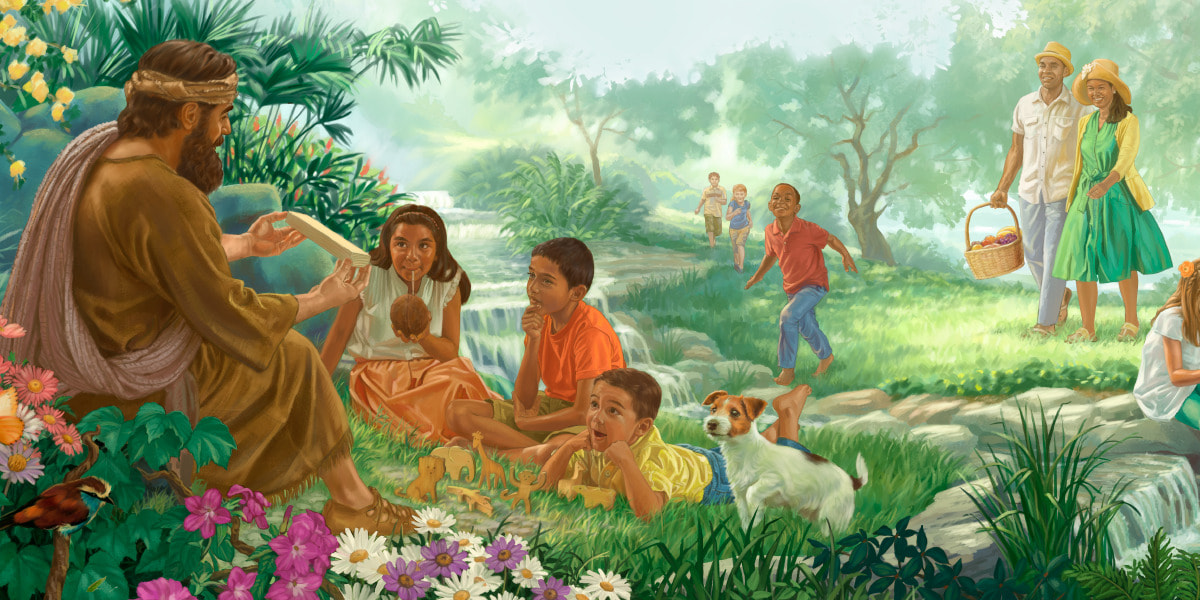
Adam and Eve lived on earth, and it was God’s original purpose that mankind lives on earth and be fruitful and fill the earth. Jehovah has not changed his purpose.
We are to pray for God’s will to be fulfilled in heaven as well as on earth. What is God’s will for earth? To be filled with his worshippers. If everyone went to heaven, how will God’s will be accomplished on earth?
Revelation says that 144,000 annointed kings in heaven will rule with Jesus over the earth. Whom will they rule over if everyone went to heaven ?
Jehovah’s faithful worshippers who have survived the End of this wicked system will be the ones to dwell on earth forever! That’s a good news!
Jehovah promises these things:
PLENTY OF FOOD: “The earth itself will certainly give its produce; God, our God, will bless us.” “There will come to be plenty of grain on the earth; on the top of the mountains there will be an overflow.”—Psalm 67:6; 72:16.
NO MORE WAR: “Come, you people, behold the activities of Jehovah, how he has set astonishing events on the earth. He is making wars to cease to the extremity of the earth.”—Psalm 46:8, 9.
NO BAD PEOPLE: “For evildoers themselves will be cut off . . . And just a little while longer, and the wicked one will be no more; and you will certainly give attention to his place, and he will not be.”—Psalm 37:9, 10.
NO SICKNESS, SORROW, OR DEATH: “At that time the eyes of the blind ones will be opened, and the very ears of the deaf ones will be unstopped. At that time the lame one will climb up just as a stag does, and the tongue of the speechless one will cry out in gladness.”—Isaiah 35:5, 6.
Ah, I see what’s going on now. You acknowledge the syntax and grammar, yet you’re leaning on AI-style reasoning to try and overturn what the text plainly teaches in Scripture.
@anon3111385 was right to point out your errors, your position ends up sounding inconsistent.
I’m out of this “discussion”
BORN AGAIN
This root (gennaō) is used in Jesus’ discussion with Nicodemus in John 3:3,7,8, also in 1 John 2:29; 3:9; 4:7; 5:1,4,18, and in 1 Pet. 1:23 (i.e., anagennaō). It speaks of a decisive act of a new life, a new orientation, a new worldview, a new relationship with God through faith in Christ.
The NT also uses other imagery to describe our salvation:
“quickened” (cf. Col. 2:13; Eph. 2:4-5)
“new creation” (cf. 2 Cor. 5:17; Gal. 6:15)
“partaker of Divine Nature,” (cf. 2 Pet. 1:4)
Paul is fond of the familial imagery “adoption” (cf. Rom. 8:23; Gal. 4:5; Eph. 1:5)
John and Peter are fond of the familial imagery “new birth.” This imagery of being “born again” or “born from above” is a biblical emphasis on the need for a totally new start (cf. Ezek. 36:26-27), a totally new family (cf. John 1:12-13; Rom. 5:12-21). Christianity is not a reformation or a new morality; it is a new relationship with God. This new relationship is made possible because of
the Father’s mercy and grace (cf. Exod. 34:6; Neh. 9:17)
the Son’s sacrificial death (cf. 2 Cor. 5:21) and resurrection from the dead (cf. 1 Corinthians 15)
the work of the Spirit (cf. John 3:6; 6:44,65; 1 Pet. 1:2)
This divine will and action gives believers a new life, a living hope, and a sure inheritance.
SPECIAL TOPIC: CHRISTIAN ASSURANCE
I have included my exegetical note from John 3:16 “born again.”
John 3:3
NASB, NKJV, TEV, REB, Peshitta “born again”
NRSV, NJB “born from above”
This is AORIST PASSIVE SUBJUNCTIVE. The word (anōthen) can mean
“physically born a second time”
“born from the beginning” (cf. Acts 26:4)
“born from above,” which fits this context (cf. John 3:7,31; 19:11)
This is probably another example of John’s use of terms that have two meanings (double entendre), both of which are true (cf. Bauer, Arndt, Gengrich and Danker’s A Greek-English Lexicon of the New Testament, p. 77). As is obvious from John 3:4, Nicodemus understood it as option # 1. John and Peter (cf. 1 Pet. 1:23) use this familial imagery for salvation as Paul uses the term “adoption.” The focus is on the Father’s acts in begetting (cf. John 1:13). Salvation is a gift and act of God (cf. John 1:12-13; Rom. 3:21-24; 6:23; Eph. 2:8-9; 1 John 4:9-10).
The footnote to George Lamsa’s translation of the Peshitta says, “‘Born again’ in northern Aramaic, means to change one’s thoughts and habits. Nicodemus spoke southern Aramaic and hence, did not understand Jesus.”
Those who are born again receive an anointing with God’s Holy Spirit and are spiritually adopted by God with the hope of life in heaven with Christ. They have a special purpose, they are to serve with the King of kings, Christ Jesus, as kings and priest of God.
Revelation 5:9–10 NW — . . . with your blood you bought people for God out of every tribe and tongue and people and nation, 10 and you made them to be a kingdom and priests to our God, and they are to rule as kings over the earth.”
The Kingdom of God is a government which rules from heaven. You could liken these chosen ones to the members of an administration who are selected to serve under the leadership a president or prime minister in a human government. They will help Christ administer God’s blessing to the earth. Their number is limited to 144,000 faithful men and women brought from the earth and given a resurrection to immortal life in heaven.
Millions of faithful people will live on the earth under the direction of God’s heavenly government. During Christs one thousand year reign millions more will be resurrected on the earth and learn about Christ Jesus and Jehovah God and have the opportunity for everlasting life.
Matthew 5:5 — Blessed are the meek: for they shall inherit the earth.
Psalms 37:29 — The righteous will possess the earth, And they will live forever on it.
You use “born again” to refer to a personal spiritual transformation experienced by every true believer
If I did please share where-
Jehovah’s Witnesses do agree that every true believer must undergo a real personal spiritual transformation—repentance, faith in Christ, moral change, and a new way of life (e.g., Ephesians 4:22–24; Romans 12:2). In that sense, they affirm something very similar to what evangelicals describe as a changed or “new” life.
Logically speaking, what you believe and what actually is true of how it’s brought about is the issue.
Just as many people believe they have heaven when they die because they say some words.
The kick start is being born from above..How can you have faith towards God if you believe He was a mere angel ?
You say you believe those things but there is an order to how they come about. Which means if you are aquiring them by another order it most likely will turns out work based.
One doesn’t work to be saved , one works because they are saved.
One works from love…
Foundation is alway Christ- not systems
Theological Differences: Some traditions, such as Jehovah’s Witnesses, believe that maintaining faith requires works and adherence to God’s laws. However, many Christian witnesses focus on “rest” in Christ’s completed work rather than striving for it
Where the difference lies is terminology and scope. Jesus Christ used the expression “born again” for a specific spiritual begetting by holy spirit that gives a heavenly hope (1 Peter 1:3; Revelation 14:1–3), being begotten by God’s spirit as a spirit son, not only being forgiven or spiritually transformed.
JWS understanding of revelation 14: 1-3 is distorted
And of 1 Peter 1:3 too And it distorted because they try to make scripture fit their system rather than allowing scripture to tear it down.
the Jehovah’s Witness (JW) interpretation of 1 Peter 1:3 is seen as a deviation from the core message of the New Testament. The core disagreement centers on the bodily resurrection of Jesus and the “living hope” it provides, which JWs reinterpret to fit their doctrine of a spirit-only resurrection.
1 Peter 1:3 (NKJV):“Blessed be the God and Father of our Lord Jesus Christ, who according to His abundant mercy has begotten us again to a living hope through the resurrection of Jesus Christ from the dead…”
How JW Interpretation Contrasts with Traditional Understanding
The Nature of the Resurrection: Jehovah’s Witnesses claim Jesus was resurrected “in the spirit,” having sacrificed his physical body permanently. They argue that 1 Peter 3:18 (“put to death in the flesh but made alive in the spirit”) means Jesus did not take back his flesh, as that would cancel the ransom.
“Living Hope” vs. “Dead Hope”: Traditional interpretation argues that the “living hope” in 1 Peter 1:3 is directly tied to the fact that Jesus lives bodily. If Jesus is not resurrected in a tangible, though glorified, body, it invalidates the hope of our own physical resurrection, making it a “dead hope” or mere spirit existence.
The “Born Again” Process: JWs tend to limit “born again” to a special, limited class of 144,000 believers who go to heaven, rather than a universal necessity for all believers to experience spiritual transformation, as Willard emphasizes.
We strongly emphasize the importance of the physical resurrection of Jesus, not just as a historical event, but as the foundation of our present life in the Kingdom of God.
Resurrection Means Life Now: The resurrection is the ultimate proof that the spiritual realm is real and active now. A spirit-only resurrection removes the “tangible” evidence of God’s rule over the physical world.
Spiritual Transformation: The “new birth” (1 Peter 1:3) leads to an inward transformation of the self, organized around God by God.
By reinterpreting the verse to mean a limited, exclusive heavenly call, the JW interpretation removes the practical, present-tense transformation that 1 Peter promises to all believers.
The “Living” Reality: The gospel is not just about where you go when you die, but about living in Christ’s presence now. A “living hope” means the risen Savior is currently active and present, not just a historical figure who exists only as a spirit.
Hence, JWs interpretation of 1 Peter 1:3 stripps it of its promise of tangible, present-tense “living hope” and substituting it with a doctrine that reduces the resurrection to a spirit-only event, thus undermining the bodily and spiritual resurrection of the believer.
The majority of Christians—the “great crowd” (Revelation 7:9)—are not born again but are still saved, with the hope of everlasting life on earth. So the term as used by Jesus is a distinct calling tied to heavenly rulership with Christ.**
Born Again = Born from Above: Willard preferred “born from above” or “born of the Spirit” to describe the infusion of God’s life into a person’s existence.
** Regeneration for All: Willard argued that the new birth is a regeneration that enables all believers to see and enter the Kingdom of God here and now. It is not a special calling limited to a small, elite group, but the essence of Christian discipleship.*
** The Gospel of the Kingdom: Willard’s “good news” focused on the availability of living in the Kingdom of God now, through the power of Christ, rather than merely waiting for a future, distant kingdom.*
Jehovah God is the creator and sustainer of the universe, who lives eternally and will eventually resurrect most humans.
Jehovah is a perfect, singular, immortal, omnipotent, and omniscient god, completely infinite in all of his attributes. Christianity further emphasizes that God is most-merciful.
He is absolutely pure and free from equality with other beings, which means it is a sin to attribute the supreme powers and qualities of God to his creation, and vice versa. Jehovah is also never portrayed in any image.
The Bible specifically forbade ascribing equals to share his singular sovereignty, as he is the Absolute One, an indivisible and incomparable being, who is similar to nothing, and nothing is comparable to him.
Thus, God is absolutely transcendent, unique and utterly other than anything in or of the world is beyond all forms of human thought and expression.
Jehovah God is described as the Alpha and Omega, without beginning or end; absolute, not limited by time or place or circumstance, nor is subject to any decree so as to be determined by any precise limits or set times, but is the First and the Last.
This is why when Jesus says, “unless one is born again, he cannot see the kingdom of God” (John 3:3), Witnesses understand “seeing the kingdom” as entering it as rulers in heaven, not merely benefiting from it.
** Perception and Reality: Without this spiritual awakening, people are blind to the kingdom that is already present (“at hand”) and functional around them.*
** The Nature of Rebirth: Rebirth is a transformation of the “will” or inner self by the Holy Spirit, which shifts one’s identity from purely earthly constraints to a life governed by God.*
** A “Now” Experience: Willard emphasizes that “seeing the kingdom” means recognizing and entering into an interactive relationship with God in the present moment, not just waiting for heaven.*
** Misconceptions: He argues against viewing the kingdom merely as a future event or only a vague, internal emotional state. Instead, he sees it as the effective, active rule of God that we are called to live in and act upon daily.*
** The Shift in Focus: It requires a move away from self-governed, little kingdoms toward trusting Jesus and walking in his reality, as explained in*
The terms “save” and “salvation” are sometimes used by Bible writers to convey the idea of a person’s being delivered from danger or destruction. (Exodus 14:13, 14; Acts 27:20) Often, though, these terms refer to deliverance from sin. (Matthew 1:21) Since death is caused by sin, people who are saved from sin have the hope of living forever.—John 3:16, 17.
whoever lives and believes in me will never die" (John 11:26), as a literal, present-tense reality for the believer, rather than just a future hope. He argued that for those in an active, interactive relationship with God, physical death is not an interruption of life, but a “passage” to a different kind of presence.
To gain salvation, you must exercise faith in Jesus and demonstrate that faith by obeying his commands.—Acts 4:10, 12; Romans 10:9, 10; Hebrews 5:9.
“To gain”
Salvation is a free gift of grace not earned by work, but as Willard would say: grace is not opposed to effort, only to earning. Salvation is an active, ongoing transformation into Christlikeness,
The Bible shows that you must have works, or acts of obedience, to prove that your faith is alive. (James 2:24, 26) However, this does not mean that you can earn salvation. It is “God’s gift” based on his “undeserved kindness,” or “grace.”—Ephesians 2:8, 9
Again You say one thing, but I believe you think and do another. Why because your foundation is a system rather than Christ…where the process is ordered from.
Yes, while James says faith without works is dead-
Faith is worked from the relationship; knowing the true God and Jesus Christ whom you have sent.
And from what I read earlier you dont believe you have eternal life now.
1 John 5:20 says that the Son came to give us knowledge of the Father, and Jesus closely links having eternal life with knowing the Father in John 17:3.
True True true
“Jesus spoke these words, lifted his eyes to heaven and said: ‘Father, the hour has come. Glorify your Son so that your Son may glorify you, just as you have given him authority over all flesh, so that he may give eternal life to all those you have given him. Now this is eternal life: that they may know you, the only true God, and Jesus Christ whom you have sent.’”
True
Notice this carefully: when Jesus says “you, the only true God,” he applies the title “true God” exclusively to the Father. And we see that Jesus Christ is included in the reference to eternal life, since God has given Jesus the authority to grant eternal life. And we must also know Jesus, in addition to knowing the only true God, in order to have eternal life.
I did…but it’s saying what it needs to say not in order for you to feed it into your system. It is not saying Jesus is Not God…its emphasizing the way to the Father…which is the task He came to uphold, It does not denounce Jesus’s essence as God.
See what systems do? They cherry pick to their taste; their system of beliefs.
That is not what we believe. Jehovah’s Witnesses believe that Jehovah promises that the dead will live again (Isaiah 26:19). They will be brought back to life. That is the hope of the resurrection.
God grants Jesus the power to raise the dead (John 11:25). Jesus will restore “all those in the memorial tombs” to life, each one with his unique identity, personality, and memories (John 5:28, 29). Those resurrected to heaven receive a spirit body, while those resurrected to life on earth receive a healthy physical body, completely sound (Isaiah 33:24; 35:5, 6; 1 Corinthians 15:42–44, 50).
I am glad to have corrected your misunderstanding.
@Johann so can i not get a response, from last night? I know you are awful busy chasing your tail but us uneducated people like to learn sometimes as well. And so you know im not challenging anything you said i just want to understand. We are both on the same side, im just now learning a lot of everything so you will have to excuse my lack of knowledge.
Well it’s either one of two things: either you do not understand what I am saying, in which case I will glady rephrase my words, or you are pretending to not understand.
I prefer to give you the benefit of the doubt, so I will rephrase what I said earlier:
Jesus saved faithful humans when he gave his life as a ransom sacrifice. (Matthew 20:28)
Jesus ‘tasted death for everyone’ who exercises faith in him. (Hebrews 2:9; John 3:16) Thereafter, “God raised him up from the dead,” and Jesus returned to heaven as a spirit. (Acts 3:15) There, Jesus is able “to save completely those who are approaching God through him, because he is always alive to plead for them.”—Hebrews 7:25.
Although we must believe in Jesus to gain salvation, more is required. (Acts 16:30, 31) The Bible says: “Just as the body without spirit is dead, so also faith without works is dead.” (James 2:26) To be saved, we must:
Learn about Jesus and his Father, Jehovah.—John 17:3.
Build faith in them.—John 12:44; 14:1.
Demonstrate our faith by obeying their commands. (Luke 6:46; 1 John 2:17) Jesus taught that not everyone who called him “Lord” would be saved but only those “doing the will of [his] Father who is in the heavens.”—Matthew 7:21.
Continue to demonstrate our faith despite hardships. Jesus made that clear when he said: “The one who has endured to the end will be saved.”—Matthew 24:13.
And God himself will be with them. And he will wipe out every tear from their eyes, and death will be no more, neither will mourning nor outcry nor pain be anymore. The former things have passed away.”—Revelation 21:3, 4.
Everything Jehovah promises must come true. (Luke 1:36, 37) Jehovah loves you and wants you to live in the Paradise that he will make. So learn about the marvelous truths found in God’s Word. If you apply the truth in your life, you will be set free from bondage to falsehood, superstition, and ignorance. In time, you will even be released from bondage to sin and death. As Jesus said: “You will know the truth, and the truth will set you free.”—John 8:32.

 ?
?

 pick to their taste; their system of beliefs.