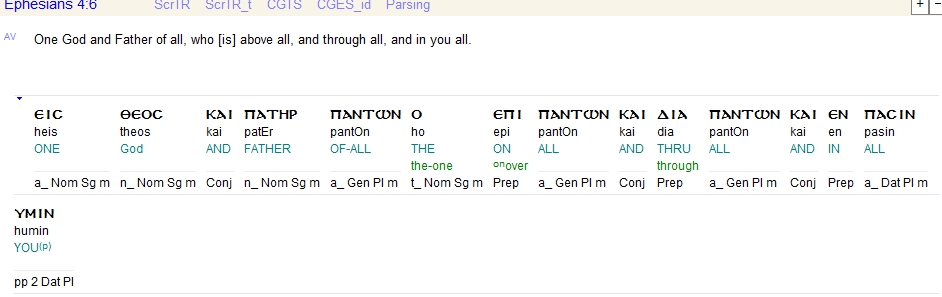
Just my 2 cents here @TheologyNerd
in you all — The oldest manuscripts omit “you.” Many of the oldest versions and Fathers and old manuscripts read, “in us all.” Whether the pronoun be read or not, it must be understood (either from the “ye,” Eph_4:4, or from the “us,” Eph_4:7); for other parts of Scripture prove that the Spirit is not “in all” men, but only in believers (Rom_8:9, Rom_8:14). God is “Father” both by generation (as Creator) and regeneration (Eph_2:10; Jas_1:17, Jas_1:18; 1Jn_5:1).
- Context of the Passage
Paul’s statement sits inside Ephesians 4:1–6, where he exhorts the church to walk “worthy of the calling” they have received. His focus is not on the universality of God’s indwelling, but on the unity of believers within the one body of Christ.
He writes:
“There is one body and one Spirit, just as you were called to one hope of your calling, one Lord, one faith, one baptism, one God and Father of all, who is over all and through all and in all.”
This entire passage is Trinitarian in structure:
One Spirit (v.4)
One Lord (v.5)
One God and Father (v.6)
Paul is emphasizing that the same God, the Father, Son, and Spirit, is the unifying source and authority behind the church’s calling. The context is ecclesial and relational, not pantheistic or universalistic.
- The Greek Syntax and Key Terms
The clause reads in Greek:
εἷς Θεὸς καὶ Πατὴρ πάντων, ὁ ἐπὶ πάντων καὶ διὰ πάντων καὶ ἐν πᾶσιν.
Let’s break this down:
εἷς Θεός καὶ Πατήρ πάντων – “one God and Father of all.”
The word πάντων (panton), “of all,” must be interpreted by its contextual group. It refers not to all humanity indiscriminately, but to all who are included in the “one body” of verse 4 — that is, believers.
ὁ ἐπὶ πάντων – “who is over all.”
This expresses sovereign authority. God reigns over all creation, including unbelievers. This part indeed shows His universal lordship.
καὶ διὰ πάντων – “and through all.”
Here διά (through) speaks of divine providence and agency, how God works through all His people to accomplish His purpose. It parallels Philippians 2:13, “for it is God who works in you both to will and to work for His good pleasure.”
καὶ ἐν πᾶσιν – “and in all.”
The preposition ἐν (in) here refers to God’s indwelling presence through the Spirit, but again, context limits “in all” to the body of believers, not the whole world. Paul consistently uses ἐν to describe the indwelling of God or Christ in believers, such as in Ephesians 2:22, “you also are being built together into a dwelling place for God in the Spirit.”
So grammatically and contextually, the “all” refers to all believers, not all mankind.
- The Immediate Literary Context: The Church Body
Paul has just spoken of one body, one Spirit, and one hope. His “oneness” theme continues to build. The “all” of verse 6 is limited to the same group defined by these earlier references, the redeemed community united in Christ.
To read “in all” as “in every human being” would break Paul’s argument. In the preceding verse (v.5), he speaks of one faith and one baptism, unbelievers have neither faith nor baptism into Christ. Therefore, they cannot be included in the “in all” of verse 6.
This unity is spiritual, grounded in the shared participation of believers in the Spirit (Eph. 2:18; 1 Cor. 12:13).
- The Broader Theological Context of Ephesians
Paul already clarified earlier that the unbelieving world is spiritually separated from God:
“You were dead in your trespasses and sins… separated from Christ, alienated from the commonwealth of Israel… having no hope and without God (ἄθεοι, atheoi) in the world” (Ephesians 2:1, 12).
That last phrase, “without God in the world,” directly refutes any idea that God indwells unbelievers. The only sense in which God is “in” all creation is by His omnipresence (Psalm 139:7–10, Acts 17:28), but not by indwelling fellowship. The indwelling presence is covenantal, not natural.
Paul distinguishes these two realities in Romans 8:9:
“Anyone who does not have the Spirit of Christ does not belong to Him.”
Thus, God is omnipresent “over all,” but only personally present “in” those who are in Christ.
- The Doctrinal Summary
Over all = God’s sovereignty over creation.
Through all = God’s providential working and sustaining power.
In all = God’s indwelling in the community of believers.
There is one God and Father who rules over all creation, works through His people, and dwells within His redeemed.
- The Cross and Application
The reason believers can experience this indwelling is because of the cross of Christ. Through His blood, the barrier of sin was broken (Ephesians 2:13–18). By His death and resurrection, He created “one new man” out of Jew and Gentile, reconciling both to God in one body through the cross. The Spirit’s indwelling presence, described in Ephesians 1:13–14, flows directly from this redemptive act.
So when Paul says God is “in all,” he is describing the spiritual reality of the church as God’s dwelling place (Eph. 2:22), a truth made possible only by the crucified and risen Christ.
In sum.
Ephesians 4:6 does not mean that God is “in” unbelievers in the relational or spiritual sense. God is over all by sovereignty, through all by providence, and in all believers by His indwelling Spirit. The “all” is the redeemed community united by one faith, one Lord, and one baptism. The verse celebrates the unity of the body of Christ under one God and Father, not a universal divine presence in all humanity.
J.