As Christians reflect on how we speak about God, we invite your voice in Crosswalk Forums. #GodOurFather#BiblicalLanguage#christianforums#crosswalkforums#forums#crosswalk#faithcommunity#faithforums
In a cultural moment where language is constantly being re-evaluated, some voices have begun referring to God as “Mother” or using gender-neutral terms for the divine. Others hold firmly to calling God “Father,” as Jesus taught His disciples.
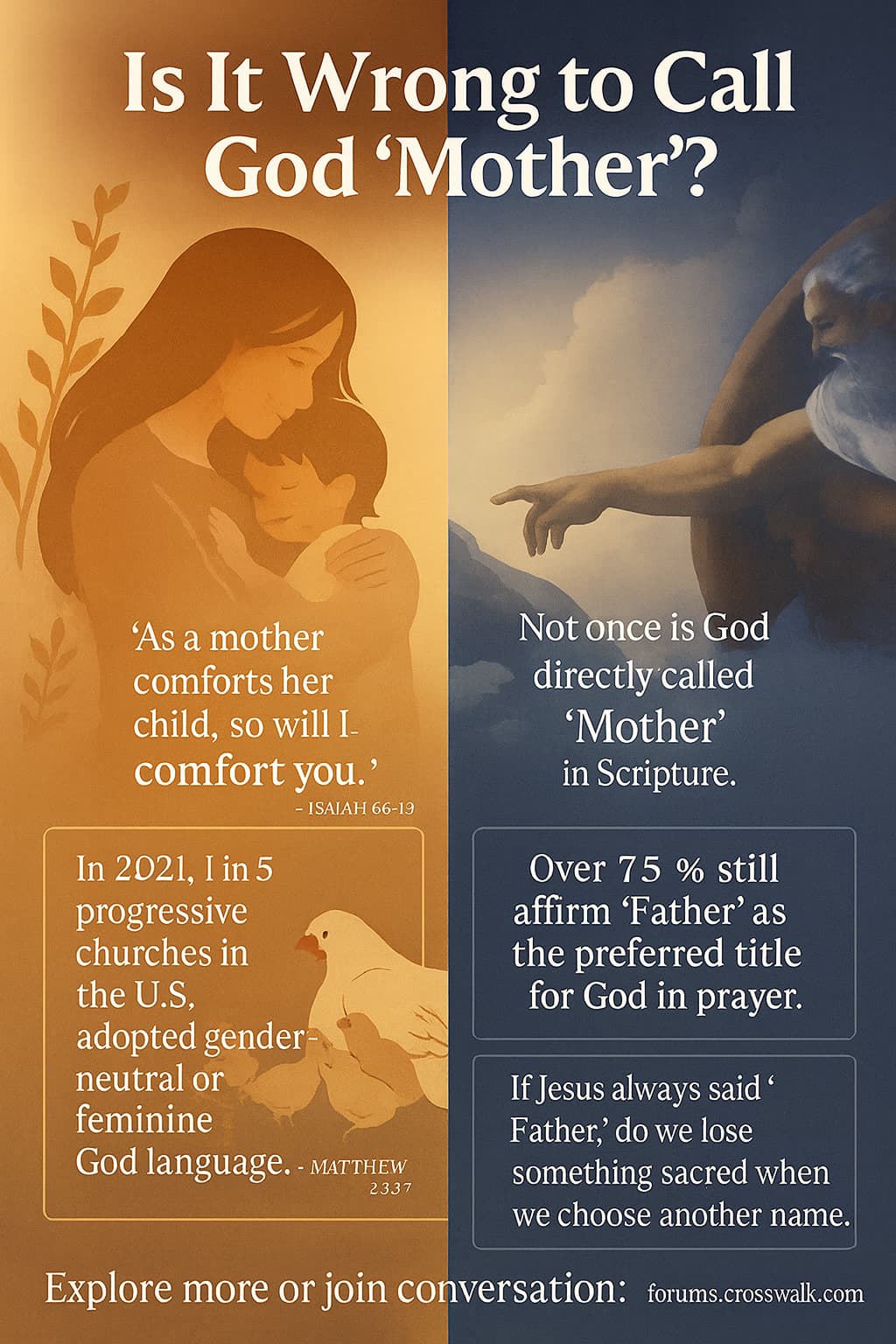
But does using feminine imagery for God blur the lines of biblical truth—or help us better grasp God’s nature? Scripture occasionally uses motherly metaphors, but never calls God “Mother” directly. So where’s the line between metaphor and misrepresentation?
Is it just about words… or about how we view God’s authority, intimacy, and identity?
Why did Jesus consistently say “Father”—and does it matter if we don’t?
“What we call God shapes how we see Him—and how we relate to Him.”
Are we talking about gender? Or role? And how specific do you want to get?
Whether we call God Father or Mother, both roles are parental in nature. So either would work. If we are using gender to affirm Power in a patriarchy society, then Father is the better choice. If we are affirming nurture and care, then Mother.
If a child was abandoned or abused by their mother, then Father. If a child was raped or abused by his or her father, then Mother would be the better route to go, if only to make it easier for that person to come to God.
Let nothing hinder a little one from coming to God, even gender specifc pronouns which do not change the nature or existence of God whatsoever… as God gave man the authority to name the created world, but not to give God Him or Herself a name. No man is allowed to spell or say the Name of God. We only get to write or speak a shadow of THAT Name through other names. Even “GOD” is a generic word that can refer to any god or goddess. It is God’s Role, not God’s name.
But if we are specifically talking about God’s Gender….
God is neither masculine nor feminine. Or God is both.
For God to be just one denotes limitation.
We call God the Creator because God created life. But in this Creation, God specifically gave the ability to create life to the female component of all species that exist. No man can bring forth life from within himself.
But no female can bring forth life alone apart from a male. Both genders must play a part in order for life to continue to exist.
God integrated the male and the female aspects into the design of Creation, even before They took the rib from Adam.
Eve was made from a part of Adam’s body. Adam lost a part of himself in order for her to exist, and became incomplete in himself.
Man was made in the image of God. But Adam was originally made as one singular being before being divided by God to make two. From Adam, who was one being, came two seperate beings.
Adam was no longer whole. Eve was a part of him. Meaning, female and male together are in the image of God. Adam, the first “human” was made in the image of God. Not Adam the first “man” or Eve the first “woman” who are one person divided.
But even seperate, if you study psychology, we are deeply woven with masculine and feminine aspects in our minds. So that blueprint of being both still remains a part of each and every one of us, regardless of physical gender.
Lastly, as was mentioned, it is said that God is Spirit. And when we speak of God’s Gender, we of course do not imply genatelia. But just as this world is a shadow of the world to come, and just as man was made in the image of God the Parent who has no form that we know of, what we know of as masculine and feminine is only a shadow of something more.
God is both Ultimate Mind and Source Of All Life. God is both THAT which envisions and determines, and THAT which makes it so and brings it forth. God is both THAT which GIVES, and THAT which RECEIVES. Or as Scripture says, the Lord Giveth and the Lord Taketh Away.
That’s a key distinction. God is not gendered in a biological sense—He is spirit. But Scripture consistently uses Father to describe both His relationship and authority. So when people say “Mother God,” the question becomes: are they exploring God’s nurturing role, or are they redefining His identity? That’s where the tension lies.
God is often depicted with female imagery throughout the Bible. And there is never a conversation in the Bible where it says God spoke to anyone in a masculine voice or where God says He is explicitly male. For all we know, the gender references are purely assumed by the culture which considered women and children property, an historical fact.
The “spirit of God” (ruach Elohim) is grammatically feminine in Hebrew, using feminine verbs.
And historically an early Christian sect pre Catholic Church referred to the Holy Spirit in the Feminine rather than gender neutral as is common today.
In Jewish mystic traditions God is considered to have aspects of both genders.
@anon75384934… you spun a soft web of words and then tried to cradle God in it like a philosophical cocoon. But let’s torch the silk and get back to the rock.
God is not a concept you get to rebrand for emotional convenience. He is who He reveals Himself to be. His self-disclosure isn’t subject to our preferences or personal narratives. Compassion doesn’t override revelation.
God has disclosed Himself… consistently, intentionally, and authoritatively… as Father. Not just once, not just metaphorically, not just culturally, but relentlessly and relationally. Jesus didn’t teach us to pray “Our Parent in Heaven.” He said “Our Father.” Full stop. If the Son of God calls Him Father, and you want to swap that for “Mother” based on feelings, you’re not following Christ… you’re following the culture.
Now I get it… people are wounded. Fathers have failed. Abuse is real. But God the Father is not your dad. He’s not a projection of your pain. He is perfect, holy, just, and good. If you redefine Him to dodge your hurt, you don’t end up with healing… you end up with heresy.
The whole arc of Scripture is soaked in the Father-Son dynamic. The Father sends the Son. The Son obeys the Father. The Spirit proceeds from the Father. You tear out “Father” and you’re not just tweaking pronouns… you’re severing the lifeline of Trinitarian revelation. You’re gutting the Gospel.
You said God is both masculine and feminine… or neither. But that’s not theology… that’s mythology. God is spirit, yes, but He is not some yin-yang duality of energies. He is personal. He speaks. He acts. And He chose to reveal Himself using masculine language and fatherly roles. That’s not because He needed pronouns… but because we did. Because He’s not just Creator… He’s covenantal. He’s not a force… He’s a Father.
And please… don’t throw Hebrew grammar at the wall and hope it sticks. The word “ruach” is grammatically feminine, but grammar doesn’t assign divine identity. The word “table” is feminine in French… that doesn’t mean we worship a goddess every time we eat dinner. The Holy Spirit is referred to as “He” by Jesus in John 14 through 16. If the Word made flesh had no problem using masculine pronouns for the Spirit, why should you?
What you’re peddling isn’t biblical nuance… it’s postmodern perfume on a golden calf. You’re trying to soften God into something more palatable, more inclusive, more therapeutic… and you end up shrinking Him into your own image.
God doesn’t need a PR makeover. He needs to be feared, loved, obeyed, and worshiped on His terms… not yours.
He is Father. That is not oppressive. That is glorious.
—Sincere Seeker. Scripturally savage. Here for the Truth.
No God is not often depicted with female imagery. There are images where God’s is depicted of loving as a mother but these images are nowhere as common as God being depicted or called Father.
• Isaiah 66:13: is probably the most well known, but this is nothing when compared to Jesus’s calling God Father and instructing us to also call him Father.
@Fritz_Admin, I believe in using Scriptural language for God, since it is his Word. We need to resist cultural influences and explain to people why we do what we do so that people from the culture can understand us better, instead of conforming to our secular culture’s pressure. The Bible is always countercultural.
Human categories, language, and imagination are limited—we cannot fully define or comprehend who God is using our own ideas. God is infinite, beyond gender, beyond human constraints. As created beings, we can only know what God has chosen to reveal to us—and He has done so primarily through Scripture.
In the Bible, God is most often referred to using masculine titles, such as Father, King, and Lord. Jesus Himself taught His disciples to pray to “Our Father,” and consistently referred to God that way. That’s not incidental—it reflects something profound about God’s relational nature, authority, and the intimacy He offers through Christ.
But Scripture also includes metaphorical language that draws on feminine imagery to describe God’s character and actions. For example:
In Isaiah 66:13, God says: “As a mother comforts her child, so will I comfort you.”
In Matthew 23:37, Jesus laments over Jerusalem, saying He longed to gather the people like “a hen gathers her chicks under her wings.”
In Hosea 11, God is described as a parent who teaches a child to walk and bends down to feed them—a nurturing, tender image.
These metaphors don’t mean God is female or mother in the literal sense, but they show that God’s care, compassion, and gentleness are not bound to masculine stereotypes. Rather, God’s nature includes the fullness of love and strength, justice and mercy—traits that are not limited by human gender roles.
So where does that leave us?
We should be careful not to redefine God according to cultural trends or personal preferences. God has chosen to reveal Himself in a certain way, and it’s wise to honor that—especially when it comes to how Jesus spoke of the Father.
At the same time, the rich metaphors in Scripture remind us that God is not a man or a woman. God is Spirit (John 4:24), and both masculine and feminine qualities reflect aspects of His image—since both male and female are made in God’s image (Genesis 1:27).
“Let us, therefore, believe the prophets, let us believe the apostles, as God Himself speaks through them… Let us not go beyond what is written.”
– On the Trinity, Book I
St. Augustine of Hippo sums it up beautifully, let us not go beyond what was revealed in scripture.
@Fritzpw_Admin
In examining Scripture, two facts become clear. First, God is a Spirit and does not possess human characteristics or limitations. Second, all the evidence contained in Scripture agrees that God revealed Himself to mankind in a male form. To begin, God’s true nature needs to be understood. God is a Person, obviously, because God exhibits all the characteristics of personhood: God has a mind, a will, an intellect, and emotions. God communicates and He has relationships, and God’s personal actions are evidenced throughout Scripture.
As John 4:24 states, “God is spirit, and his worshipers must worship in spirit and in truth.” Since God is a spiritual being, He does not possess physical human characteristics. However, sometimes figurative language used in Scripture assigns human characteristics to God in order to make it possible for man to understand God. This assignment of human characteristics to describe God is called “anthropomorphism.” Anthropomorphism is simply a means for God (a spiritual being) to communicate truth about His nature to humanity, physical beings. Since humanity is physical, we are limited in our understanding of those things beyond the physical realm; therefore, anthropomorphism in Scripture helps us to understand who God is.
Some of the difficulty comes in examining the fact that humanity is created in God’s image. Genesis 1:26-27 says, “Then God said, ‘Let us make man in our image, in our likeness, and let them rule over the fish of the sea and the birds of the air, over the livestock, over all the earth, and over all the creatures that move along the ground.’ So God created man in his own image, in the image of God he created him; male and female he created them.”
Both man and woman are created in the image of God, in that they are greater than all the other creations as they, like God, have a mind, will, intellect, emotions, and moral capacity. Animals do not possess a moral capacity and do not possess an immaterial component like humanity does. The image of God is the spiritual component that humanity alone possesses. God created humanity to have a relationship with Him. Humanity is the only creation designed for that purpose.
That said, man and woman are only patterned after the image of God—they are not tiny “copies” of God. The fact that there are men and women does not require God to have male and female features. Remember, being made in the image of God has nothing to do with physical characteristics.
We know that God is a spiritual being and does not possess physical characteristics. This does not limit, however, how God may choose to reveal Himself to humanity. Scripture contains all the revelation God gave to humanity about Himself, and so it is the only objective source of information about God. In looking at what Scripture tells us, there are several observations of evidence about the form in which God revealed Himself to humanity.
Scripture contains approximately 170 references to God as the “Father.” By necessity, one cannot be a father unless one is male. If God had chosen to be revealed to man in a female form, then the word “mother” would have occurred in these places, not “father.” In the Old and New Testaments, masculine pronouns are used over and over again in reference to God.
Jesus Christ referred to God as the Father several times and in other cases used masculine pronouns in reference to God. In the Gospels alone, Christ uses the term “Father” in direct reference to God nearly 160 times. Of particular interest is Christ’s statement in John 10:30: “I and the Father are one.” Obviously, Jesus Christ came in the form of a human man to die on the cross as payment for the sins of the world. Like God the Father, Jesus was revealed to humanity in a male form. Scripture records numerous other instances where Christ utilized masculine nouns and pronouns in reference to God.
The New Testament Epistles (from Acts to Revelation) also contain nearly 900 verses where the word theos—a masculine noun in the Greek—is used in direct reference to God. In countless references to God in Scripture, there is clearly a consistent pattern of His being referred to with masculine titles, nouns, and pronouns. While God is not a man, He chose a masculine form in order to reveal Himself to humanity. Likewise, Jesus Christ, who is constantly referred to with masculine titles, nouns, and pronouns, took a male form while He walked on the earth. The prophets of the Old Testament and the apostles of the New Testament refer to both God and Jesus Christ with masculine names and titles. God chose to be revealed in this form in order for man to more easily grasp who He is. While God makes allowances in order to help us understand Him, it is important to not try to “force God into a box,” so to speak, by placing limitations on Him that are not appropriate to His nature.
@Bruce_leiter, @Samuel_23, @Johann… I’m not here to argue against any of you, because frankly you’re already hitting the bullseye. The trouble is, some folks see the target, nod politely, and then draw their own dartboard on the wall.
Yes, God is Spirit. Yes, He is infinite. Yes, our language is finite. But none of that gives us permission to tamper with the way He has revealed Himself. The whole point of revelation is that we would know Him as He actually is, not as we’d prefer Him to be. And in Scripture, that revelation is not random. It is overwhelmingly, deliberately, covenantally masculine in how God names Himself, how He relates to His people, and how the Son teaches us to address Him.
You can comb the Bible for every mother-bird or labor-pains metaphor, and you’ll still find the same inescapable truth — God never once calls Himself “Mother.” The metaphors are just that… metaphors. They don’t override the fact that when the Lord gave us His name and relational role, He said Father. The prophets said Father. The Psalms said Father. The Son of God said Father over and over until the title rang in the ears of His disciples. That is not cultural accident… that is divine intent.
Johann is right — anthropomorphism is God bending down to our level so we can grasp what would otherwise be beyond us. But He didn’t bend down to say “Call Me whatever works for you.” He bent down and said “I am your Father in heaven.” And He backed that up by sending the Son as a man to perfectly reveal Him.
Samuel’s reminder is also key — God’s nature contains the fullness of justice and mercy, strength and compassion, but those traits aren’t gendered stereotypes in Him. They’re perfectly balanced in the Father’s character. And Bruce is dead on — the church’s job is not to conform our language to culture’s demands but to explain why we hold to God’s own words.
This is not about clinging to a patriarchal relic. It’s about refusing to edit the self-revelation of the Almighty. We don’t upgrade God’s branding to be more palatable in the 21st century. We bow to the branding He gave Himself before the foundation of the world.
If that feels narrow, it’s because truth is always narrow. And if we claim to worship the God of Scripture, we don’t get to change His name tag.
—Sincere Seeker. Scripturally savage. Here for the Truth.
I think that the topic is a relevant question of today’s climate. Terms such as Goddess, Devine-Feminine, Supreme-Mother, and songs with female pronouns for God have been considered acceptable substitutes and some are popular in some social circles. This digital-savy generation is being inundated with a gender-fluidity mindset in every manner.
Fritz dialed in the current phenomenom in the preface:
In a cultural moment where language is constantly being re-evaluated, some voices have begun referring to God as “Mother” or using gender-neutral terms for the divine.
When I hear these alternates used, more often in the last decade, I feel it is an opportunity to open a dialogue. This topic surfaces a very relevant distinction that should still be honored today.