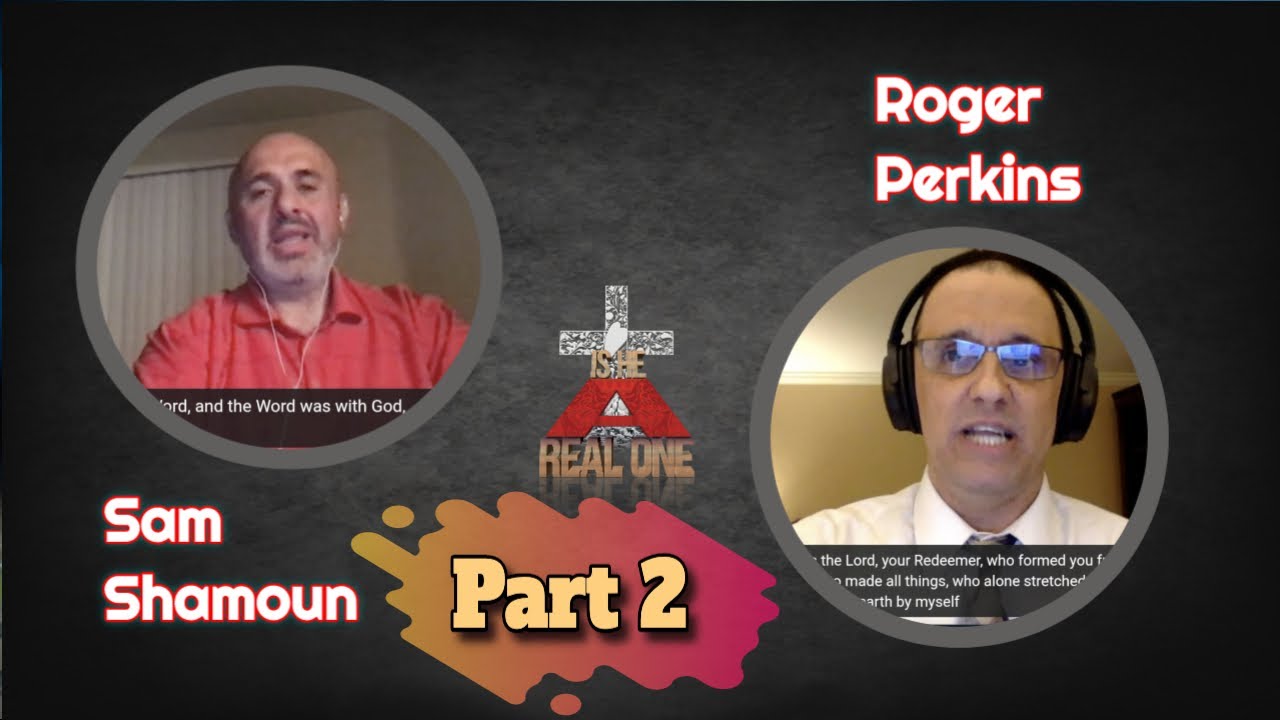
Well, since he is God, as the Holy Spirit is God, they are all together in the beginning. Not really hard to understand, as I pointed out through scriptures a few posts back. If you have a different take, let’s talk about it.
The Rabbinic and Christian Understanding of Messiah’s Preexistence
Suffice it to say, texts such as Micah 5:2 led some of the Jews to embrace the notion of the Messiah’s preexistence, or at least the preexistence of his name, e.g. Jews understood from such passages that even before the universe was created God had already determined to send the Messiah into the world.
Note, for instance, how the following Aramaic paraphrase of the Hebrew Bible interprets Micah 5:2:
“And you, O Bethlehem Ephrathah, you who were too small to be numbered among the thousands of the house of Judah, from you shall come forth before me the anointed One [Messiah], to exercise dominion over Israel, he whose name was mentioned from of old, from ancient times.”
(Kevin J. Cathcart & Robert P. Gordon, The Targum of the Minor Prophets: The Aramaic Bible [Liturgical Press, 1989], Volume 14, p. 122; italic emphasis ours)
Another passage that was understood in this same sense is Psalm 72, specifically v. 17:
“Composed by Solomon, uttered in prophecy. O God, give your just rulings to the King Messiah, and your righteousness to the son of King David… May his name be invoked for ever; and before the sun came to be his name was determined; so all the peoples will be blessed by his merit, and they shall speak well of him.”
(Targum Psalms: An English Translation, by Edward M. Cook)
Here is another version of the Targum:
“May his name be remembered forever, his name which was made ready even before the sun came into being.”
(Samson H. Levey, The Messiah: An Aramaic Interpretation [Hebrew Union College, New York 1974], Targum to the Hagiographa, p. 117)
And:
Yet was the fire of the Gehenna created on the eve of the Sabbath? Surely it was taught: Seven things were created before the world was created, and these are they: The Torah, repentance, the Garden of Eden, Gehenna, the Throne of Glory, the Temple, and the name of the Messiah. The Torah, for it is written, The Lord made me [sc. the Torah] as the beginning of his way. Repentance, for it is written, Before the mountains were brought forth, and it is written, Thou turnest man to contrition, and sayest, Repent, ye children of men.27 The Garden of Eden, as it is written, And the Lord planted a garden in Eden from aforetime.28 The Gehenna, for it is written, For Tophet [i.e., Gehenna] is ordered of old. The Throne of Glory and the Temple, for it is written, Thou throne of glory, on high from the beginning, Thou place of our sanctuary. The name of the Messiah, as it is written, His [sc. the Messiah’s] name shall endure for ever, and has exited before the sun! — I will tell you: only its cavity was created before the world was created, but its fire [was created] on the eve of the Sabbath.
Pesahim 54a
Finally:
Resh Lakish said: Where is visiting the sick indicated in the Torah? In the verse, If these men die the common death of all men, or if they be visited after the visitation of all men etc. How is it implied? — Raba answered: [The verse means this:] If these men die the common death of all men, who lie sick a-bed and men come in and visit them, what will people say? The Lord hath not sent me for this [task]. Raba expounded: But if the Lord make a new thing: if the Gehenna is already created, ‘tis well: if not, let the Lord create it. But that is not so, for it was taught: Seven things were created before the world, viz., The Torah, repentance, the Garden of Eden, Gehenna, the Throne of Glory, the Temple, and the name of the Messiah. The Torah, for it is written, The Lord possessed me [sc. the Torah] in the beginning of his way, before his works of old.6 Repentance, for it is written, Before the mountains were brought forth, or ever thou hadst formed the earth and the world . . . Thou turnest man to destruction, and sayest, Repent, ye sons of men. The Garden of Eden, as it is written, And the Lord God planted a garden in Eden from aforetime. Gehenna, as it is written, For Tophet is ordained of old. The Throne of Glory, as it is written, Thy Throne is established from of old. The Temple, as it is written, A glorious high throne from the beginning is the place of our sanctuary. The name of the Messiah, as it is written, His name [sc. of Messiah] shall endure for ever, and [has existed] before the sun! — But Moses said thus: If a mouth has already been created for it [sc. Gehenna], ‘tis well; if not, let the Lord create one. But is it not written, There is no new thing under the sun? — He said thus: If the mouth is not near to this spot, let it draw near.
Nedarim 39b
There are also references which say that the Messiah was actually born before the world and that he has been in heaven ever since!
Remember, our Bible is a Jewish book with a Jewish Messiah, and I have all these Jewish sources and highly recommend Sam as well as other {few} apologists.
Unfortunately, most here don’t read “secondary sources”.
@NeutralZone, but the doctrine of the Trinity did show up long before the 4th century A.D. It shows up in the Old Testament about the oneness of God and then in the Gospel of John most clearly in the New Testament, where John’s account emphasizes Jesus’ many claims to be God and yet to be distinguished from the Father, @The_Omega.
Deu 6:4 “Hear, O Israel: The LORD our God, the LORD is one.
John 1:1 In the beginning was the Word, and the Word was with God, and the Word was God.
John 1:2 He was in the beginning with God.
John 1:3 All things were made through him, and without him was not any thing made that was made.
John 1:14 And the Word became flesh and dwelt among us, and we have seen his glory, glory as of the only Son from the Father, full of grace and truth.
John_10:30 I and the Father are one.”
John_6:35 Jesus said to them, “I am the bread of life; whoever comes to me shall not hunger, and whoever believes in me shall never thirst.
John_6:41 So the Jews grumbled about him, because he said, “I am the bread that came down from heaven.”
John_6:48 I am the bread of life.
John_6:51 I am the living bread that came down from heaven. If anyone eats of this bread, he will live forever. And the bread that I will give for the life of the world is my flesh.”
John_8:12 Again Jesus spoke to them, saying, “I am the light of the world. Whoever follows me will not walk in darkness, but will have the light of life.”
John_8:42 Jesus said to them, “If God were your Father, you would love me, for I came from God and I am here. I came not of my own accord, but he sent me.
John_10:11 I am the good shepherd. The good shepherd lays down his life for the sheep.
John_10:14 I am the good shepherd. I know my own and my own know me,
Jhn_10:36 do you say of him whom the Father consecrated and sent into the world, ‘You are blaspheming,’ because I said, ‘I am the Son of God’?
John_10:37 If I am not doing the works of my Father, then do not believe me;
John_10:38 but if I do them, even though you do not believe me, believe the works, that you may know and understand that the Father is in me and I am in the Father.”
John 14:26 But the Helper, the Holy Spirit, whom the Father will send in my name, he will teach you all things and bring to your remembrance all that I have said to you.
The doctrine of the Trinity is based correctly and squarely on the Bible. The Triune God is a mysterious Being, but the Bible says that he is three Persons in one God. Therefore, I believe that he is.
Every spot in OT where GOD or LORD( all capitols) God put the tetragrammaton=YHWH or YHVH=Jehovah. It is Jesus’ Fathers will for his name to be in his bible over 7000 spots. What occurred= Wicked men by satans will removed Gods name, they had no right. Thus everyone’s religion shows whose will they support by the translation they use. Its 100% fact if Jesus were on Earth he would use a translation with his Fathers name in all of those over 7000 spots, because he supports his Fathers will 100% in everything. Thus so does his real religion and all true followers. Not to difficult to see who supports Jesus’ Fathers will( Matt 7:21)
I understand why some people feel that way about these discussions. Trinity debates can easily become repetitive, and I agree that no one benefits if the conversation turns into people just repeating slogans at each other. But I do want to gently push back on the idea that simply holding a firm theological conviction means someone is trying to force the text to say what they already believe.
All of us come to Scripture with conclusions we currently think are correct. Trinitarians do. Unitarians do. Oneness believers do. Catholics do. Mormons do. The real question isn’t whether someone has a position; the question is whether the arguments being presented are grounded in the text and open to examination.
From my side, I’m not appealing to an extra book, a modern prophet, or a new revelation outside the Bible. I’m working from the same passages everyone else is discussing. My reasoning simply starts with two things I see consistently emphasized in Scripture:
First, the absolute oneness of God as understood within 1st Century Jewish monotheism. The prophets repeatedly stress that God is one and that there is no other beside Him.
Second, the genuine humanity of Jesus. The New Testament doesn’t present Jesus merely appearing human. He is born in time, grows, learns obedience, prays, is tempted, and submits His will to the Father. Those are real human experiences.
Because I take those two things seriously, I interpret the relational language between the Father and the Son through the reality of the incarnation. When Jesus prays or speaks of the Father, I see the authentic human Messiah relating to God—not necessarily two eternal divine minds speaking to each other before creation.
That doesn’t mean I deny Christ’s divinity. I affirm that the fullness of God is revealed in Him. My question has simply been whether the biblical text requires us to posit multiple eternal centers of divine consciousness in order to explain that revelation.
People may disagree with that conclusion, and that’s completely fair. But disagreement alone doesn’t mean someone is unwilling to examine Scripture. It just means we’re weighing the same data differently.
If the discussion ever stops being about the text and becomes about labeling one another,
(Which I see a lot here doing) (Use text (Scripture) to show me where I’m wrong, don’t just say it and label me, without explanation grounded in the word)
then it probably does become unproductive. But if the goal is genuinely to understand what the apostles were trying to communicate about God and Christ, then I still think it’s worth having the conversation respectfully, even if we end up seeing things differently.
First, I do not remember labeling you. If I did, then I sincerely apologize. As for what you said here, I agree, I think we are all, most here are, seeking the Truth According to God. That is the whole point of the blog TAG.
I’m glad we can agree. However, Truth is truth. God is God. No matter how much someone tries to put Him in a Box.
Uh, neither am I?
This is what I mean. We have. At least I know I have done this very thing. Multiple Scriptures were presented, but they were either ignored or interpreted through the lens of pre-existing beliefs, or twisted to support a different understanding than what the text clearly states.
As I’ve mentioned before, I respect that you’ve been a part of your denomination for 30 years, and it’s understandable that changing long-held beliefs can be challenging. However, the most straightforward path to understanding God’s truth is to examine the Bible itself, to read it as it is, without preconceived notions, personal desires, or hopes, and simply allow its meaning to unfold.
I mentioned that I ran a search on your TAG blog for material on the doctrine of election and did not find anything relevant, but that is a discussion for another occasion and not the subject under consideration here.
Their unity is not found in being a single “persona,” but rather in their shared nature, purpose, and perfect love. They are “too one to be many but too many to be one”.
Aftet reading the above, to me its not One person that takes on different roles. It seems that Essence comes first.
The essence being unbodied personal power
(Side Note 4 self:And hypothetically speaking: it might just be the essence is in where power lies. )
Hence where is the “unity” if there is only one?
Unity has to be at least two to create a union; coming together. And I don’t think that’s going to look like two roles coming together for…for when Jesus prayed something like, they are to be one as we are one was He talking about the roles He played? That would be as God were talking to one man that played many roles. But He is talking about man, man that God made in His image or likeness.
And sense this is so while one man can play different roles one thing is there is not just one man there are many men.
No, the doctrine of the Trinity did not suddenly show up in the 4th century.
No, it had nothing to do with Roman emperors.
There were no “Roman Catholic bishops” in the 4th century. There were, however, Christian bishops who had suffered and bled as martyrs for Christ.
What are you are repeating is just anti-Trinitarian, anti-Catholic, anti-Christian propaganda. If you are a sincere person who is willing to modify your views based on facts, I am more than happy to offer historical resources to help you learn.
I have already informed you that I do not have the time nor the inclination to read your walls of text, Johann. I read only the portion of your post that I quoted above in which you are giving me wash, rinse, and repeat while telling me that I’m wrong.
You are making an issue of the word “firstborn” so that you can continue to argue that the term “firstborn” refers to status and privilege and that it does not necessarily refer to the first child. That’s the argument that Trinitarians use at every website where I debate. It’s a lame argument, because it does not address the fact that the word “born” always applies to created beings regardless of status or privilege.
Until you can talk your way around the word “born,” nothing that you continue to copy-paste within your various walls of text will change the fact that “born” applies only to created beings.
Below is another verse of scripture that Trinitarians can’t cope with. Focus on the word that I bolded, then notice the definition that follows.
(John 3:16 – King James Bible)
”For God so loved the world, that he gave his only begotten Son, that whosoever believeth in him should not perish, but have everlasting life.”
"begotten
2 of 2
: brought into existence by or as if by a parent"
(Source: Merriam-Webster Dictionary)
Let’s see you talk your way around the word “begotten.”
NeutralZone
__________________________
". . . be swift about hearing, slow about speaking, slow about wrath. . . . " (James 1:19-20)
I actually agree with the principle you stated: the straightforward path to understanding God’s truth is to examine the Bible itself, to read it as it is, without preconceived notions, personal desires, or hopes, and simply allow its meaning to unfold. That is exactly the approach I’m trying to take.
But if we’re going to apply that principle consistently, we also have to be honest about something: many of the key terms used to explain the Trinity are not words found in the biblical text itself, but later philosophical and metaphysical language developed to describe how theologians understood the text.
For example, when Trinitarian theology is explained, we often hear terms such as:
Trinity
Triune
God the Son
God the Holy Spirit
Three persons
Personhood within the Godhead
Eternal Sonship
Eternal generation
Procession of the Spirit
Consubstantial
Homoousios (“same essence”)
Ousia (essence/substance)
Hypostasis (person/subsistence)
Perichoresis (mutual indwelling of the persons)
Ontological Trinity
Economic Trinity
Immanent Trinity
Relational distinctions within the Godhead
Subsistences
Co-equal persons
Co-eternal persons
Tri-personal being
These terms were developed centuries after the New Testament in order to articulate a specific metaphysical model of God’s inner life.
My point isn’t to attack those terms. My point is simply this: if we are truly committed to the principle of reading the Bible itself and letting its meaning unfold without importing philosophical categories, then we have to recognize that many of the conceptual tools used to explain the Trinity come from later theological reflection rather than directly from the biblical vocabulary.
When I read Scripture, what I consistently see emphasized is:
God is one.
God reveals Himself through His Word and Spirit.
Jesus is the man in whom the fullness of God is revealed.
Because of that, I try to interpret the passages about the Father, Son, and Spirit through the framework the Bible itself repeatedly emphasizes—the oneness of God and the reality of the incarnation—rather than beginning with metaphysical categories that the text itself never explicitly introduces.
And to be clear, in everything I’ve presented in this discussion, I have never introduced any ideas that are not explicitly drawn from the biblical text itself. My arguments have come directly from the language and themes of Scripture.
So again, I actually agree with your principle. The straightforward path to understanding God’s truth is to examine the Bible itself, to read it as it is, without preconceived notions, personal desires, or hopes, and simply allow its meaning to unfold. My argument is simply that we should apply that principle consistently to all of our theological systems, including the philosophical language historically used to explain the Trinity.