
John 3:16 - Do You Really Know What it Means?

This is one of the most misunderstood verses in the New Testament because English translations smooth out the Greek.

The short answer is:

The Greek is not “whosoever” as an indefinite invitation. It literally refers to “everyone who is believing” or “every believing one.”

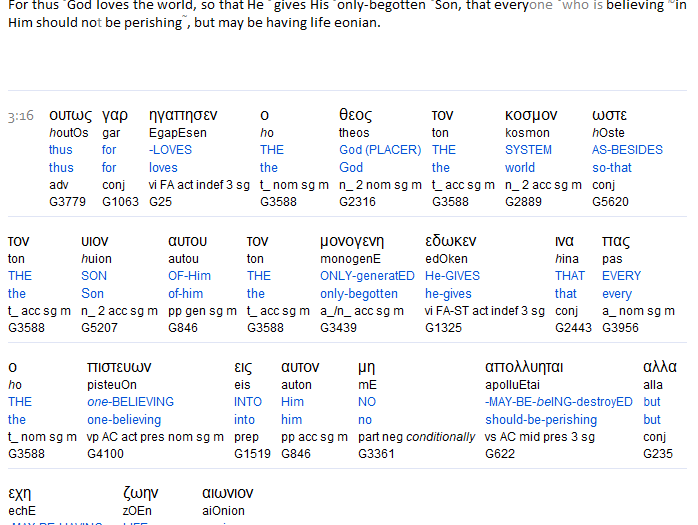
Joh 3:16 For γὰρ - ὁ God Θεὸς so Οὕτως loved ἠγάπησεν the τὸν world κόσμον, that ὥστε He gave ἔδωκεν, the τὸν - τὸν only begotten μονογενῆ Son, Υἱὸν so that ἵνα everyone πᾶς - ὁ believing πιστεύων in εἰς Him αὐτὸν vvv μὴ should not perish, ἀπόληται but ἀλλ’ should have ἔχῃ eternal αἰώνιον. life. ζωὴν

Let’s look at the Greek.

John 3:16 reads:

Οὕτως γὰρ ἠγάπησεν ὁ Θεὸς τὸν κόσμον,
ὥστε τὸν Υἱὸν τὸν μονογενῆ ἔδωκεν,
ἵνα πᾶς ὁ πιστεύων εἰς αὐτὸν
μὴ ἀπόληται ἀλλ᾽ ἔχῃ ζωὴν αἰώνιον.

The key phrase is:

πᾶς ὁ πιστεύων

Let’s parse it.

πᾶς (pas) - every, all, each.
ὁ (ho) - the (article).
πιστεύων (pisteuōn) = believing (present active participle).

Literally:

every the believing one

or more idiomatically,

everyone who believes

or

every believing person

Notice what πᾶς modifies.

It modifies ὁ πιστεύων (“the believing one”), not an implied “whoever.”

The grammar is:

πᾶς + article + participle

This is a very common Greek construction meaning:

everyone characterized by the action of the participle

Examples include:

“everyone hearing”
“everyone coming”
“everyone doing”

Thus, John 3:16 is literally speaking of the class of believing people.

It is not grammatically saying:

“Whoever chooses to believe…”

Rather, it identifies those who possess eternal life as the believing ones.

Does this support Calvinism?

Not by itself.

John 3:16 answers:

Who receives eternal life?

Answer:

Every believing person.

It does not answer:

Why some believe.
Why others do not believe.
Whether faith is self-generated or divinely given.

Those questions are answered elsewhere in John’s Gospel.

For example:

John 6:37 - “All that the Father gives Me will come to Me.”
John 6:44 - “No one can come unless the Father draws him.”
John 6:65 - “No one can come unless it has been granted him by the Father.”

Likewise, John 1:12–13 says that those who receive Christ are those who were born “not of the will of man, but of God.”

Is “whosoever” a bad translation?

Not necessarily.

Translations like the King James Version render it:

“That whosoever believeth…”

That was perfectly idiomatic English in the 17th century.

Modern translations often say:

“whoever believes”

or

“everyone who believes”

These are good English renderings because English lacks an exact equivalent to the Greek articular participle.

However, if someone argues that the Greek literally says:

“Whosoever”

that is not precise.

The Greek literally says:

πᾶς ὁ πιστεύων

which is better translated:

every believing one

or

everyone who believes.

This subtle grammatical point is important because the verse defines the recipients of eternal life, the believing ones, but it does not explain the origin or cause of their faith. That theological question must be answered from the broader context of John’s Gospel and the rest of the New Testament, not from the phrase πᾶς ὁ πιστεύων alone.

Is there a more beloved Scriptural passage than John 3:16? Throughout church history, there has not been a more quoted or preached upon verse than this one. It is that special text concerning God’s love for the world and the eternal life that is found in the person of Jesus Christ. The richness of this special life-changing verse is seen in Jesus’ dialogue and instruction to the Pharisee Nicodemus. Christ’s teaching in this passage demonstrates that Nicodemus was living a life devoid of the power of the Holy Spirit, and attempted, in outward religious acts, to please God by his perceived good works. Jesus’ instruction cures Nicodemus from his man-centered religious views, and brings the Pharisee back to the meaning of the Old Testament, and God’s plan of redemption in the Son of Man who came down from heaven to teach men about what it means to have true communion with the Father.

Being faithful to the text, and ultimately focusing in on the meaning of John 3:16, McMahon accurately employs proper hermeneutics and exegesis to consider this most important verse in its complete context. He also engaged in a large amount of extra-biblical reading in hundreds of historical and theological volumes to find the consensus view on the meaning of this passage in church history. McMahon covers John 2:23-3:21 divided into various chapters that demonstrate the meaning behind the plan of the Father and Son to save sinners, and the outworking of that plan in the initial power of the Holy Spirit’s spiritual operation on the hearts of sinners.

Paradoxical?

J.

1 Like

John 3:16 is often utilized out of the context of Jesus’ didactic teaching to Nicodemas, and employed as a proof text for God’s saving love to the entire world.1 Some Calvinists believe that God is not saving all men here, but does intend a general “saving” love to all men. Some attempt to force John 3:16 within a context of a “general love.” Neither the context, nor the grammar, or the specific use of the words “so” and “gave,” allow for a general love to all men.2 As Hugh Latimer has stated, “God is not only a private Father, but a common Father unto the whole world, unto all the faithful, be they never so poor and miserable.”3 As will be demonstrated, the world of the faithful, and they alone, have God as their Father.
First, the text reads, “For God so loved the world that He gave His only begotten Son, that whoever believes in Him should not perish but have everlasting life.”4 The article, gar (gar, for) denotes the information previous in the conversation which Jesus is expounding to Nicodemas. The immediate context is taken from the Old Testament passage of the brass serpent in the wilderness for those who would look upon it.5 The larger context is on regeneration and Jesus’ discourse with Nicodemas—how the Spirit, Son and Father accomplish redemption. The “for” is immediately connected with the objects of the last verse instrumentally; everyone who believers should not perish because God sent his son to those who believe. The “for” of the verse links the thought in the previous verse, 3:15, to verse 16. The “for” is transitive. It is also to be noted that John 3:16 recalls the promise of the prologue seen in 1:12-13 and prepares the reader of the Gospel to encounter God’s expanded realm of salvation, not only for the Jews, but also for the Samaritans and Gentiles in John 4:1-54.6

The author of this love is God. The grammar is literally, “so loved God…”7 The word, “Outws” (houtos) is the emphatically8 used “so” of the verse.9 It is not a general love, but an emphatic love10, of which there is none higher than this.11 The “so” stresses12 the aorist tense of the verb “hugaphsen.” “So” acts as an adverb in this instance, connected vitally as a preceding intensive particle to the verb “love”. As an adverb, it denotes the “degree of intensity” of the verb to be stated. As is often noted, the phrase as a whole (“For, God so loved the world”) is a clause attached to a subordinate result clause (“that He gave…”). This is important since it causes the phrase to stand on its own, except for the connection between the last verse and the word “for.” As with most constructions in the Greek language, the sentence could literally be ripped apart and the words themselves strewn upon the floor. But because word endings are the key to helping us understand the construction, even if we did jumble the words around, the meaning would still be the same. The meaning, then, is quite straight forward in the Greek – not only did God love the world, but He intensely loved the world which is emphatically seen in use of the often neglected adverb Outwv.

https://www.apuritansmind.com/arminianism/an-exegetical-look-at-john-316-by-dr-c-matthew-[mcmahon/#:~:text=Do%20you%20know%20of%20any%20other%20Bible%20verse%20more%20quoted%20than%20John%203%3A16%3F%20And%20yet%2C%20even%20though%20this%20verse%20is%20known%20by%20everyone%2C%20it%20is%20often%20the%20most%20misunderstood%20verse%20in%20the%20Bible.](https://www**.apuritansmind.com/arminianism/an-exegetical-look-at-john-316**-by-dr-c-matthew-mcmahon/)

Excellent read.

J.

J.

I’m sorry @Johann, but I have no desire to buy his book. Second, you are trying very hard to get John 3:16 to say something it clearly says, to be something else. Let’s play semantics for a second, and I will even agree with you.

Or whomever. Or anyone. Of everyone. Or

Yup.

And there is the twist. The subtle change to attempt to prove a set belief system of election. When even changing the wording from Whosoever to everyone hearing, everyone, believing, or every believing person, does not change the reality that anyone who believes in Him is saved.

Notice you did not address the rest. Whosoever does NOT believe is what? Condemned already. I guess we could make that every unbelieving person? Or every person of unbelief?

Nope. But John 3:18 tells us those who do not are condemned already.

My friend, It is very easy for technical analysis to get so bogged down in the mechanics of a language that it loses the forest for the trees. In the original Greek, that little word “outws” (houtos) doesn’t mean “so much” (like a quantity). It literally means “in this manner” or “thus.”

Instead of reading it as: “God loved the world so much that He gave…”
The Greek grammar actually reads: “This is how God loved the world: He gave…”

I think you are using a lot of academic jargon (“aorist tense,” “subordinate result clause,” “intensive particle”) to state a very simple linguistic fact: the ultimate proof of God’s love isn’t a vague feeling; it is a concrete action (the giving of His Son).

These two ideas don’t actually contradict each other; they are two sides of the same coin. The Greek Grammar emphasizes the depth and manner of the action (God’s intense love is defined by the sacrifice of Christ). The “Whosoever” Clause emphasizes the accessibility of the action (the rescue package is available to anyone who believes).

What you shared is essentially a mechanic taking an engine apart to show you how a piston moves, when all you really want to know is where the car can take you. The car still takes you to the same place: a universally open invitation based on a radical act of love.
Peter

Peter, with respect, you’ve changed the subject. My point was not about οὕτως (“thus/in this manner”), but about the syntax of πᾶς ὁ πιστεύων (“everyone who believes”). Those are separate grammatical issues.

I fully agree that οὕτως describes the manner in which God loved the world, namely, by giving His Son. I have no disagreement there.

However, dismissing grammatical and syntactical analysis as “academic jargon” misses the point. Those aren’t philosophical terms or unnecessary technicalities; they are simply the tools used to understand what the biblical authors actually wrote. Grammar, syntax, morphology, and context are not obstacles to interpretation, they are the very means by which faithful interpretation is achieved.

When we speak of an aorist verb, a participle, a subordinate clause, or syntax, we’re not trying to impress anyone with technical language. We’re describing objective features of the inspired Greek text. Just as a physician uses medical terminology to explain the human body, or an engineer uses technical language to explain how a bridge stands, biblical scholars use grammatical terminology to explain how the text communicates its meaning. The terminology is descriptive, not philosophical.

Regarding John 3:16, the phrase πᾶς ὁ πιστεύων literally means “everyone who is believing” or “every believing one.” The adjective πᾶς modifies the participial phrase ὁ πιστεύων. Therefore, the “everyone” is not an unrestricted category detached from belief; it is defined by the participle itself. The promise is made to the believing ones. That is simply what the grammar says.

Joh 3:16 For γὰρ - ὁ God Θεὸς so Οὕτως loved ἠγάπησεν the τὸν world κόσμον, that ὥστε He gave ἔδωκεν, the τὸν - τὸν only begotten μονογενῆ Son, Υἱὸν so that ἵνα everyone πᾶς - ὁ believing πιστεύων in εἰς Him αὐτὸν vvv μὴ should not perish, ἀπόληται but ἀλλ’ should have ἔχῃ eternal αἰώνιον. life. ζωὴν

Joh 3:16 Thus01 For02 Loves03 The04 God05 The06 world07 so-that08 The09 Son10 Of-him11 The12 only-begotten13 N1 He-gives14 That15 Every16 The17 one-believing18 Into19 Him20 No21 should-be-perishing22 But23 May-be-having24 Life25 Eonian26

all, every (thing, one), whole; always
all, every (thing, one), whole;
always
all;
in the singular the whole, entire, usually when the substantive has the article, Mt. 6:29; 8:32; Acts 19:26; every, only with an anarthrous substantive, Mt. 3:10; 4:4;
plural all, Mt. 1:17, and frequently ;
πάντα, in all respects, Acts 20:35; 1Cor. 9:25; 10:33;
11:2;
by a Hebraism, a negative with πᾶς is sometimes equivalent to οὐδεις or μηδεις, Mt. 24:22; Lk. 1:37; Acts 10:14; Rom. 3:20; 1Cor. 1:29; Eph. 4:29

So my appeal is not to academic elitism but to sound exegesis. If our theology is to be governed by Scripture rather than assumptions, then we must let the grammar, syntax, and context determine what the text means. That’s not losing the forest for the trees; it’s making sure we’re looking at the right forest in the first place.

Let’s keep this discussion civil, brother. There’s no need to come out in full attack mode. Please read what I’ve actually written before responding. I think that will help us avoid talking past one another, as happened in our discussion on free will.

Wise words here…

I started by saying that we are the benefactors when we pore over the Word to better grasp the work of Christ. As we do this to help ourselves and others learn, it must be done with a sense of humility. One should only have to think for a moment about how insensitive it is to find personal pride when arguing about atonement for our sins!

A conversation like this should be characterized by the gentleness, patience, and precision it demands.

Thanks.

J.

No, thank you. I’m not interested. The article from The Gospel Coalition already addresses the points you’ve raised. If you choose not to read it, that’s your decision, but others may read it and be edified by it.

Shalom.

J.

The “twist?”

My point is that the grammar identifies the class of people who receive eternal life You are reacting as if I am denying the universal offer of salvation.

The Reformed position has always affirmed:

Anyone who believes will be saved.
Everyone who comes to Christ will be received (The Gospel of John 6:37).
The gospel is to be preached to all people.

The question is not who will be saved? The question is why do some believe while others remain in unbelief? John 3 does not answer that question. John 6 does. And elsewhere in the Pauline Epistles and in the Torah (תּוֹרָה) – The Law (Instruction)
Nevi’im (נְבִיאִים) – The Prophets
Ketuvim (כְּתוּבִים) – The Writings

That question is answered elsewhere in John’s Gospel:

The Gospel of John 1:12–13 - Those who receive Christ are born “not of the will of the flesh nor of the will of man, but of God.”
The Gospel of John 3:3–8 - One must be born again by the Spirit.
The Gospel of John 6:37 - “All that the Father gives Me will come to Me.”
The Gospel of John 6:44 - “No one can come to Me unless the Father who sent Me draws him.”
The Gospel of John 6:65 - “No one can come unless it is granted him by the Father.”
The Gospel of John 10:26–29 - “You do not believe because you are not among My sheep.”

Notice especially John 10: Jesus does not say, “You are not My sheep because you do not believe.” Rather, He says, "You do not believe because you are not My sheep." That is a significant theological point in John’s Gospel.

And here…

Explicit passages on election

These passages actually use the language of elect, chosen, choose, election, or predestined.

Jesus’ teaching

The Gospel of Matthew 22:14

“For many are called, but few are chosen.”

The Gospel of Matthew 24:22

“…for the sake of the elect…”

The Gospel of Matthew 24:24

“…if possible, even the elect.”

The Gospel of Matthew 24:31

“He will gather His elect…”

The Gospel of Mark 13:20, 22, 27

The Gospel of Luke 18:7

“Will not God give justice to His elect…?”

John’s Gospel

The Gospel of John 6:37

“All that the Father gives Me will come to Me.”

The Gospel of John 6:39
The Gospel of John 6:44
The Gospel of John 6:65
The Gospel of John 10:26–29

The Gospel of John 15:16

“You did not choose Me, but I chose you.”

The Gospel of John 17:2

“…to give eternal life to all whom You have given Him.”

The Gospel of John 17:6, 9, 24
Acts

Acts of the Apostles 13:48

“As many as were appointed to eternal life believed.”

Romans

This is arguably Paul’s fullest treatment.

The Epistle to the Romans 8:28–30

Foreknown - Predestined - Called - Justified - Glorified.

The Epistle to the Romans 9:10–24
Jacob and Esau, “though they were not yet born…”

The Epistle to the Romans 11:5–7

“The elect obtained it.”

The Epistle to the Romans 11:28–29
Ephesians

Perhaps the clearest statement in the New Testament.

The Epistle to the Ephesians 1:3–14

Especially:

“He chose us in Him before the foundation of the world…”

“Having predestined us…”

“According to the purpose of Him who works all things according to the counsel of His will.”

Philippians

The Epistle to the Philippians 1:29

“It has been granted to you to believe…”

Colossians

The Epistle to the Colossians 3:12

“As God’s chosen ones…”

1 Thessalonians

First Epistle to the Thessalonians 1:4–5

“Knowing, brothers loved by God, your election.”

2 Thessalonians

Second Epistle to the Thessalonians 2:13

“God chose you from the beginning for salvation…”

Pastoral Epistles

Second Epistle to Timothy 1:9

“…who saved us… not because of our works…”

Second Epistle to Timothy 2:10

“For the sake of the elect.”

Titus

The Epistle to Titus 1:1

“For the faith of God’s elect.”

Peter

First Epistle of Peter 1:1–2

“To those who are elect…”

First Epistle of Peter 2:4–10

“A chosen race…”

Second Epistle of Peter 1:10

“Make your calling and election sure.”

Revelation
The Book of Revelation 13:8
The Book of Revelation 17:8

The Book of Revelation 17:14

“Called and chosen and faithful.”

  1. Old Testament foundations

Election didn’t begin in the New Testament.

Deuteronomy 7:6–8
God chose Israel because He loved them, not because of anything in them.
Deuteronomy 10:14–15
Isaiah 41:8–9
Isaiah 42:1
Isaiah 45:4
Three “pillar” passages

If someone asked me to defend election from just three passages, I would choose…

The Epistle to the Ephesians 1:3–14 - God’s eternal choice before creation.
The Epistle to the Romans 9:10–24 - God’s sovereign purpose in election apart from human works.
The Gospel of John 6:37–65 - The Father’s giving, drawing, and granting as the explanation for why anyone comes to Christ.

These three passages form a remarkably coherent picture: the Father chooses a people, gives them to the Son, effectually draws them, and ensures they come to faith and are kept to the end.

Where am I “twisting” God’s holy word Peter?

J.

My friend, I’m not in attack mode. Perhaps a bit frustrated. I both love and respect you and your opinion. I respect your knowledge of the Word, and as I have said a few times, I believe we are both right. God leads, and we decide to follow this. Without God, it is impossible; without choice, it is pointless.

Again, I apologize if I offended you or came across as attacking you. I still think you are losing the forest by examining the trees too closely, but I really do not think you are totally wrong either. Please forgive me for the perceived attack; that was not my intention.
Peter

1 Like

You handed me a classic list of proof-texts used to argue for theological determinism (unconditional individual election). But a list of verses containing the words “chosen” or “elect” doesn’t automatically prove how or why someone is chosen. In philological and historical analysis, context dictates meaning. When we look closely at these passages, we find that the biblical concept of “election” often differs markedly from the modern debate over individual free will versus deterministic choice.

Let’s look at your “three pillar passages” first, as they represent the core of your argument. We can look at how the language functions in context to see where a different, highly valid interpretation exists.

You highlight: “He chose us in Him before the foundation of the world…”

The linguistic key here is the pronouns. Paul does not say, “He chose Peter and Johann as isolated individuals before the foundation of the world.” He uses the plural: “us in Him.” In the ancient world, and specifically in Jewish thought, election was primarily corporate (group-oriented), not individualistic.

As I mentioned before, think of a cruise ship. The ship itself is chosen, destined, and predestined to go to a specific destination (salvation/glory). Anyone who chooses to step onto the ship becomes part of the “chosen” group.

Paul is writing to a mixed congregation of Jews and Gentiles. His point in Ephesians 1 is the grand scope of God’s plan. That Gentiles are now included in the corporate chosen body of Christ. The choice is Christ Himself (“in Him”), and corporate security is found by being united to Him.

Pillar 2: Romans 9:10–24 (Historical Instrumentality vs. Eternal Salvation)

You highlight: Jacob and Esau, “though they were not yet born…”

This passage is widely misunderstood because people read it as a description of God deciding before birth who goes to heaven and who goes to hell. But if you look at the Old Testament passages Paul is quoting, the focus is entirely different.

Jacob and Esau: When God says “the older shall serve the younger,” He is quoting Genesis 25:23. The full verse says, “Two nations are in your womb.” Esau, the individual, never historically served Jacob the individual. This is about the nations of Israel (Jacob) and Edom (Esau) and their roles in redemptive history.

Romans 9 is not about the eternal destination of souls; it is about historical assignment. Which lineage did God choose to bring the Messiah into the world? God chose Jacob’s line, not Esau’s, to be the instrument of blessing. The potter molds vessels for specific uses or roles within the household (historical functions), not for eternal damnation or salvation.

Pillar 3: John 6:37–65 (The Covenant Drawing)

You highlight: “All that the Father gives Me will come to Me” and “No one can come to Me unless the Father… draws him.”

In the Gospel of John, the Greek word for “draws” (helkyō) is often argued to imply an irresistible, physical drag. However, we have to look at how John defines this drawing just one verse later.

“It is written in the Prophets, ‘And they will all be taught by God.’ Everyone who has heard and learned from the Father comes to Me.” John 6:45

The Father’s “drawing” is not a bypass of human volition; it is an act of divine teaching and revelation. Those who are “given” to Jesus are those who have listened, responded, and learned from the Father’s prior revelation (the law and the prophets). The religious leaders rejecting Jesus were refusing to learn from the Father, which is why they weren’t being “drawn” to the Son. It emphasizes the necessity of divine initiative, but it doesn’t eliminate the human responsibility to listen and learn.

When you look at the rest of your list, like John 15:16 (“You did not choose Me, but I chose you”) or the greetings in Peter’s letters, the word “chosen” almost always carries an Old Testament connotation of election to a task or a covenant role, rather than a selection for final destiny.

When Jesus told the disciples, “I chose you,” the immediate context explains why: “…and appointed you that you should go and bear fruit.” He chose them to be Apostles. It was a choice of service and office, not an arbitrary selection for heaven (after all, Judas was among those chosen for that historical role).

You think I’m attacking you. But I’m really not. I’m simply refusing to look at these words through a single, specific theological lens that developed centuries after they were written.

Continued…

1 Like

These two passages are fascinating because they sit on opposite sides of the linguistic coin. One appears entirely passive, while the other demands active human effort. Looking at them closely reveals why a purely deterministic view misses the subtle textures of the text.

“And when the Gentiles heard this, they began rejoicing and glorifying the word of the Lord, and as many as were appointed to eternal life believed.” Acts 13:48

On the surface, this looks like the ultimate proof-text for individual, pre-determined choice. It sounds like God checked off a list of names before time began, and those specific people believed. But when we look at the Greek grammar and the immediate literary context, a completely different picture emerges.

The Greek word translated as “appointed” or “ordained” is tassō (specifically tetagmenoi here). In Greek, the form of this verb can be read as either a passive voice (something was done to them by God) or a middle voice (they disposed or aligned themselves).

If Luke intended the middle voice, the text reads: “As many as were disposed/aligned toward eternal life believed.”

We don’t have to guess which interpretation fits best because Luke provides a direct, intentional contrast just two verses earlier. Look at how Paul rebukes the religious leaders who rejected the message:

“Since you thrust it aside and judge yourselves unworthy of eternal life, behold, we are turning to the Gentiles.” Acts 13:46

Notice the parallel structure Luke is building. In verse 46, a group acts upon themselves: they thrust the word aside and appoint themselves unworthy of eternal life. In verse 48, a group reacts differently: they welcome the word and are disposed/aligned toward eternal life.

Luke is describing a contrast in human responsiveness to the preaching of the Gospel, not an arbitrary, cosmic pre-selection. The Gentiles in Antioch were ripe for the message; they were aligned and ready to receive it.

"Therefore, brothers, be all the more diligent to confirm your calling and election, for if you practice these qualities you will never fall.” 2 Peter 1:10

If election is an unchangeable, unconditional decree made by God before the creation of the world, this verse becomes a logical contradiction. Why would an author tell believers to be “diligent” to make something sure that is already cosmically locked in? How can a human being make God’s eternal decrees any more secure than they already are?

Peter is writing to communities facing trials and false teachers. Right before this verse, he lists a sequence of virtues to cultivate: faith, virtue, knowledge, self-control, steadfastness, godliness, brotherly affection, and love. He then states:

" For if these qualities are yours and are increasing, they keep you from being ineffective or unfruitful in the knowledge of our Lord Jesus Christ. For whoever lacks these qualities is so nearsighted that he is blind, having forgotten that he was cleansed from his former sins." 2 Peter 1:8-9

Peter’s theology of election is thoroughly conditional on perseverance. In the biblical mindset, your “calling” is the invitation, and your “election” is your entry into that covenant community. But staying inside that covenant requires active, lived faithfulness. To “make it sure” (bebaian, meaning firm, stable, or valid) means to validate your position in the body of Christ by actually living out the faith. If it were entirely a matter of unconditional divine choice, the warning about forgetting one’s past cleansing and becoming unfruitful makes no sense.

When you say these verses prove election over choice, you seem to be operating under the assumption that “election” means the selective salvation of certain individuals. But as we see here:

" And when the Gentiles heard this, they began rejoicing and glorifying the word of the Lord, and as many as were appointed to eternal life believed. " Acts 13:48

This emphasizes a person’s alignment and readiness to receive the truth, contrasted with those who willfully reject it.

“Therefore, brothers, be all the more diligent to confirm your calling and election, for if you practice these qualities you will never fall.” 2 Peter 1:10

This seems to explicitly place the responsibility on the believer to maintain and solidify their standing through active diligence.

As I’ve said a few times now, God initiates the covenant and opens the door, but human beings must actively respond, step through, and remain faithful.
Peter

1 Like

I appreciate the care you’ve taken with these passages, but I don’t think your conclusions follow from the text. In Acts 13:48, the perfect passive participle tetagmenoi most naturally means “having been appointed,” which is how virtually all major Greek grammarians understand it. Luke’s point is that those whom God had appointed to eternal life believed, not that they first aligned themselves and were therefore saved. Acts 13:46 and 48 present two complementary truths: the Jews are responsible for rejecting the gospel, while the believing Gentiles are recipients of God’s sovereign grace. Likewise, in 2 Peter 1:10, Peter is not telling believers to make God’s eternal decree more certain, but to confirm the reality of their calling and election by lives marked by the fruit of sanctification. This is entirely consistent with the New Testament pattern: God sovereignly saves, and those He saves persevere in faith and holiness. Human responsibility is not the cause of election but the evidence of it.

The phrase ‘as many as were appointed to eternal life’ (hosoi esan tetagmenoi eis zoen aionion) uses the perfect passive participle of tasso (‘arrange, appoint, assign’). The divine passive indicates God as the one who appoints. This is one of the strongest statements of divine election in Acts, presented without qualification or explanation.

Believed (episteusan). Summary or constative first aorist active indicative of pisteuō. The subject of this verb is the relative clause. By no manner of legerdemain can it be made to mean “those who believe were appointed.” It was saving faith that was exercised only by those who were appointed unto eternal life, who were ranged on the side of eternal life, who were thus revealed as the subjects of God’s grace by the stand that they took on this day for the Lord. It was a great day for the kingdom of God.
MV

And as many as were ordained [ tetagmenoi (G5021), or ‘appointed,’] to eternal life believed. A very remarkable statement, which cannot, without force, be interpreted of anything lower than this-that a divine ordination to eternal life is the cause, not the effect, of any man’s believing. Grotius (and after him many others, as Humphry) plead ingeniously for a middle sense of the verb, and translate thus: 'As many as disposed (or ‘addicted’) themselves to eternal life’-referring to 1Co_16:15. But this, besides having very much of a strained appearance, is vapid, and almost tautological. In favour of the King James Version are such critics as Bengel, Olshausen, Meyer, DeWette, Winer, Alford, Hackett, Webster and Wilkinson. 'In the words, “as many as were ordained to eternal life,” we must reckon (says Olshausen, himself a Lutheran) the idea which pervades the whole Scriptures of a predestination of saints. The attempts which have been, made to evade it are in the highest degree forced.’
JFB.

τάσσω (tassō) to appoint (G5021)
(Verb Perfect Passive Participle Nominative Plural Masculine)

ordained = appointed. Greek. tasao. Here, Act_15:2; Act_22:10; Act_28:23. Mat_28:16. Luk_7:8. Rom_13:1. 1Co_16:15.

Any other verses you want me to have a look brother?

J.

“As many as were ordained to eternal life, believed” (Acts 13:48).

Every artifice of human ingenuity has been employed to blunt the sharp edge of this Scripture and to explain away the obvious meaning of these words, but it has been employed in vain, though nothing will ever be able to reconcile this and similar passages to the mind of the natural man. “As many as were ordained to eternal life, believed.”

Here we learn four things:

First, that believing is the consequence AND NOT THE CAUSE of God’s decree.

Second, that a LIMITED NUMBER only are “ordained to eternal life,” for if all men without exception were thus ordained by God, then the words “as many as are a meaningless qualification.

Third, that this “ordination” of God is not to mere external privileges but to “eternal life,” not to service but to SALVATION ITSELF.

Fourth, that ALL—”as many as,” NOT ONE LESS, who are thus ordained by God to eternal life WILL most certainly believe.

The comments of the beloved Spurgeon on the above passage are well worthy of our notice. Said he –

“Attempts have been made to prove that these words do not teach predestination, but these attempts so clearly do violence to language that I shall not waste time in answering them.

I read: ‘As many as were ordained to eternal life believed’, and I shall not twist the text but shall glorify the grace of God by ascribing to that grace the faith of every man.
Is it not God who gives the disposition to believe? If men are disposed to have eternal life, does not He-in every case-dispose them?

Is it wrong for God to give grace? If it be right for Him to give it, is it wrong for Him to purpose to give it? Would you have Him give it by accident? If it is right for Him to purpose to give grace today, it was right for Him to purpose it before today, and, since He changes not, from eternity.”

J.

Romans 8:29-30 tells us, “For those God foreknew he also predestined to be conformed to the likeness of his Son, that he might be the firstborn among many brothers. And those he predestined, he also called; those he called, he also justified; those he justified, he also glorified.” Ephesians 1:5 and 11 declare, “He predestined us to be adopted as his sons through Jesus Christ, in accordance with his pleasure and will…In him we were also chosen, having been predestined according to the plan of him who works out everything in conformity with the purpose of his will.”

Many people have a strong hostility to the doctrine of predestination. However, predestination is a biblical doctrine. The key is understanding what predestination means, biblically.

The words translated “predestined” in the Scriptures referenced above are from the Greek word proorizo, which carries the meaning of “determining beforehand,” “ordaining,” “deciding ahead of time.” So, predestination is God determining certain things to occur ahead of time. What did God determine ahead of time? According to Romans 8:29-30, God predetermined that certain individuals would be conformed to the likeness of His Son, be called, justified, and glorified. Numerous scriptures refer to believers in Christ being chosen (Matthew 24:22, 31; Mark 13:20, 27; Romans 8:33, 9:11, 11:5-7, 28; Ephesians 1:11; Colossians 3:12; 1 Thessalonians 1:4; 1 Timothy 5:21; 2 Timothy 2:10; Titus 1:1; 1 Peter 1:1-2, 2:9; 2 Peter 1:10). Predestination is the biblical doctrine that God in His sovereignty chooses certain individuals to be saved.

Predestination is an explicitly biblical doctrine. Yet the determination of predestination is not disconnected from the rest of God’s unchanging character (Malachi 3:6). It is connected to His foreknowledge (Romans 8:29, 11:2), His love (Ephesians 1:4-5), and His plan and pleasure (Ephesians 1:5). God’s desire is that all would be saved and come to repentance (1 Timothy 2:4, 2 Peter 3:9). Predestination is personal and relational, not capricious.

The most common objection to the doctrine of predestination is that it is unfair. Why would God choose certain individuals and not others? We must remember that no one deserves to be saved. We have all sinned (Romans 3:23) and are all worthy of eternal punishment (Romans 6:23). As a result, God would be perfectly just in allowing all of us to spend eternity in hell. However, God chooses to save some of us. He is not being unfair to those who are not chosen, because they are receiving what they deserve. God’s choosing to be gracious to some is not unfair to the others. No one deserves anything from God; therefore, no one can object if he does not receive anything from God. An illustration would be a man randomly handing out money to five people in a crowd of twenty. Would the fifteen people who did not receive money be upset? Probably so. Do they have a right to be upset? No, they do not. Why? Because the man did not owe anyone money. He simply decided to be gracious to some.

If God is choosing who is saved, doesn’t that undermine our free will to choose and believe in Christ? The Bible says that we have the choice—all who believe in Jesus Christ will be saved (John 3:16; Romans 10:9-10). The Bible never describes God rejecting anyone who believes in Him or turning away anyone who is seeking Him (Deuteronomy 4:29). The truths of God’s sovereign predestination and also man’s responsibility are not mutually exclusive. Somehow, in the mystery of God, predestination works hand-in-hand with a person being drawn by God (John 6:44) and believing unto salvation (Romans 1:16). God predestines who will be saved, and we must choose Christ in order to be saved. Both facts are equally true. Romans 11:33 proclaims, “Oh, the depth of the riches of the wisdom and knowledge of God! How unsearchable his judgments, and his paths beyond tracing out!”
GotQuestions.

J.

There’s no need to apologize, Peter. I’m not the one who was offended.

I believe all of us would do well to approach these doctrines with humility, prayer, and a sincere desire to know what God’s Word truly teaches. Let us ask the Holy Spirit to illuminate the Scriptures and strive to be like the Bereans, who “received the word with all eagerness, examining the Scriptures daily to see if these things were so” (Acts 17:11).

Ultimately, our authority is not our theological tradition or personal convictions, but the inspired Word of God. May our discussions always lead us back to the text, seeking faithfulness to Christ above all else.

J.

The Meaning of Predestined
Predestined is a biblical word. The writers of the confession were not aiming to be extrabiblical when they employed the word predestinated. They were attempting to deal with the Bible when they said, “some men and angels are predestinated, or foreordained.” What does the Bible have to say about the verb predestined?

It is important to note a couple things at the outset of attempting to answer such a question. First the biblical language that serves the doctrine of predestination encompasses more than just one word. To develop an accurate meaning of the doctrine of predestination, then, biblical words beyond the verb of predestine (proorizo) must be examined like the noun elect (eklektos), and the verb choose (haireomai; eklego). For example, a study merely of the verb predestine (proorizo) will leave one confounded as to why the confession speaks of predestined angels. But a study of the word elect (eklektos) reveals 1 Timothy 5:21, “In the presence of God and Christ Jesus and of the elect angels.” Second, the doctrine of predestination “does not depend upon the use of a few words, for as one studies the Bible as a whole this doctrine is seen to be central to much of the teaching of both testaments.”4 In other words, there are theological realities concerning God, man, and salvation, that take shape as the totality of Scripture is digested. These realities support the doctrine of predestination. Nevertheless, considering the biblical use of the verb predestine (proorizo) begins to shed light on the doctrine so to that consideration we now turn.

The verb predestine (proorizo) is used six times in the New Testament:

Acts 4:28 “to do whatever your hand and your plan had predestined (proorizo) to take place.”
Romans 8:29 “For those whom he foreknew he also predestined (proorizo) to be conformed to the image of his Son.”

Romans 8:30 “And those whom he predestined (proorizo) he also called, and those who he called he also justified, and those whom he justified he also glorified.”

1 Corinthians 2:7 “But we impart a secret and hidden wisdom of God, which God decreed (proorizo) before the ages for our glory.”

Ephesians 1:5 “he predestined (proorizo) us for adoption as sons through Jesus Christ, according to the purpose of his will.”

Ephesians 1:11 “In him we have obtained an inheritance, having been predestined (proorizo) according to the purpose of him who works all things according to the counsel of his will.”

This verb has been defined as to “decide upon beforehand, predetermine.”5 So if a man decides mid-week that he will take his family to the park downtown on Saturday, then he has predestined. He decided upon it beforehand. This definition fits the passages above very nicely. In every case, God is the one doing the deciding.

And notice that when His deciding concerns people, He is deciding future realities of some, not all. In Acts 4:28, He has decided upon the crucifixion beforehand. In Romans 8:29, He has decided to conform those whom He foreknew to the image of His Son beforehand. In Romans 8:30, He subsequently called, justified, and glorified, those whom He had decided upon beforehand to be conformed to the image of his Son. In 1 Corinthians 2:7, He decided upon a secret and hidden wisdom before the ages. In Ephesians 1:5, He decided to adopt Christians as sons beforehand. In Ephesians 1:11, He decided to give an inheritance to Christians beforehand.

So the confession is synthesizing biblical language when it says, “some men and angels are predestinated, or foreordained.” The biblical teaching is that some men and angels are decided upon beforehand. But what does that decision consist of?

The Decision of Predestination
The confession continues by saying, “some men and angels are predestinated, or foreordained to eternal life.” The doctrine of predestination teaches that some men were decided upon beforehand to obtain eternal life. This truth is demonstrated by some of the texts above which contain the verb predestined (proorizo) as well as others.

In Romans 8:29 what God specifically decides upon is that those whom He foreknew would be “conformed to the image of his Son.” This is evidently one aspect of eternal life. No one gets conformed to the image of Christ without obtaining eternal life and no one obtains eternal life without being conformed to the image of Christ.

The reaction to seeing this truth might be to think that God, in order to be fair, must have done this for all people. The problem with this is twofold. First, as can be seen in verse 29, the text simply does not say all people, but plainly limits the number of those who are predestined by saying “those whom he foreknew he also predestined.”

If the question is raised as to whether God foreknew all people, then the second problem is confronted in verse 30 for all those who are foreknown are glorified, “And those whom he predestined he also called, and those who he called he also justified, and those whom he justified he also glorified.”

Ephesians 1:5 says that what God specifically decided upon beforehand was that Christians would be adopted as God’s children, “he predestined us for adoption as sons.” This adoption, like conformity to Christ, is one aspect of eternal life. No one gets adopted as a child of God without receiving eternal life and vice versa.

Jesus in John 8:44 and John in 1 John 3:10 teach that unbelievers are indeed not children of God, but children of the devil. Again the “some” of the confession is seen in Paul’s use of the word us in Ephesians 1:5. The word us must be determined by the context of Paul’s letter. He identifies who the us is only four verses earlier when he says he is an apostle of Christ writing to “the saints.”

Continue…

Whatever may be said about the doctrine of election, it is written in the Word of God as with an iron pen, and there is no getting rid of it. To me, it is one of the sweetest and most blessed truths in the whole of revelation, and those who are afraid of it are so because they do not understand it. If they could but know that the Lord had chosen them, it would make their hearts dance for joy.13

J.

Ephesians 1:11 also demonstrates that it is eternal life to which God has predestined some men. Paul writes, “In him we have obtained an inheritance, having been predestined.”

This heavenly inheritance that is obtained by believers is certainly one aspect of eternal life. The position is untenable that God has somehow predestined some men to (1) be conformed to the image of Christ, (2) be adopted as God’s children, and (3) obtain a heavenly inheritance, but not too obtain eternal life.

This truth is only strengthened by other texts like Matthew 25:34 which says, “Then the King will say to those on his right, ‘Come, you who are blessed by my Father, inherit the kingdom prepared for you from the foundation of the world.”

This kingdom (eternal life) was prepared for Christians beforehand. Before what? Before the foundation of the world. 1 Peter 1:1-2 as well speaks of being chosen for sprinkling with Christ’s blood. “To those who are elect exiles of the Dispersion in Pontus, Galatia, Cappadocia, Asia, and Bithynia, according to the foreknowledge of God the Father, in the sanctification of the Spirit, for obedience to Jesus Christ and for sprinkling with his blood.”

Finally, 1 Thessalonians 5:9-10 clearly demonstrates this point, saying, “For God has not destined us for wrath, but to obtain salvation.”

The Key to Predestination
The 1689 Confession adds to the Westminster Confession when it says that God has predestined some men “to eternal life through Jesus Christ.” Although this phrase is short, it ought not be overlooked. This focus on Christ emphasizes that all of God’s blessings come to His people through Christ. We often think of justification, sanctification, and adoption, coming through Christ, but here we see that the very decision of God which He made before the foundation of the world that some men would obtain salvation was made through Christ. 2 Timothy 1:9 sheds some light on this reality when Paul says, “[God] who saved us and called us to a holy calling, not because of our works but because of His own purpose and grace, which He gave us in Christ Jesus before the ages began.”

Not only did Christians get their grace before the ages began, but they got it in Christ. God delivered grace to them in reference to Christ, because of Christ, for the sake of Christ.

Jesus indicates this truth in His own words when He says in John 17:9, “I am praying for them. I am not praying for the world but for those whom you have given me, for they are yours.” God the Father had given Christ certain people. Therefore, not only was the decision of God made in reference to Christ, but He decided to give us to Christ. The eternal life to which some men have been predestined is eternal life through Christ. It is dependent upon Christ. It is experienced in Christ.

In this context, Ephesians 1:3 takes on greater meaning for God the Father has “blessed us in Christ with every spiritual blessing.” The spiritual blessing of being chosen by God as well as the eternal life to which we have been chosen both find their ground in the crucified and risen Savior.

J.

Predestination.

A Biblical Doctrine

Few doctrines in the history of American religion have assembled such a pugilistic resume.

And yet, there it stands, in the plainest and most unapologetic of terms, in Ephesians 1:5, “In love he predestined us for adoption as sons through Jesus Christ.” And again six verses later: “In him (Christ) we have obtained an inheritance, having been predestined according to the purpose of him who works all things according to the counsel of his will.”

Those Ephesians texts, along with Romans 9, much of John 6, and Jesus’s high priestly prayer in John 17 toppled my commitment to freewill theology two decades ago. Acts 13:48 threw the knockout punch.

Disputed and disdained though it may be, predestination and its sibling, election, are plainly taught in Scripture and every exegete must make peace with it. In Chapter 3, paragraph 3, the Second London Confession sets forth the doctrine this way:

“By the decree of God, for the manifestation of His glory, some men and angels are predestinated, or foreordained to eternal life through Jesus Christ, to the praise of his glorious grace; others being left to act in their sin to their just condemnation, to the praise of His glorious justice.”

Many evangelicals, including pastors, see the doctrine as best left alone, forbidden theological fruit, fraught with speculation. It’s just not practical, they argue. It’s a debate for seminary classes with no real bearing on the full-court press of everyday life.

But John Calvin, the pastor-theologian often credited with inventing predestination, argues to the contrary:

“This great subject is not, as many imagine, a mere thorny and noisy disputation, nor speculation which wearies the minds of men without any profit; but a solid discussion eminently adapted to the service of the godly, because it builds us up in sound faith, trains us to humility, and lifts us up into an admiration of the unbounded goodness of God toward us, while it elevates to praise this goodness in our highest strains.”

From the same article.

J.

Peter, thank you. This is probably your clearest explanation so far, and I think I understand your position much better now.

Can I stay with just one passage for the moment, John 6?

You argue that the Father’s drawing is simply His teaching through the Law and the Prophets, and that those who respond become the ones given to Christ.

My question is this: if that is John’s point, how do you understand verses 37 and 39?

“All that the Father gives Me will come to Me…”

and

“This is the will of Him who sent Me, that I should lose nothing of all that He has given Me…”

The giving seems to precede the coming, and everyone who is given actually comes. There doesn’t appear to be a category of those who are given but refuse to come. Correct?

Then in verse 44 Jesus says:

“No one can come to Me unless the Father who sent Me draws him…”

That sounds like inability before drawing, not simply invitation.

So here is my problem: if the drawing is merely teaching that can ultimately be resisted, how do you account for the certainty in the text? Jesus doesn’t say, “Everyone who is drawn may come.” He says, “All that the Father gives Me will come.”

How do you reconcile that with your interpretation?
And…

Did Augustine invent John 6, or is John 6 the reason Augustine argued the way he did?

J.

Same here…

Can I ask just one question about 2 Peter 1:10?

You wrote:

“If election is an unchangeable, unconditional decree… why would Peter tell believers to make something sure that is already cosmically locked in?”

Is Peter saying we make God’s election certain, or is he saying we make our election evident?

Those seem to be two very different things.

Peter has just listed the fruit that should characterize a believer (vv. 5–9). Then he says, “Therefore… be all the more diligent to confirm your calling and election.”

Could it be that Peter isn’t telling us to secure God’s decree, but to confirm its reality by the fruit it produces?

That seems consistent with how James argues that genuine faith is demonstrated by works, not created by them (James 2:18). Likewise, Paul tells believers to “examine yourselves, to see whether you are in the faith” (2 Corinthians 13:5). Neither passage suggests that our obedience establishes God’s decree; rather, it evidences that His saving work is present.

So my question is simply this:

Where does 2 Peter say that our diligence makes God’s election conditional, rather than confirming that His calling has borne fruit in our lives?

The Greek bebaian (‘firm, certain, reliable’) applied to ‘calling and election’ (klēsin kai eklogēn) does not mean that God’s choice is uncertain and needs human help — rather, the cultivation of virtues provides subjective assurance and objective evidence that one’s calling is genuine. The strong negation ou mē ptaisēte pote (‘you will never, ever stumble’) guarantees stability to those who pursue these virtues.

Do you think Acts 27 presents a contradiction? God had already decreed that everyone would survive (v. 24), yet Paul still says, ‘Unless these men stay in the ship, you cannot be saved.’ Could it be that Scripture regularly presents God’s decrees and the means by which He accomplishes them together?"

J.