@Joanne.1966
You love deep dives into Scripture sister and that is why I pointed you toward Bob Utley, because simple word studies will not take you very far, the real growth comes when you begin to work with the morphology, the syntax, the grammar, the immediate context, and the broader summary of the passage you are studying, and that is exactly what he has done, he has given you the tools that actually build discernment rather than surface level impressions.
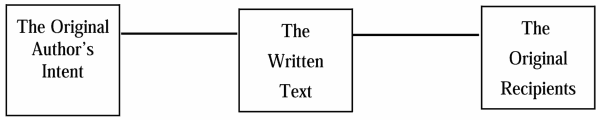
In the past, different reading techniques have focused on one of the three components. But to truly affirm the unique inspiration of the Bible, a modified diagram is more appropriate:
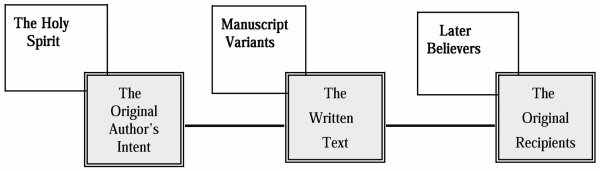
Here is Miles…
It shall greatly helpe ye to understand Scripture, if thou mark not only what is spoken or wrytten, but of whom, and to whom, with what words, at what time, where, to what intent, with what circumstance, considering what goeth before, and what followeth after.
Utley…
III. Possible Approaches to Good Bible Reading
At this point I am not discussing the unique techniques of interpreting specific genres but general hermeneutical principles valid for all types of biblical texts. A good book for genre-specific approaches is How To Read The Bible For All Its Worth, by Gordon Fee and Douglas Stuart, published by Zondervan.
My methodology focuses initially on the reader allowing the HolySpirit to illumine the Bible through four personal reading cycles. This makes the Spirit, the text and the reader primary, not secondary. This also protects the reader from being unduly influenced by commentators. I have heard it said: "The Bible throws a lot of light on commentaries.” This is not meant to be a depreciating comment about study aids, but rather a plea for an appropriate timing for their use.
We must be able to support our interpretations from the text itself. Five areas provide at least limited verification:
historical setting
literary context
grammatical structures (syntax)
contemporary word usage
relevant parallel passages
genre
We need to be able to provide the reasons and logic behind our interpretations. The Bible is our only source for faith and practice. Sadly, Christians often disagree about what it teaches or affirms. The four reading cycles are designed to provide the following interpretive insights:
The first reading cycle
Read the book in a single sitting. Read it again in a different translation, hopefully from a different translation theory
(1) word-for-word (NKJV, NASB, NRSV)
(2) dynamic equivalent (TEV, JB)
(3) paraphrase (Living Bible, Amplified Bible)
Look for the central purpose of the entire writing. Identify its theme.
Isolate (if possible) a literary unit, a chapter, a paragraph or a sentence which clearly expresses this central purpose or theme.
Identify the predominant literary genre
(1) Old Testament
a) Hebrew narrative
b) Hebrew poetry (wisdom literature, psalm)
c) Hebrew prophecy (prose, poetry)
d) Law codes
(2) New Testament
a) Narratives (Gospels, Acts)
b) Parables (Gospels)
c) Letters/epistles
d) Apocalyptic literature
Shalom.
J.
