To whom did Jesus’ death apply?

Exactly whom Jesus died for is a point of theological disagreement among evangelical Bible believers. Some Christians believe that Jesus died only for the elect; this is the doctrine of limited atonement, the L in Calvinism’s TULIP.

Other Christians believe that Jesus died for everyone who has or ever will live; this is the doctrine of unlimited atonement, held by Arminians and most four-point Calvinists, or Amyraldians.

Limited atonement, sometimes called particular redemption, is based on the doctrine of election or predestination (Romans 8:30, 33; Titus 1:1).

Since only the elect of God will be saved, the reasoning goes, Jesus must have died only for them. Otherwise, Jesus’ death “failed” those who are not elect. If Jesus died for everyone, then hell will be full of people for whom Jesus died—was His atonement insufficient?

If Jesus died only for the elect, then His atonement perfectly accomplished its goal. Every person for whom Jesus died will be in heaven.

Unlimited atonement, on the other hand, says that Jesus died for everyone but that only those who respond in faith will reap the benefits of His sacrifice. In other words, Jesus’ death was sufficient for all, but only effectual for some (those who have faith).

If Jesus did not die for everyone, the reasoning goes, then the offer of salvation is empty, because the non-elect cannot be saved. The teaching of unlimited atonement is based on verses such as 1 John 2:2, “He is the atoning sacrifice for our sins, and not only for ours but also for the sins of the whole world.”

Precise theological thinking is a good thing. We are called to be students of the Word (2 Timothy 2:15). But on this point, it seems that most people follow a theological system to get to their answer, rather than the clear Word of God. If it were not for theological systems (namely, Calvinism and Arminianism), the question of whom Jesus died for would probably never come up—but it has come up!

One side says that, if Christ did not die for all, then there can be no genuine offer of salvation. The other side says that, if Christ died for some who will never be saved, then His death in some sense fails to accomplish its purpose. Either way, there seems to be an attack upon God’s character or Christ’s work—either God’s love is limited or Jesus’ power is limited. This presents an unnecessary dilemma and creates a tension where none need exist. We know that God’s love is infinite (Psalm 107:1) and that Christ’s power is infinite (Colossians 1:16–17). The dilemma is a false one of our own making.

In short, the offer of salvation is universal—to all who will believe (Romans 10:11, 13). We also know that, regardless of how broad Christ’s atonement is, it is limited in some respect—it is effective only for those who believe (John 3:18).

John 10 provides more insight into the issue of whom Jesus died for. In that passage we see that Christ died for His sheep (John 10:11, 15).

Also, all who are His sheep will come to Him (verses 4 and 27), and they are kept secure in Christ (verses 28–30). However, when we share the gospel, we don’t try to “pre-screen” the hearers of the message.

We don’t delve into who are the elect or for whom Jesus may or may not have died. Those discussions would distract from the goal of evangelism. When presenting the gospel, we simply say, “Jesus died for your sin, and He rose again from the dead. His death is sufficient to pay for your sins if you will put your faith in Him.” This is a biblically accurate statement, and it avoids trying to get too specific. The preaching of the apostles in the New Testament doesn’t try to cut it more finely than that.

Right?

J.
I may not be as studied, but God is limitless, therefore assuming Jesus died only to save a limited number of people makes no sense to me, His love is infinite, therefore those who can embrace Him, have no numerical boundary.

one cannot place limitations on the eternally infinite.

just my opinion.

Late here, your opinion well received.

ARTHUR DENTA - A king, consulting with himself and purposing to declare his honour and authority, enacteth such laws and statutes as the best industry of his subjects shalt not be able to observe, pretending nevertheless, of his own especial grace, to be favourable or merciful to some and upon the remnant of transgressors to execute justice. From this spring (to wit, the honour of the king) do distill two streams, the one for his beloved subjects to drink at and live, the other for the malignant to drown in.

THOMAS GOODWIN - Moreover, as God respects no persons, so He respects no conditions upon which He gives salvation to us.

THOMAS WATSON - It is absurd to think that anything in us could have the least influence upon our election. Some say that God did foresee that such persons would believe, and therefore did choose them; so they would make the business of salvation to depend upon something in us. Whereas God does not choose us FOR faith, but TO faith. “He hath chosen us, that we should be holy” (Eph. 1:4), not because we would be holy, but that we might be holy. We are elected to boldness, not for it.

THOMAS WATSON - Let us then ascribe the whole work of grace to the pleasure of God’s Will. God did not choose us because we were worthy, but by choosing us He makes us worthy.

THOMAS BROOKS - The purpose of God is the sovereign cause of all that good that is in man, and of all that external, internal and eternal good that comes to man. Not works past, for men are chosen from everlasting; not works present, for Jacob was loved and chosen before he was born; nor works foreseen, for men were all corrupt in Adam. All a believer’s present happiness, and all his future happiness springs from the eternal purpose of God.

ELNATHAN PAM - This doctrine affords comfort: thy unworthiness may dismay thee, but remember that thy election depends not upon thy worthiness but upon the will of God.

THOMAS MANTON - Election is ascribed to God the Father, sanctification to the Spirit, and reconciliation to Jesus Christ… This is the chain of salvation and never a link of this chain must be broken. The Son cannot die for them whom the Father never elected, and the Spirit will never sanctify them whom the Father hath not elected nor the Son redeemed.

SAMUEL RUTHERFORD - If so be that freewill were our tutor, and we had our heaven in our own keeping, then we would lose all. But because we have Christ for our tutor, and He has our heaven in His hand, therefore the covenant it must be perpetual.

JOHN ARROWSMITH - Election having once pitched upon a man, it will find him out and call him home, wherever he be. It called Zaccheus out of accursed Jericho; Abraham out of idolatrous Ur of the Chaldees; Nicodemus and Paul, from the College of the Pharisees, Christ’s sworn enemies; Dionysius and Damaris, out of superstitious Athens. In whatsoever dunghills God’s elect are hid, election will find them out and bring them home.

JOHN BARLOW - Whom He chooseth, shall be created, called, justified, sanctified, glorified; because His purpose cannot be altered, His promise revoked. Let Manasseh repair the high places, rear altars for Baal; the Prodigal run from his Father, drink and swift, consume his portion; Saul make havoc of the saints, put them in prison, do many things against Jesus of Nazareth; yet shall they come to themselves, mourn for their sins, and be saved. For they are elected, beloved of Him who is the same for ever. Were it not thus, what hope could the faithful have to see Babel ruined, the Roman whore burned, the Jew called, the Devil’s kingdom destroyed and Christ’s perfected?

THOMAS BROOKS - Christ is to be answerable for all those that are given to Him, at the last day, and therefore we need not doubt but that He will certainly employ all the power of His Godhead to secure and save all those that He must be accountable for. Christ’s charge and care of these that are given to Him, extends even to the very day of their resurrection, that He may not so much as lose their dust, but gather it together again, and raise it up in glory to be a proof of His fidelity; for, saith He, “I shall lose nothing, but raise it up again at the last day.”

CHRISTOPHER LOVE - If the elect could perish then Jesus Christ should be very unfaithful to His Father because God the Father hath given this charge to Christ, that whomsoever He elected, Christ should preserve them safe, to bring them to heaven. John 6:39.

THOMAS MANTON - Our spiritual estate standeth upon a sure bottom: the beginning is from God the Father, the dispensation from the Son, and the application from the Holy Ghost… It is free in the Father, sure in the Son, ours in the Spirit.

THOMAS GOODWIN - Oh despise not election! therein lies all your hope, that there is a remnant who shall infallibly be saved.

JOSEPH ALLEINE - The right procedure: You begin at the wrong end if you first dispute about your election. Prove your conversion, and then never doubt your election. If you cannot yet prove it, set upon a present and thorough turning. Whatever purposes be, which are secret, I am sure His promises are plain. How desperately do rebels argue! “If I am elected I shall be saved, do what I will. If not, I shall be damned, do what I can.” Perverse sinner, will you begin where you should end?

JOSEPH ALLEINE - Do not stand still disputing about your election, but set to repenting and believing. Cry to God for converting grace. Revealed things belong to you; in these busy yourself… Whatever God’s purposes may be, I am sure His promises are true. Whatever the decrees of heaven may be, I am sure if I repent and believe I shall be saved.

J.

[1] WCF. III. Chapter III, Of God’s Eternal Decree: [1] God from all eternity, did, by the most wise and holy counsel of His own will, freely, and unchangeably ordain whatsoever comes to pass; yet so, as thereby neither is God the author of sin, nor is violence offered to the will of the creatures; nor is the liberty or contingency of second causes taken away, but rather established. [II] Although God knows whatsoever may or can come to pass upon all supposed conditions; yet has He not decreed anything because He foresaw it as future, or as that which would come to pass upon such conditions. [III] By the decree of God, for the manifestation of His glory, some men and angel are predestinated unto everlasting life; and others foreordained to everlasting death. [IV] These angels and men, thus predestinated, and foreordained, are particularly and unchangeably designed, and their number so certain and definite, that it cannot be either increased or diminished. [V] Those of mankind that are predestinated unto life, God, before the foundation of the world was laid, according to His eternal and immutable purpose, and the secret counsel and good pleasure of His will, has chosen, in Christ, unto everlasting glory, out of His mere free grace and love, without any foresight of faith, or good works, or perseverance in either of them, or any other thing in the creature, as conditions, or causes moving Him thereunto; and all to the praise of His glorious grace. [VI] As God has appointed the elect unto glory, so has He, by the eternal and most free purpose of His will, foreordained all the means thereunto. Wherefore, they who are elected, being fallen in Adam, are redeemed by Christ, are effectually called unto faith in Christ by His Spirit working in due season, are justified, adopted, sanctified, and kept by His power, through faith, unto salvation. Neither are any other redeemed by Christ, effectually called, justified, adopted, sanctified, and saved, but the elect only. [VII] The rest of mankind God was pleased, according to the unsearchable counsel of His own will, whereby He extends or withholds mercy, as He pleases, for the glory of His sovereign power over His creatures, to pass by; and to ordain them to dishonor and wrath for their sin, to the praise of His glorious justice. [VIII] The doctrine of this high mystery of predestination is to be handled with special prudence and care, that men, attending the will of God revealed in His Word, and yielding obedience thereunto, may, from the certainty of their effectual vocation, be assured of their eternal election. So shall this doctrine afford matter of praise, reverence, and admiration of God; and of humility, diligence, and abundant consolation to all that sincerely obey the Gospel.
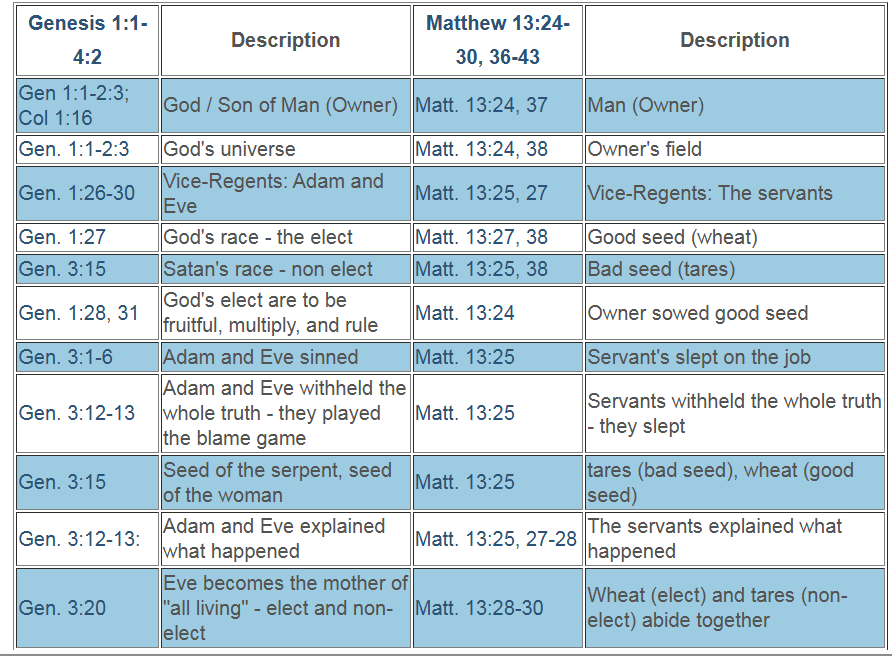
[2] though the “seed of the woman” (Gen. 3:15) is Jesus Christ, his children are adopted into his family (Eph. 1:5).

J.

One may ask, “Why did not God then elect ALL people from the foundation of the world?” In Isaiah 55:8-9 God says, “For my thoughts are not your thoughts, neither are your ways my ways, saith the LORD. For as the heavens are higher than the earth, so are my ways higher than your ways, and my thoughts than your thoughts.”

If we believe this, why do we question God’s love? In addition, Paul speaks to this in Romans 9:21-22, saying: “Does not the potter have the right to make out of the same lump of clay some pottery for noble purposes and some for common use? What if God, choosing to show his wrath and make his power known, bore with great patience the objects of his wrath prepared for destruction?” Well, simply, it is God’s prerogative. But note that he does have a purpose - a holy purpose - when he ordained such - “to show his wrath and make his power known.”

This leads us to point three: God is not only a loving God (John 3:16), but a holy (Ex. 15:11; Psa. 103:1; Isa. 6:3) and just (Deut. 32:4; Job 4:17; 8:3; Psa. 89:14, etc.) God who MUST necessarily judge sin (John 3:18).

Therefore, there must necessarily be those who are judged. There must also necessarily be a Hell. If neither of these existed, then God would simply not be God; the punishment of evil would be a farce, unreal, a deception. However, God does not lie (Num. 23:19; 1 Sam. 15:29; Psa. 92:15; Mal. 3:6; Rom. 3:4; Heb. 6:18) and therefore sin must be, will be, and is being punished.

The fact that some will go to Hell is not God’s fault, as it is not his sin that put some there. All of us are fallen in Adam. Indeed, not only are we all fallen in Adam, but each of us is a purposeful sinner (Rom. 3). The fact that any of us go to Heaven is all because of loving grace (Eph 2:8-10). Christ, before the foundation of the world (1 Pet. 1:18-21) chose to go to the Cross for his Church (Eph. 5:23). His sacrifice is for his own (John 1:13; 6:44, 65; Rom. 9:16, etc.) and them alone, as the rest are “judged already” (John 3:18).

In light of everything above, we observe that reprobation is indeed a very sad doctrine. “Jesus wept” (John 11:35) is the shortest verse in Scripture. This is my reaction to this biblical doctrine. It brings sadness to the soul. As a jury, that because of the evidence must find someone guilty of murder and thus the death penalty, they understand that while it is a just verdict, at the same time they are saddened that it must be given. Weep for the lost. See Ezekiel 18:32; 33:11.
Dr. Joseph R. Nally, Jr.

J.

This is not a matter of how “learned” we are or how much we study. The question is simple: is it written in Scripture, and if so, in what context and for what reason?

Just the core Greek “elect/election/chosen” family appears roughly:

50+ times in the New Testament alone…

ἐκλεκτός (eklektos) select (G1588)
(Adjective Accusative Plural Masculine )

This word occurs about 21 x
Meaning
elect, chosen, the Chosen One
chosen out, selected;
in NT chosen as a recipient of special privilege, elect, Col. 3:12;
specially beloved, Lk. 23:35;
possessed of prime excellence, exalted, 1Tim. 5:21;
choice, precious, 1Pet. 2:4, 6

to select (eklegō - ἐκλέγω)
selecting (eklogē - ἐκλογή)
chosen with (suneklektos - συνεκλεκτός)

And that is before including related concepts such as:

predestined,
foreknown,
called,
appointed,
chosen beforehand,
given by the Father,
remnant,
inheritance,
etc.

In the Old Testament, the Hebrew:

בָּחַר (bachar) - “choose/chosen”

is used extensively for:

Israel as God’s chosen nation,
David,
priests,
Jerusalem,
God choosing individuals or peoples.

So the doctrine/theme of divine choosing is deeply woven throughout Scripture, not confined to a few isolated Pauline texts.

One important clarification:

The Bible uses “elect/chosen” in several categories:

Israel nationally,
Christ Himself as the Chosen One,
angels (“elect angels”),
the church/believers,
individuals chosen for service,
and sometimes corporate groups rather than isolated individuals.

So every occurrence is not automatically about:

“individual election unto eternal salvation”

Context determines the meaning.

Here is a link I highly recommend, Utley, and he is Arminian in his theology.

Shalom and goodnight.

J.

I thought the answer was clear. I didn’t realize that some groups differ. The clincher for me is 1 John 2:2

“He is the atoning sacrifice for our sins, and not only for ours, but also for the sins of the whole world.”

1 Like

This is for you, read it when you have time. And yes, the debate is still very active because both sides appeal to Scripture, but interpret the order and nature of salvation differently.

Here are some solid resources from both perspectives:

Reformed / Monergistic
Monergism: Reformed vs Arminian Overview
Regeneration: Reformed vs Arminian Views
Alpha & Omega Ministries – Monergism vs Synergism
Arminian / Synergistic
Society of Evangelical Arminians – Monergism and Arminianism
Arminius and Arminians on Monergism vs Synergism

A concise way to frame the debate.

Reformed theology argues:

regeneration causes faith.

Arminian theology argues:

prevenient grace enables faith, and regeneration follows faith.

The central disagreement is usually not whether grace is necessary, both sides affirm that, but whether grace is:

effectual and irresistible for the elect,
or
resistible and universally enabling

https://www.monergism.com/reformed-faith-and-arminianism?**utm_source=.com

“all the world”, or “the whole world”, in Scripture, unless when it signifies the whole universe, or the habitable earth, is always used in a limited sense, either for the Roman empire, or the churches of Christ in the world, or believers, or the present inhabitants of the world, or a part of them only, Luk_2:1; and so it is in this epistle, 1Jn_5:19; where the whole world lying in wickedness is manifestly distinguished from the saints, who are of God, and belong not to the world; and therefore cannot be understood of all the individuals in the world; and the like distinction is in this text itself, for “the sins of the whole world” are opposed to “our sins”, the sins of the apostle and others to whom he joins himself; who therefore belonged not to, nor were a part of the whole world, for whose sins Christ is a propitiation as for theirs: so that this passage cannot furnish out any argument for universal redemption; for besides these things, it may be further observed, that for whose sins Christ is a propitiation, their sins are atoned for and pardoned, and their persons justified from all sin, and so shall certainly be glorified, which is not true of the whole world, and every man and woman in it; moreover, Christ is a propitiation through faith in his blood, the benefit of his propitiatory sacrifice is only received and enjoyed through faith; so that in the event it appears that Christ is a propitiation only for believers, a character which does not agree with all mankind; add to this, that for whom Christ is a propitiation he is also an advocate, 1Jn_2:1; but he is not an advocate for every individual person in the world; yea, there is a world he will not pray for Jhn_17:9, and consequently is not a propitiation for them. Once more, the design of the apostle in these words is to comfort his “little children” with the advocacy and propitiatory sacrifice of Christ, who might fall into sin through weakness and inadvertency; but what comfort would it yield to a distressed mind, to be told that Christ was a propitiation not only for the sins of the apostles and other saints, but for the sins of every individual in the world, even of these that are in hell? Would it not be natural for persons in such circumstances to argue rather against, than for themselves, and conclude that seeing persons might be damned notwithstanding the propitiatory sacrifice of Christ, that this might, and would be their case.
Gill.

Here is John Calvin, Book 3, of The Institutes of the Christian Religion:THE WAY IN WHICH WE RECEIVE THE GRACE OF CHRIST: WHAT BENEFITS COME TO US FROM IT, AND WHAT EFFECTS FOLLOWChapter I: The Things Spoken Concerning Christ Profit Us by the Secret Working of the Spirit1. The Holy Spirit as the bond that unites us to Christ. WE must now examine this question. How do we receive those benefits which the Father bestowed on his only-begotten Son–Not for Christ’s own private use, but that he might enrich poor and needy men? First, we must understand that as long as Christ remains outside of us, and we are separated from him, all that he has suffered and done for the salvation of the human race remains useless and of no value for us. Therefore, to share with us what he has received from the Father, he had to become ours and to dwell within us.Calvin’s words immediately line up with the Westminster Standards from a century or so later. They don’t work that well with Packer’s description of the work of Christ–the one he insists all Calvinists believe in.

Acquaint yourself with the ongoing debate between Reformed and Arminian theology. The Reformers are not appreciated in our modern culture. And not here, as I have noticed.

J.

Joh 17:9 I am asking on behalf of them. I am not asking on behalf of the world, but on behalf of those whom you have given me, because they are yours;
Joh 17:10 and all things that are mine are yours, and yours are mine; and I have been glorified in them.
Joh 17:11 And I am no longer in the world, but they are in the world, and I am coming to you. Holy Father keep them in your name, which you have given me, that they may be one, even as we are.
Joh 17:12 While I was with them, I kept them in your name, which you have given me; and I guarded them and not one of them perished but the son of destruction,N1 so that the Scripture would be fulfilled.
Joh 17:13 But now I am coming to you; and these things I speak in the world so that they may have my joy made full in themselves.
Joh 17:14 I have given them your word; and the world has hated them, because they are not of the world, even as I am not of the world.
Joh 17:15 I do not ask that you take them out of the world, but that you keep them from the wicked one.
Joh 17:16 They are not of the world, even as I am not of the world.
Joh 17:17 Sanctify them in the truth; your word is truth.
Joh 17:18 As you sent me into the world, so I have sent them into the world.
Joh 17:19 And for their sakes I sanctify myself, that they themselves also may be sanctified in truth.
Joh 17:20 "I do not ask for these only, but also for those who will believe in me through their word;
Joh 17:21 that they may all be one, just as you, Father, are in me, and I in you, that they also may be in us, so that the world may believe that you have sent me.
Joh 17:22 The glory that you have given me I have given to them, that they may be one even as we are one,
Joh 17:23 I in them and you in me, that they may be perfected in unity, so that the world may know that you sent me, and loved them, even as you have loved me.
Joh 17:24 Father, I desire that they also, whom you have given me, may be with me where I am, so that they may see my glory that you have given me because you loved me before the foundation of the world.
Joh 17:25 O righteous Father, even though the world does not know you, I know you, and these know that you sent me.
Joh 17:26 I made known to them your name, and will make it known, so that the love with which you have loved me may be in them, and I in them."

J.

To the verse.

The Father imposed His wrath due unto, and the Son underwent punishment for, either:

  1. All the sins of all men.

  2. All the sins of some men, or

  3. Some of the sins of all men.
    In which case it may be said:

  4. That if the last be true, all men have some sins to answer for, and so, none are saved.

  5. That if the second be true, then Christ, in their stead suffered for all the sins of all the elect in the whole world, and this is the truth.

  6. But if the first be the case, why are not all men free from the punishment due unto their sins?
    You answer, “Because of unbelief.”

“I ask, Is this unbelief a sin, or is it not? If it be, then Christ suffered the punishment due unto it, or He did not. If He did, why must that hinder them more than their other sins for which He died? If He did not, He did not die for all their sins!”

Of course unbelief is a sin for which Christ died! If he didn’t, none could be saved. Limited atonement is a biblical doctrine.

The text is question is:

1 John 2:1-2 My little children, these things write I unto you, that ye sin not. And if any man sin, we have an advocate with the Father, Jesus Christ the righteous: He is the propitiation for our sins, and not for ours only but also for the sins of the whole world.
Seeing that limited atonement is a biblical doctrine what is John actually saying? After all, the Bible does not contradict itself. All Scripture is God breathed (2 Tim. 3:16), so what remains is for us to “rightly divide” it (2 Tim. 2:15). As we know, in rightly dividing any text, we need to look at not only at the immediate and the book’s overall context, but the author, audience, word meanings, historical setting, grammar, syntax, textual issues, the type of literature, the author’s and the over all biblical context. When this is not properly done we may end up with error, division, and even different denominations, etc.

So, what is John talking about? John is the author. He was a Jew, a Hebrew. “Jews” (Ioudaioi) is used 71 times in his Gospel, as compared to Matthew, Mark, and Luke, which only mention the word 16 times. So, comparably where was John’s emphasis? Who was his primary audience? The Jews, or the Hebrews.

So, John is simply saying in 1 John 2:2, that Jesus Christ is the "the propitiation for our [the Hebrews] sins; and not for ours [the Hebrews] only, but also for the whole world [the Gentiles]. This is consistent with what John wrote in his gospel in John 11:51-52. Let’s briefly compare them:

It is clear that John is speaking of the same idea in each set of verses. “The whole world” (1 John 2:2) refers to only the children of God scattered throughout the whole world (John 11:52; 17:6, 9, 19; Rev. 5:9; 7:9), the “many” of Hebrews 9:28, but not each person in the human race (John 5:29).

Logic also must dictate here. If God desires all men to be saved without exception, then why are any lost? Was Judas lost? Yes, he was (John 17:12; cf. Matt 26:24). It is impossible to give the words ransom, substitute, reconcile, and propitiate their biblical meaning and still hold to universal atonement without also accepting universal salvation. If these terms hold to their rightful meanings, then Christ died only for the elect.

As George Smeaton in his book, The Apostles’ Doctrine of the Atonement (Banner of Truth, 1991) so eloquently put it:
The words plainly allude to the atonement as offered and applied - that is, to the actual expiation, which does not go beyond the number of believing recipients. It is a perversion of the language when this is made to teach the dogma of universal propitiation; or that atonement was equally offered for all, whether they receive it or not, whether they acknowledge its adaptation to their case or not. The passage does not teach that Christ’s propitiation has removed the divine anger in such a sense from all and every man. Nothing betokens that the apostle had others in his eye than believers out of every tribe and nation.
So, 1 John 2:2 does not disprove limited atonement, rather it affirms it.

J.

1 JOHN—NOTE ON 2:2 propitiation. Cf. 4:10. The word means “appeasement” or
“satisfaction.” The sacrifice of Jesus on the cross satisfied the demands of God’s
holiness for the punishment of sin (cf. Rom. 1:18; 2 Cor. 5:21; Eph. 2:3). So
Jesus propitiated or satisfied God. See notes on Heb. 2:17; 9:15 for a clear
illustration of propitiation. for the sins of the whole world. This is a generic
term, referring not to every single individual, but to mankind in general**. Christ
actually paid the penalty only for those who would repent and believe.
**
A number
of Scriptures indicate that Christ died for the world
(John 1:29; 3:16; 6:51; 1
Tim. 2:6; Heb. 2:9). Most of the world will be eternally condemned to hell to
pay for their own sins, so they could not have been paid for by Christ. The
passages that speak of Christ’s dying for the whole world must be understood to
refer to mankind in general (as in Titus 2:3–4). “World” indicates the sphere, the
beings toward whom God seeks reconciliation and has provided propitiation.
God has mitigated his wrath on sinners temporarily, by letting them live and
enjoy earthly life (see note on 1 Tim. 4:10). In that sense, Christ has provided a
brief, temporal propitiation for the whole world. But he actually satisfied fully
the wrath of God eternally only for the elect who believe. Christ’s death in itself
had unlimited and infinite value because he is Holy God. Thus his sacrifice was
sufficient to pay the penalty for all the sins of all whom God brings to faith**. But
the actual satisfaction and atonement was made only for those who believe** (cf.
John 10:11, 15; 17:9, 20; Acts 20:28; Rom. 8:32, 37; Eph. 5:25). The pardon for
sin is offered to the whole world, but received only by those who believe
(cf. 1
John 4:9, 14; John 5:24). There is no other way to be reconciled to God.
Johnny Mac.

The phrase peri tōn hamartiōn hēmōn (“for our sins”) uses peri with the genitive, a construction frequently used in sacrificial contexts in the Septuagint and New Testament. Here it carries the sense of “concerning,” “with respect to,” or more specifically, “for sins” in an atoning sense.

John then introduces a contrast-expansion formula:

οὐ… μόνον ἀλλὰ καὶ
“not only… but also…”

This is a standard Greek syntactical structure used to expand the scope of a statement. Thus:

“not for ours only, but also for the whole world.”

The expression tōn hēmeterōn (“ours”) is stronger than a simple possessive pronoun and can carry the idea of “our own.” John is therefore deliberately widening the scope beyond his immediate audience.

The phrase peri holou tou kosmou (“for the whole world”) contains holou (“whole”), a genitive masculine singular adjective modifying kosmou (“world”). Grammatically, kosmos is singular and collective, not distributive. John does not explicitly say “every individual person,” but rather “the whole world” as a unified expression.

Importantly, grammar alone does not settle the theological debate over whether “whole world” means every individual universally or humanity globally without ethnic distinction. Morphology and syntax can show the structure and force of the statement, but the precise extent of “world” must ultimately be determined from Johannine usage and broader theological context.

Another important observation is John’s deliberate repetition of peri (“for/concerning”):

peri tōn hamartiōn hēmōn
peri tōn hēmeterōn
peri holou tou kosmou

This repetition creates rhetorical balance and emphasis throughout the verse.

Theologically and syntactically, the force of hilasmos remains significant. As a predicate nominative, it presents Christ’s atoning work as objective and accomplished, not merely hypothetical. John’s wording is declarative: Christ is the propitiation. Combined with the present tense estin, the verse portrays Christ as the continuing and abiding ground of reconciliation and advocacy for His people before the Father.

1Jn 2:2 And καὶ He αὐτὸς is ἐστιν [the] propitiation ἱλασμός for περὶ our ἡμῶν, - τῶν sins, ἁμαρτιῶν and δὲ not οὐ only μόνον for περὶ - τῶν ours, ἡμετέρων but ἀλλὰ also καὶ for περὶ those τοῦ of [the] whole ὅλου world. κόσμου.

1Jn 2:2 and he [Or “he himself” (emphatic)] is the propitiation [Or “expiation”; or “atoning sacrifice”] for our sins, and not for ours only, but also… of the whole world.

J.

Jesus answered this question plainly.

“When one of those who reclined at table with him heard these things, he said to him, 'Blessed is everyone who will eat bread in the kingdom of God!” But he said to him, "A man once gave a great banquet and invited many. And at the time for the banquet he sent his servant to say to those who had been invited, ‘Come, for everything is now ready.’

But they all alike began to make excuses. The first said to him, ‘I have bought a field, and I must go out and see it. Please have me excused.’ And another said, ‘I have bought five yoke of oxen, and I go to examine them. Please have me excused.’ And another said, ‘I have married a wife, and therefore I cannot come.’ So the servant came and reported these things to his master.

Then the master of the house became angry and said to his servant, ‘Go out quickly to the streets and lanes of the city, and bring in the poor and crippled and blind and lame.’ And the servant said, ‘Sir, what you commanded has been done, and still there is room.’ And the master said to the servant, ‘Go out to the highways and hedges and compel people to come in, that my house may be filled. For I tell you, none of those men who were invited shall taste my banquet.’" Luke 14:15-24

Jesus initially came for the Jewish people, as He Himself indicated. However, when they rejected Him, He extended the invitation to all. Some believe this was to create a sense of envy in the Jewish people. Regardless, I am thankful that we were grafted in.
Peter

This is a parable, universal call and then there is the effectual call.
What is your take on the doctrine of election Peter?

J.

I immediately think of John 3:16 "For God so loved the world that he gave his one and only Son, that whoever believes in him shall not perish but have eternal life.”

I also think it makes sense that Christ died for all based on how we are instructed to share the Good News with anyone and everyone, telling them that Christ died for them. Obviously not all will believe in him, but I think it somewhat diminishes Jesus’ work on the cross if we say that he only died for the elect.

This here for your perusal @DaughterOfEve24

Mt 23:37

O Jerusalem, Jerusalem, the city that kills the prophets and stones those who are sent to it! How often would I have gathered your children together as a hen gathers her brood under her wings, and you were not willing!
The heart of God, clearly, is a heart which grants freedom, and which sometimes suffers profoundly because of it. In the case of Matthew 23:37, what the Son of God longed for the Son of God didn’t get! The fact that most theologians in the classical tradition found it necessary to attribute this lament not to the heart of the eternal God but only to the humanity of Christ simply testifies to the strength with which a non-biblical philosophical concept of God (viz. God’s impassability) has held biblical exegesis hostage.

Boyd has a more consistent hermeneutical approach than traditional Arminians. He rejects the Reformed appeal to anthropomorphic or anthropopathetic depictions. Traditional Arminians must straddle the fence without falling over on the Calvinist side or the open theist side. It’s quite a balancing act. In addition:

  1. Jn 1:12-13

12 But to all who did receive him, who believed in his name, he gave the right to become children of God, 13 who were born, not of blood nor of the will of the flesh nor of the will of man, but of God.

Some interpreters forcefully reject any idea that the relative clause with which v13 begins (“who were born…”) is a comment on the preceding clause (“who believed in his name”) since then faith would proceed from regeneration whereas, according to their view, a person must opt for rebirth as a possibility opened up for him or her in the call that comes from the Revealer.

In the choice that faith makes a person can be “born again” and so change and come to his or her real being. However, against this it has to be asserted that the concluding statement in v13 traces the entire gift of being a child of God, including the manner in which it is effected, to its deepest ground: “procreation” by God. The idea that faith as a human choice should precede that birth and therefore that in some sense a person should have this rebirth of God at his or her disposal not only seems absurd but is also at variance with statements like this in 1 Jn 5:1," H. Ridderbos, The Gospel of John, 47.

No evangelical would say that before we are born again we must practice righteousness, for such a view would teach works-righteousness. Nor would we say that first we avoid sinning, and then are born of God, for such a view would suggest that human works cause us to be born of God. Nor would we say that first we show great love for God, and then he causes us to be born again. No, it is clear that practicing righteousness, avoiding sin, and loving are all the consequences or results of the new birth. But if this is the case, then we must interpret 1 John 5:1 in the same way, for the structure of the verse is the same as we find in the texts about practicing righteousness (1 John 2:29), avoiding sin (1 John 3:9), and loving God (1 John 4:7). It follows, then, that 1 John 5:1 teaches that first God grants us new life and then we believe Jesus is the Christ.
http://www.9marks.org/journal/does-regeneration-necessarily-precede-conversion
5) Jn 3:16

For God so loved the world, that he gave his only Son, that whoever believes in him should not perish but have eternal life.

Some argue that the term “world” here simply has negative connotations–the created human world. But the characteristic use of “the world” (ho cosmos) elsewhere in the narrative is with negative overtones–the world in its alienation from and hostility to its Creator’s purposes. It makes better sense in the soteriological context to see the latter notion as in view. God loves that which has become hostile to God. The force is not, then, that the world is so vast that it takes a great deal of love to embrace it, but rather that the world has become so alienated from God that it takes an exceedingly great love to love it at all. A. Lincoln, The Gospel According to St. John, 154.
6) Acts 7:51
You stiff-necked people, uncircumcised in heart and ears, you always resist the Holy Spirit. As your fathers did, so do you.
More puzzling still is why God sincerely tries to get individuals and groups to turn from their wicked ways and surrender to him if he is eternally certain his efforts will fail (e.g. Acts 7:51…).
G. Boyd, “God Limits His Control,” Four Views on Divine Providence, 202.
7) Rom 5:18; 11:3

All proof texts from Arminian-ism theology. If you have time, read the whole article.

Shalom.

J.

In my understanding, more particularly He gave Himself as the Gift or Sacrifice for all. More particularly, for the Church, to which He came to deliver, though in its scribes and pharisees leaders a considerable part did not accept it. Then also, for others the disciples, and then also for the whole world, because the processes in the world are contingent on the processes in the church. So, in that sense, his death, but still more - the resurrection, and thus the Divine Human is that due to which a man now are regenerated from the Lord, when they look to Him and shun evils as sins, for it is in Him, in His Divine Human and from it that they can obtain the true faith and true charity, and the whole spiritual life, and eventually salvation.

But it is not only the death, but every step of the Lord’s Life and His Trials on earth was for the sake of all, the death on the cross was the last of his trials.

I think the question “for whom did Jesus die?" lacks clarity, and requires more information for an accurate answer. What exactly does the word “for” mean in the question?

As it stands, the question is a little like asking, “For whom are the free samples at Costco (or the market)?” Of course, the free store samples are for everyone, but why then did the grocer not prepare enough samples for everyone who would enter the store? Because the wise grocer knew, from experience, how many free samples he should probably prepare. The wise grocer was able to use statistics to prepare ample samples, but Almighty God is omniscient.

There is no conflict to suggest an offer of something without cost is available to everyone, but availed upon by a lesser number. To limit the offer’s effective scope is semantics.

“Then Peter said to them, “Repent, and let every one of you be baptized in the name of Jesus Christ for the remission of sins; and you shall receive the gift of the Holy Spirit. For the promise is to you and to your children, and (group A) to all who are afar off, and (sub-group B) as many as the Lord our God will call.” Acts 2:38-39

IMHO

KP

@KPuff

I think your analogy actually concedes part of the Reformed argument without realizing it.

The question is not merely whether the Gospel offer goes out broadly, Reformed theology fully affirms that it does. The question is, what was Christ’s intention in His atoning death, and what did the cross actually accomplish?

Your Costco analogy presents provision as merely potential, awaiting human participation to become effective. But Scripture often speaks of the cross accomplishing something definite for a particular people:

“…you shall call His name Jesus, for He will save His people from their sins.” (Matthew 1:21)

“…the good shepherd lays down His life for the sheep.” (John 10:11)

“Christ loved the church and gave Himself up for her.” (Ephesians 5:25)

Notice the language is not hypothetical. Scripture does not merely say Christ made salvation possible; it says He actually saves, redeems, reconciles, and secures a people.

Even Acts 2:39, which you cited, contains both the outward call and the inward effectual call:
“the promise is for all who are far off” - broad proclamation,
“as many as the Lord our God will call to Himself” - particular application.

That distinction runs throughout Scripture. Many are externally invited, but only the elect are effectually called (Matthew 22:14). Strange to the ears? Another gospel, strange fire?

The issue is not whether the Gospel is freely offered to all, it is. The issue is whether Christ died with a definite saving purpose for His people, or merely created a universal possibility that still depends upon fallen man to make it effective.

The Reformed position argues the cross actually accomplished redemption for those the Father gave to the Son (John 6:37-39), rather than merely making men savable.

and to all that are afar off; either in place, as those that were dispersed, among the several nations of the world; and so carried in it a comfortable aspect on the multitude of Jews, that were of every nation under heaven; or in time, who should live in ages to come; or else the Gentiles are intended, who were afar off from God and Christ, and the way of life and salvation by him; see Eph_2:12 even as many as the Lord our God shall call: not externally only, by the ministry of the word, but internally, by his grace and Spirit; with that calling, which is according to the purpose and grace of God, and is inseparably connected with eternal glory; the promise is to all such, and is made good to all such, whether they be Jews or Gentiles, fathers, or children, greater or lesser sinners. The Syriac version reads, “whom God himself shall call”.
Gill

Do you really think this thread is merely about semantics or a lack of clarity? Or is there perhaps a strong reaction against Reformed theology and the implications of this discussion?

Because the central issues being raised, election, effectual calling, remnant theology, and the intent of the atonement, are all explicitly biblical categories, not semantic inventions.

Correct? Looks like Im going to have a tough time ahead. And this thread is simply asking, what does the Bible say? I did not think there was anything wrong with asking a question, yet much of the response seems to be reactionary rather than exegetical.

Triablogue: Arminian prooftexts… IF you have time.

J.

Ha! This analogy made me laugh, but I love it! Thanks for sharing it. It makes a lot of sense. It’s what I was trying to articulate, but couldn’t quite get at.