To whom did Jesus’ death apply?

I’m not solidly in the Arminian or Calvinist camps. To be honest, there was a time when I would have called myself a Calvinist, because that was the kind of theology and spiritual influence I was exposed to, but I am now much less convinced of either view, but quite thoroughly convinced that God cannot fit into any label theologians may have created. Undoubtedly there is some truth to Arminianism, to Calvinism, and to views that aim to reconcile the two.

I suppose this debate is kind of like asking which came first, the chicken or the egg—the Holy Spirit must soften someone’s heart so that they can hear God’s call, but God does not force them to respond; if he did, what we know about the loving Christian God starts to break down. If we are made in his image, and most of us would never wish for someone to love us, trust us, have faith in us because we forced them, then I think it’s a reasonable assumption that God views it the same way and does not want a relationship with us if we did not choose it freely.

So which theological “camp” would you say you identify with now, since you’ve moved away from both Calvinism and Arminianism?
Non-Denominational? Or…

Provisionist,
moderate Arminian,
“mere Christianity” anti-systematic theology,
or a mediating position sometimes called “compatibilist-lite” or “soft synergism.”

Since you seem to explicitly reject rigid theological systems:

“God cannot fit into any label theologians may have created.”

And this sentiment is very common among people moving away from confessional Calvinism into a more eclectic or relational theology.

Or maybe Universalism?

To be honest, I’ve been trying to stay off the moderators’ radar here, but I’m glad @Kpuff gave you a good laugh.

J.

Bro. @Johann

You’ll get no tough time from me. You make a well-reasoned argument (as always). My personal position is of little consequence, but if pressed, I too would confess that I subscribe to the bulk of the reformed position on these issues, (as The Lord has taught me thus far). The issue itself is not semantic (to me), but how the question might be framed is semantic (to me).

If your question had been:
“To whom did Jesus offer salvation through His personal death?” Your answer would be: “To all”, as you have said.

If your question had been:

“To whom did Jesus’ death apply?” your Biblical answer has to be: “To God’s elect.”

Both times you would be corect (IMHO) But, as your OP question “For whom did Jesus die?” was stated, the answer hinges on precisely what you mean by the word “for”, and so I suggested we may be speaking in semantics. (Does that make sense?)

(p.s. I added the word “market” becuse I didn’t know if Cosco was in S. Africa)

Absolutely! I cannot conceive of any act of God Almighty that must not be both “definite” and “for a particular purpose”. He has told us such many times. I understand that we (people) often do not perceive how “definite”, and “for what purpose” He might act. I think our natural inclination is to subconsciously think God’s Holy acts are as unsure of their effect as ours are; that He decrees and then must wait and see what consequences transpire. Of course, we are wrong.

I have developed a personal intellectual construct that I hold in my own mind that addresses both sides of this apparent paradox, one that helps be hold both ideas simultaneously in my mind, but that is for a different conversation. As for this one, let me assure you that everything you have said makes perfect sense to me.

KP

1 Like

Much appreciated, especially this:

“…but if pressed, I too would confess that I subscribe to the bulk of the Reformed position on these issues, as the Lord has taught me thus far.”

That said, I suspect the concern arose particularly from the statement, **“God cannot fit into any label theologians may have created.”**Not from you.

Personally, I think we should be careful not to dismiss theological distinctions too quickly, especially in an age where we have unprecedented access to Scripture, historical theology, language tools, and sound teaching resources. While no theological system is perfect, precision in doctrine still matters.

For what it’s worth, my sources are not exclusively Reformed. I’ve benefited from a wide range of teachers and perspectives over the years, including Bob Utley, who has had a tremendous impact on me, and I’ve spent considerable time examining the various theological traditions and offshoots within Christianity.

If possible, brother, perhaps consider changing the thread title.

Shalom achi.

J.

I am well aware with this KP. The apparent paradoxes replete in Scripture.

J.

There was a time, when people cried foul because Moses compared the people in Egypt to that of an iron furnace. Iron was centuries after a supposed Moses, and then it happened. In 1922, they found the untouched tomb of king Tut, and in the location of his most prized possession sat that iron dagger.

There was a time, and still today, that people cry foul over lack of evidence concerning the Exodus, and the use of chariots to chase the people. Animals of the field had died, where did they get them? In 1999, buried in Egypt, they stumbled across the oldest, and largest, horse stable of the ancient world. Practically in near perfect condition. About 200,000 sq. ft. Of structure buried for all this time. It was a fluke that they came across it, Horses were not kept in the fields, and that may not be the only one waiting to be found. I view His elect, in the same vein as these two points.

Her “seed” will be given one time, and one time only, when they are gone, there will be no more. That event will happen with the female fetus, about what percent will remain when that fetus is born, and she can become pregnant? About four percent. Four percent.

The male “seed” will begin when the male is about 10 years old, they will last about how long before being replaced by new “seed”? About 37 days. So to me, his “elect” are anyone that survives to be born. It appears to me, that we are saying that God has made a mistake if we attempt to further cut who is here, into an elect and non elect situation. He wants us all, He cut out what has no chance, what was being born pre-flood, before they get His image. If someone has a number, like 666, that number should have never been born. That is a number that is from her “seed” that never made it beyond birth, with his “seed” from a 10 year old boy. We all have a number, only God knows how close we are to what He really wants; higher the number, closer to the ones that mean the most to Him. No one believes as I do, which is perfectly fine, I know what viewing these numbers truly means. Put on the whole armor, keep building on what is needed, and continue to prepare. I view myself as bottom of the barrel, last one to make the cut from my parents potential choices that God elected to have a shot at being born. If God wants to wind things down in my lifetime, I am not going to argue if He takes people or not, I just pray, and beg to stay. I am bottom of the barrel, he wants them all, and more than me, just do what I can to get Him what he wants. Gruesome death, sure, try and help Him get His numbers better than me before it happens. Yes, He determined who makes the cut, they have been elected to have a shot at knowing who He is. Evil is not a metaphor, I do not intend to let people languish with that thing without a fight. I have God, He will provide, and be there for the bottom of barrel guy trying to do what I know is right. He died for us all, time to return the favor.

Exegetical Notes
Titus 2:11 is a balance to other NT passages on election. I thought it might be theologically helpful to provide my commentary notes from Romans 8:29 and chapter 9, as well as Ephesians 1.
Romans 8:29 ‒ Paul uses “foreknew” (proginōskō, “to know before”) twice, here and 11:2. In 11:2 it refers to God’s covenant love for Israel before time began.

Remember that the term “know” in Hebrew related to intimate, personal relationship, not to facts about someone (cf. Gen. 4:1; Jer. 1:5). Here it was included in a chain of eternal events (cf. Rom. 8:29-30). This term was linked with predestination. However, it must be stated that God’s foreknowledge is not the basis of election because if that were so, then election would be based on fallen humanity’s future response, which would be human performance. This term is also found in Acts 26:5; 1 Pet. 1:2,20 and 2 Pet. 3:17.

“foreknew” (proginōskō, “to know before”)
The terms “foreknow” and “predestine” are both compounds with the PREPOSITION “before” and, therefore, should be translated “to know before,” “to set bounds before,” or “mark off before.” The definitive passages on predestination in the NT are Rom. 8:28-30; Eph. 1:13-14; and Romans 9.

These texts obviously stress that God is sovereign. He is in total control of all things. There is a preset divine plan being worked out in time. However, this plan is not arbitrary or selective. It is based, not only on God’s sovereignty and foreknowledge, but on His unchanging character of love, mercy, and undeserved grace. See SPECIAL TOPIC: YHWH’S ETERNAL REDEMPTIVE PLAN.

We must be careful of our western (American) individualism or our evangelical zeal coloring this wonderful truth.

We must also guard against being polarized into the historical, theological conflicts between Augustine versus Pelegius or Calvinism versus Arminianism.
“predestined” (proorizō, “to set the bounds before”)

Predestination is not a doctrine meant to limit God’s love, grace, and mercy nor to exclude some from the gospel. It is meant to strengthen believers by molding their worldview. God is for all mankind (cf. John 1:12; 3:16; 1 Tim. 2:4; 2 Pet. 3:9; 1 John 2:2; 4:14).

God is in control of all things. Who or what can separate us from Him (cf. Rom. 8:31-39)? God views all history as present; humans are time bound. Our perspective and mental abilities are limited. There is no contradiction between God’s sovereignty and mankind’s free will. It is a covenantal structure.

This is another example of truth given in dialectical tension.

Biblical doctrines are presented from different perspectives. They often appear paradoxical.

The truth is a balance between the seemingly opposite pairs. We must not remove the tension by picking one of the truths. We must not isolate any biblical truth into a compartment by itself.

It is also important to add that the goal of election is not only heaven when we die, but Christlikeness now (cf. Rom. 8:29-30; 2 Cor. 3:18; Gal. 4:19; Eph. 1:4; 2:10; 4:13; 1 Thess. 3:13; 4:3; 5:23; 2 Thess. 2:13; Titus 2:14; 1 Pet. 1:15). We were chosen to be “holy and blameless.” God chooses to change us so that others may see the change and respond by faith to God in Christ. Predestination is not a personal privilege, but a covenantal responsibility. This is the major truth of the passage. This is the goal of Christianity. Holiness is God’s will for every believer. God’s election is to Christlikeness (cf. Eph. 1:4), not a special standing. The image of God, which was given to man in creation (cf. Gen. 1:26; 5:1,3; 9:6), is to be restored.
“conformed to the image of His Son” ‒ God’s ultimate goal is the restoration of the image lost in the Fall. Believers are foreordained to Christlikeness (cf. Eph. 1:4).
Romans 9
Romans 9 is one of the strongest NT passages on God’s sovereignty (the other being Eph. 1:3-14), while chapter 10 states humans’ free will clearly and repeatedly (cf. “everyone” Rom. 9:4; “whosoever” 9:11,13; “all” 9:12 [twice]). Paul never tries to reconcile this theological tension. They are both true!

Most Bible doctrines are presented in paradoxical or dialectical pairs. Most systems of theology are logical half-truths. Augustinianism and Calvinism versus semi-Pelegianism and Arminianism have elements of truth and error.

Biblical tension between doctrines is preferable to a proof-texted, dogmatic, rational, theological system that forces the Bible onto a preconceived interpretive grid.

This same truth (found in Rom. 9:23) is stated in Rom. 8:29-30 and Eph. 1:4,11. This chapter is the strongest expression of God’s sovereignty in the NT. There can be no dispute that God is in total charge of creation and redemption. This great truth should never be softened or diminished. However, it must be balanced with God’s choice of covenant as a means of relating to human creation, made in His image. It is surely true that some OT covenants, like Genesis 15, are unconditional and do not relate at all to human response, but other covenants are conditioned on human response (e.g., Eden, Noah, Moses, David). God has a plan of redemption for His creation; no human can affect this plan. God has chosen to allow individuals to participate in His plans. This opportunity for participation is a theological tension between sovereignty (Romans 9) and human free will (Romans 10).

Here Bob is explaining the biblical paradoxes, @KPuff. While I appreciate much of his approach and emphasis on holding tensions together in Scripture, I would still disagree with some of his conclusions, particularly where he leans more toward an Arminian understanding of election and predestination.

J.

For a good discussion on the necessity of human freedom and the historical rise of Augustinian/Calvinistic predestination see

Dale Moody, The Word of Truth, pp. 337-348
also note Millard Erickson, Christian Theology, 2nd ed., pp. 920-940
YouTube videos of Steve Gregg
“Calvinism Q and A”
“The Distinctives of Calvinism and Non-Calvinism”
his website is www.thenarrowpath.com

My note.

Advice to Arminians.

“You can’t attack Calvin’s armour with a butter knife”

J.

Let’s keep it biblical brother @CloserThanABrother.

Thanks.

J.

Let’s keep it biblical brother @adelphos.

Thanks.

J.

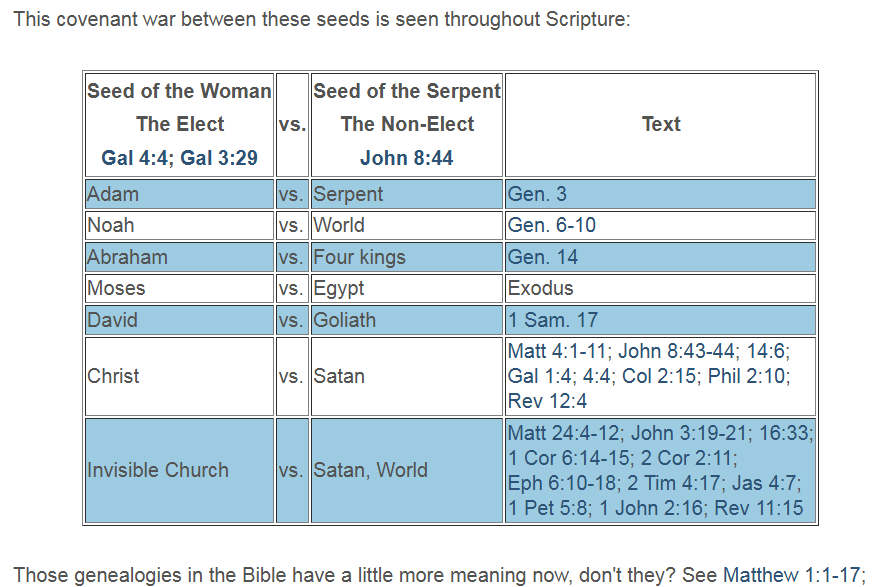
While the sowers slept “his” (not just “a” but “his” = God’s) enemy came and sowed weeds among the wheat (Matt. 13:25; 13:39). Similarly in the Garden of Eden, Satan (“the adversary”) came with his temptation. Mankind in Adam fell (Gen 3:1-6; Rom 5:12-21). Satan sowed his “seed” (Gen. 3:15). Satan’s seed are the non-elect who never belonged in God’s Kingdom in the first place. They are outsiders, invaders, and enemies. Whereas, Eve use to be the mother of just the seed of the elect (Gen. 2:23, Adam called Eve “woman” when she could only bare the seed of the elect, as sin had not yet been introduced by the Fall), now she was also the mother of the non-elect (Gen. 3:20 - the mother of “all” living - “all” = elect and non-elect). Weeds had been sown among the wheat. The non-elect (seed of the serpent) were sown among the elect (seed of the woman [Gen. 3:15]; the seed of Christ [Gal. 3:29; cf. Rom. 8:17]).

In Matthew 13:26-27, the servants came to their master and in Genesis 3:8 God came to visit Adam and Eve - “walking in the garden in the cool of the day.” The owner states that “his enemy” (Matt. 13:25) sowed weeds among the wheat (Matt. 13:27-28) and God clearly knew his enemy who was behind the Garden deception (Gen 3:12-15). Adam and Eve (as well as the servants who slept), were VERY culpable and needed the grace of God for redemption. In Genesis 3:21, God shed blood and clothed the first couple. Adam and Eve did not successfully cloth themselves (fig-leaf Armianism didn’t work, Gen 3:7) as they could not be saved by their own works (Eph 2:8-10).

In Jesus’ parable the servants ask, “‘Do you want us to go and pull them up?’” (Matt. 13:28), but Jesus answers and says, “No, because while you are pulling the weeds, you may root up the wheat with them. Let both grow together until the harvest. At that time I will tell the harvesters: First collect the weeds and tie them in bundles to be burned; then gather the wheat and bring it into my barn” (Matt. 13:29-30; 13:40-42). And truly, the righteous (Rom 1:17; 3:22; 4:5; Phil 3:9) have lived in the midst of the unrighteous from the beginning. Adam and Eve bore the non-elect seed Cain first and then elect seed Abel (Gen 4:1-2). We have seen generations of each since. Only on the last day will the non-elect and the elect be separated. First the non-elect will be cast into the furnace and then the elect gathered to live with their Lord (King, Master, Owner - cf. Matt. 13:47-52; 25:32-33). See WCF 25.5; BC 29.

So, how do the non-elect then come forth out of the first couple, Adam and Eve? How does evil come forth from that which very good (Gen 1:31)? Let’s be explicitly clear, the Bible nowhere says that Eve had sexual relations with Satan. So, how do we answer this question?

While we know it was sin, we do not actually know the specifics. It is interesting though that the Holy Spirit concentrates upon the words “seed” (conception, bring forth, mother, thorns, thistles, knew, conceived, bare) in Genesis 1:11-12, 29; 3:15-16, 18, 20; 4:1-2 (and the rest of the chapter, including phases such as “fruit of the ground,” “firstlings of his flock,” “field,” “tillest the ground,” “yield,” “born,” “begat,” etc. Gen 4:3-4, 8, 10, 17-18, 20, 22, 25-26) and the terms “seed” (tares, wheat, sowed) in Matthew 13:24-27, 29-30, 37-40 (and the rest of the chapter, Matt 13:4, 19, 20, 22-23, 31-32). Biblically election and non-election are God ordained and “seed” driven (Rom 9:10-13). Israel was commanded in the Old Testament to destroy a lot of non-elect “seed” (Hittites, Girgashites, Amorites, Canaanites, Perizzites, Hivites and the Jebusites, etc., Deut 7:1-5). It is also interesting that God uses the word “seed” when describing the Abrahamic covenant (Gen 12:7; 13:15-16; 15:5, 13, 18; 17:7-10; cf. Rom 4:13; Gal 3:29). Also see the use of “Father” (Rom 8:15), “children” (Rom 8:17), “heirs” (Rom 8:17), and “adoption” (Eph 1:5), et. al. as well. As far as evil coming from that which is “very good” see the example below in “Evil and God?”

J.

Will all mankind eventually be saved? (Isn’t election unjust?)

Only the elect will be saved and others will be eternally lost. As Jesus states, “Enter through the narrow gate. For wide is the gate and broad is the road that leads to destruction, and many enter through it. But small is the gate and narrow the road that leads to life, and only a few find it” (Matt. 7:13-14).

This can be a difficult issue for some to understand. So, this answer will be in simple terms a basic understanding with biblical references.

First, one must realize that God is not only 100% love (John 3:16), but 100% judge (John 3:18) as well. God is holy. As such, He may not deny His nature so, He must judge sin which all men have partaken of (Rom. 3:23). He is the JUDGE (Ps. 9:7; 50:3-6; 96:13; Luke 12:2-5; Acts 10:42; 2 Pet. 2:4-9; Rev. 20:11-15) and He judges righteously (Gen. 18:25).

Second, God is a King over His Kingdom (Ps. 29:10; 103:19; Rev.19:16). He is Sovereign (Is. 45:9; Dan. 4:28-37; Rom.9:20-21). As such, He rules His Kingdom according to His rules and nature. His Kingdom shall ultimately stand.

Third, election is a biblical doctrine (Eph. 1:4-5, 11, etc.) of God’s Kingdom. It is the only door to enter His Kingdom (John 10:1-18). Only the elect will hear the voice of the Great Shepherd and follow His voice (John 10:3-8, 14, 16).

How does this work?

God created man in His own image (Gen. 1:27). Adam and Eve, two elect creations, were told to be fruitful and multiply (Gen. 1:28). Therefore, we understand that the universe was designed for those made in God’s image. It was meant for the “seed” of the elect. See Matthew 13:24-30. Though we are living in a momentary pause of seeing this fully realized, ultimately, at the consummation of all things, the new heavens and new earth will be populated by only the elect (Rev. 21). God’s plan of Genesis 1 will ultimately be fully realized - only the elect will fill the earth.

However, there was a pause placed within God’s plan. Adam and Eve fell into sin (Gen. 3:1-6). When they fell, Eve became the mother of ALL living (Gen. 3:20). She would bare the “seed” of the woman and the “seed” of the serpent (Gen. 3:15; 4:1-2, etc.). The seed of the elect and non-elect would come forth from Eve. Within the womb, the tares would be mixed with the wheat (Matt. 13:24-30). Ultimately, they shall be separated, but during this pause, they dwell together.

Why this pause? One reason for this momentary pause is so the children of God - those whom He called in Adam and Eve before the Fall - can understand His love for them more fully. Adam and Eve knew “of” God’s love, but had not fully “experienced” it. What is the greatest way to experience God’s love? The Scripture says, “Greater love has no one than this, that he lay down his life for his friends” (John 15:13). God says to more fully experience His love someone MUST DIE! Therefore, for God’s elect to fully experience His love Christ had to die. However, Christ could not die without the introduction of sin. Therefore, within the plan of God, God allowed sin as a possibility, while not being its author.

Another reason (and there are more) for this momentary pause, is so that God could destroy the devil and his seed (1 John 3:18), thus revealing more fully God’s holy nature. As Christ says, “Ye are of your father the devil, and the lusts of your father ye will do. He was a murderer from the beginning, and abode not in the truth, because there is no truth in him. When he speaketh a lie, he speaketh of his own: for he is a liar, and the father of it” (John 8:44). God will be seen in the end as justified in every action He ever took (Rom. 1:32-2:11), including His eternal judgment of the devil and his seed (the non-elect). The non-elect are the enemy of God. They are intruders onto God’s earth. They are invaders that have pitted their kingdom against God’s (Matt. 12:26; John 12:31; 14:30; 16:11; 2 Cor. 4:4; Eph. 6:11-12). As enemies they are hated by God (Rom. 9:10-13). As such, they are judged already (John 3:18, 36). As such, they deserve to be judged (Lam. 3:39; Jer. 21:14; Jude 1:5-16). They are worthy of God’s eternal wrath (Deut. 32:39-41; Zeph. 2:3; Rom. 1:18). They deserve to be destroyed (Nah. 1:2-8; Zep. 1:2-6; 3:6-10) for eternity.

However, while upon this earth, God does not fail to show His love to all men as “He makes the sun to rise on the evil and the good” (Matt. 5:45; Acts 14:17 and other forms of Common Grace). There are riches of divine kindness which beckon all men to entrust their souls to the faithful Creator (Rom 2:4). God is merciful to all (common grace) - especially the elect (1 Tim. 4:10). So, all are without excuse (Rom. 1:20). However, though God is generous and loving and gives grace when it is not due, ultimately God will judge His enemies, fully and finally (Rev. 20:7-15 the consummation of judgment). Jesus has already triumphed over them upon the Cross (Col. 2:15 the incarnation of judgment). The one who walks after his own will and obeys not the gospel of Christ “shall be punished with everlasting destruction from the presence of the Lord, and from the glory of his power” (2 Thess. 1:8-9). God’s wrath is justified and warranted towards the non-elect His enemies the “seed” of the serpent. God’s justice is holy and sure. “It is a fearful thing to fall into the hands of the living God” (Heb. 10:31).

J.

Ezekiel 18:32 For I take no pleasure in the death of anyone, declares the Sovereign LORD. Repent and live!

Ezekiel 33:11 Say to them, As surely as I live, declares the Sovereign LORD, I take no pleasure in the death of the wicked, but rather that they turn from their ways and live. Turn! Turn from your evil ways! Why will you die, O house of Israel?

First, regarding the actual meaning of Ezekiel 33:10-11. These verses focus on the responsibility of those covenant people who heard the messages of the watchman (Ezek 18:21-32). In Ezekiel 33 an exhortation is followed by the principle of individual responsibility. The people said, “Our offenses and sins weigh us down, and we are wasting away because of them. How then can we live?” (Ezek 33:10). God replies that individuals have the opportunity to repent and are commanded to do so. He says, “Turn! Turn from your evil ways!” (Ezek 33:11). This was a call to repent so the house of Israel could be healed and restored. God was careful to warn of judgment and to call his covenant people to repentance as he takes no pleasure in their death because of covenantal disobedience (cf. Ezek. 18:23, 32). So, the Ezekiel passages actually deal with the church and not all humanity.

Second, there are some other verses that bear upon this issue of understanding God and his pleasure (and lack thereof) of the death of the wicked. Here is a sampling:

Deuteronomy 28:63 Just as it pleased the LORD to make you prosper and increase in number, so it will please him to ruin and destroy you. You will be uprooted from the land you are entering to possess.
Psalm 135:6-11 The LORD does whatever pleases him, in the heavens and on the earth, in the seas and all their depths. He makes clouds rise from the ends of the earth; he sends lightning with the rain and brings out the wind from his storehouses. He struck down the firstborn of Egypt, the firstborn of men and animals. He sent his signs and wonders into your midst, O Egypt, against Pharaoh and all his servants. He struck down many nations and killed mighty kings Sihon king of the Amorites, Og king of Bashan and all the kings of Canaan.

Proverbs 1:24-26 But since you rejected me when I called and no one gave heed when I stretched out my hand, since you ignored all my advice and would not accept my rebuke, I in turn will laugh at your disaster; I will mock when calamity overtakes you.

Ezekiel 5:30 Then my anger will cease and my wrath against them will subside, and I will be avenged. And when I have spent my wrath upon them, they will know that I the LORD have spoken in my zeal.

Revelation 18:20 Rejoice over her, O heaven! Rejoice, saints and apostles and prophets! God has judged her for the way she treated you.

These are just and righteous statements from the living God, as sin deserves and must be punished. Reviewing all the verses above, we should understand that in some sense God does not delight in the death of the wicked, but in another sense, to satisfy his justice, he does. As seen below, this is not contradictory, but complimentary. We call this God’s will of disposition. See “What are the Wills of God?” below.

God Does Not Delight in the Death of the Wicked
As a former police detective, I have observed the death sentence being given out. While the sentence was just and deserved, I never observed a judge saying, “Ha, Ha, Ha, I get to kill another one.” The judge’s sentence is given out in grief - at times even with literal tears! Individuals who witness an electrocution leave with a very real heaviness of heart. It is not a memory one desires to reflect upon. It saddens the heart, but none-the-less justice must prevail!

God is love (1 John 4:7-8). It is his very nature. He is patient and merciful (2 Pet 3:9). Those he must punish were originally created in his own image. Similar to a human judge, God grieves (perfect righteous and just grief) when his justice must be meted out. So, in one sense, the death and suffering of the unrepentant is no delight to the Lord. Nonetheless, his perfect justice must be meted out!

God certainly cares (Matt. 6:25-34; 1 Pet. 5:7). He actually understands (Psa. 103:13-14; Hos. 11:8-9). He is truly compassionate (Neh. 9:16-17; Psa. 103:8-14; 145:8-9; Isa. 49:13; Matt. 9:36; 20:34). He really loves (Mat. 5:45; 1 John 4:7-8, 16) - so much so that he stretched out his arms and died for his people (Rom. 5:8; i.e. John 15:13).

God Does Delight in the Death of the Wicked
In another sense, God is not grieved by the death of the wicked. When a warranted sentence is given in a courtroom, justice has been done. A crime is worthy of its time. There is some relief. There is some comfort. The truth has been heard, received, and believed, and a just verdict has prevailed.

God’s justice (Ezek. 18:4) is even more righteous that of a just judge upon this earth (Gen. 18:25). No judge or jury knows the facts as well as God does (Psa. 44:21; Luke 16:15). God knows the heart; he knows the sin behind the sin. He knows all our motives (Prov 16:2). God is the righteous judge (2 Tim. 4:8). Righteousness and justice are the foundation of his throne (Psa. 97:2). He judges and governs with justice and righteousness (Psa. 9:8; Acts 17:31). God is the righteous Father (John 17:25), the Son is the righteous advocate (1 John 2:1), and the Spirit is sent to convict the world of righteousness (John 16:8-10). God is righteous, and he always acts only in keeping with what is just. “Shall not the Judge of all the earth do what is just?” (Gen 18:25; cf. Deut 32:4; Heb 12:23).

The King is mighty, he loves justice (Psa. 99:4). So, when a sinful, wicked, unbelieving person is judged, what God rightfully delights in is the vindication of his truth and goodness and his own glory and honor. Rightfully, God rejoices in the demonstration of his justice, power, and the infinite worth of his glory (Rom. 9:22-23).

J.
Universalism

Universalism is a false doctrine.

Though it grieves God to condemn some for eternity (2 Cor 5:10; cf. Matt 25:31-46) he must. God is holy, holy, holy (Isa 6:3). He can’t look upon evil (Hab 1:13). Even a Christian’s sin had to be placed upon Christ and wiped out (Acts 3:19; cf. Psa 51:1; Isa 44:22). So, God must judge sin. Those that come to Christ have their sins washed away and those that don’t bear them for eternity.

J.

1 John 2:2

And he is the propitiation for our sins: and not for ours only, but also for the sins of the whole world.

1 Like

Seeing that limited atonement is a biblical doctrine what is John actually saying? After all, the Bible does not contradict itself. All Scripture is God breathed (2 Tim. 3:16), so what remains is for us to “rightly divide” it (2 Tim. 2:15). As we know, in rightly dividing any text, we need to look at not only at the immediate and the book’s overall context, but the author, audience, word meanings, historical setting, grammar, syntax, textual issues, the type of literature, the author’s and the over all biblical context. When this is not properly done we may end up with error, division, and even different denominations, etc.

So, what is John talking about? John is the author. He was a Jew, a Hebrew. “Jews” (Ioudaioi) is used 71 times in his Gospel, as compared to Matthew, Mark, and Luke, which only mention the word 16 times. So, comparably where was John’s emphasis? Who was his primary audience? The Jews, or the Hebrews.

So, John is simply saying in 1 John 2:2, that Jesus Christ is the "the propitiation for our [the Hebrews] sins; and not for ours [the Hebrews] only, but also for the whole world [the Gentiles]. This is consistent with what John wrote in his gospel in John 11:51-52.

It is clear that John is speaking of the same idea in each set of verses. “The whole world” (1 John 2:2) refers to only the children of God scattered throughout the whole world (John 11:52; 17:6, 9, 19; Rev. 5:9; 7:9), the “many” of Hebrews 9:28, but not each person in the human race (John 5:29). Logic also must dictate here. If God desires all men to be saved without exception, then why are any lost? Was Judas lost? Yes, he was (John 17:12; cf. Matt 26:24). It is impossible to give the words ransom, substitute, reconcile, and propitiate their biblical meaning and still hold to universal atonement without also accepting universal salvation. If these terms hold to their rightful meanings, then Christ died only for the elect.

As George Smeaton in his book, The Apostles’ Doctrine of the Atonement (Banner of Truth, 1991) so eloquently put it:
The words plainly allude to the atonement as offered and applied - that is, to the actual expiation, which does not go beyond the number of believing recipients. It is a perversion of the language when this is made to teach the dogma of universal propitiation; or that atonement was equally offered for all, whether they receive it or not, whether they acknowledge its adaptation to their case or not. The passage does not teach that Christ’s propitiation has removed the divine anger in such a sense from all and every man. Nothing betokens that the apostle had others in his eye than believers out of every tribe and nation.
So, 1 John 2:2 does not disprove limited atonement, rather it affirms it.

J.

I was just replying to Topic heading. This is not directed at you, but for everyone- of course everyone that wants to respond . :blush:

And he is the propitiation for our sins: and not for ours only, but also for the sins of the whole world.

In my opinion, maby using a very bad example, Like A king, who can forgive sins or have you tossed into the fire.

Not everyone in the kingdom abides by the kings rules. But if you want to live “quality life”, in the Kingdom then you learn to obey the rules under the king.

Salvation begins now, and one ideal of the security, or salvation is that we know God is with us. Scripture says it something like this: if you love me you will keep my commands/words and the Father and I will come to you and make our obode.

So getting heaven or life into us now is the core subject, then heaven after one dies takes care of it self.

For He told the woman if You believe on me you’ll will never die.

So anybody, regardless of creed, nationality, et etc who trust the savior knows that Jesus is for all. But all may not come to Him to be secured or saved by Him.

I heard God does not force His will on people, then we’d be puppets, right? So if they want to be in a place without Him then they choose hell themselves.

It is Biblical. God is Love, and out of Love He came into the world and allowed Himself to be put to death as to His Human. He did not come out of some petty hate or revenge, though in the letter of the Old Testament such things are indeed attributed to the Lord, because the church was in quite a low state at that time, and so the Divine Truth was accommodated to its comprehension.

If you consider, then, that the Lord is light, and that there is no darkness in Him, thus no hatred or revenge stemming from some sick love of self, then it is easier to understand that our God, being angry, is not taking it out on His Son because He needs to satisfy His burning revenge, and then, seeing those sufferings, is moved a little to mercy and thinks: “Okay, enough is enough; let those people live. I am satisfied.”

Is it not evident that such an interpretation of the Holy Scripture, which is essentially full of Love and Mercy, is rather more becoming to the heathen gods of some kind of Game of Thrones epic?

Even the disciples were inclined, at some point, following the appearances of the letter of the Old Testament, to think of some kind of local holocaust against those who did not accept the Lord:

52 and he sent messengers before his face, and having gone on, they went into a village of Samaritans, to make ready for him,

53 and they did not receive him, because his face was going on to Jerusalem.

54 And his disciples James and John having seen, said, `Sir, wilt thou [that] we may command fire to come down from the heaven, and to consume them, as also Elijah did?’

55 and having turned, he rebuked them, and said, Ye have not known of what spirit ye are;

They may have simply thought, in their simplicity, that those holocaust- and revenge-type paradigms which they took from the appearances of the letter of the Old Testament were quite Biblical and should be implemented with precision. But they were mistaken, not yet being fully aware of the true nature of God’s Love and Wisdom, which is Love and Mercy, even toward the evil and enemies.

1 Like

Got it. You deny PSA, Penal Substitutionary Atonement.

Christus Victor
Ransom Theory of Atonement
Moral Influence Theory
Governmental Theory of Atonement
Satisfaction Theory of Atonement
Recapitulation Theory of Atonement
Scapegoat Theory of Atonement

But this is for another thread/topic.

You’re welcome to start a separate thread if you want to present your own view of the atonement, but this thread is focused on a different discussion.

I think maybe you should, I would be happy to participate in that discussion.

Shalom.

J.

Corlove13,

re: “So if they want to be in a place without Him then they choose hell themselves.”

What do you suppose they think they are choosing?