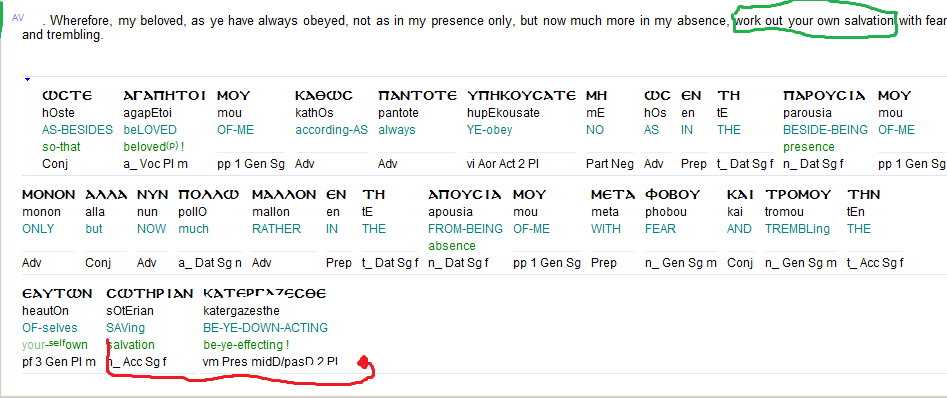
Brother, would you allow for synergism after our initial salvation since Scripture gives us plenty of imperatives that call for an active response from those already in Christ. Utley points directly to this when he notes that the command work out your salvation uses a present middle imperative plural which carries the force of ongoing communal obedience.
He explains that Paul is not speaking of earning eternal salvation but of bringing the believer’s relationship with Christ to full mature expression since salvation in this context speaks of wholeness and lived out obedience.
He shows that the tension between God’s sovereign working in the believer and the believer’s responsibility is intentional because Paul places divine enabling in verse thirteen right beside the human command in verse twelve. The plural forms make clear that the charge is corporate and directed to the entire Philippian church and not to an isolated individualistic spirituality.
Utley stresses that believers do not work for salvation but work from salvation since God initiates by grace and the church responds in costly, repentant, continuous faith that expresses the life of Christ in real conduct. This is why Paul can command them to live out what God has already planted within them since divine action and human participation operate together in the ongoing growth of the redeemed community.
A. συνεργέω occurrences meaning to work together or to cooperate
~Romans 8:28
συνεργεῖ is present active indicative third singular of συνεργέω meaning is working together. Paul declares that all things are working together under God’s sovereign hand for the good of those who love Him which places divine orchestration, human love for God, and purposeful outcomes in one coordinated action.
~1 Corinthians 16:16
συνεργοῦντι is present active participle dative singular of συνεργέω meaning the one who is working together. Paul directs the church to submit to men who are laboring together with him which shows cooperative ministry within the body.
~2 Corinthians 6:1
συνεργοῦντες is present active participle nominative plural of συνεργέω meaning working together. Paul and his team identify themselves as working together with God in the ministry of reconciliation which shows apostolic cooperation with the divine initiative.
~James 2:22
συνηργεῖ is imperfect active indicative third singular of συνεργέω meaning was working together. James states that Abraham’s faith was working together with his works meaning faith and works cooperated in producing a completed faith.
B. συνεργός occurrences meaning coworker or fellow laborer
~Romans 16:3
συνεργούς is accusative plural meaning fellow workers. Paul calls Priscilla and Aquila his fellow workers in Christ Jesus.
~Romans 16:9
συνεργός is nominative singular meaning a coworker. Urbanus is named as a coworker in Christ.
~2 Corinthians 1:24
συνεργοί is nominative plural meaning coworkers. Paul says the apostles are coworkers for the joy of the church.
~2 Corinthians 8:23
συνεργός is nominative singular meaning coworker. Titus is described as a coworker of Paul.
~Philippians 2:25
συνεργός is nominative singular meaning coworker. Epaphroditus is Paul’s coworker in the ministry.
~Philippians 4:3
συνεργῶν is present active participle nominative plural meaning those working together. Clement and other unnamed believers are coworkers whose names are in the book of life.
~Colossians 4:11
συνεργοί is nominative plural meaning coworkers. Several Jewish believers are described as fellow workers for the kingdom of God.
~1 Thessalonians 3:2
συνεργόν is accusative singular meaning coworker. Timothy is Paul’s coworker in the gospel.
~Philemon 1:1
συνεργῷ is dative singular meaning a coworker. Philemon is described as Paul’s coworker.
~Philemon 1:24
συνεργοί is nominative plural meaning coworkers. Mark, Aristarchus, Demas, and Luke are Paul’s coworkers.
~3 John 8
συνεργοί is nominative plural meaning coworkers. John teaches that those who support faithful teachers become coworkers for the truth.
The noun συνεργία appears zero times, but the New Testament is filled with συνεργέω and συνεργός forms that describe believers as cooperating, working together, laboring alongside apostolic authority, and engaging with God’s purposes. The verbs are real, the morphology is clear, and the theological pattern is consistent which is why the early church never framed salvation as a passive warehouse but as a living participation in what God is doing.
Not one of these texts supports passive determinism. Every one of them joins divine initiative with human participation in real time.
SPECIAL TOPIC: EASTERN LITERATURE**
J.