What Would Martin Luther Say to “Free Will”?

Pastor @PeterC

…you’ve misunderstood the nature of biblical context. The Old Testament isn’t an external framework that I’m imposing on the New Testament. It is the inspired framework the New Testament authors themselves assume. That’s not “forcing a grid,” it’s following the apostles’ hermeneutic.

Paul didn’t write Romans into a vacuum. Romans is saturated with the Old Testament. Nearly every major argument he makes is grounded in Genesis, Exodus, Deuteronomy, Isaiah, the Psalms, Hosea, Habakkuk, Jeremiah, and Malachi. If you ignore that covenantal and redemptive-historical background, you aren’t letting Romans speak for itself, you’re divorcing Paul’s words from the Scriptures that shaped his thinking.

The irony is that you appeal to the “plain meaning” while detaching Paul’s argument from the very context he repeatedly cites. Context doesn’t begin at Romans 1:1. It begins with the Scriptures Paul assumes his readers know. The New Testament consistently interprets the Old Testament, and the Old Testament provides the categories through which the New Testament is understood. Augustine said it well: “The New Testament lies hidden in the Old, and the Old Testament is unveiled in the New.”

Finally, “sometimes what it says is what it means” is not a hermeneutic, it’s a slogan. The question is not what appears plain to a modern English reader, but what Paul intended to communicate to his first-century audience. That requires literary context, historical context, grammatical analysis, and the Old Testament Scriptures Paul constantly appeals to. Ignoring those is not grammatical-historical interpretation, it’s proof-texting.

I would like you to study Utley on sound, biblical hermeneutics.
The Big Mistake Christians Make About Belief.

By Dr. Bob Utley, retired professor of hermeneutics (Biblical interpretation)

TABLE OF CONTENTS

Abbreviations Used in This Commentary

A Word From the Author: How Can This Commentary Help You?

A Guide to Good Bible Reading: A Personal Search for Verifiable Truth

Commentary:

Introduction to Romans

Romans 1 Romans 6 Romans 12
Romans 2 Romans 7 Romans 13
Romans 3 Romans 8 Romans 14
Romans 4 Romans 9 Romans 15
Romans 5 Romans 10 Romans 16
Romans 11
Appendices:

Brief Definitions of Greek Grammatical Structure

Textual Criticism

Glossary

Doctrinal Statement

This might help you to be like a Berean.

Shalom.

J.

Utley writes…

The study of each of these areas becomes the object of our study of a passage. Before I explain my methodology for good Bible reading, let me delineate some of the inappropriate methods being used today that have caused so much diversity of interpretation, and that consequently should be avoided:

II. Inappropriate Methods

Ignoring the literary context of the books of the Bible and using every sentence, clause, or even individual words as statements of truth unrelated to the author’s intent or the larger context. This is often called "proof-texting.”
Ignoring the historical setting of the books by substituting a supposed historical setting that has little or no support from the text itself.
Ignoring the historical setting of the books and reading it as the morning hometown newspaper written primarily to modern individual Christians.
Ignoring the historical setting of the books by allegorizing the text into a philosophical/theological message totally unrelated to the first hearers and the original author’s intent.
Ignoring the original message by substituting one’s own system of theology, pet doctrine, or contemporary issue unrelated to the original author’s purpose and stated message. This phenomenon often follows the initial reading of the Bible as a means of establishing a speaker’s authority. This is often referred to as "reader response” ("what-the-text-means-to-me” interpretation).

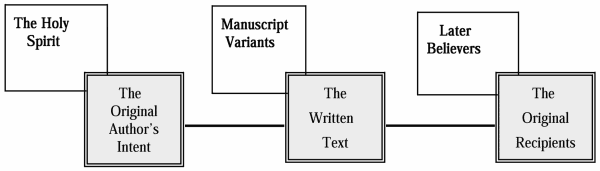
At least three related components may be found in all written human communication:
Free Bible Commentaries by Dr. Bob Utley, Professor of Hermeneutics

Free Bible Commentaries by Dr. Bob Utley, Professor of Hermeneutics

My methodology focuses initially on the reader allowing the HolySpirit to illumine the Bible through four personal reading cycles. This makes the Spirit, the text and the reader primary, not secondary. This also protects the reader from being unduly influenced by commentators. I have heard it said: "The Bible throws a lot of light on commentaries.” This is not meant to be a depreciating comment about study aids, but rather a plea for an appropriate timing for their use.
We must be able to support our interpretations from the text itself. Five areas provide at least limited verification:

historical setting
literary context
grammatical structures (syntax)
contemporary word usage
relevant parallel passages
genre
We need to be able to provide the reasons and logic behind our interpretations. The Bible is our only source for faith and practice. Sadly, Christians often disagree about what it teaches or affirms. The four reading cycles are designed to provide the following interpretive insights:

The first reading cycle
Read the book in a single sitting. Read it again in a different translation, hopefully from a different translation theory
(1) word-for-word (NKJV, NASB, NRSV)
(2) dynamic equivalent (TEV, JB)
(3) paraphrase (Living Bible, Amplified Bible)
Look for the central purpose of the entire writing. Identify its theme.
Isolate (if possible) a literary unit, a chapter, a paragraph or a sentence which clearly expresses this central purpose or theme.
Identify the predominant literary genre
(1) Old Testament
a) Hebrew narrative
b) Hebrew poetry (wisdom literature, psalm)
c) Hebrew prophecy (prose, poetry)
d) Law codes
(2) New Testament
a) Narratives (Gospels, Acts)
b) Parables (Gospels)
c) Letters/epistles
d) Apocalyptic literature
https://www.freebiblecommentary.org/HTML_Common/good_bible_reading.htm#:~:text=A%20PERSONAL%20SEARCH%20FOR%20VERIFIABLE%20TRUTH

Sound, biblical hermeneutics is what matters. And since you seem intent on applying labels, it’s worth noting that Bob Utley is Arminian, not Reformed. I don’t let Calvin do my Bible study for me. I seek to let Scripture speak for itself through careful exegesis under the illuminating work of the Ruach HaKodesh. Simply stringing together isolated proof texts without regard for their literary, historical, and redemptive context is not sound biblical interpretation.

Shalom.

J.

Pastor @PeterC

…you’ve misunderstood the nature of biblical context. The Old Testament isn’t an external framework that I’m imposing on the New Testament. It is the inspired framework the New Testament authors themselves assume. That’s not “forcing a grid,” it’s following the apostles’ hermeneutic.

Paul didn’t write Romans into a vacuum. Romans is saturated with the Old Testament. Nearly every major argument he makes is grounded in Genesis, Exodus, Deuteronomy, Isaiah, the Psalms, Hosea, Habakkuk, Jeremiah, and Malachi. If you ignore that covenantal and redemptive-historical background, you aren’t letting Romans speak for itself, you’re divorcing Paul’s words from the Scriptures that shaped his thinking.

The irony is that you appeal to the “plain meaning” while detaching Paul’s argument from the very context he repeatedly cites. Context doesn’t begin at Romans 1:1. It begins with the Scriptures Paul assumes his readers know. The New Testament consistently interprets the Old Testament, and the Old Testament provides the categories through which the New Testament is understood. Augustine said it well: “The New Testament lies hidden in the Old, and the Old Testament is unveiled in the New.”

Finally, “sometimes what it says is what it means” is not a hermeneutic, it’s a slogan. The question is not what appears plain to a modern English reader, but what Paul intended to communicate to his first-century audience. That requires literary context, historical context, grammatical analysis, and the Old Testament Scriptures Paul constantly appeals to. Ignoring those is not grammatical-historical interpretation, it’s proof-texting.

I would like you to study Utley on sound, biblical hermeneutics.

The Big Mistake Christians Make About Belief.

1 Like

There are a lot of things i can say and reply in regards to your thoughtful post. But I don’t have the time for that. In general you will see what you do. And I will see what I do. So I’m trying to select perhaps the best core distinctions where even if discussion in their regards don’t go much anywhere, at least, in my mind, they would be the most helpful things to consider over time. Perhaps over the rest. Not that they are greater. Just that they may be lower hanging fruit routes to discoveries perhaps later on.

I don’t look at the disciples and free will to understand God’s insights generally in any text. The main difference is I see John 6 as transition from Father to Son language (as had occurred on the pages of time). So i see quite a bit of our differences summed up in “I see this as obvious transition.” You see it as evidence of a deeper revelatory arc of how God saves theologically. In general, to me, I have come to a place where what the reformed perspective seems to have become, in my estimation, is a making of the same mistake Israel did about them being chosen and Abraham’s descendants. Only now the church is doing that in our own way.

To me, this is a severe point. Where we will differ. This may sound odd, but the connection in similarity i would see is: The coopting redefining of chosen and elect to imply a meaning where we have a class of those God awards salvation to (like the Jews thought it came by heritage) and a class He has not (the way Israel would have seen the “dogs” outside–as not worthy). Jonah highlights this attitude of the Jews to just be ok with them being the chosen and not wanting God to forgive their enemies. I don’t think the reformed take is a matter of unforgiveness perhaps like the Jews of old. But rather plays toward interpreting God’s character as favoring their/our class.

I understand what is going on theologically is quite different. But at the end of the day it looks like the same mistake, different clothes. If it is, I mean a lot of this came from Augustine and Calvin (two mere men who were not prophets). So in a sense, it seems to be the quintessential fleshy understanding of the word made to look like revelation.

. . . . .

As we discover historically, the Jews as a race remained in stubborn unbelief. Stephen even tried to help them see so long even after. And ultimately they lost their temple and their country. And are still thousands of years later under partial hardening. As apposed to what though? Gentile total depravity? If depravity is true in inability, what does it matter than anyone is partially hardened? How can "completely hardened via totally depraved minds then be on top of that also partially hardened? Hardening only becomes “a thing” if they can believe anyway. Philosophically the system perpetuates far more mystery, to me, than exegesis. In any event, this long standing condition of Israel rejecting their Lord and remaining in unbelief explains the sense of grammatical use of ongoing.

I’m not aware that he does. But being a fallible man its possible. To me its obvious that God has to reveal His intimate things to us because we are fallen. I see as you that both are true. i believe though you might rubric that under: compatibilism. Where I would just see:

  • on one hand – people are sinful and can harden in their ways and get judged for it
  • on the other hand – the only way to see the profound things of God is if His spirit reveals it

Why I may not think Leighton does not dismiss God’s revelation (in context of your point) is this:

  • God already acted by sending His son and the canon of His word

This is revelation. And God already has moved. Blessings.

Thanks Peter. I love this. You stated something about how the “goal post,” I believe is how Leighton puts it, is constantly moving. We see this radically in James White as a rule. But I don’t think the things you pointed out so well articulated is unique to Johann. I believe it is a generic operating system handed down.

So I will give an example with a reformed friend of mine. I realize this friend has a lot of issues. So i don’t see him as the poster child for the reformed thought. But what i do see is the Jmac operating system invading his soul like Invasion of the Body Snatchers. Like he is becoming a pod person version of himself over time. Creepy.

So i asked him why he asked me why i don’t just submit to the leadership of his church. But not as a genuine question…but as a “You should be like me and submit…what is wrong with you,” kind of way. He realized he overreached but could not disclose that. Instead he said: “I’m not your experiment.” And told me because I don’t trust him we are done as friends. THEN…

Once he hung up on me, he left several voicemails. His rubric is not “to understand” but to be heard. So i texted him saying that we should have a conversation. But I was too much over the “sober discussion target.” He could not allow that. But wanted me to listen to an hour’s worth of voicemail lecture. And when i texted him telling him what i thought he was doing, he blocked me. SO THAT, he could still leave voicemail letting me know how i should see the world.

. . . . .

In no way do I see Johann like this…lol. God forbid. He is very genuine in conversation. And i have seen him work hard at discussion. Which is a total virtue. But what you have noted about what I see as an operating system of sorts, to me, is a much much much lighter (and even more civil) version of embedding obfuscation. I don’t think Johann intends anything of the sort. And it is of great blessing that you guys have such great discourse. But i think what my friend is really immature. I don’t see Johann that way at all. But i do see Jmac’s ministry as what I have described to some of what happens when 3rd graders get master’s degrees. The operating system there in many ways was “We want leverage that God gave us. If you don’t want us to have that leverage, then you are not trusting God with us.” This is true. i did not. And in some ways, even so, I totally believe i should have because of God being more important than what they do or did with it. But the operating system was similar. One of operational leverage. Like my friend, at the 1st grade level tries to emulate. lol.

To be clear @Johann, I am not saying you are like my friend. Or even like the Jmac ministry. You are your own person. And from what i can tell, an upstanding one for sure. But what Peter noted here is something i have wanted to say too to you. But did not have energy or time. I will read your reply to him. And i think you are of mature character where he and are just 2 random men who see similarly. Nothing more. Blessings. :heart:

What Kevin Thompson of Beyond the Fundamentals would call this is something like how God needs the help of reformed scholars to help Him say what He is saying. I know this would not be how you would consider to process at all brother. But, to me, its kind of true.

While at Jmac’s church i was involved with a ministry called Hope Bible Study. It was their version of 12-step. In the past I had radical drug issues. But i’ve been sober for 2 decades. I just like to be at church. So i would go. I asked the pastor of that ministry or something or shared, I don’t recall. He did not like the observation. I don’t believe it was too off at all. But honestly don’t remember. His reply was: My question/statement was an example of when the devil asked Eve, “hath God said?”

So I would say that trying to explain why the plain meaning of what God is saying is not a hermeneutic makes sense to some. I would tend to see that as a 12-step issue needing recovery from. Not so much because what you say is inaccurate. For sure we can dumb things down and eisegete all over the place. And that is in style today for sure. So amen to that. But this reminds me of one of the main reasons I got kind of tired of the reformed approach. It would seem a systematic has taken the voice of His spirit. And the potential of that being a thing kind of stopped me dead in my tracks to weigh carefully. When i did, and honestly did. I think the authority in the word of God to be permitted and allowed to gain context from immediate context is God’s peragative no man has the right to suggest God wait in line while the systematic bus is passing. The one, you know, He ordained? lol. I meant to sound silly there. Just kind of playing around. But God has the right for His word to mean immediate context when that is obvious.

I liken systematic theology to Europe. The governing of many countries from unelected bureaucrats. I think there is a place for systematics. Amen. And i still think there is a lot of learn from the reformed perspective that is blessed. But I use the analogy because I have honestly weighed both sides. Painstakingly with my own life. And although a life does not = good hermeneutics, i believe i have seen enough ripe and helpful alternative views so as to place reformed thought in high suspicion. And I say this while realizing much of my own life choices were my own demise for having not cooperated with what God was doing even in a punch drunk church operation. I even still ask God to show me these things. Where I can thaw out from defensiveness to just see the pure precious milk of His goodness and what His intentions toward me have been. Blessings.

I’m well aware of Thompson’s Beyond the Fundamentals, and I’ve listened to most of his rebuttals. The issue, as I see it, is that both you and Peter seem to rely heavily on analogies rather than engaging in careful exegesis of the biblical text. No offense intended, but analogies can illustrate a point, they cannot establish doctrine. Scripture, interpreted in its literary, historical, and grammatical context, must remain our final authority.

..both of you seem more intent on attacking Calvin or the Reformed position, while all I’m doing is presenting the Scriptures and letting the text speak for itself. From the very first post, neither you nor Peter has actually explained or exegeted the passages I’ve presented. Instead, the discussion keeps shifting to analogies, labels, and lists of proof texts. It also seems you’ve found a renewed enthusiasm in aligning with Peter over his “choosing” passages. I don’t think that’s a helpful direction. Let’s get back to careful exegesis of the text rather than debating theological camps.

So far, all I get is…

Moving the goalposts - You answer an objection, but instead of acknowledging it, they raise a new objection or demand a different standard.
Red herring - Diverting the discussion to a different issue instead of addressing the original argument.
Straw man - Misrepresenting your position to make it easier to attack.
Proof-texting - Quoting isolated verses without engaging their context or your exegesis.
Gish gallop - Overwhelming the discussion with a long list of verses or claims rather than addressing one argument carefully.
Begging the question - Assuming the very point that needs to be proved.

Shalom bro.

J.

From Beyond the Fundamentals…

Local Church Resolution

Situation: Calvinism is being intentionally spread by unannounced infiltration into non-Calvinist churches. This is orchestrated by seminaries, professors, associational missionaries, denominational leaders, convention leaders, fellow pastors, and influencers in fellowships and other types of official and unofficial affiliations. The orchestration side has been witnessed first-hand, and countless church members testify of hostile infiltrating take-overs from Calvinist leaders who do not announce their doctrinal stance until after they are firmly established in their positions. This has been the cause of much heartache and despair and has resulted in split churches and split families. Most concerning, this has resulted in churches losing their focus on reaching the lost due to being distracted by deception, heartache, and false doctrine from within.

This resolution is intended to have the dual purpose of
Preventing Calvinist infiltration in the local church
Educate members and raise awareness of what is relevant to suspected infiltration

We, the members of this Local church resolve the following:

Whereas Calvinism is a seductive deception of false doctrine and practice, we resolve to forbid adherence to this system in any of our leaders or officers.

Whereas Calvinism is propagated by deceitful and clandestine methods, we resolve to remain alert of its presence, understanding that it will be hidden behind various alternative labels and clever semantic phrases which patronize the good senses of Christians in general (Romans 16:17-18).

Whereas Calvinist infiltrators tend to conceal their affiliation with Calvinism, persons shall be deemed unfit for office or leadership of any kind who do not voluntarily, vehemently and articulately oppose the system of Calvinism. There is no toleration for any sympathy toward Calvinism or for any “leaning” toward Calvinism to any degree with regard to church officers and leaders.

…“Calvin infiltrators”..“Slick, slippery and desceptive”.but you agree with your tutor, correct @TCC?

J.

1 Like

But this is the problem brother. If there is no world where you can see that “your view” with systematic does not = the plain text. It does when you look at it. It doesn’t when we do because God forbid Jello fell out of my pocket and formed a chalk outline of burning man on the floor somehow…as some lame attempt at an analogy. I realize you mean no insult brother. But right there is the problem. Peter and I can’t be looking at the text even though we share it ALL THE TIME. A masterful plan is it not…lol. It kind of gives me goose bumps.

I would challenge you to consider what if Romans 9 was about Israel losing their temple and their country. I don’t think it is possible. In order to do that you would need a brain transplant. i can’t have a different view than yours and it not be some form of fallacy because you see Romans 9 from systematics that make sense and have stood the test of scholarly time. One thing i liked about Leighton when i watched him a lot is his rabbit/duck comparison of passage like found in Eph 1. One sees 1 picture. Another sees a different one. Pareidolia, I think they call it.

For me when i was able to finally see how Jewish Romans was (having all this time thought because it is called Romans and because Paul was an apostle to the gentiles) it had to be more about “a blend” of concepts leaning church-age"y" ward. But when i saw the enormous Old Testament references, i came to believe this book was God’s official treaty to confirm Israel (what the whole bible kind of focus on for centuries–thousands of years), poof…was gone.

“Yeah but that is not as big of an issue as what “salvation” really means. So what. They came and went. Now its the church. God is sovereign.” I just think in terms of general humane and philosophical arenas, to miss the Romans connection to the most massive upheaval in religious herstory is willful blindness i believe. I don’t think it is so willful because i would see the West pretty infected to not see it.

So one way that might be fun to think about this is if my leanings of Israel in Romans is correct, there is a super high possibility that Israel will before our eyes gain massive power and status via US supercharging…but yeah even likely beyond. And that the mid terms place Trump in Emperor status. So that is my wager. It may be wrong. I am a cessationist. So it could be way silly stupid wrong. But if things go down like that before our eyes, i don’t think it could be easily said, “Yeah that means the dispensational view is more weighty than the reformed.” But since we both dabble in pulling rabbits and ducks out of hats, my friend once told me what he saw in Eph 1 was a rhino. So, yeah, this would be, “my” rhino. lol. Blessings.

One observation from listening to his material is that his ministry has broadened over time. It began largely as a critique of Calvinism, but it now emphasizes epistemology, psychology, philosophy, and “sense-making” alongside biblical teaching. His own biography says that after rejecting Calvinism, he later shifted his focus toward understanding how people think, how deception works, and how to cultivate wisdom, which explains why his recent content often contains lengthy discussions of philosophy and cognitive frameworks rather than verse-by-verse exposition.

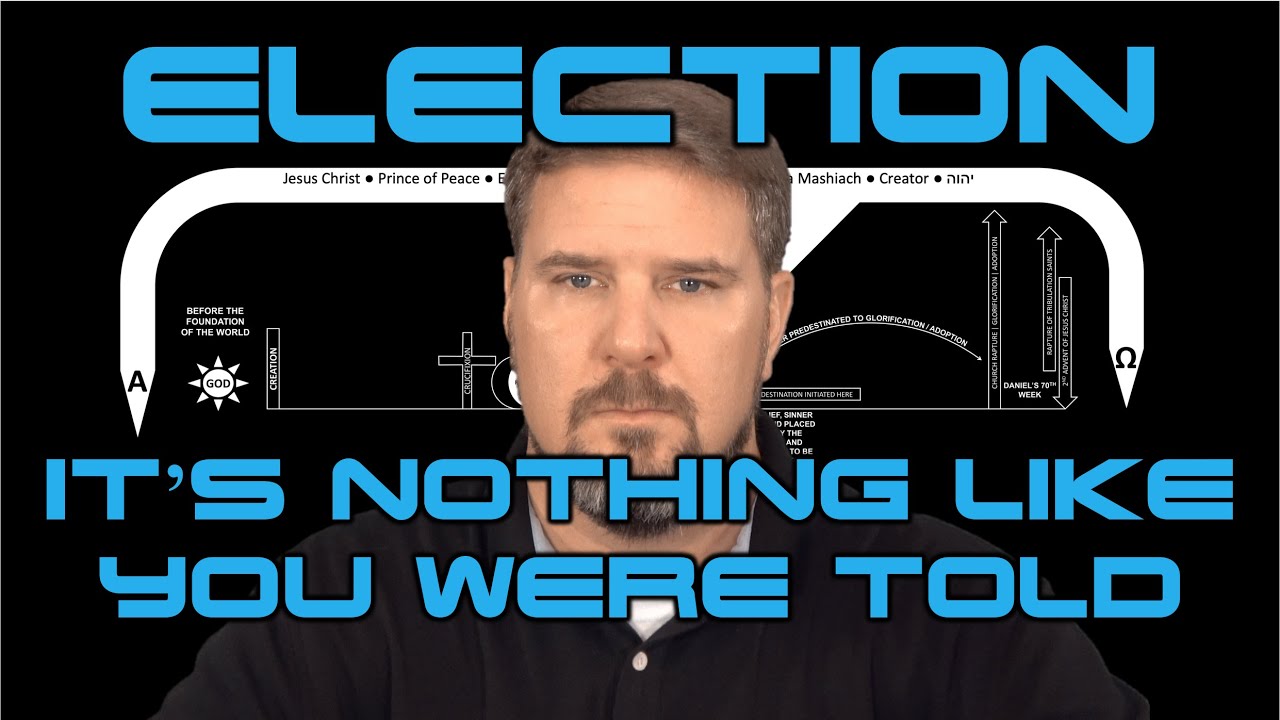
Your Thomson Beyond the Fundamentals Tutor says election is not unto salvation @TCC, is he correct? He is also against Arminianism, probably more a Provisionist?

Just to show you I’m not biased, and for the readers sake. Again, election NOT unto salvation? >>>Only for service?<<<

He also committed a straw man, or more accurately, made a false claim by saying, “Calvinists believe the elect were already in Christ before the foundation of the world.” No mainstream Reformed theologian teaches that. Calvinists teach that believers were chosen in Christ before the foundation of the world (Eph. 1:4), not that they already existed or were already united to Christ before creation. Those are two very different claims.

Let’s see if you can hold a conversation since “Calvinists are infiltrators”

Again, here is Dr. Utley, an Arminian, saying this…again, I’m not biased…

Opening Statement
Election is a wonderful doctrine. However, it is not a call to favoritism, but a call to be a channel, a tool, or means of others’ redemption! In the Old Testament the term was used primarily for service; in the New Testament it is used primarily for salvation which issues in service. See that @TCC? Diametrically opposed to your Tutor and what He is saying.
Logos N’ all…

The Bible never reconciles the seeming contradiction between God’s sovereignty and mankind’s free will, but affirms them both! A good example of the biblical tension would be Romans 9 on God’s sovereign choice and Romans 10 on mankind’s necessary response (cf. Rom. 10:11,13; also note Phil. 2:12-13).
Election/Predestination and the Need for a Theological Balance.

So let me press you for an answer. Using your own sources and teachers, let’s set the labels aside for a moment. My purpose in starting this thread was never to debate Calvinism versus Arminianism, but to ask a much simpler question: What do the Scriptures actually teach about free will?

J.

This isn’t about seeing “ducks or rabbits.” It’s about exegesis. Romans 9 isn’t an inkblot where every interpretation is equally valid. Paul builds his argument from the Old Testament, traces God’s sovereign choice through Isaac, Jacob, Pharaoh, and the potter and clay, and then applies it to mercy and hardening. If you think that exegesis is wrong, show from the text where it fails. Appealing to perception or psychology doesn’t answer Paul’s argument.

I agree that Romans is thoroughly Jewish and saturated with the Old Testament. But that doesn’t mean its purpose is simply to declare that Israel is “gone.” Paul spends three entire chapters (Romans 9–11) explaining God’s continuing purpose for Israel while also unfolding His saving plan for both Jews and Gentiles. The Old Testament background doesn’t eliminate the Church or redefine the gospel, it provides the framework for understanding both.

No one is denying the historical significance of Israel or the upheaval surrounding the first century. The question is whether that historical backdrop determines the meaning of every passage in Romans. History provides context, but context must serve the text, not replace it. Paul’s primary concern is the gospel, God’s righteousness, justification by faith, and His sovereign purposes in salvation. Those themes are unfolded through Israel’s history, not reduced to it.

Appreciate the humor, but biblical interpretation can’t rest on wagers about current events or political predictions. Whether Israel gains influence or not doesn’t determine the meaning of Romans. Exegesis must drive our theology, not headlines. Let’s keep the discussion anchored in what Paul actually wrote, not in speculative scenarios or “rhinos” we think we see.

J.

I ended up on one of Kevin’s videos once. It was about 2.5 years ago.

Background: I always liked Kevin since around 2017. I liked his brass knuckles no nonsense approach because it seemed rare (outside of fundamentalist groups that dogged Calvinism…like Steven Anderson…but those folks have too many issue to take seriously). I liked Kevin because he was a fun version of brash. Although I did not align with his hyper dispensational views, I did find his concerns with Calvinism helpful. Not nearly as much as Leighton, but I believe i came across Kevn a short while just before finding Leighton.

LATER ON Kevin started to shift from evangelicalism to something else. He often invited on his channel a man named Seraphin, who was Eastern Orthodox. I did not like nor trust that guy. So it was sad to watch Kevin have him as his tutor. Kevin did listen to some pushback from his leaning toward Kabala and other non-sense. He’d have another guy, George, on. Who was from a far more sound Orthodox position (I think Greek if not mistake) aligning much more with evangelical views–at least as expressed. I reached out to George and encouraged him to pursue Kevin. George was already on that route. But Kevin can stonewall like anyone might. So Kevin did a couple of podcasts discussing things with George. But Kevin never seemed to change his dissolving from the evangelical perspective.

. . . . .

So I sent Kevin a 5 paragraph post sharing my concerns. And he actually made a video about it. Reading the whole thing and critiquing. My concern was mainly of his dismissing biblical truth claims the bible makes as the transformational power of God “included” in the actual text of scripture. Concepts like: The power of God in the gospel.

What Kevin did is align me with a moralist and told me to shut up and just be about growing in the background. I happen to agree with Kevin on his sentiments of placing so much value on propositions (reducing life to argument). But his critique of me actually committed the fallacy he accused me of being about, I believe. I was sharing a concern. He used that to propositionally show me where I was wrong to trust in the sincere claims of the gospel. Pretty friggen ironic…lol.

It was at that point I tried to follow up with where I thought our differences were. But he shut me down and deleted my comments. To which I still replied: “I appreciate your ministry Kevin, and want you to know I just purchased your excel sheet on “chosen” use throughout scripture for $15 from Etsy.” He gave that comment a heart…lol. So I kind of see Kevin somewhat like I do with the reformed perspective. He has some good things to offer, but the platform is off. Although I am encourage by his pioneering spirit.

. . . . .

As far as his concern of Calvinist takeover, yeah. I agree. This is a concern. Leighton was involved in one of them while he was a Calvinist. Its the neo-crusades. This would be one fine example of the church making the same mistake Israel did in claiming their own human thoughts about religion and God something to be owned by them. Which is how I see Calvinism. As i explained before. I hope this helps answer your question. Can I ask why you are asking? Blessings.

Nothing in particular… but with respect, that’s all anecdotal. Whether Kevin was right or wrong, who he interviewed, who he blocked, or how he treated people has no bearing on whether Calvinism is biblically true or false.

I’m not interested in Kevin, Leighton, or Beyond the Fundamentals. I’m interested in what the text actually says. Let’s leave personalities aside and open the Greek and Hebrew Scriptures.

Truth isn’t determined by podcasts, YouTube channels, or personal experiences. It’s determined by faithful exegesis.

J.

No. He and Leighton did i believe 2 video’s together. When they were on together, they did very well. Afterward though Kevin would peg provisionism as an ideology. The same as Calvinism. And he would sometimes say some pretty edgy things about providsionism. Even so, Leighton would come on to do a third podcast with him where Leighton understood why Kevin would dog provisionism. And like an adult in the room, understood it as part of where Kevin was at as a person. And just worked with where they could agree. Which to me far more expresses the right heart example framing of provisionism more than Kevins world view helps him be more gracious. Although I think he has become less hostile over the years.

I realize it is a temptation to peg me with Kevin as my mentor…lol. But this is the problem as I see it. Calvin is man describing how not to be man centered. Yet by so doing kind of creating a man centered cult. Presuming to own the sovereignty of God. I find that sad. And although I think there have been some pretty awesome things said and done over the centuries by a host of Calvinists (and I find value and edification in all of that), I don’t think Calvinist realize just how man centered their theology is.

I don’t just go by what a man says. I like Bob. And think his view on the wedding invitation parable was very helpful to me. But to me Bob suffers from reformed ideology of the West to see election about Salvation in the New Testament. I don’t agree. There could be overtures in that direction. But for the most part, the doctrine of election, as I have come to understand it, is man centered because it is man perceptive overlay onto scripture.

So remember…lol…you are asking “me.” So I doubt this will satisfy. Because I have my divergent views. And i am comfortable knowing that. I don’t know what your view would be on “Presuppositional Apologetics.” Although i like and agree that the bible is written from the standpoint of “God is” unapologetically (pun intended), I would see this tool in the hands of man to be almost mad scientist like. Owning for ourselves what we might presume about God is the concern there, I believe.

However, having said that, I believe the premise and feature of the “God is” approach to scripture writing is passed on to His creation in His image. Not that we are little gods. But in the sense of it matter of fact being from the Father unto us. So i see free will as presuppositionally His children bearing that quality. I believe that God genuinely allows people to not choose Him. I believe there are times God will use our bad faith for His good gesture. Sometimes they overlap. I think Leightons (I’m sick of analogies) take on the “the cop sting” is close to how I would view God’s sovereignty and human will. To cut the chase and not be too overly wordy. Blessings.

Interesting. Kevin charges people for material that is readily available in any decent free Bible software. You can search elect, election, chosen, and their Greek cognates yourself. If you simply examine the passages in their literary context, you’ll find that election in the New Testament is repeatedly unto salvation. I could give you five clear examples right now, but I suspect it would be a futile exercise if we’re unwilling to let the text speak for itself.

I can’t help but wonder whether you spend more time listening to Kevin and Beyond the Fundamentals than actually studying the Scriptures yourself.

What puzzles me is paying for a study on “chosen,” “elect,” and “election,” only to arrive at a conclusion that, in my view, the biblical text simply does not support.

Of course, each of us must ultimately be judged by how faithfully we handle God’s Word, not by the teachers we follow.

Shalom.

J.

When Leighton did a debate with White about Roman’s 9, there will never be enough to satisfy White. And the president of the ministry defending White against Leighton with murder in his eyes and expression. Because they want to be the tutor and have tutor control. You know, like their daddy. I would just defer to the Romans 9 debate for that answer.

I don’t see Romans 9 as much about His sovereign choice (or continuity of sovereignty in doctrines of grace) as it is about Christ. So yes I would see the doctrine of election as man’s power of thought, psychology, and philosophy in contrast to “the Man” Jesus Christ. The reason for Romans 9 is to demonstrate how God’s divine promises have not be overturned despite His dissolving Israel from their orator post. But the focus of import is lineage more than His sovereign rite. Although certainly from chapter 3 we can see there are things about His sovereign rite, amen. I don’t think God is as fixated as Calvinists would like Him to be on that. To me, Calvinism has God as a narcissist. What God is showing in Romans is that God is demonstrating His sovereign choice of lineage to be given His Son. And that God’s sovereign choice of His Son over Isreal does not mean God changed anything or that things have shifted so much that God is scrambling for a new plan.

. . . . .

More than a salutation:

Chapter 1

**2 **which He promised beforehand through His prophets in the holy Scriptures, **3 **concerning His Son, who was born of a [b]descendant of David according to the flesh, **4 **who was declared the Son of God with power according to the [c]Spirit of holiness [d]by the resurrection from the dead, Jesus Christ our Lord,

Paul does not open with election but Christ and promise…tone setter.

Chapter 9

**4 **who are Israelites, to whom belongs the adoption as sons and daughters, the glory, the covenants, the giving of the Law, the temple service, and the promises; **5 **whose are the fathers, and from whom is the [b]Christ according to the flesh, who is over all, God blessed [c]forever. Amen.

Romans 15:8

“For I say that Christ became a servant to the circumcision on behalf of the truth of God, to confirm the promises given to the fathers.

. . . . .

Woven throughout. You see man’s theology of His sovereignty (God’s not mans). I see Christ. The promise. The potters promise.

I have repeatedly said that this thread is about free will. Peter has already opened a separate thread on Romans, yet you’ve conveniently skipped the passages that deal directly and explicitly with election, the elect, chosen, and their related terms.

If you want to debate Romans 11, then please do so on Peter’s thread, not here. This thread is about free will, not Romans 11.

You seem to regard election as a man-made theological construct, yet the language of election is woven throughout both the Old and New Testaments. If you want to challenge that doctrine, then engage the passages that actually use the biblical terms rather than changing the subject.

Debate Peter on his thread, brother. Let’s keep this one on topic.

And…

You really should invest in a good Bible software package where you can search the Hebrew and Greek Scriptures for yourself and add the lexical and commentary modules you find helpful.

Also, please stop attacking Calvin as though I were a follower of Calvin. I follow Christ and submit my theology to Scripture, not to any man. Misrepresenting my position is bearing false witness.

“You shall not bear false witness against your neighbor.” (Exodus 20:16; Hebrew: לֹא־תַעֲנֶה בְרֵעֲךָ עֵד שָׁקֶר)

“Therefore, having put away falsehood, let each one of you speak the truth with his neighbor.” (Ephesians 4:25; Greek: ἀποθέμενοι τὸ ψεῦδος, “having put away falsehood”)

“The one who states his case first seems right, until the other comes and examines him.” (Proverbs 18:17)

If you want to critique my position, then critique my exegesis, not a caricature of Calvinism. Show me from the Hebrew and Greek texts where my interpretation is wrong. That’s a discussion worth having.

J.

So this would be a different side of the same problematic coin I believe Peter pointed out. Notice how you asked about Thompson. But before hearing my answer you pegged me as having him as my tutor. In order to prove his error. Your interest is clearly to win and be heard more than understand. You leave the human dignity element on the side of road of argument.

I shared with you how I don’t make Kevin my mentor. And instead of humanely acknowledge that you point to how whatever Kevin thinks or does not think is not the issue. It is the issue when it serves to clock me over the head with “before hearing an answer from my heart.” Then after the “dirty little deed” hehe, you wipe your mouth and put your fork down and say, “Now lets not make this about men.” You certainly don’t. For my person is not in the same room with you. For there is no room for me and your argument.

Where I would agree with Kevin is the ideological interest to win an argument as problematic. We live in desperately wicked times, but I am proud of our era for recognizing that conversation is better than debate. For it tends to allow things to come to the surface that are otherwise hiding in the wings under the assertive tutelage of our sense upon argument would not permit to see the light of day.

So I think what Peter pointed out earlier is you tend to operate from a place of an operating system programmed to win. Like a pocket full of debate tricks. We can do this all day long Johann. But I still believe what is more important than what you label exegesis…is the scary place to discuss things as two grown men coming from two very different places. I’m not sure you have that in you. Although i have seen promise of it. You tend to allow ideology to manhandle your choices of expression. As far as I can tell.

. . . . .

Again, from earlier statements of mine, I think you posses the qualities of humanity that could actually bring a lot of edification into my life. Probably Peter’s too. But Peter is a pastor already well established sober and rounded. Whereas I am a trainwreck of a person by comparison. It has been bestowed on you by God on high to have measure of edification toward helping this poor broken soul…lol. I have seen you can. And i would just encourage wherever you might find that place in heart…to consider that is probably the Spirit of God. Blessings.

Since you’ve described yourself as a “trainwreck,” my encouragement would be this, get yourself a good free Bible software and study the Scriptures for yourself. Compare Scripture with Scripture, examine the Hebrew and Greek where you can, and prayerfully seek the Spirit’s guidance as you do. Don’t let podcasts, personalities, or theological camps do your studying for you. Test everything by the Word of God. Even mine, as I have done so with Beyond the Fundamentals.

This is δοκιμάζω (dokimazō), not πειράζω (peirazō). They are not synonymous, so it’s important to understand the distinction.

I will haply point you to solid Bible softwares, just holler.

J.

1 Like

Appreciated but that is not the point. It feels like there is no really reaching you for dimensional discussion. I mean i think the heart is there. But the command center cannot allow perspective. Well, that does drive me more to God. Since it does not seem to be more than wallpaper to bounce off of. I kind of mean that tongue-in-cheek and playfully brother. And sorry fully, so kinda not. Well i’ve been avoiding the other forum for different reasons. But I’ll take this i guess as an open door. Love you brother. Sincerely. And thanks for what you have afforded here. Blessings.

1 Like