Really? yetzer hatov
yetzer hara, right?
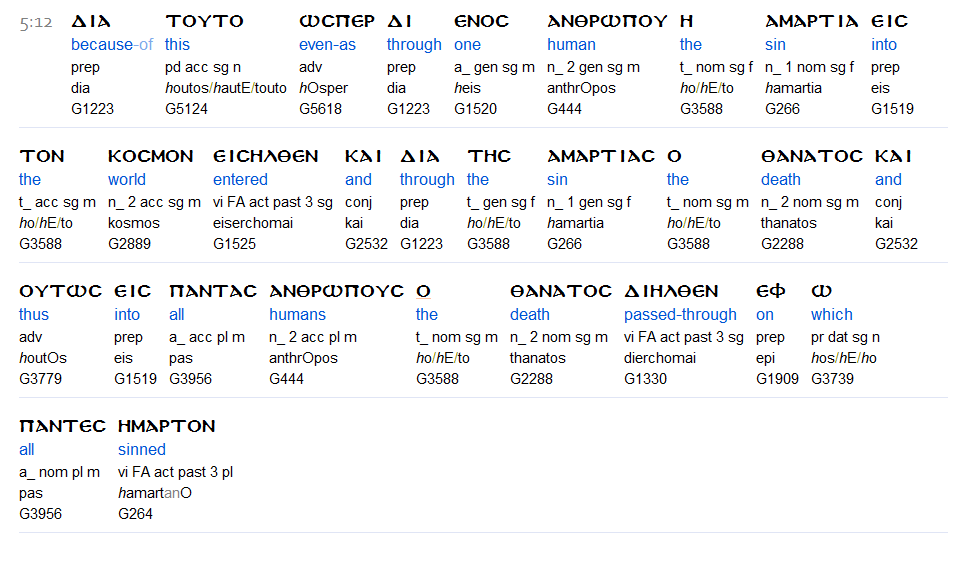
Romans 5 never says all people sinned in Adam by performing his act, the Greek phrase eph ho pantes hemarton in ~Romans 5.12 uses the aorist hemarton which states the fact that all sinned, but Paul does not say when, where, or whether it was Adam’s act itself, and to insert that idea is to overreach the text, Gordon Fee, Bob Utley, and F F Bruce all note that Paul immediately interrupts himself in verses 13 and 14 to show a different point, namely that death reigned even over those who did not sin in the likeness of Adam’s transgression, in other words men sinned, but their sin was not identical to Adam’s act, nor does Paul say Adam’s guilt is automatically imputed to every descendant without qualification.
Sin entered into the world (hē hamartia eis ton kosmon eisēlthen). Personification of sin and represented as coming from the outside into the world of humanity. Paul does not discuss the origin of evil beyond this fact. There are some today who deny the fact of sin at all and who call it merely “an error of mortal mind” (a notion) while others regard it as merely an animal inheritance devoid of ethical quality.
And so death passed unto all men (kai houtōs eis pantas anthrōpous diēlthen). Note use of dierchomai rather than eiserchomai, just before, second aorist active indicative in both instances. By “death” in Gen_2:17; Gen_3:19 physical death is meant, but in Rom_5:17, Rom_5:21 eternal death is Paul’s idea and that lurks constantly behind physical death with Paul.
For that all sinned (Ephesians’ hōi pantes hēmarton). Constative (summary) aorist active indicative of hamartanō, gathering up in this one tense the history of the race (committed sin). The transmission from Adam became facts of experience. In the old Greek Ephesians’ hōi usually meant “on condition that,” but “because” in N.T. (Robertson, Grammar, p. 963).
tn The translation of the phrase ἐφ᾿ ᾧ (eph hō) has been heavily debated. For a discussion of all the possibilities, see C. E. B. Cranfield, “On Some of the Problems in the Interpretation of Romans 5.12,” SJT 22 (1969): 324-41. Only a few of the major options can be mentioned here: (1) the phrase can be taken as a relative clause in which the pronoun refers to Adam, “death spread to all people in whom [Adam] all sinned.” (2) The phrase can be taken with consecutive (resultative) force, meaning “death spread to all people with the result that all sinned.” (3) Others take the phrase as causal in force: “death spread to all people because all sinned.”
NET notes.
So which is it?
Romans 5.19 says the many were made sinners, the verb kathistemi means to appoint or constitute, and the passive voice signals an outcome in the human condition**, not a statement that all performed Adam’s deed,** it describes the environment of corruption into which all are born, the domain of death that Adam’s fall unleashed, but it does not state that God views every infant as having committed Adam’s trespass, nor that guilt is transferred mechanically, not one phrase in the chapter says all sinned in Adam in the strict substitutionary sense you are asserting.
Psalm 51.5 is David’s poetic confession of his own moral brokenness, it uses the Hebrew chet for sin and the line is in parallelism that expresses depth of depravity rather than metaphysics of inherited guilt, it does not say David sinned in Adam, it says he was born into a fallen environment, and Utley repeatedly notes that Hebrew poetry asserts relational realities, not doctrinal formulas about federal headship.
Genesis 8.21 states that the inclination of the human heart is evil from youth, but that still does not state that every human committed Adam’s act or that Adam’s guilt is judicially stamped on all newborns, it describes the universal bent of fallen humanity, not the metaphysical claim that all sinned in Adam.
Romans 3.10 declares universal unrighteousness, but again it does not answer the question you raised.
John 3.3 on the new birth proves that humans need regeneration because they are fallen and spiritually dead, but Jesus does not say they sinned in Adam, He says they cannot see the kingdom unless they are born from above.
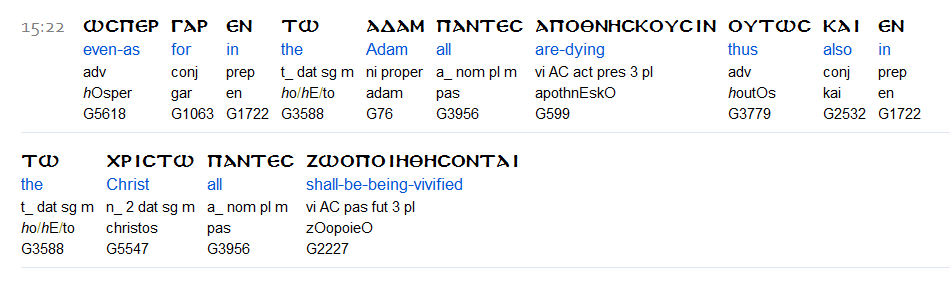
Your appeal to ~1 Corinthians 15.22 misses Paul’s actual argument, the phrase in Adam all die is a statement about solidarity in mortality, not about everyone performing Adam’s transgression, the entire chapter is about resurrection, not inherited guilt, the Greek en Adam is a sphere of existence, the realm of death that Adam opened, just as en Christ denotes the sphere of resurrection life for all who belong to Him, the contrast is between two realms, not between two individual acts committed by every human.
Not one verse in your list says explicitly that all sinned in Adam by committing his act or bearing his guilt in a legalistic transfer, the text says all die in Adam because Adam opened the door of mortality and corruption for the race, and all who are in Christ receive life, but the text does not assert the tight formulation you are forcing on it.
What Scripture teaches is universal fallenness, universal corruption, universal need for the cross, and universal necessity of the new birth, and I affirm all of that without hesitation, because the gospel is for sinners, not the morally neutral, the problem is that you are reading Augustine’s later formulation back into texts that use broader categories, and claiming that anyone who does not read them through that lens is rejecting Scripture, when the reality is that the verses do not make your precise claim.
J.