Does the Bible Teach That Communion Brings Healing?
Does the Bible Teach That Communion Brings Healing?

As Christians reflect on the meaning and power of the Lord’s Supper, we invite your voice in Crosswalk Forums.
#Communion #HealingFaith #BiblicalDebate #christianforums #crosswalkforums #forums #crosswalk #faithcommunity #faithforums

For centuries, the Lord’s Supper has been one of the most central practices of the Christian faith. Churches may differ on how often communion is observed, how the elements are served, or what theological framework guides their understanding—but most agree it is deeply significant.

Yet a growing conversation within parts of the church asks whether communion not only symbolizes Christ’s sacrifice but also provides healing—both spiritual and physical. Some point to passages like 1 Corinthians 11, where Paul warns that those who partake in an unworthy manner bring judgment on themselves, and they connect this with the idea that proper participation could, conversely, bring strength and even health. Others reference Isaiah 53:5 (“by His wounds we are healed”) and suggest that communion is a way to actively receive that promise.

On the other hand, many Christians caution against treating communion like a mystical ritual or formula. They emphasize that the bread and cup are signs pointing us to Christ’s once-for-all sacrifice, and that the true healing they offer is reconciliation with God, not guaranteed deliverance from sickness in this life. This leads to tension: is communion a symbol only, or is there a mystery at work that brings more than remembrance?

For some believers, testimonies of healing tied to communion are deeply moving. For others, such claims risk overshadowing the gospel’s central message or creating false expectations. Should Christians approach the Lord’s Table with the hope of healing, or simply with reverence, repentance, and gratitude for Christ’s sacrifice?

What do you think—does the Bible teach that communion brings healing, or is this an interpretation that goes beyond Scripture?
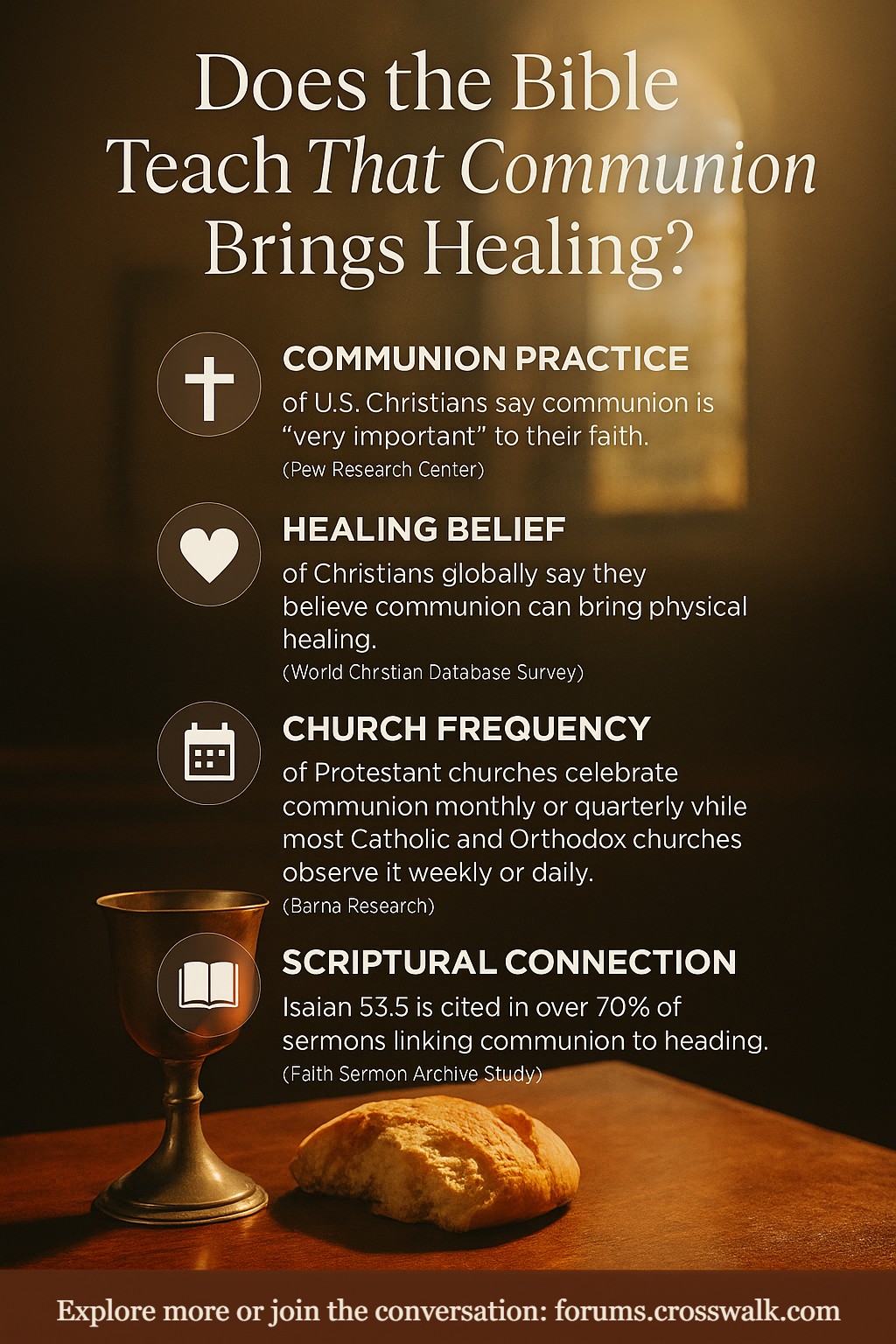
Infographic

Read more about what you should know about the Lord’s Supper here:
@Fritzpw_Admin, I don’t think that taking Communion causes healing or that Paul in 1 Corinthians 11, says that it does either. Rather, he is saying that God has disciplined Christians who have taken it without faith or flippantly to humble them through sickness, or rather he has allowed some evil force to do it.

My choice is the second one; it must be taken “with reverence, repentance, and gratitude for Christ’s sacrifice,” and that way is not very simple but important.

1 Like

@Fritzpw_Admin

In 1 Corinthians 11 the rebuke is sharp. Some in Corinth were treating the Supper as a common meal, eating selfishly while others went hungry, some even drunk. Paul warns that those who partake “in an unworthy manner” are guilty of the body and blood of the Lord. The Greek word for “unworthy manner” is ἀναξίως (anaxiōs), meaning irreverently or without due regard. The judgment of weakness, sickness, and even death (verses 29–30) was divine discipline on a church that despised Christ’s sacrifice by their conduct. Paul is not teaching that the elements carry a healing property when taken worthily. His point is judgment for profanation, not medicine for the body.

You also quoted Isaiah 53:5, “by His wounds we are healed.” The Hebrew word רָפָא (raphaʿ) often means to cure or restore, but in the context of Isaiah 53 it is tied to sins and iniquities, not diseases. Peter himself interprets it for us in 1 Peter 2:24, saying that Christ bore our sins on the tree so that we might die to sin and live to righteousness, “by whose stripes you were healed.” The healing is spiritual restoration through forgiveness, not a guarantee of bodily health.

Jesus Himself told us the purpose of the Supper: “Do this in remembrance of Me” (Luke 22:19, 1 Corinthians 11:24–25). Paul adds that by eating the bread and drinking the cup, we proclaim the Lord’s death until He comes (1 Corinthians 11:26). The Greek verb here for proclaim is καταγγέλλω (katangellō), meaning to announce or declare publicly. The Supper announces the cross. It calls for self-examination, repentance, unity, and gratitude, not the expectation of a ritual cure.

Yes, the Lord can heal according to His will. James tells the sick to call for the elders to pray in faith (James 5:14–15). But nowhere in Scripture are we told that communion itself imparts bodily healing. To suggest so risks turning the bread and cup into a mystical charm rather than what Christ ordained it to be, a proclamation of His once-for-all sacrifice.

The true healing it offers is reconciliation with God through the cross. The bread speaks of His body given for us, the cup of His blood poured out for the forgiveness of sins. When we gather at the Table, we do not seek a ritual cure, we proclaim Christ crucified, risen, and coming again.

And fully concur here-

My 2 cents.

J.

@Johann @Bruce_Leiter
The seeds of a healing Eucharist are found not first in the Upper Room but in the OT.
Biblical foundations
The Old Testament Prefigurations
The concept of a sacred meal conferring blessing is deeply embedded in the Jewish consciousness. The Passover Seder was more than a recollection; it was a participatory memorial (zikkaron). In Jewish Thought, Zikkaron makes a past salvific event truly present, allowing subsequent generations to participate in its power and benefits. The manna in the wilderness was “bread from heaven” that sustained the physical life of Israel, a sign of God’s faithful provision. Futhermore, the sacrificial system itself involved portions of the offering being consumed by the priests (Leviticus 7:15), signifying a communion between the offerer, the priest and God. The prophet Isaiah’s song of the Suffering Servant, particularly the line “by his wounds we are healed” becomes a cornerstone for Christian soteriology, linking suffering, sacrifice, and healing in an inextricable bond. The elements, i.e. participatory memorial, life-giving food, sacrificial communion and atoning healing, converge and find their ultimate fulfillment in the NT institution of the Eucharist.

B. The Words of Institution and the Johannine Discourse:
The Synoptic Gospels and Paul’s first letter to the Corinthians record the institution narrative with a shocking literalism:
“This is my Body…This is my Blood of the Covenant, which is poured out for many for the forgiveness of sins”
The Greek verb estin (“is”) is unequivocal. The phrase “for the forgiveness of sins” directly ties to the reception of the elements to the application of Christ’s atoning work. However, it is the Gospel of John, which notably lacks a direct institutive narrative, that provides the most profound theological commentary on the Eucharist’s effects in the Bread of Life Discourse.
Here, Jesus moves from the typology of manna to the stunning reality of His own flesh and blood as true food and true drink. The language is intensely physical and promises nothing less than participation in the divine life:
“Whoever eats my flesh and drinks my blood remains in me, and I in them” (John 6:54-56)
The Greek work for “eats” is trōgō which is graphic, meaning to “gnaw” or “chew”, emphasising the physical, real nature of the participation. The effects promised are twofold:
eternal life (a present possession with future eschatological fulfilment)
mutual indwelling (perichoresis)
This is the foundational biblical basis for understanding the Eucharist as a medicine that confers immortality and unites the believer to the source of all life.
C. Pauline Admonition: Discerning the Body
This passage is the locus classicus for the discussions of Eucharistic efficacy, both for good and for ill. Paul warns that whoever eats and drinks “without discerning the body” eats and drinks judgment in themselves. He directly connects this unworthy reception to physical consequences:
“That is why many among you are weak and sick, and a number of you have fallen asleep” (1 Corinthians 11:30)
A surface reading might suggest a punitive God meeting out sickness for ritual infractions.
BUT, a deeper, patristic reading reveals a more profound sacramental principle.
The Eucharist is the real presence of Christ
To receive it unworthily, in a state of unrepentant mortal sin that rejects charity and fractures ecclesial communion, is to encounter the transformative, purifying fire of God’s love in a destructive rather than constructive manner. It is not that God actively zaps the communicant with illness, but that the life-giving medicine, received by a soul in a state of spiritual death, cannot produce its healing effect and instead manifests its power as a judgment, revealing the deadly contradiction between the recipient’s state and the gift received. The inverse principle is powerfully implied:
to receive worthily, with faith, repentance and charity, is to receive the medicine for one’s weakness and sickness, both spiritual and by extension, physical.

The Withness of Tradition
St. Ignatius of Antioch, in his letter to the Ephesians, famously called the Eucharist as the “medicine of immortality, the antidote we take in order not to die but to live forever in Jesus Christ.” This phrase encapsulates the patristic view:
The Eucharist is the remedy for the ultimate sickness, death itself, which entered the world through sin.
St. Irenaeus of Lyons, fighting Gnosticism that despised the material, argued that since Eucharist is the true body and blood of Christ, and our physical bodies are nourished by it, they are thereby prepared for the resurrection. “For as the bread from the earth, receiving the invocation of God, IS NO LONGER COMMON BREAD BUT EUCHARIST, consisting of two things, an earthly and a heavenly; so also our bodies, receiving the Eucharist, are no longer corruptible, but have the hope of resurrection” (amazing, I’m crying)
Against Heresies, IV.18.5

St. Cyril of Jerusalem, in his mystagogical catechesis, instructed neophytes on the healing power of the Eucharist:
“Consider therefore the Bread and the Wine not as bare elements, for they are, according to the Lord’s declaration, the Body and Blood of Christ…Having your body partaken of the Body and Blood of Christ, you have become concorporeal and consanguineous with Him. Thus we become Christ-bearers, His Body and Blood being distributed through our members.”
He explicitly connects this to spiritual healing from sin. The Greek Fathers, particularly St. Gregory of Nyssa and St. John Chrysostom, further developed this, seeing the Eucharist as the agent of deification.

1 Like

@Johann, I remember last time, you gave me some references, and I think one of them was from St. Thomas Aquinas.
The medieval period, particularly with the work of St. Thomas Aquinas, systematized this patristic intuition into a precise metaphysical framework. Aquinas’s doctrine of transubstantiation, defined at the Fourth Lateran Council provided the language to explain how the bread and wine become the Body and Blood of Christ while retaining their “accidents” (sensory appearances).
This change of substance is not a physical change but a metaphysical one, effected by the power of God.
For Aquinas, the Eucharist is the “sacrament of sacraments” containing the very author of grace, Jesus Christ. In the Summa Theologica (III.q.73, a.3), he states that the Eucharist is the perfect sacrament because it not only signifies grace but contains it in reality.
The effects of the Eucharist (res tantum) are multifaceted:

  1. Primarily: It signifies and effects the unity of the Mystical Body, the Church. It is the sacrament of ecclesial unity
  2. Spiritually: It repairs the spiritual damages caused by sin, remitting venial sins and preserving from mortal sins. It strengthens the soul by increasing sanctifying grace and the theological virtues.
  3. Eschatologically: It is the pledge of future glory and the resurrection of the body. It is the antidote by which we are freed from our daily spiritual maladies and preserved for eternal life.

Aquinas is cautious about claming physical healing as a routine effect, as the sacraments are ordained for a spiritual end. However, he acknowledges that since grace perfects nature, the spiritual grace of the Eucharist can, by a kind of overflow (per redundentiam), sometimes bring about physical healing as a secondary effect, according to God’s will, as a sign of the future resurrection.

@Bruce_Leiter, we need to know how the Eucharist Heals us.
@Johann
so..
A. Primary effect: Spiritual Healing and Theosis
The most fundamental and guaranteed healing is spiritual. The Eucharist is the supreme application of the atonement to the individual soul. Its reception:

  1. Re-members and Re-orients:
    It repairs the soul wounded by sin, healing the fractures of intellect, will and memory. It reorders our desires away from disordered attachments and toward God, the Supreme Good.
  2. Increases Sanctifying Grace:
    It deepens the soul’s participation in the divine life, strengthening it against future sin. It is nourishment for the journey, sustaining the life of grace received at Baptism.
  3. Effects Theosis: As the Eastern Fathers emphasize, the Eucharist is the primary means of deification. By consuming God, we are gradually assimilated to Him; we become by grace what He is by nature. This is the ultimate healing, the restoration of the Imago Dei to its full splendor.

B. Secondary Effect: Physical Healing and Eschatological Promise
Physical healing is a real but secondary possibility, flowing from the logic of the Incarnation.
If God truly took flesh to redeem all of creation, then His glorified Body and Blood can indeed have a sanctifying effect on our mortal bodies.

  1. Eschatological Pledge:
    The Eucharist is the “seed of immortality”. In receiving the resurrected Body of Christ, we receive a real anticipation of our own future resurrection. It is a medicine that begins its work now but whose full effect i.e the resurrection of the body, is only realized at the end of time.
  2. Gratuitous Grace:
    In God’s providence, physical healing can occur as a sign of the Kingdom’s inbreaking power. This is a gratia gratis data, meaning a grace given for the good of others and as a sign of God’s mercy. It is not automatic or mechanistic. The Church’s history is replete with miracles and healings associated with Eucharistic adoration or reception, from Lanciano to countless unrecorded personal miracles. These are gifts, not entitlements. (The Eucharistic Miracle of Lanciano, Italy - Our Lady of Fatima, Piscataway, NJ)

Now here comes the two views that I try to fight against.
The first view is the “reduction to Magic” (while not prominant)
To approach the Eucharist as a ritual forula that obligates God to produce physical results is to lapse into superstition. It treats the sacrament as a cause-and-effect mechanism, divorcing it from faith, repentance and the sovereign freedom of God. This is a pagan understanding of ritual and fundamentally misunderstands the nature of a sacrament as a personal encounter with Christ within the communion of His Church.
The next view is a prominent one, and its “reduction to mere symbolism”
The purely memorialist view (associate with Zwingli) evacuates the sacrament of its objective power. If Christ is not truly present, then the Eucharist is merely a communal act of remembrance. It may inspire thoughts of healing, but it does not confer the healing power of the Divine Life itself. This view cannot adequately account for the serious tone of Paul’s warnings in 1 Corinthians 11.
So in conclusion I will bring light to three important points.

  1. With Reverence and Repentance
    The Primary disposition is not demand for healing but a humble recognition of the awesome gift being offered. This involves examining one’s conscience, seeking reconciliation for serious sin, and approaching with “fear of God, faith and love” (Byzantine Liturgy of St. John Chrysostom)

  2. With Faith, Not Formula:
    We should approach with expectant faith that we are receiving the Author of Life Himself. We can and should pray for healing, spiritual, emotional and physical, entrusting all our needs to Him. But we do so with the faith of the Centurion: “Lord, I am not worthy that you should enter under my roof, but only say the word and my soul shall me healed”. We trust in His wisdom to know what healing we truly need.

  3. With Eschatological Patience:
    We must hold the “already-not-yet” tension. The healing has begun, but it is not yet complete. The ultimate healing is the resurrection. The grace offered in the Eucharist is often the Strength to endure suffering with faith.

Peace
Sam

@Samuel_23

Your claim that the “seeds of a healing Eucharist” originate in the Upper Room, or in the Old Testament as a healing act, lacks biblical and early Christian support. As a non-Reformed, non-Catholic Christian, I argue the Lord’s Supper is a memorial meal commemorating Christ’s sacrifice, rooted in Old Testament covenantal meals, not a healing rite. Below, I refute your points with Scripture, new biblical texts, and pre-Augustinian ECF quotes (with links), maintaining an academic tone for our forum.

  1. Old Testament Prefigurations
    Your Claim: Passover, manna, sacrificial meals, and Isaiah’s Suffering Servant prefigure a healing Eucharist.

My rebuttal- Old Testament meals emphasize remembrance, not healing. Passover (Exod. 12:1-14) is a zikkaron recalling God’s deliverance (Exod. 12:26-27). Manna (Exod. 16:4, 32) signifies provision, preserved for memory (Deut. 8:3). Peace offerings (Lev. 7:11-15) foster fellowship, not healing. Isaiah 53:5 (“by his wounds we are healed”) refers to atonement (1 Pet. 2:24), not a meal. Numbers 9:11-13 and Deut. 16:3 reinforce Passover as memorial, not therapeutic.
ECF Testimony:

Justin Martyr (c. 150 AD): “Passover prefigures Christ’s sacrifice, commemorated in bread and wine” (Dialogue with Trypho 40, ANF 1:215).
Clement of Alexandria (c. 200 AD): “The Eucharist fulfills Passover as remembrance” (Stromata 2.22, ANF 2:369).

No Old Testament text supports a healing meal, refuting your claim.

  1. Words of Institution and Johannine Discourse
    Your Claim: Institution narratives and John 6:54-56 (estin, trōgō) show a healing Eucharist.

My rebuttal- The narratives (Matt. 26:26-28; Luke 22:19-20; 1 Cor. 11:23-25) emphasize “do this in remembrance of me” (Luke 22:19), echoing Passover (Exod. 12:14). Estin ties elements to Christ’s sacrifice, not healing. John 6:51-56 (trōgō, “gnaw”) is clarified by John 6:63 (“the Spirit gives life”) and 6:47 (“whoever believes”), pointing to faith, not a healing meal. 1 Cor. 11:26 and John 13:14-15 focus on proclamation and service, not healing.
ECF Testimony:

Tertullian (c. 200 AD): “The bread is a figure of Christ’s body, a memorial” (Against Marcion 4.40, ANF 3:418).
Hippolytus (c. 215 AD): “Eucharist is thanksgiving for Christ’s passion” (Apostolic Tradition 4, Chadwick, p. 43).

Scripture and ECFs stress remembrance, not healing.

  1. Pauline Admonition
    Your Claim: 1 Cor. 11:29-30 shows the Eucharist’s efficacy, implying healing if worthily received.
    My rebuttal-Paul’s warning about “discerning the body” (1 Cor. 11:29) addresses church unity (1 Cor. 10:17), not healing. Sickness reflects discipline (1 Cor. 11:32), not sacramental power. 1 Cor. 5:11 and Acts 20:7 emphasize communal integrity, not healing.
    ECF Testimony:

Justin Martyr: “Eucharist is thanksgiving for Christ’s death” (First Apology 65, ANF 1:185).
Clement of Alexandria: “Eucharist symbolizes passion, not bodily healing” (Paedagogus 2.2, ANF 2:246).

No healing is implied; focus is on reverence.

  1. Witness of Tradition
    Your Claim: Patristic sources confirm a healing Eucharist.

Rebuttal-Pre-Augustinian ECFs prioritize remembrance, not healing, secondary to Scripture (Luke 22:19; Exod. 12:27).
ECF Testimony:

Tertullian: “Eucharist is a memorial, not a potion” (On Prayer 6, ANF 3:682).
Hippolytus: “Eucharist unites us in memory” (Apostolic Tradition 21, Chadwick, p. 103).

ECFs align with biblical memorial focus.

The Lord’s Supper is a memorial, not a healing act, rooted in Old Testament meals (Exod. 12:14; Lev. 7:11-15), not the Upper Room. Scriptures (Num. 9:11-13; Acts 20:7) and ECFs (Justin, Clement, Tertullian, Hippolytus) confirm this, refuting your healing claim.

Thanks.

J.

@Johann brother
A. The Ontological Force of Estin in the Words of Institution
In Koine Greek the verb eimi (to be) frequently carries an ontological force, particularly in declaratory statements. This is evident in the LXX rendering of Exo 3:14, where God declares ἐγώ εἰμι ὁ ὤν (" I AM WHO AM"). Christ’s use of estin in the institution narratives parallels this definitive, reality-effecting speech.
The Church Fathers unanimously understood estin not as a metaphorical “represents” but as a statement of transformative identity. As St. John Chrysostom articulates in his Homilies on Matthew, “It is not man that causes the things offered to become the Body and Blood of Christ, but Christ Himself who was crucified for us. The priest stands there carrying out the action, but the power and grace are those of God. ‘This is my Body,’ he says. This word transforms the things offered.”
If Christ intended mere symbolism, the Aramaic vernacular offered abundant metaphorical language (eg “this is like my body” or “this signifies my body”). His deliberative choice of the verb estin within the context of the Passover zikkaron indicates a fulfilment that is both representational and ontological.
B: John 6: Trōgō
The verb trōgō appears four times (which means chew, gnaw or munch) in this passage (Jn 6: 54, 56, 57,58). Its usage is deliberative, emphatic and intentionally graphic. It is a hapax legomenon in the context of the Fourth Gospel, chose to preclude any spiritualizing interpretation. As the Protestant scholar William Temple acknowledged:
“The verb trōgein is a coarse word, used of animals…it is doubtless used here to emphasise the physical act of eating, and so to make sure that the spiritual truth it conveys is not spiritualized away” (Readings in St. John’s Gospel)

John 6:63’s context:
τὸ πνεῦμά ἐστιν τὸ ζῳοποιοῦν, ἡ σὰρξ οὐκ ὠφελεῖ οὐδέν
(“The Spirit gives life; the flesh is of no avail”)
This verse is not a negation of the preceding realism, but its necessary qualification. The “flesh” (sarx) that profits nothing is not the sacramental flesh of Christ, but the fallen, human understanding (refer to Rom 8:5-8). Christ is distinguishing between carnal, Cannibalistic misunderstanding (which the Jews propose) and sacramental, Spirit-empowered eating (which He institutes). The Eucharist is precisely the means by which the life-giving Spirit communicates through the sanctified elements.
The literal, scandalous force of Christ’s words is confirmed by the reaction of this followers:
“This is a hard saying; who can listen to it?”(Jn 6:60)*
“After this many of his disciples drew back and no longer went about with him” (Jn 6:66)
If Christ were merely speaking metaphorically about belief, His teaching would have been unremarkable to a Jewish audience familiar with Wisdom Literature ( like Sirach 24:21). The mass apostasy only makes sense if He was asserting something shockingly literal.

C. 1 Corinthians 11:27-30
The interpretation of this passage as pertaining only to “church unity”..is it eisegesis?

The phrase, “guilty of the Body and Blood of the Lord” (ἔνοχος… τοῦ σώματος καὶ τοῦ αἵματος τοῦ κυρίου) implies a direct, objective profanation of a sacred reality, not merely a social offence against the community.
One cannot be “guilty” of a symbol in this judicial sense.
The judgment is not presented as a divine punishment meted out from on high, but as an intrinsic consequence:
"For anyone who eats and drinks without discerning the body eats and drinks judgment upon himself "
This language of intrinsic consequence i.e. “judgment upon himself”, parallels the biblical principle of touching the Ark of the Covenant (2 Sam 6:6-7) or partaking of holy offerings in an unworthy state (Lev 22:9). It presumes the objective holiness and power of the elements themselves.

Look at the consequences
A triad of consequences “weakness, illness, and death”…are physical realities (very imp point to note @Johann)
If the Eucharist were a bare memorial, the notion that unworthy remebrance could cause physical sickness and death is theologically incoherent and ontologically absurd.
Paul’s warnings only makes logical sense if the Eucharist is the real, powerful and therefore dangerous, presence of the Lord.

The one part that I felt sad reading, was the selective use of the Fathers and a catastrophic misrepresentation achieved by wrenching phrases from their polemical and theological context.

Lets take it one by one:
A. Justin Martyr
Ok, the citation from the Dialogue with Trypho is incomplete. In his First Apology (chp 66), was written for a pagan audience, brother @Johann, with no reason to obsure his meaning.
Justin Martyr is unequivocal:
“For not as common bread and common drink do we receive these; is the flesh and blood of that Jesus who was made flesh.”
This is a clear doctrine and real presence. The nourishment of “our blood and flesh” is a direct affirmation of the Eucharist’s effect on the whole human person.
B. Tertullian
To cite Tertullian’s Against Marcion without context wasnt right brother…
Tertullian was combatting Marcionite Docetism, a heresy that Christ’s Body was not real but phantasmal
In this context, when Tertullian calls the bread a “figure”, he is arguing against Marcion, that the Eucharist truly represents and makes present the real flesh of Christ, which Marcion denied.
For Tertullian, figura implies a real connection to the thing signified, not a negation of it.
In his On the Resurrection of the Dead (8), he states plainly:
“The flesh feeds on the Body and Blood of Christ, so that the soul may be fattened on God.”

Even I have some (the notion that pre-Augustinian Church held a mere memorialist view is wrong):

The Word became Flesh (Jn 1:14). The divine Logos assumed a complete human nature, body and soul, to redeem it. The Eucharist is the extension of the Incarnation in space and time. To receive the Eucharist is to receive the whole Christ, the Great Physician, whose very person is healing.

  1. St. Ignatius of Antioch (c. 110 AD): “They [the Docetists] abstain from the Eucharist and from prayer, because they do not confess that the Eucharist is the flesh of our Savior Jesus Christ, flesh which suffered for our sins and which the Father, in his goodness, raised up.” (Letter to the Smyrnaeans , 6:2).
    Ignatius, a disciple of the Apostle John, directly links orthodox Christology (belief in Christ’s real flesh) to belief in the real presence.

  2. St. Irenaeus of Lyons (c. 180 AD): “When, therefore, the mingled cup and the baked bread receives the Word of God and becomes the Eucharist, the body of Christ… how can they say that the flesh is not capable of receiving the gift of God, which is eternal life?” (Against Heresies , 5:2:2-3).
    Irenaeus argues for the resurrection of the flesh based on its nourishment by the Eucharistic body of Christ.

  3. St. Cyril of Jerusalem (c. 350 AD): “Do not regard the bread and wine as mere ordinary elements, for they are, according to the Lord’s declaration, Christ’s body and blood… Strengthen your heart by partaking of that bread as spiritual food, and gladden the face of your soul.” (Mystagogical Catechesis 4 , Ch. 6 & 9).
    Cyril’s catechetical lectures provide the most detailed early witness to the Church’s belief in the real presence and the transformation of the elements.

The healing power of the Eucharist is not a separate “benefit” tacked onto, but rather it flows intrinsically from its nature as the real presence of the Incarnate Word.

The Eucharist is not a static symbol but an eschatological reality, a foretase of the heavenly banquet and the resurrection of the body (Jn 6:54). In it, the future resurrection power breaks into the present age. Physical healing can occur as a tangible sign of this inbreaking Kingdom, a pledge of the future resurrection where there will be no more sickness or death.

Grace perfects nature. The primary and guaranteed effect of the Eucharist is spiritual healing:
the forgiveness of venial sins, the strengthening of the soul against sin, and an increase in sanctifying grace and charity. From this primary spiritual effect, grace can “overflow” (per redundentiam) to bring about physical healing, according to God’s wisdom and providence. This is not magic but the intrinsic logic of a sacrament that sanctifies the whole person.

@Samuel_23 , let us take this piece by piece with Scripture and context, because your argument presented here relies on selective readings of Greek verbs, misapplication of patristic sources, and a neglect of the biblical emphasis on faith and remembrance in Christ’s finished sacrifice on the cross. I will dismantle A, B, and C systematically.

First, about estin in the Words of Institution. Your claim is that estin (is) must always carry ontological force, meaning it always indicates a literal transformation. Correct? That is simply not true. In Koine Greek, eimi (to be) frequently serves a copula for metaphor and representation. Jesus Himself uses it that way many times. He says “I am (egō eimi) the door” in John 10:9. He says “I am the vine” in John 15:5. He says “the field is (estin) the world” in Matthew 13:38.

These are not ontological identities, they are metaphorical representations, and the audience understood them as such. Your appeal to Exodus 3:14 ignores genre and context. When God says “I AM WHO I AM” (egō eimi ho ōn), He is revealing His self-existent being, which is fundamentally different from Christ using estin over bread and wine at Passover.

In fact, the Passover context confirms remembrance. Luke 22:19 says “Do this in remembrance (anamnesis) of me.” The memorial nature is embedded in the institution itself. Furthermore, Paul reiterates in 1 Corinthians 11:26 that “as often as you eat this bread and drink the cup, you proclaim the Lord’s death until He comes.” This is proclamation, not repetition of sacrifice.

Second, about trōgō in John 6. Your argument rests on the verb meaning chew or gnaw, claiming it cannot be spiritualized. But one cannot lift a single verb out of Johannine theology. The entire Gospel of John is saturated with metaphorical “I am” sayings. In the same chapter Jesus says “I am the bread of life” (Jn 6:35) and immediately interprets it spiritually: “Whoever comes to me shall not hunger, and whoever believes in me shall never thirst.” Notice the verbs “come” and “believe” parallel “eat” and “drink.” John 6:54-56 must be read in light of John 6:35, which interprets the eating and drinking as believing. When the disciples stumble at His words in John 6:60, Jesus clarifies in John 6:63 “It is the Spirit who gives life, the flesh profits nothing. The words that I have spoken to you are spirit and life.” He does not double down on physical realism, He redirects to spiritual reception. That is why in the same chapter Peter responds, not by saying “we will eat your flesh,” but “You have the words of eternal life, and we have believed” (Jn 6:68–69). The interpretive key is faith in His word, not chewing His substance.

Third, 1 Corinthians 11. Paul indeed warns against eating and drinking “unworthily,” but the context shows the issue is profaning the community and despising the poor (1 Cor 11:20–22). The “not discerning the body” (v.29) refers not to metaphysical transformation of bread but to failing to recognize the body of Christ, the church (1 Cor 10:16–17, 1 Cor 12:12–27). That is why his rebuke ties directly to divisions and selfishness, not to mechanics of elements. The consequences of weakness and illness are covenantal judgments like those in the wilderness (cf. 1 Cor 10:1–12), not magical effects of bread. Paul is not teaching that bread becomes lethal with improper handling. He is teaching that to profane Christ’s people and His memorial is to invite divine discipline.

Now about the Fathers. Justin Martyr, in First Apology 66, indeed speaks of the Eucharist as more than common bread and drink, but his explanation is consistent with spiritual participation, not transubstantiation. He links it to the incarnation, but he also says it is received through prayer of thanksgiving (eucharistia) and for the nourishment of faith. He does not use Aristotelian substance-language. Tertullian, likewise, when he says figura, means sign. To say “the bread is a figure of His body” is not a denial of reality but an affirmation of sacramental signification. That is exactly what Protestants hold. The argument that “figure” always implies ontological presence is tendentious. Tertullian elsewhere explicitly distinguishes between sign and substance, such as in Against Marcion IV.40, where he calls the Eucharist “a figure of my body” and links it to memorial proclamation. Chrysostom’s homily quoted is a later development of real presence language, but even Chrysostom emphasizes the mystery as rooted in Christ’s death, not in metaphysical alteration of elements.

The biblical burden is this. Christ offered His body once for all on the cross (Heb 10:10, 14). His sacrifice is not repeated nor re-presented in the elements. The Supper is memorial and proclamation, a covenant meal that points back to the cross and forward to the kingdom. To collapse it into ontological transformation is to obscure the finality of Calvary. The bread remains bread, the cup remains the fruit of the vine (Matt 26:29), yet by faith we feed on Christ spiritually through the Spirit, who unites us to the crucified and risen Lord.

The punchline is this. Estin does not force literalism. Trōgō does not overthrow John’s symbolic discourse. Paul’s warnings are about covenantal reverence, not magical danger. The Fathers are complex and not unanimous, and to wrench them into a medieval doctrine is dishonest. The cross of Christ is sufficient, the Supper proclaims it, and faith receives Him by the Spirit without collapsing symbol into substance.

Shalom

J.

1 Like

@Johann Brother
Hermeneutical Foundations
Category error…
Lets talk about the Genre and the Context
The “I am” statements in John’s Gospel are profound theological metaphors revealed in public teaching.
The Words of the Institution are something entirely different:
They are consecratory words spoken within the context of a covenantal ritual (the Passover).
In the Jewish understanding, divine words spoken within a ritual context are effective, they bring about what they signify. When God says in Gen 1, creation happens. When Christ speaks in the Upper Room, the transformation of the elements happens. (@Johann and @Bruce_Leiter, very important to note, and the reason of why Jesus said the Words of Institution on that specific day)
To reduce “This is my Body” to the same linguistic category as “I am the vine” is to ignore the most basic principles of form criticism and genre analysis.

Citing Luke 22:19 and 1 Cor 11:26 is good but you empty the word anamnesis of its rich, Hebraic meaning.
As demonstrated prev, that in OT, zikkaron (memorial) is not a mere psychological recall, but a liturgical re-actualisation of a past event, making its power and benefits present to the current generation. When Christ commands the Apostles to “do this in anamnesis of me”, He is instituting a ritual that makes His one, eternal sacrifice present on the altar. The “proclamation” of the Lord’s death is not a mere verbal announcement but a sacramental manifestation. We do not merely say He died, we show the Lord’s death by making it sacramentally present until He comes again in glory.

Hebrews 10 says Christ’s sacrifice is “once for all” and therefore cannot be “re-presented”..
Now lemme make something clear..

  1. The Sacrifice on Calvary is a historical event that occurred once in time. It is unique, complete and unrepeatable.
  2. The Mass is not a re-sacrificing of Christ. This is the heresy of ultra-realism, condemned by the Council of Trent. Rather, the Mass is the sacramental re-presentation of that one sacrifice. Through the ministry of the priest, by the power of the Holy Spirit, the Church is lifted out of time to participate in the eternal, heavenly liturgy, where Christ, the Lamb who was slain, eternally offers Himself to the Father.
  3. The Eucharist is the unbloodied application of that bloody sacrifice. We do not sacrifice Christ again; we partake of the fruits of the one sacrifice. The distinction between the historical event and the sacramental reality is crucial and was maintained by the greatest medieval theologians like St. Thomas Aquinas

About John 6:

  1. The Trōgō argument stands brother:
    Please provide a substantive counter to the force of the verb Trōgō. Its usage is coarse, literal and intentional.
    To suggest that the audience understood this as a metaphor for “belief” is historically untenable.
    What we can say, is the crowds reaction filled with confusion, disgust and abandonment (Jn 6:60, 66) proves they understood Him literally. If He were merely speaking about belief, this reaction would be inexplicable. The disciples were already believers (John 2:11), why would they leave over a metaphor they already accepted?
  2. About John 6:63, The “flesh” that profits nothing is not the sacramental flesh of Christ, but human, fallen understanding, please refer to Romans 8:5-8.
    Christ is correcting a carnal, Cannibalistic misinterpretation of His words. He is not saying “Do not eat my physical flesh” but “You must understand that the mode of eating my flesh will be spiritual, not carnal”, like that brother.
    The Eucharist is precisely the means by which the Spirit gives life through the material element. This is the classic patristic interpretation. St. Cyril of Alexandria comments on this very verse:
    “He says that His own flesh is possessed of life-giving power… for it is the flesh of the Word, who gives life to all.”
  3. Peter’s words in John 6:68-69 (“You have the words of eternal life”) and then arguing that as evidence that the Chapter is only about belief in Christ’s teaching, is a false dichotomy. For the Apostolic Church, “believing” in Christ inherently included receiving the sacraments He instituted. Peter’s confession is not a rejection of the literal interpretation but an act of faith in the entirety of Christ’s person and work, including this hard saying, which he may not yet have fully understood but accepted on Christ’s authority.

About 1 Cor 11

  1. I would like to point out that the grammar of Judgement, “guilty concerning the Body and Blood of the Lord,” grammatically and theologically requires a direct object. One is guilty of something sacred. One cannot be “guilty” of a symbol in this judicial, covenantal sense. The language parallels the OT warnings, like in Leviticus 22:9 and Numbers 18:32.
  2. The judgment is not portrayed as an external punishment but as an intrinsic consequence:
    "For anyone who eats and drinks without discerning the body eats and drinks judgment upon himself " (1 Cor 11:29)
    This language of intrinsic consequence presumes the objective holiness and power of the elements themselves. If the bread and wine are only bread and wine, there is nothing intrinsically holy about them to profane; thus, there would be no mechanism by which one could bring judgment upon oneself by eating them.
  3. The results are physical: weakness, sickness and death.
    If the sin were only a lack of charity toward the poor, the physical consequence would be disproportionate and unrelated. However, if the sin is the profanation of the sacramental body (which also constitutes a sin against the ecclesial body as per 1 Cor 10:17), then the physical consequence makes perfect sense within a biblical worldview where violating sacred realities has physical effects like Uzzah and the Ark in 2 Sam 6:7, the misuse of the Passover meal in Numbers 9:13.

You are just repeating yourself @Samuel_23, repeat after repeat, with no real substance.

In John 6 the verb trōgō (to chew, gnaw) does not force a crude literal reading, for John himself uses it figuratively in John 13:18, ho trōgōn mou ton arton (“the one who eats my bread”),

Joh 13:18 I speak λέγω· not Οὐ about περὶ all πάντων of you. ὑμῶν I ἐγὼ know οἶδα whom τίνας I chose; ἐξελεξάμην· but [it is] ἀλλ’ that ἵνα the ἡ Scripture γραφὴ may be fulfilled: πληρωθῇ ‘The [one] ‘Ὁ eating τρώγων My μου - τὸν bread ἄρτον has lifted up ἐπῆρεν his αὐτοῦ.’ - τὴν heel πτέρναν against ἐπ’ Me.’ ἐμὲ

where Judas is not literally gnawing on Jesus bread but sharing covenant fellowship. Already in John 6:35 Jesus defines the metaphor, “he who erchetai (comes) to me shall not hunger, and he who pisteuōn (believes) in me shall never thirst.”

Eating and drinking equal coming and believing. When the Jews stumble in verse 52, it is the same pattern of misunderstanding seen with Nicodemus in John 3:4 or the Samaritan woman in John 4:15. Jesus explains in verse 63, “to pneuma estin to zōopoioun, hē sarx ouk ōphelei ouden” (“the Spirit is the one who gives life, the flesh profits nothing”), which matches Romans 8:5–8 where sarx means fallen human perspective, not the incarnate flesh of the Son given on the cross. The words (rhēmata) of Jesus are “pneuma kai zōē” (Spirit and life). Peter confirms the point, “You have the rhēmata zōēs aiōniou” (John 6:68). Feeding is by faith in the crucified Christ, not by chewing His molecules.

Paul in 1 Corinthians 11 says the Supper is done “eis tēn anamnēsin” (in remembrance) of Christ and is a “katangellō” (proclamation) of His death “achri hou elthē” (until He comes).

To eat “unworthily” makes one enochos tou sōmatos kai tou haimatos (guilty with respect to the body and blood) just as James 2:10 says enochos pantōs (guilty of all) concerning the law, without requiring physical presence.

The judgment is covenantal discipline from the Lord (1 Cor 11:32), not chemical hazard in bread. “Mē diakrinōn to sōma” (not discerning the body, 11:29) ties back to 10:17 where “we who are many are one sōma, for we all partake of the one bread.” The sin was despising the ekklēsia (church), humiliating the poor (11:22), and thereby lying about the cross the Supper proclaims.

Just as Passover was a zikkārôn (זִכָּרוֹן memorial, Exod 12:14) yet was deadly if profaned (Num 9:13), so the Supper as Christ’s memorial is holy without ontological change in the elements.

The synoptics confirm this, Jesus says, “I will not drink apo tou genēmatos tēs ampelou” (of the fruit of the vine) until the kingdom (Matt 26:29, Mark 14:25, Luke 22:18). He calls the cup wine after consecration. The miracle is the cross itself, once for all, Hebrews 10:10, not a repeated change at every Mass. The life comes from Christ crucified and risen, received by the Spirit through faith, remembered in the Supper, never from bread turned into substance.

J.

@Johann

Lets specifically focus on ECF part:
I think I have already addressed the ECF part, but no problem, lets go through it again:
A. Justin Martyr
To claim that Justin’s description is “consistent with spiritual participation” isn’t right.
His language is clear:
The food is “the Flesh and Blood of that Jesus who was made Flesh.” He states it is not “common” food but food “consecrated by the word of prayer”. This is a doctrine of change and real presence. His lack of “Aristotelian substance-language” is an anachronistic red herring; the concept of real presence predates the specific philosophical vocabulary used to defend it in later centuries.

B. Tertullian
The use of Tertullian is particularly disingenuous. In Against Marcion IV.40, Tertullian is arguing aginst Marcion’s docetism. When he calls the Eucharist a “figure”, he is arguing that it truly represents and makes present the real flesh of Christ, which Marcion denied. For the Fathers, figura rarely means “mere symbol”; it means a promised reality that finds its fulfilment. The Eucharist is that figura which contains the veritas (truth). Furthermore, in On the Resurrection of the Dead (8), Tertullian is unequivocal:
“The flesh feeds on the Body and Blood of Christ, so that the soul may be fattened on God.”
(For those who don’t know, what Marcion Docetism is, Marcion believed that Jesus’ body was a phantom. The God of the OT was a lesser, wrathful deity, while the God of the NT was benevolent, through Jesus, and would not have taken on a physical body, as it would be a contradiction to God’s pure spiritual nature and the evil nature of the material world.)

Now, St. Ignatius of Antioch (Disciple of John) calls the Eucharist “the flesh of our saviour Jesus Christ” and the “medicine of immortality” (Smyrnaeans 7:1). St. Irenaeus of Lyons argues for the resurrection of the body based on its nourishment by the Eucharistic Body and Blood (Against Heresies 5:2.2-3). St. Cyril of Jerusalem in his Mystagogical Catecheses gives detailed instructions, warning catechumens not to see mere bread and wine but the Body and Blood of Christ.

Conclusion is (Lets focus on 5 questions…)

  1. Do you affirm that all of Christ’s “I am” statements function identically in terms of their ontological referent? If so, please explain the hermeneutical principle by which you determine that “I am the resurrection and the life” is spiritual reality, “I am the door” is a metaphor and “This is my body” is a symbol. If you admit that context, genre, and audience determine meaning, then on what basis do you ignore the unique context of the Passover zikkaron, a ritual of re-actualization, and the fact that the audienceof John 6 understood Christ literally and were scandalized by it, a reaction that is nonsensical if He was merely speaking of belief?
  2. If the Real Presence is a medieval invention how do you explain the testimony of Ignatius of Antioch, a direct disciple of Apostle John, who called the Eucharist “the flesh of our Saviour Jesus Christ” and made it the litmus test for orthodoxy agianst the Docetists? Was the beloved disciple’s own pupil already corrupting the gospel?
  3. If the bread and wine remain only bread and wine, and the sin is only “a lack of charity toward the poor” please explain the mechanisms by which eating common food without charity results in physical sickness and death? How does this differ from the pagan concepts of magical curses? Conversely, if the elements are truly the Body and Blood of Christ, Paul’s logic is flawless: to profane a holy reality is to incur holy judgement (refer to Leviticus 22:9 and 2 Samuel 6:6-7). Which interpretations upholds the sanctity of the covenant and provides a coherent causation for the judgement?
  4. When Christ says “the flesh profits nothing” is He referring to (a) His own Eucharistic flesh, or (b) human, fallen, carnal understanding?
    If (a), then you have Christ negating the very sacrament He is instituting within the same discourse, a nonsensical contradiction. If (b), then the verse is a correction against a Cannibalistic misinterpretation and an affirmation that the mode of reception if spiritual (i.e sacramental, by the power of the Spirit), not carnal. Does your interpretation require you to believe that Christ’s own flesh, the flesh of the Word Incarnate, “profits nothing”? Does this not verge on the Docetism that the Apostle John himself condemned?
  5. If the Word truly became flesh, and that the flesh was crucified, raised, and glorified, then it is now a life-giving spirit (1 Cor 15:45). If Christ intended to give His disciples access to His life-giving humanity, how could He possibly do so in a way more intimate, real and physical than by giving them His flesh to eat and His blood to drink? If He did not mean this literally, what could His words possibly mean that would have been more shocking and offensive to His Jewish audience?

Please take these as my genuine doubts that I have had…
Peace, Take Care and Stay Safe
Sam

If you hear repetition, Johann, it may be because the same questions remain unanswered. Substance does not disappear simply because one grows tired of it. I’ve raised points from the Fathers, from Paul, and from Christ’s own words—if they sound repetitive, it’s because they all converge on the same reality.

Already answered, not my problem if you can’t ingest it.

In John 6, when Jesus says “he who eats my flesh and drinks my blood,” the Greek verb is trōgō (τρώγω, to chew or gnaw). The form is in the present active participle:

ὁ τρώγων μου τὴν σάρκα καὶ πίνων μου τὸ αἷμα
“the one eating my flesh and drinking my blood” (John 6:54, 56)

This present participle stresses continuous, ongoing action, not a one-time act. In Johannine style, that means the focus is on abiding, continual participation in Christ by faith, not a literal moment of chewing His flesh. Compare John 6:35 where “he who comes (ὁ ἐρχόμενος, present participle) to me shall never hunger, and he who believes (ὁ πιστεύων, present participle) in me shall never thirst.” The same grammar shows that “eating” is parallel to “believing.”

This here from Robertson-

He that eateth (ho trōgōn). Present active participle for continual or habitual eating like pisteuete in Jhn_6:29. The verb trōgō is an old one for eating fruit or vegetables and the feeding of animals. In the N.T. it occurs only in Jhn_6:54, Jhn_6:56, Jhn_6:58; Jhn_13:18; Mat_24:38. Elsewhere in the Gospels always esthiō or ephagon (defective verb with esthiō). No distinction is made here between ephagon (Jhn_6:48, Jhn_6:50, Jhn_6:52, Jhn_6:53, Jhn_6:58) and trōgō (Jhn_6:54, Jhn_6:56, Jhn_6:57, Jhn_6:58). Some men understand Jesus here to be speaking of the Lord’s Supper by prophetic forecast or rather they think that John has put into the mouth of Jesus the sacramental conception of Christianity by making participation in the bread and wine the means of securing eternal life. To me that is a violent misinterpretation of the Gospel and an utter misrepresentation of Christ. It is a grossly literal interpretation of the mystical symbolism of the language of Jesus which these Jews also misunderstood. Christ uses bold imagery to picture spiritual appropriation of himself who is to give his life-blood for the life of the world (Jhn_6:51). It would have been hopeless confusion for these Jews if Jesus had used the symbolism of the Lord’s Supper. It would be real dishonesty for John to use this discourse as a propaganda for sacramentalism. The language of Jesus can only have a spiritual meaning as he unfolds himself as the true manna.

Barns

Except ye eat the flesh … - He did not mean that this should be understood literally, for it was never done, and it is absurd to suppose that it was intended to be so understood. Nothing can possibly be more absurd than to suppose that when he instituted the Supper, and gave the bread and wine to his disciples, they literally ate his flesh and drank his blood.

Yet this absurdity must be held by those who hold that the bread and wine at the communion are “changed into the body, blood, and divinity of our Lord.” So it is taught in the decrees of the Council of Trent; and to such absurdities are men driven when they depart from the simple meaning of the Scriptures and from common sense.

J.

Simply saying ‘already answered’ doesn’t resolve the questions, Johann. If your answers were sufficient, they would stand up under scrutiny instead of being waved off. The fact that the same challenges keep resurfacing shows they remain unaddressed, not that they’ve been settled.
Please address those doubts of mine, and please write it in a clear format..

You are quietly smuggling in Catholic dogma and creeds, leaning on the church fathers as your primary source instead of standing on Scripture alone brother.

Our discussion ends here.

J.

I’ve been engaging Scripture all along, brother. True, I brought in the Fathers toward the end, but the bulk of my case rests on the biblical text itself. The fact remains: the key questions still haven’t been answered. And when they are touched on, the answers only expose the cracks in the memorialist framework.

It honestly looks like the reason you won’t put all 5 questions in a single reply is because doing so would make those weaknesses impossible to avoid (Thats what I feel).

Let’s see who are you quoting

Albert Barns
19th-century Presbyterian, reflecting post-Reformation symbolism, thats not absurd, it makes sense why he is saying that..

yes a baptist imposing an anti-sacramental grid

To be honest, I don’t know why I should respond to you.

The claim that John 6 commands literal chewing of Christ’s flesh collapses under the weight of context and Greek precision.

Jesus begins by feeding the crowd physically, but then pivots to the eternal: “τὸν ἄρτον ὁ ἐρχόμενος πρὸς ἐμὲ οὐ μὴ πεινάσῃ, καὶ ὁ πιστεύων εἰς ἐμὲ οὐ μὴ διψήσει ποτε” — the one coming to Me will never hunger, and the one believing in Me will never thirst.
The verbs ἐρχόμενος and πιστεύων are present participles, continuous actions, defining eating and drinking as coming to Him in faith and trusting Him perpetually. This is the first clue: the nourishment Jesus promises is spiritual, not physical.

The tension intensifies in John 6:53–56. He says, “ὁ τρώγων μου τὴν σάρκα καὶ πίνων μου τὸ αἷμα ἔχει ζωὴν αἰώνιον, καὶ ἐγὼ ἀναστήσω αὐτὸν ἐν τῇ ἐσχάτῃ ἡμέρᾳ… ὁ τρώγων μου τὴν σάρκα καὶ πίνων μου τὸ αἷμα μένει ἐν ἐμοί, καὶ ἐγὼ ἐν αὐτῷ.”
To a Jew, drinking blood was strictly forbidden (Leviticus 17:10–12). If Jesus demanded literal consumption, He would be commanding sin.

The verbs τρώγων and πίνων here are covenantal participles, participation in His sacrificial death, reliance on His atoning blood, continual union with Him. They are figurative, not culinary.

Verse 63 delivers the interpretive hammer: “τὸ πνεῦμά ἐστιν τὸ ζωοποιοῦν, ἡ σὰρξ οὐκ ὠφελεῖ οὐδέν· τὰ ῥήματα ἃ ἐγὼ λελάληκα ὑμῖν πνεῦμά ἐστιν καὶ ζωή ἐστιν.” The flesh profits nothing. The words themselves are spirit and life. Any literalistic reading dies here.

Christ defines the “eating” and “drinking” as internalizing His words by the Spirit, trusting His cross, abiding in Him.

John’s Gospel consistently ties eternal life to πιστεύειν. John 3:16 states, “ὁ πιστεύων ἔχει ζωὴν αἰώνιον.” John 5:24 affirms, “ὁ ἀκούων τὸν λόγον μου καὶ πιστεύων τῷ πέμψαντί με ἔχει ζωὴν αἰώνιον.”
John 20:31 explicitly says, “ταῦτα γέγραπται ἵνα πιστεύσητε ὅτι Ἰησοῦς ἐστιν ὁ Χριστὸς ὁ Υἱὸς τοῦ Θεοῦ, καὶ πιστεύοντες ζωὴν ἔχητε ἐν τῷ ὀνόματι αὐτοῦ.” Eternal life is accessed through coming, believing, abiding, not literal mastication.

Paul in 1 Corinthians 11 clarifies the Lord’s Supper. He emphasizes “ἐν ἀνάμνησιν” — doing it in remembrance of Christ’s death.
The sin is eating “ἄξια” unworthily, turning the Supper into selfish indulgence.

The issue is moral and covenantal, not metaphysical ignorance. Paul never commands chewing Christ’s literal flesh.

Historical tradition can enforce interpretations, and both Rome and the East anathematize symbolic-only views.

Trent declares that those who deny that Christ is truly present are anathema.

The Synod of Jerusalem affirms that the bread and wine become truly and really the body and blood of Christ and anathematizes deviation. But Scripture itself in Greek never curses believers who understand John 6 as calling for faith in the crucified Lamb.

The verbs ἐρχόμενος, πιστεύων, μένων, τρώγων, and πίνων in John 6 consistently point to faith and abiding, not literal cannibalism. Jesus’ flesh profits nothing physically, His words are spirit and life, and eternal nourishment flows through the Spirit into hearts that believe. John 6 is a vivid, unsettling metaphor, intensified to force trust in the cross, not to mandate literal chewing.

Anyone who contorts this text to support physical mastication ignores the grammar, context, and explicit interpretive statement of Christ Himself. Faith in His crucifixion is the only true eating and drinking that gives eternal life

"Chew the cud " on this @Samuel_23

And for the readers sake, you do believe the passage in John is “literal” correct?

J.