Would you like to share where I am in error?
Peter
I think what we have here is an infant that is pretending to be a grown-up.
“Like newborn babies, crave pure spiritual milk, so that by it you may grow up in your salvation.”
You accuse, yet you bring nothing. You claim to be a grown-up but make statements like this.
That is extremely immature, but that is what you seem to be. The early church lived together, served together, learned, and taught 24/7. Paul lays out the makeup of the church and says we should not forsake the gathering together. Now, of course, people like me and @Johann agree with you as far as this goes. Religion is not going to save you. Being a good little “Insert religion here” is not going to save you. Religion is a man-made concept and most of the time has nothing to do with the true God and or His plan of salvation.
Jesus is “the way, the truth, and the life.” John 14:6 Jesus is the key to Salvation. It is simply accepted by you or not, a fact that without Him, you can not enter into Heaven. It is simply a fact, again, accepted by you or not, that “neither is there salvation in any other: for there is no other name under heaven given among men, whereby we must be saved.” Acts 4:12
God made His plan of salvation simple and easy for all to obtain.
" For God so loved the world, that he gave his only Son, that whoever believes in him should not perish but have eternal life. For God did not send his Son into the world to condemn the world, but in order that the world might be saved through him. Whoever believes in him is not condemned, but whoever does not believe is condemned already, because he has not believed in the name of the only Son of God." John 3:16-18
Jesus does not say “If you eat meat on Friday, or don’t eat meat at all, or walk a half a mile on the Sabbath day, or if you say ten “Hail Marry’s”” No He says, “For God so loved the world, that he gave his only Son, that whoever believes in him should not perish but have eternal life.” Whoever. This means? Whoever. Anyone. Everyone. All you have to do is accept Jesus and believe He rose from the dead, and you shall be saved. Romans 10:9.
However, we are also taught this.
"How then will they call on him in whom they have not believed? And how are they to believe in him of whom they have never heard? And how are they to hear without someone preaching? And how are they to preach unless they are sent? As it is written, “How beautiful are the feet of those who preach the good news!” Romans 10:14-15
Jesus commanded us
“Go therefore and make disciples of all nations, baptizing them in the name of the Father and of the Son and of the Holy Spirit, teaching them to observe all that I have commanded you. And behold, I am with you always, to the end of the age.” Matthew 28:19-20
God most definitely sends out teachers and calls us to church. Without a doubt, some denominations are filled with some junk, which is why I believe in non-denominational churches.
Again, all you seem to want to do is make accusations and offer no solutions. Are you looking to actually have a conversation, or are you just looking to divide?
Peter
1 Like
I have no need to defend myself to you or anyone. Like I said, God is my teacher and judge.
I think its time for me to go. I dont desire conflict but like-minded fellowship. Church folks will never understand me. God called me to walk alone in these last days it seems.
If that is what you feel you should do, may God be with you.
Peter
Thank you. Before I go I just want to say im not acting mature. I have flaws. But when it comes to understanding God’s will i am mature. People accuse me of pride and forsaking the assembly because I won’t follow their teachers. So I tell them I’m not an infant. I try to get people to see that their teachers are failing them. But im just not welcome in churchianity. Anyway im leaving now to go be lonely. I’ll leave you all with this scripture. God bless.
1 Corinthians 14:20 Brethren, do not be children in understanding; however, in malice be babes, but in understanding be mature. (NKJV)
1 Like

I need a healing environment where people dont argue against God’s commandments. I hate contentions and divisions and Paul said to avoid that. I have yet to find such a place. I just wanted you to know why im leaving. I need peace so I’ll leave but doing so leaves a huge hole of loneliness in my heart. I wished a could find suitable fellowship.
So does the New Testament really teach that Jesus is God? The NT often uses “God” (Greek: theos) as synonymous with “God the Father”— and Jesus is not the Father. But the NT also frequently uses “God” as the more generic term for the divine nature. So “God” is not always a reference to the Son in particular, but the Son is always God.
There are several examples where Jesus is explicitly called God. Here are the clearest ones:
John 1:1, “In the beginning was the Word, and the Word was with God, and the Word was God.”
John 1:18, “No one has ever seen God; the only God, who is at the Father’s side, he has made him known.”
John 20:28, ”Thomas answered him, ‘My Lord and my God!'”
Romans 9:5, ”To them belong the patriarchs, and from their race, according to the flesh, is the Christ who is God over all, blessed forever. Amen.”
Titus 2:13, “waiting for our blessed hope, the appearing of the glory of our great God and Savior Jesus Christ”
Hebrews 1:8, ”But of the Son he says, ‘Your throne, O God, is forever and ever, the scepter of uprightness is the scepter of your kingdom.'”
2 Peter 1:1, ”To those who have obtained a faith of equal standing with ours by the righteousness of our God and Savior Jesus Christ”
But the evidence for Jesus’ divinity is hardly limited to these examples where he is explicitly identified as God. Murray Harris, who wrote a definitive treatment on this question (Jesus as God: The New Testament Use of Theos in Reference to Jesus) has a helpful summary of the broader lines of evidence:
Even if the early Church had never applied the title [‘God’] to Jesus, his deity would still be apparent in his being
the object of human and angelic worship and of saving faith;
the exerciser of exclusively divine functions such as creatorial agency, the forgiveness of sins, and the final judgment;
the addressee in petitionary prayer;
the possessor of all divine attributes;
the bearer of numerous titles used of Yahweh in the Old Testament; and
the co-author of divine blessing.
Faith in the deity of Christ does not rest on the evidence or validity of a series of ‘proof-texts’ in which Jesus may receive the title θεός but on the general testimony of the New Testament corroborated at the bar of personal experience.
—Murray J. Harris, “Titus 2:13 and the Deity of Christ,” in Pauline Studies: Essays Presented to F. F. Bruce, ed. Donald A. Hagner and Murray J. Harris (Grand Rapids: Eerdmans, 1980), 271.
An excellent book that lays out all of the evidence—going beyond just the New Testament to include the Old Testament, the history of the church, the place of contemporary culture, and the role of missions, is The Deity of Christ, part of the Theology in Community series edited by Christopher Morgan and Robert Peterson.
One of the most accessible books on this topic is Robert Bowman and Ed Komoszewski’s Putting Jesus in His Place: The Case for the Deity of Christ. They provide a helpful way to remember the case for Christ’s divinity through the acronym H.A.N.D.S.
Jesus deserves the Honors only due to God,
Jesus shares the Attributes that only God can possess,
Jesus is given Names that can only be given to God,
Jesus performs Deeds that only God can perform
Jesus possesses a Seat on the throne of God
Finally, it’s worth remember the helpful summary of Jaroslav Pelikan:
The oldest surviving sermon of the Christian church after the New Testament opened with the words: “Brethren, we ought so to think of Jesus Christ as of God, as the judge of living and dead. And we ought not to belittle our salvation; for when we belittle him, we expect also to receive little.”
The oldest surviving account of the death of a Christian martyr contained the declaration: “It will be impossible for us to forsake Christ . . . or to worship any other. For him, being the Son of God, we adore, but the martyrs . . . we cherish.”
The oldest surviving pagan report about the church described Christians as gathering before sunrise and “singing a hymn to Christ as to [a] god.”
The oldest surviving liturgical prayer of the church was a prayer addressed to Christ: “Our Lord, come!”
Clearly it was the message of what the church believed and taught that “God” was an appropriate name for Jesus Christ.
—Jaroslav Pelikan, The Christian Tradition: A History of the Development of Doctrine, Vol. 1: The Emergence of the Catholic Tradition (100-600) (Chicago: University of Chicago Press, 1971), p. 173; emphasis added.
J.
1 Like
The church has unanimously confessed, in the words of the Nicene Creed (325), that our Lord Jesus Christ is the only begotten (μονογενής, monogenēs) Son of God. To confess that Jesus is the Son of God means that he is the eternal Son of the Father who is truly God and not a created being. As the divine Son, he fully shares the one divine nature with the Father and the Spirit. As such, the Son is of one nature (ὁμοούσιος, homoousios) with the Father and the Spirit, and thus fully and equally God.
But what is the biblical basis for the church’s confession? Is the Jesus of the Bible different from the Jesus confessed in the Nicene Creed? Does the creed distort the Bible’s teaching? Did Jesus see himself as God’s Son? Did the NT authors teach that Jesus is the divine Son of the Father who is truly God? And why is the truth that Jesus is God important?
We will answer these questions in four steps.
We will define some key terms.
We will give the biblical warrant for the claim that Jesus is God, the divine Son.
We will consider whether Jesus himself ever claimed to be God.
We will note that the church’s confession is exactly what Scripture teaches, as the church arrived at fresh articulations in response to various denials of Jesus’s deity.
We will conclude with why this matters.
What terms help us understand Jesus as God?
Let’s start by defining key terms and ideas, specifically that Jesus is the eternal Son of God, the Second Person of the Trinity, and the divine Son who became human in order to save us.
We will do so by allowing John 1:1–18Open in Logos Bible Software (if available) to frame our discussion.
- Son of God
To say that Jesus is the Son of God is to confess that he is the eternal Son of the Father, who is God.
This truth is taught explicitly in the prologue of John’s Gospel (John 1:1–18Open in Logos Bible Software (if available)), as well as in the entire NT. John teaches that Jesus is the divine Word, the eternal Son of the Father, become human. In fact, as D. A. Carson reminds us, these verses summarize
how the “Word” which was with God in the very beginning came into the sphere of time, history, tangibility—in other words, how the Son of God was sent into the world to become the Jesus of history, so that the glory and grace of God might be uniquely and perfectly disclosed.
J.
1 Like
How does John identify Jesus as the divine Son who became human? He does so by his use of “Word” and “God.” John is the only biblical author to identify Christ by the title, “Word.” To establish its meaning, we need to locate it within the OT, instead of looking outside of Scripture (despite its widespread use in Greek thought). In the OT, “Word” is closely associated with the God who creates, reveals, and redeems—all by his Word (Gen 1:3–31Open in Logos Bible Software (if available), 3:8–19Open in Logos Bible Software (if available); 12:1Open in Logos Bible Software (if available); Ps 33:6Open in Logos Bible Software (if available), 9Open in Logos Bible Software (if available); 119:9Open in Logos Bible Software (if available), 25Open in Logos Bible Software (if available); Isa 55:11Open in Logos Bible Software (if available)). By the use of this title, John identifies Jesus, the Son, with God. Also, by John’s use of “God,” he not only closely identifies the Word with God, he also teaches that the Word is God, yet simultaneously distinct from God (the Father).
John uses a triadic structure to teach these points in John 1:1Open in Logos Bible Software (if available).2 Each of the three clauses has the same subject, “Word” (ὁ λόγος), and an identical verb “was,” and each clause progresses to the next.
The first clause, “In the beginning was the Word” (John 1:1aOpen in Logos Bible Software (if available)), teaches that the Word is eternal. Hence, Jesus as the Son is eternal.
The second clause, “the Word was with God” (John 1:1bOpen in Logos Bible Software (if available)), affirms that although the Word is eternal, he is also distinct from God (the Father). Hence, the Father-Son relation is eternal.
The last clause, “the Word was God” (John 1:1cOpen in Logos Bible Software (if available)), affirms that the Word shares the full deity of God. Since there is only one God, this entails that within God there is a Father-Son relation that shares the one divine nature.
In this verse, John declares that the Word, the Son, has an eternal existence in personal intercommunion with God (the Father) and that both share the same nature. And, as John will go on to explain, it’s this Word, God’s own self-expression—true God of God—who becomes human and is our Lord Jesus Christ (John 1:14Open in Logos Bible Software (if available)).
J.
If they say what Jesus said, they most likely are Christians!
If they say otherwise, their FALSE Christians.
Simple as that!
You are a 75 year old “lonely wanderer” with no receipts and I pray to Yeshua you may see the Light. Stop patronizing the Christians on this forum.
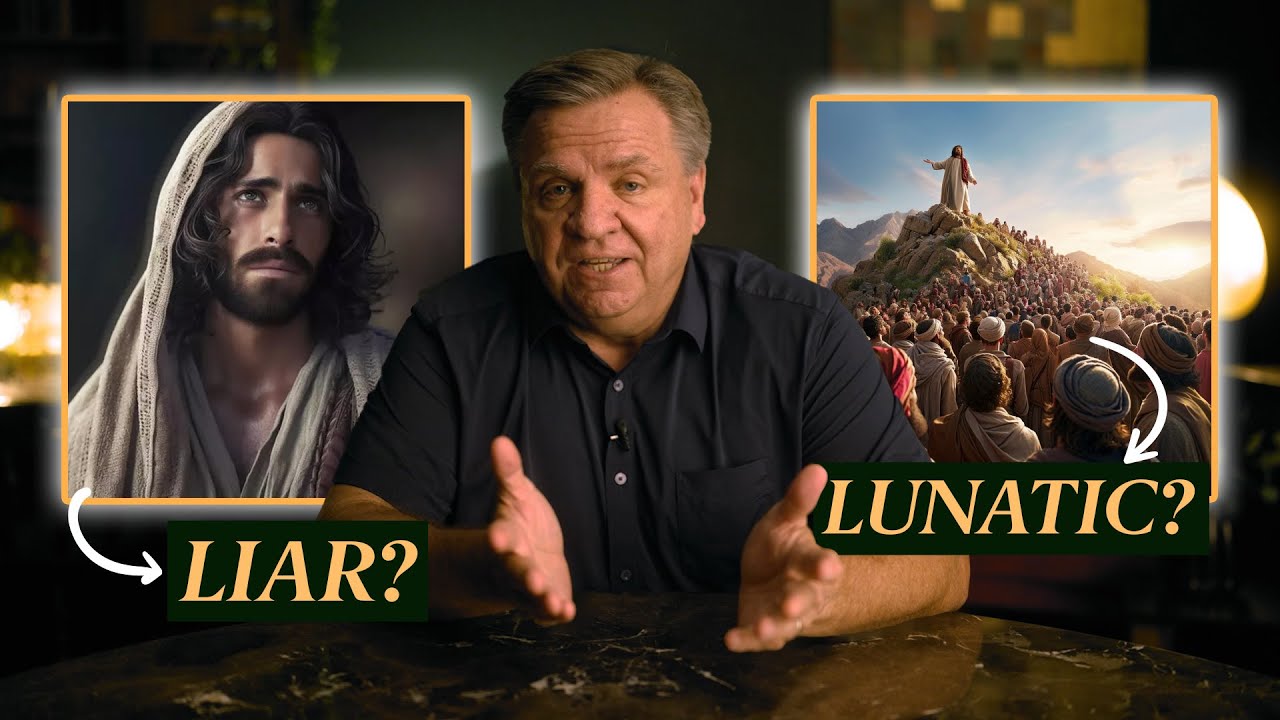
C. S. Lewis, concerned that people too easily dismiss Jesus as merely a “great moral teacher,” argues that the claim to deity leaves us with only three options. This is the Lewis Trilemma :
“I am trying here to prevent anyone saying the really foolish thing that people often say about Him: I’m ready to accept Jesus as a great moral teacher, but I don’t accept his claim to be God. That is the one thing we must not say. A man who was merely a man and said the sort of things Jesus said would not be a great moral teacher. He would either be a lunatic — on the level with the man who says he is a poached egg — or else he would be the Devil of Hell. You must make your choice. Either this man was, and is, the Son of God, or else a madman or something worse. You can shut him up for a fool, you can spit at him and kill him as a demon or you can fall at his feet and call him Lord and God, but let us not come with any patronizing nonsense about his being a great human teacher. He has not left that open to us. He did not intend to.” [8]
By claiming to be God, Jesus forces a choice. He is either crazy, or demonic, or the Lord God he claimed to be. If the evidence leads to the latter, then he demands and deserves our utmost allegiance.
J.
Until you discard you Polytheism, you are only a pretend Christian.
Christ and the Bible don’t teach it- and I KNOW you know it.
Article 8: The Trinity.
In keeping with this truth and Word of God we believe in one God, who is one single essence, in whom there are three persons, really, truly, and eternally distinct according to their incommunicable properties —
namely, Father, Son, and Holy Spirit.
The Father is the cause, origin, and source of all things, visible as well as invisible.
The Son is the Word, the Wisdom, and the image of the Father.
The Holy Spirit is the eternal power and might, proceeding from the Father and the Son.
Nevertheless, this distinction does not divide God into three, since Scripture teaches us that the Father, the Son, and the Holy Spirit each has his own subsistence distinguished by characteristics mdash yet in such a way that these three persons are only one God.
It is evident then that the Father is not the Son and that the Son is not the Father, and that likewise the Holy Spirit is neither the Father nor the Son.
Nevertheless, these persons, thus distinct, are neither divided nor fused or mixed together.
For the Father did not take on flesh, nor did the Spirit, but only the Son. The Father was never without his Son, nor without his Holy Spirit, since all these are equal from eternity, in one and the same essence.
There is neither a first nor a last, for all three are one in truth and power, in goodness and mercy.
Article 9: The Scriptural Witness on the Trinity.
All these things we know from the testimonies of Holy Scripture as well as from the effects of the persons, especially from those we feel within ourselves.
The testimonies of the Holy Scriptures, which teach us to believe in this Holy Trinity, are written in many places of the Old Testament, which need not be enumerated but only chosen with discretion.
In the book of Genesis God says, “Let us make man in our image, according to our likeness.” So “God created man in his own image”-- indeed, "male and female he created them."6 "Behold, man has become like one of us."7
It appears from this that there is a plurality of persons within the Deity, when he says, “Let us make man in our image”-- and afterwards he indicates the unity when he says, “God created.”
It is true that he does not say here how many persons there are — but what is somewhat obscure to us in the Old Testament is very clear in the New.
For when our Lord was baptized in the Jordan, the voice of the Father was heard saying, “This is my dear Son”;8 the Son was seen in the water; and the Holy Spirit appeared in the form of a dove.
So, in the baptism of all believers this form was prescribed by Christ: "Baptize all people in the name of the Father, and of the Son, and of the Holy Spirit."9
In the Gospel according to Luke the angel Gabriel says to Mary, the mother of our Lord: "The Holy Spirit will come upon you, and the power of the Most High will overshadow you; and therefore that holy one to be born of you shall be called the Son of God."10
And in another place it says: "The grace of our Lord Jesus Christ, and the love of God, and the fellowship of the Holy Spirit be with you."11
"There are three who bear witness in heaven — the Father, the Word, and the Holy Spirit — and these three are one."12
In all these passages we are fully taught that there are three persons in the one and only divine essence. And although this doctrine surpasses human understanding, we nevertheless believe it now, through the Word, waiting to know and enjoy it fully in heaven.
Furthermore, we must note the particular works and activities of these three persons in relation to us. The Father is called our Creator, by reason of his power. The Son is our Savior and Redeemer, by his blood. The Holy Spirit is our Sanctifier, by his living in our hearts.
This doctrine of the holy Trinity has always been maintained in the true church, from the time of the apostles until the present, against Jews, Muslims, and certain false Christians and heretics, such as Marcion, Mani, Praxeas, Sabellius, Paul of Samosata, Arius, and others like them, who were rightly condemned by the holy fathers.
And so, in this matter we willingly accept the three ecumenical creeds — the Apostles’, Nicene, and Athanasian — as well as what the ancient fathers decided in agreement with them.
Gen. 1:26-27.
Gen. 3:22.
Matt. 3:17.
Matt. 28:19.
Luke 1:35.
2 Cor. 13:14.
1 John 5:7.
Article 10: The Deity of Christ.
We believe that Jesus Christ, according to his divine nature, is the only Son of God-- eternally begotten, not made nor created, for then he would be a creature.
He is one in essence with the Father; coeternal; the exact image of the person of the Father and the "reflection of his glory,"13 being in all things like him.
He is the Son of God not only from the time he assumed our nature but from all eternity, as the following testimonies teach us when they are taken together.
Moses says that God “created the world”;14 and John says that "all things were created by the Word,"15 which he calls God. The apostle says that "God made the world by his Son."16 He also says that "God created all things by Jesus Christ."17
And so it must follow that he who is called God, the Word, the Son, and Jesus Christ already existed when all things were created by him.
Therefore the prophet Micah says that his origin is "from ancient times, from eternity."18 And the apostle says that he has "neither beginning of days nor end of life."19
So then, he is the true eternal God, the Almighty, whom we invoke, worship, and serve.
Col. 1:15. Heb. 1:3.
Gen. 1:1.
John 1:3.
Heb. 1:2.
Col. 1:16.
Mic. 5:2.
Heb. 7:3.
He is true and eternal God, as the Holy Scriptures teach us.
J.
You’re a CATHOLIC? I would have never quessed!
You are dismally ignorant, aren’t you?
J.
Now insulting. That’s what Trinnies do…
Can you feel the love? Maybe if you stick with commandments instead of theology and denominations that only cause quarrels then you would love each other.
I changed my mind. Ive decided to stay, until my next mental breakdown that is. Im weak but thats ok. Gods power is perfected in weakness. Im glad im weak. It keeps me humble. Praise the Lord. God loves the weak.
1 Corinthians 1:**26 **For [k]you see your calling, brethren, that not many wise according to the flesh, not many mighty, not many [l]noble, are called. **27 **But God has chosen the foolish things of the world to put to shame the wise, and God has chosen the weak things of the world to put to shame the things which are mighty; **28 **and the [m]base things of the world and the things which are despised God has chosen, and the things which are not, to bring to nothing the things that are, **29 **that no flesh should glory in His presence. **30 **But of Him you are in Christ Jesus, who became for us wisdom from God—and righteousness and sanctification and redemption— **31 **that, as it is written, “He who glories, let him glory in the Lord.”