How can that possibly be?
Where, in Scripture, do you find this @Pater15 ?
J.
1 Like
Hello Johann!
Gal 6 - “3. If anyone thinks they are something when they are not, they deceive themselves. 4. Each one should test their own actions. Then they can take pride in themselves alone, without comparing themselves to someone else”
This is a little bit of a challenge to make solid sense of, in addition to being a passage that helps in closing some loops for us with regard to evil in the world. I do sound like a broken record, but it IS why we are on the earth.
Your brother
That’s a great passage to bring up. I’ve wrestled with it too. It seems like Paul is warning against inflated pride in verse 3, but in verse 4, he’s pointing to a different kind of pride; maybe something closer to healthy self-respect or taking ownership of our walk with God.
To me, it’s less about boasting and more about accountability. Like, don’t measure yourself by comparison, but by whether you’re walking faithfully. There’s something freeing in that.
Curious to hear how others read it.
2 Likes
This passage has nothing to do with καύχημα as pride of/IN self, because Paul is not addressing self exaltation but self deception through false measurement, and the grammar will not support a reading that turns verse 4 into an endorsement of ego or inward glory. @Pater15
καύχημα
Gal_6:2 — “Burdens” (Greek: baros) is “weight.” Bear one another up in frailty, weakness, grief, tension or pressure. “A load is half a load when two are carrying it.”
Gal_6:3 — This is one of Paul’s sledgehammer blows against pride.
Gal_6:4 — This is also a characteristic statement of Paul, that a man needs to keep close tab on his own life’s work (see 1Co_16:13; 2Co_13:5).
Gal_6:5 — “Burden” (Greek: phortion) is something to be borne, as a ship’s cargo; a child in the womb; a responsibility. Dr. Phillips has a good interpretation: “Shoulder his own pack.”
There are burdens you can share; there are burdens you must bear alone. We are born alone, become sick alone, suffer alone, face problems alone, and go through the valley of the shadow of death alone.
We go before the judgment seat of Christ alone (see Rom_14:12; 2Co_5:10).
-
"For if a man think himself to be something " (ei gar dokei tis einai ti) “For if anyone thinks (presumes) to be something,” himself. If one is conceited, deluded, wholly trusts in the flesh of himself, Rom_12:3; 1Co_8:2; 2Co_3:5. Any sufficiency a child of God has is of Christ.
-
“When he is nothing,” (meden on) “Yet, being nothing,” not being one thing, apart from God’s mercy and goodness, La 3:22; Act_17:28.
-
“He deceiveth himself,” (phrenapata heauton) “He deceives or deludes himself;” not God, nor others, Gal_6:7; 1Jn_1:8; Even children of God, trusting in the flesh, may deceive themselves as Peter did, and all the disciples in denying the Lord, and fleeing in the time of his betrayal and persecution, Mat_26:35-36.
Someone has well written:
"Beware of Peter’s words, nor confidentially say, never deny my Lord But trust / never may.
Gal 6:3 For if any person thinks himself to be somebody [too important to condescend to shoulder another’s load] when he is nobody [of superiority except in his own estimation], he deceives and deludes and cheats himself.
Gal 6:4 But let every person carefully scrutinize and examine and test his own conduct and his own work. He can then have the personal satisfaction and joy of doing something commendable [N1in itself alone] without [resorting to] boastful comparison with his neighbor.
Gal 6:5 For every person will have to bear (N1be equal to understanding and calmly receive) his own [N2little] load N3[of oppressive faults].
Gal 6:6 Let him who receives instruction in the Word [of God] share all good things with his teacher [contributing to his support].
Gal 6:7 Do not be deceived and deluded and misled; God will not allow Himself to be sneered at (scorned, disdained, or mocked N1by mere pretensions or professions, or by His precepts being set aside.) [He inevitably deludes himself who attempts to delude God.] For whatever a man sows, that and N2that only is what he will reap.
AMP.
Gal 6:1 Brethren, if a man be overtaken in a fault, ye which are spiritual, restore such an one in the spirit of meekness; considering thyself, lest thou also be tempted.
Gal 6:2 Bear ye one another’s burdens, and so fulfil the law of Christ.
Gal 6:3 For if a man think himself to be something, when he is nothing, he deceiveth himself.
Gal 6:4 But let every man prove his own work, and then shall he have rejoicing in himself alone, and not in another.
Gal 6:5 For every man shall bear his own burden.
Gal 6:6 Let him that is taught in the word communicate unto him that teacheth in all good things.
Gal 6:7 Be not deceived; God is not mocked: for whatsoever a man soweth, that shall he also reap.
Gal 6:8 For he that soweth to his flesh shall of the flesh reap corruption; but he that soweth to the Spirit shall of the Spirit reap life everlasting.
Gal 6:9 And let us not be weary in well doing: for in due season we shall reap, if we faint not.
Gal 6:10 As we have therefore opportunity, let us do good unto all men, especially unto them who are of the household of faith.
καύχημα
kaúchēma; gen. kauchḗmatos, neut. noun from kaucháomai (G2744), to boast.
(I) The result of boasting, a boast (Heb_3:6 referring to the boast of hope, meaning the hope in which we glory). A boast in regard to anything (2Co_5:12; 2Co_9:3). Used in an absolute sense (1Co_5:6).
(II) It also refers to the object of boasting, ground of glorying, exultation (Rom_4:2; 1Co_9:15-16; 2Co_1:14; Gal_6:4; Php_1:26; Php_2:16; Sept.: Deu_10:21; Pro_17:6; Jer_17:14). Contrasted to kaúchēsis (G2746), the act of boasting.
Syn.: alazoneía (G212), thinking of oneself higher than one really is, arrogant display, boasting, pride; huperēphanía (G5243), pride, appearing above others; huperochḗ (G5247), superiority; mataiótēs (G3153), vanity; kenodoxía (G2754), vainglory; dóxa (G1391), glory, dignity, honor.
Ant.: atimía (G819), shame, dishonor; aischúnē (G152), shame; entropḗ (G1791), introspection, withdrawal, shame; aidṓs (G127), modesty, bashfulness arising from moral conviction; aschēmosúnē (G808), unseemliness, shame.
Word studies.
καύχημά kaúchçmá (1) N-ASN
should make my glorying void 1Co_9:15, w/G2758 G3450
καύχημα kaúchçma (4)
may rejoice Php_2:16, w/G1519
rejoicing Gal_6:4, Heb_3:6
whereof to glory Rom_4:2
καύχημα kaúchçma (5)
boasting 2Co_9:3
glorying 1Co_5:6
rejoicing 2Co_1:14, Php_1:26,
to glory of 1Co_9:16
καυχήματος kauchḗmatos (1) N-GSN
to glory 2Co_5:12
English to Strong’s
boasting G2744, G2745, G2746, G3004
glory G1391, G1392, G2620, G2744, G2745, G2746, G2755, G2811
glorying G2744, G2745, G2746
rejoicing G275, G2745, G2746, G5463
J.
2 Likes
I was going to jump in here, but well, I guess I just did. I do like Johann’s answer. Just like all things, the devil takes what is, twists it, and turns it wicked. Pride in and of itself is not sinful.
Finding joy in your work as a gift from God, Ecclesiastes 2:24. Appreciation of Gifts: Acknowledging and using abilities for God’s glory, not just your own. Joy in Others: Being proud of the achievements of family or fellow believers, 2 Corinthians 7:4, ETC. This positive pride is rooted in humility, recognizing God’s role in your successes. The Difference: The crucial distinction is whether pride leads you away from God, which is sinful, Homosexuality, Idol of self, working for riches and fame, or to God, which is righteousness, as seen in the “poor in spirit” who recognize their need for God, Matthew 5:3.
Peter
2 Likes
I think there’s a misunderstanding here Peter.
The above statement as written is imprecise and requires careful qualification, because Scripture does not treat pride as a morally neutral category that only becomes sinful in certain expressions, but consistently evaluates pride by its object, direction, and grounding.
In biblical usage, pride when defined as self elevation, self sufficiency, or self comparison is repeatedly and explicitly condemned, as seen in ~Proverbs 16 .18 Berean Literal Bible, Pride goes before destruction, and a haughty spirit before a fall, and in ~Proverbs 8. 13 Berean Literal Bible, The fear of the LORD is to hate evil, pride and arrogance and the evil way, where pride itself is listed as an object of divine hatred, not merely its excesses.
In the New Testament, Paul frames pride as a distortion of self perception before God, not merely an attitude that can be redirected, as in ~Romans 12.3 Berean Literal Bible, For through the grace given to me I say to everyone among you not to think more highly of himself than he ought to think, but to think so as to have sound judgment, indicating that inflated self regard is already a moral failure rather than a neutral disposition.
What Scripture does allow is not pride but rejoicing or confidence grounded outside the self, and this distinction is crucial, because biblical language permits boasting only when its object is the Lord and His work, not the self, as stated in ~Jeremiah 9.23 to 24 Berean Literal Bible, Let not the wise man boast in his wisdom, and let not the mighty man boast in his might, let not the rich man boast in his riches, but let him who boasts boast in this, that he understands and knows Me, which Paul explicitly reaffirms in ~1 Corinthians 1. 31 Berean Literal Bible, Let the one who boasts boast in the Lord.
Even passages that speak of confidence or rejoicing in one’s work, such as ~Galatians 6. 4, do not redefine pride as acceptable, because καύχημα there refers to a non comparative ground of conscience before God rather than self admiration, and Paul immediately confines all legitimate boasting to the cross alone in ~Galatians 6. 14 Berean Literal Bible, But may it never be for me to boast except in the cross of our Lord Jesus Christ, by whom the world has been crucified to me, and I to the world.
Therefore, to say Pride in and of itself is not sinful is not correct if pride is understood in the biblical sense of self elevation, self trust, or self derived worth, because Scripture consistently treats that posture as sin, while what is sometimes mislabeled as pride in modern language is actually gratitude, assurance, or rejoicing grounded in God’s grace rather than the self.
A more accurate, text governed formulation would be that Scripture condemns all pride rooted in the self, while permitting rejoicing, confidence, and assurance only when their object is the Lord and His work, especially as revealed in the cross of Christ, and any formulation that blurs that distinction risks softening what Scripture treats with remarkable consistency and severity.
G212
Total Occurrences: 2
ἀλαζονεία alazoneía (1) N-NSF
pride 1Jn_2:16
ἀλαζονείαις alazoneíais (1) N-DPF
boastings Jam_4:16
English to Strong’s
boastings G212
pride G212, G5187, G5243
ἀλαζονεία
alazoneía; gen. alazoneías, fem. noun from the adj. alazṓn (G213), a boaster. Ostentation, boasting about what one is not or does not possess. Someone going about with empty and boastful professions of cures and other feats. An alazṓn shows off that which he thinks or pretends he possesses. An ostentatious quack. A boast or boasting (Jas_4:16). As joined with bíos (G979), life, it means the period of extension or duration of life as contrasted to zōḗ (G2222) which means the breath of life. Therefore, alazoneía toú bíou in 1Jn_2:16 means showing off to fellow mortals; the pride, pomp, or manner of life; the ambitious or vainglorious pursuit of the honors, glories, and splendors of this life; the luxury of life for the purpose of showing off, whether in dress, house, furniture, servants, food.
Syn.: kenodoxía (G2754), the act of pretending to be what one is not; kaúchēsis (G2746), the act of boasting in a good or bad sense; kaúchēma (G2745), the boast itself in a good or bad sense; huperēphanía (G5243), pride, the desire to show off what one may be or have in comparison with others, thus appearing above them.
Word studies.
τυφόω
tuphóō; contracted tuphṓ, fut. tuphṓsō, from túphos (n.f.), smoke. To swell or inflate with pride. In the pass. tuphóomai, to be lifted up with pride (1Ti_3:6; 1Ti_6:4; 2Ti_3:4).
Deriv.: tuphlós (G5185), blind.
Syn.: hupsēlophronéō (G5309), to be high-minded; epaíromai (G1869), to exalt self; huperaíromai (G5229), to become haughty, proud; phusióō (G5448), to inflate, make proud, puff up; huperéchō (G5242), to hold oneself above others.
Word studies.
I know, I know, I’m a pain…
J.
1 Like
Pain in ones body, indicates something is wrong!
a pain in a forum is a call to think again.
Pride, what’s it rooted in?
Is a case of “ I’ve done a hard days good work “ or I’m good as I’ve done a good days work!
To me the first is a recognition that one has worked hard and achieved something while the second is praising ones self for having worked.
Ultimately we should give praise and glory to God for our ability to do things, he gave us that ability.
In life we will be praised by others, by our boss etc etc and we should accept that praise for the recognition by others that one has done well. Again we can thank God for his giving us that ability.
1 Like
Right! @johann @who-me Pain is caused by healthy exercise, which serves to strengthen. Or setting a broken bone, which serves to bring to health. Or excises a tumor, which saves a life.
When it comes to bringing clarity to God’s word, give us all the pain you can dish out! Lol!
2 Likes
God says we can be proud of ourselves when we make good choices. Because the ability to make choices is genuine. We exercise our free will a thousand times a day. These are the choices we make - ourselves, alone.
And it’s always the same set of choices. Do we choose to believe God when He says that it’s better to give than receive? Or believe God when He says to carry each other’s burdens? Do we believe Him when He says to love our enemies, and pray for those who despitefully use us?
Our actions tell the tale of what we actually really believe. Our actions reflect what we believe in our heart of hearts.
One of the fundamentals of being human that God created in us is that we always do what we believe is in our best interest at the moment. Of all the choices that are available to us at any given time, we will pick the one that we think is best for us. Isn’t it always best for us to believe God?
Wouldn’t it be great if God tells us that we can be proud of ourselves when we test our actions against His word, believe Him to be telling the truth, obey Him in all humility, and thank Him for revealing Himself in a meaningful way in that situation, and giving us the strength to make the best choice? Follow through with positive actions and feel good about it, rather than wounding our conscience for the millionth time?
Wouldn’t it be great if we could be righteously proud of ourselves for that, comparing ourselves to His will rather than to other people?
Since I was tagged, I thought I would share my thoughts, for what they are worth.
Personally, I believe we will only land on the Apostle’s specific intent for this verse by having a firm grasp of his greater intent found in the surrounding context in which it resides. Only by understanding what were the specific Galatian problems can we hope to better understand what the Apostle was implying as he was helping them to subdue them. When we better understand the Apostle, we can better understand God’s application for us. The context: Galatians 5:8 - 6:10
The problem the apostle is addressing is the Galatians naive openness to teachers bringing in doctrine contrary to the Gospel of Grace. Their ideologies are foreign to the truth, and like leaven, left unchecked will leaven the whole congregation.
“This persuasion does not come from Him who calls you. A little leaven leavens the whole lump. I have confidence in you, in the Lord, that you will have no other mind; but he who troubles you shall bear his judgment, whoever he is.”
The chaos that ensues from the introduction of foreign doctrine makes it difficult for the average Christian to know what should be heeded, and what should be rejected.
“For you, brethren, have been called to liberty; only do not use liberty as an opportunity for the flesh, but through love serve one another. For all the law is fulfilled in one word, even in this: “You shall love your neighbor as yourself.” But if you bite and devour one another, beware lest you be consumed by one another! “
The apostle is encouraging an attitude of love, humility, and peacemaking; the new man, walking in-step with The Holy Spirit of God, and not listening to the old man with his desires of the flesh.
“I say then: Walk in the Spirit, and you shall not fulfill the lust of the flesh. For the flesh lusts against the Spirit, and the Spirit against the flesh; and these are contrary to one another, so that you do not do the things that you wish. But if you are led by the Spirit, you are not under the law. Now the works of the flesh are evident, which are: adultery, fornication, uncleanness, lewdness, idolatry, sorcery, hatred, contentions, jealousies, outbursts of wrath, selfish ambitions, dissensions, heresies, envy, murders, drunkenness, revelries, and the like; of which I tell you beforehand, just as I also told you in time past, that those who practice such things will not inherit the kingdom of God. But the fruit of the Spirit is love, joy, peace, longsuffering, kindness, goodness, faithfulness, gentleness, self-control. Against such there is no law. And those who are Christ’s have crucified the flesh with its passions and desires. If we live in the Spirit, let us also walk in the Spirit. Let us not become conceited, provoking one another, envying one another.”
Walking in The Spirit is how to avoid becoming conceited (Gk: kenódoxos; vain glory. It denotes a person who is void of real worth but who wants to be admired by others), which results in provoking one another and envying one another. There is always someone who is not led by The Spirit but who wants to be noticed, and considered wise. Paul considers this attitude to be destructive. Because this foreign doctrine is coming into the church, there will necessarily need to be correction, but Spiritual correction does not resemble correction in the flesh; Spiritual correction is recognized by the fruit of The Spirit.
Now, how should correction be handled?
"Brethren, if a man is overtaken in any trespass, you who are spiritual (led by the Spirit) restore such a one in a spirit of gentleness, considering yourself lest you also be tempted (in humility). Bear one another’s burdens, and so fulfill the law of Christ.”
Bear on another’s burdens? This is the spirit of serving, of “ranking under”, of being lowly, meekness, patience, lightening the load that someone else is carrying out of love, and caring for the health of The Body of Christ. It stands is stark contrast to someone who compares themselves to others, who habitually levels accusations, who unsympathetically barks out corrections, who look down on the burdened, who capitalize on other people’s difficulties, using the burden of another as a means to look smarter than others, usually just parroting the wisdom of someone else without attribution, and hoping others will see their wise counsel as coming from them. This person actually deceives themselves; this person cannot see themselves.
“For if anyone thinks himself to be something, when he is nothing, he deceives himself. But let each one examine his own work, and then he will have rejoicing (Gk: échō kaúchēma, implying continued possession of boasting) in himself alone, and not in another. For each one shall bear his own load. “
The apostle exhorts each person to examine the actual extent of their own contribution, to see themselves as God sees them. The Spirit led helper examines what he actually personally brings to the table from The Spirit of God, and does not try to look smart. A thorough examination of personal importance brings one to his knees, realizing everything they have has been given to them. A Spirit led teacher finds rejoicing in what God does through them, and thinks very little of their own personal contribution.
The emphasis of the passage that Pater15 has laid before us is not license for arrogance, but a realistic examination of our own meager contribution to the Body of Christ. We can only be please with what we have actually contributed. The apostle is reminding us of how Jesus evaluates personal contribution and devotion, like the poor widow who gave only two mites, but it was all she had.
2-cents
KP
The rest of the “context” for consideration, shared here due to the 6000 character limit.
Let him who is taught the word share in all good things with him who teaches (commonwealth) Do not be deceived, God is not mocked; for whatever a man sows, that he will also reap. For he who sows to his flesh will of the flesh reap corruption, but he who sows to the Spirit will of the Spirit reap everlasting life. And let us not grow weary while doing good, for in due season we shall reap if we do not lose heart. Therefore, as we have opportunity, let us do good to all, especially to those who are of the household of faith.
@kpuff Boffo man! Nice post. Lots of nice posts in this very stimulating discussion thread!
If I may take it in a slightly different direction for a moment, two things to explore from @KPuff
- “to see themselves as God sees them”
And,
- “The emphasis of the passage that Pater15 has laid before us is not license for arrogance, but a realistic examination of our own meager contribution to the Body of Christ. We can only be please with what we have actually contributed. The apostle is reminding us of how Jesus evaluates personal contribution and devotion, like the poor widow who gave only two mites, but it was all she had.”
How does God see us? What are we in the first place?
We are each a person, created individually by God. Body, soul and spirit. The body part of us WILL NOT PERSIST beyond our very brief lives on this earth. We live, temporarily in our bodies, that change every day, and are often consumed by our concerns for its care (what shall we eat, what shall we wear) and for concerns about its comparative value.
I remember being slightly offended at God over His descriptions of Queen Esther. How beautiful and wise and desirable she was. Sounded like He was praising His own work to me. How unfair is that? Not something to write a whole book of the Bible about. What about the ugly and dense people of the world? Didn’t You create them too? Don’t they deserve to be loved too? Don’t they deserve a shot at greatness?
Like the poor widow and her two mites, that everyone might be tempted to have contempt for. She’s not much to look at in this world. Not much to be proud of there. No great person to see.
But that’s not how God sees her. God sees that she gave every bit she had. Even in her dire situation and her brutal poverty, she cared about helping others. That’s who she decided to be. A great woman, remembered through eternity for her greatness.
“ALL she had” isn’t a tithe. God asked for a tithe. But she decided to believe the whole of God’s word, follow the guidance of the Spirit, and give it all, to honor God and to help others.
We all had/have the same opportunity that she had. Including Queen Esther. She didn’t rely on any of her many gifts. Even though her very life was on the line! And her whole nation! Yet she didn’t manipulate the King with her wiles. She didn’t trick him with her wisdom. She didn’t caress him to sleep with her beauty. She trusted God. That’s why she’s in the Bible. Her decisions to believe Him. Just like the poor widow.
She called all her people to turn to the God that created the universe, fasting and praying, and submitted herself to His loving will, and she told the King nothing but the truth, surrendering her life to his decision.
And again, we’re all in that same boat. We each have our own “unequal” physical context. God sees that we each make our decisions within that context that He has placed us. For those born with beauty, intelligence, and fancy dance steps, it’s easy to live an easy life and ignore the God that made them. For those born with no physical gifts it’s easy to become bitter and resentful (ultimately at God) about their comparative disadvantage. “God shouldn’t expect anything from them - look what He made!” Right?
God knows what we are. What He has equipped us with. What He’s interested in seeing is what we will decide to do, within the context He has placed us. If we decide to believe in Him, and further to believe what He says, and do what He says, in the midst of very difficult situations, which we ALL experience, in spite of the flesh that wars against us, then we have done well. Everyone has their own battles. Our actions reflect our overcoming faith, and we can be proud of that. On the inside. Nobody else made those decisions for us. We made those decisions.
I haven’t reached 6000 yet, but must be close!
Your brother
1 Like
It seems you had someone specific in mind when writing this, though I don’t understand how you get “échō kaúchēma, implying continued possession of boasting.” That’s a discussion for another day, not now, as I’m tired.
Topic is actually about pride/proud.
Gal 6:4 Rather let each one examine his own work. Then he will have pride in himself alone and not in comparison to anyone else.
Gal 6:5 For each one will carry his own load.
Tree of Life Version
Gal 6:4 But let every man prove his own work, and then shall he have rejoicing in himself alone, and not in another.
Gal 6:5 For every man shall bear his own burden.
KJV.
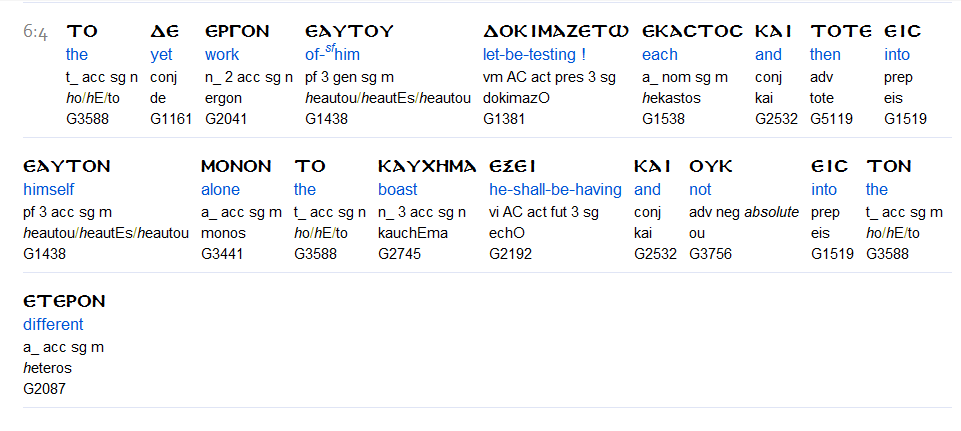
Scripture4All which I use.
Gal 6:1 Brethren, if a man be overtaken in a fault, ye which are spiritual, restore such an one in the spirit of meekness; considering thyself, lest thou also be tempted.
Gal 6:2 Bear ye one another’s burdens, and so fulfil the law of Christ.
Gal 6:3 For if a man think himself to be something, when he is nothing, he deceiveth himself.
Gal 6:4 But let every man prove his own work, and then shall he have rejoicing in himself alone, and not in another.
Gal 6:5 For every man shall bear his own burden.
Gal 6:6 Let him that is taught in the word communicate unto him that teacheth in all good things.
Gal 6:7 Be not deceived; God is not mocked: for whatsoever a man soweth, that shall he also reap.
Gal 6:8 For he that soweth to his flesh shall of the flesh reap corruption; but he that soweth to the Spirit shall of the Spirit reap life everlasting.
Gal 6:9 And let us not be weary in well doing: for in due season we shall reap, if we faint not.
Gal 6:10 As we have therefore opportunity, let us do good unto all men, especially unto them who are of the household of faith.
Gal 6:11 Ye see how large a letter I have written unto you with mine own hand.
Gal 6:12 As many as desire to make a fair shew in the flesh, they constrain you to be circumcised; only lest they should suffer persecution for the cross of Christ.
Gal 6:13 For neither they themselves who are circumcised keep the law; but desire to have you circumcised, that they may glory in your flesh.
Gal 6:14 But God forbid that I should glory, save in the cross of our Lord Jesus Christ, by whom the world is crucified unto me, and I unto the world.
Gal 6:15 For in Christ Jesus neither circumcision availeth any thing, nor uncircumcision, but a new creature.
Gal 6:16 And as many as walk according to this rule, peace be on them, and mercy, and upon the Israel of God.
Gal 6:17 From henceforth let no man trouble me: for I bear in my body the marks of the Lord Jesus.
Gal 6:18 Brethren, the grace of our Lord Jesus Christ be with your spirit. Amen. To the Galatians written from Rome.
You have a blessed day in Christ Jesus.
J.
I’m afraid I disagree with you here brother [raising my hand…]
Since this is not strictly what Scripture says, and it can be misleading in light of Paul’s argument in Galatians 6. Actions themselves do not generate legitimate grounds for boasting before God. Paul repeatedly emphasizes that any legitimate boasting is ultimately in the Lord, not in ourselves, and that self-examination is about accountability and truth, not inward pride.
For example, Galatians 6.4–5 KJV. But let every man prove his own work. and then shall he have rejoicing in himself alone. and not in another. For every man shall bear his own burden.
Here, the Greek morphology is clear: δοκιμαζέτω present active imperative commands testing one’s own work, ἕξει future active indicative simply notes the resulting possession of a καύχημα, which is a ground for rejoicing, not the act of boasting, and βαστάσει future active indicative stresses personal accountability. The emphasis is on sober self-assessment and responsibility, not pride in the sense of inward glorifying oneself.
So saying “we can be proud of that” imports a psychological or affective claim that the text never endorses. Scripture allows for recognition of God’s work through our obedience, but it does not authorize self-congratulatory pride, even “on the inside.” The focus is truthful accountability under God, not self-congratulation…
My 2 cents.
J.
Well @Johann , you know I give you the highest respect for your fluency with all the applicable languages. You should be proud of yourself. (See I can’t help it - the comedy just comes out!)
I will say that if you go to Bible Gateway, there are 64 translations listed that a person can review.
Most (way more than half) include the words “take pride in yourself”. Another large percentage include the words “then you can boast in yourself”, which was a surprise to me. Because in my opinion, you are partially making a strawman argument, in that (at least being reviewed in this thread) no one (certainly not me) is advocating for our “boasting”. Seems to me that boasting necessarily includes at least a 2 person interaction.
I’m reminded of the old church joke - “Did you hear the church awarded Brother Festus a medal for being our most humble church member? They had to take it back. He wore it to church!”
So let’s check a cross-section. Let’s say I’m not very bright at all. But I have high hopes to become a doctor. And through many long nights of arduous study, many nights on my knees in prayer, and much sacrificial self-denial, I finally achieve my goal, and graduate - a fully certificated MD. Certainly it would be unseemly to go around boasting about it. But how should I feel about what I’ve done?
You might say that I would be okay feeling an inner sense of happiness, joyful inside that I made all those hard decisions and accomplished something that is very difficult. SO what’s the word that we commonly use that means all those things? Lol just asking!
Contrasting 2 seekers - Romans 2: “7. To those who by persistence in doing good seek glory, honor and immortality, He will give eternal life. 8. But for those who are self-seeking and who reject the truth and follow evil, there will be wrath and anger.”
Would you agree that both groups are self-seeking? One seeks to find joy in the Spirit, and the other seeks to feed their flesh.
Please remember my caveat - I’m talking about our decisions that we make in 100% alignment with God’s will. Not a single thing in comparison to someone else. Not a single thing that doesn’t glorify God. The only comparison is comparing what I did, to what I could have done instead.
I can be proud (inner sense of joyful accomplishment) that I said no to my flesh, I said no to the praise of men, and I made very difficult decisions, saying yes to active sacrificial service of love to others, whom God loves every bit as much as He loves me.
It’s a happy way of life brother!
Wrong again regarding the idea that both groups are “self-seekers.” Only those rejecting God are self-seeking, those who persist in well doing seek glory and honor from God, not from themselves.
We’ve veered off topic, but it is significant that Jesus gave three imperatives that frame discipleship, deny self, take up your cross, and follow me.
Mark 8.34 KJV. And when he had called the people unto him with his disciples, he said unto them, Whosoever will come after me, let him deny himself (ἀπαρνήσασθαι ἑαυτὸν, aorist middle infinitive of ἀπαρνέομαι), and take up his cross, and follow me.
The Greek ἀπαρνήσασθαι is aorist middle infinitive, signaling decisive, volitional renunciation. It emphasizes a concrete, once-for-all decision of self-denial as the prerequisite for following Christ. This is not self-esteem, not inward boasting, and not a moderated pride, it is total orientation away from self-interest.
As Scripture consistently teaches, there is no commendation of pride. Every command, whether to deny self, test one’s own work (δοκιμαζέτω), or bear one’s own load (βαστάσει τὸ ἴδιον φορτίον, future active indicative), directs the believer toward God-centered accountability and obedience, not inward glorification or self-exaltation. Pride is repeatedly condemned, legitimate “ground for rejoicing” (καύχημα) is carefully bounded, objective, and ultimately subordinate to the cross of Christ.
καύχημα (kauchēma) pride (G2745)
(Noun Accusative Singular Neuter )
This word occurs about 11 x
Meaning
something to boast about, boasting;
pride, joy
a glorying, boasting, 1Cor. 5:6;
a ground or matter of glorying or boasting, Rom. 4:2;
joy, exultation, Phil. 1:26;
complimentary testimony, 1Cor. 9:15, 16; 2Cor. 9:3

Shalom, and enjoy Christmas, brother. Perhaps later we can return to Galatians 5–6.
Strange Perception.
Johann.
Several Shapes of Pride
If pride is preoccupation with ourselves, then we cannot defeat pride by becoming preoccupied with how we are doing against pride. When we do, we play right into the hands of pride because we take a page out of pride’s playbook. Think about yourself more. Obsess more. Become preoccupied with how you are doing — how the fight is going.
You can fall into self-exaltation (takes credit for success) and self-promotion (put those successes in other peoples faces so they will give us credit for them). But pride can shift into the shape of self-degradation and self-demotion when we beat ourselves up for our failures. We are still obsessed with ourselves. In the first form, we are obsessed with our successes; in the second, we are obsessed with our failures.
Think of Yourself Less
Maybe some of this will make more sense if we talk about what real humility is. As C.S. Lewis said, true humility is “not thinking less of ourselves, but thinking of ourselves less.” We can spend a lot of time thinking less of ourselves but we only end up thinking a lot about ourselves. The problem of pride does not boil down to whether we think high thoughts or low thoughts about ourselves but that we think lots of thoughts about ourselves.
Humility is fundamentally a form of self-forgetfulness as opposed to pride’s self-fixation. Humility can set you free because when you think about yourself less you are free to think about Christ more. Humility puts us on the path of grace; pride puts us on the path of opposition. God opposes the proud, but gives grace to the humble (James 4:6; 1 Peter 5:5).
Two Crash Sites
The collision between the glory of God and the pride of man has two possible crash sites: hell or the cross. In other words, either we will pay for our sins in hell or Christ will pay for our sins on the cross. Hell is like an eternal crash site and crime scene. It is a horror movie in which there are no closing credits because it never ends.
“The collision between the glory of God and the pride of man has two possible crash sites: hell or the cross.”
God opposes pride actively and hates it passionately, which means that pride is spiritual suicide. The reason is simple. Pride is on a collision course with God himself and the date is set. “For the Lord of hosts has a day against all that is proud and lofty, against all that is lifted up — and it shall be brought low” (Isaiah 2:12). All must be torn down so that one thing alone may be left standing. “The Lord alone will be exalted in that day” (Isaiah 2:11). The Bible calls it the day of the Lord.
But God in his mercy made another way. The Son of God emptied himself by taking on humanity and humbled himself by obeying to the point of death — even the death of the cross. God sends his Son to vindicate the worth of his great name, which sinners have defamed. The sacrifice of Christ fully absorbs and satisfies the wrath of God. This glorious aspect of the atonement is called “propitiation” (Romans 3:24–25).
The Solution to Our Self-Obsession
Seeing the cross rightly crushes our pride decisively. Why? Seeing the cross rightly means that we see ourselves rightly. We see him on the cross and conclude that we are actually seeing our sin on the cross. The cross reveals what we deserve from God. We cannot receive the grace of Christ apart from seeing and embracing the undeserved dis-grace of Christ.
We see the cross rightly through the miracle of conversion. We were blind to the glory of Christ on the cross (2 Corinthians 4:3–4), but God’s grace is stronger. When Christ is proclaimed, God overcomes our spiritual blindness by flooding our hearts with light. The eyes of the heart are opened to see and savor the glory of God in the face of Jesus Christ (2 Corinthians 4:6). The Spirit acts like a floodlight to illuminate the work of Christ on the cross.
The Bible’s answer to our fallen self-obsession is a great work of grace in the gospel that creates a worshipful obsession with God. Pride is defeated decisively at conversion, progressively in sanctification, and totally at glorification — where we experience ever-increasing, everlasting, white-hot worship of God. The day is coming when God alone will be exalted. It will be the worst day for unbelievers and the happiest day for all Christians.
https://www.desiringgod.org/messages/think-of-yourself-less#:~:text=Several%20Shapes%20of,for%20all%20Christians.
J.
You misunderstand. The question is not where the glory is coming from, but who it’s for. You could tell me that you’re not a Christian because you want to go to heaven for yourself, but I wouldn’t believe you.
He is saying every believer should be seeking their own glory and honor from God. And immortality. For ourselves. To do that, we should persist in doing good. Wouldn’t that be called “self-seeking”?
You haven’t adequately explained away the clear scripture that I offered. Our goal should be to rightly divide, and reconcile the several things that are true at once. You’re not allowed (by God) to ignore and disregard any of it.
When Jesus caught His disciples arguing over who was the greatest, He didn’t rebuke them for desiring their own greatness. He told them how to achieve greatness.
You keep raising up strawman arguments. If you like, I can be more precise.
Perfectly false. We get saved because upon the hearing of the gospel, we are convicted of sin, and righteousness, and judgement to come. We know the truth - we are a sinner, and we want to be saved. We ask God to save us. It’s the best self-interested decision we can make.
I haven’t said anything about self-esteem, inward boasting, or moderated pride. Those are your words.
You have a good Christmas too!