“But I will harden Pharaoh’s heart, and though I multiply my signs and wonders in Egypt, he will not listen to you.” - Exodus 7:3-4
This verse has always made me pause. What do you make of God hardening Pharaoh’s heart? How do we reconcile that with free will? Just curious how others have understood this tension.
Depends on how you understand freewill.
If you think it is an absolute unmoveable ability then pharaoh harden his heart through his refusal to listen to moses.
If you think freewill is movable, then God did it to make pharaoh an example to us.
@ellenvera I will be 100 percent honest here. I read this.
“And in very deed for this [cause] have I raised thee up, for to shew [in] thee my power; and that my name may be declared throughout all the earth.” Exodus 9:16
And here
“For the scripture saith unto Pharaoh, Even for this same purpose have I raised thee up, that I might shew my power in thee, and that my name might be declared throughout all the earth.” Romans 9:17
Then I thought about Judas Iscariot.
“Jesus answered them, ‘Did I not choose you, the twelve? And yet one of you is a devil.” He spoke of Judas, the son of Simon Iscariot, for he, one of the twelve, was going to betray him.” John 6:70-71
Also, here in Jesus’s prayer.
“While I was with them, I kept them in your name, which you have given me. I have guarded them, and not one of them has been lost except the son of destruction, that the Scripture might be fulfilled.” John 17:12
I thought to myself, God must create and raise those who are to be destroyed to show the power and or glory of God. I went with that one Bible study and found some became quite offended that I would say an all-loving God would create a human being to destroy them.
After this, I asked my pastor, and he said, “It’s a hard lesson. It really is a hard lesson.” SO? Is it true? Cause that was not helpful. He said that he believes that God already knows who will do what, and uses that for His power to be displayed and for His glory.
Which do I believe now? I would love to go with my pastor’s view, then everyone truly has a chance to be saved.
Peter
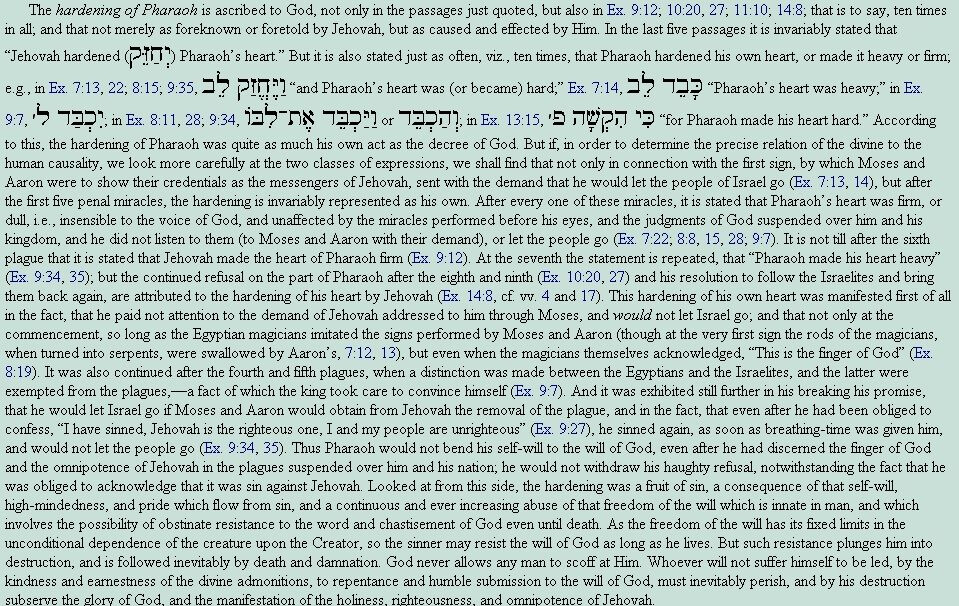
This is how I read the narrative @PeterC
If we restrict ourselves to explicit textual attributions where Pharaoh himself is the clear grammatical agent, Scripture states that Pharaoh hardened his own heart seven times, before and alongside later statements where God is said to harden it judicially, and this count depends on careful attention to subject, verb, and narrative flow rather than theological compression.
The first instance occurs after the sign of the staffs, where Pharaoh’s heart is hardened and he does not listen, with the narrative clearly attributing the resistance to Pharaoh’s response to the sign rather than divine causation ~Exodus 7:13.
The second instance follows the plague of blood, where Pharaoh’s heart is hardened again and he turns away, despite seeing the power of Yahweh, reinforcing volitional resistance to revealed truth ~Exodus 7:22.
The third instance comes after the plague of frogs, where Pharaoh explicitly hardens his heart when relief is granted, demonstrating deliberate obstinacy in response to mercy rather than compulsion ~Exodus 8:15.
The fourth instance follows the plague of gnats, where Pharaoh’s heart is hardened and he refuses to listen even when his own magicians confess “This is the finger of God,” intensifying culpability through rejected testimony ~Exodus 8:19.
The fifth instance occurs after the plague of flies, where Pharaoh hardens his heart again and does not let the people go, despite negotiated concessions and clear warning ~Exodus 8:32.
The sixth instance appears after the plague on livestock, where Pharaoh investigates the situation and still hardens his heart, showing calculated resistance grounded in self interest ~Exodus 9:7.
The seventh instance is implied in the narrative summary prior to explicit divine hardening, where Pharaoh remains unmoved by the escalating judgments and refuses repentance, culminating the pattern of self hardening before Yahweh acts judicially ~Exodus 9:34–35.
Only after this repeated self hardening does the text explicitly state that “the LORD hardened Pharaoh’s heart,” beginning at ~Exodus 9:12, marking a theological shift from human rebellion to divine judicial confirmation, not a reversal of agency but a sealing of it.
This pattern is consistent with the wider biblical principle that God’s hardening is responsive and judicial, never arbitrary, as seen in ~Psalm 81:11–12, ~Isaiah 6:9–10, and ~Romans 1:24–28, where God gives people over to what they persistently choose.
Therefore, according to the narrative itself, Pharaoh hardens his own heart seven times before God is said to harden it, establishing clear human responsibility prior to divine judgment, a sequence that safeguards God’s righteousness while exposing the cost of resisting His word, and this same principle finds its ultimate resolution at the cross, where human hardness executes Christ, yet God uses that rebellion to accomplish redemption ~Acts 2:23, ~Acts 4:27–28.
J.
Thank you so much for taking the time to respond. @Johann I see your point on Pharaoh. Is this the same as you see in Judas? Kind of like when we see things like this,
”Let every person be subject to the governing authorities. For there is no authority except from God, and those that exist have been instituted by God.” Romans 13:1
Then, when we read 1st & 2nd Kings, we see, good king, bad king, good king, etc. Not arguing, just asking.
Peter
How does the following verse fit into your exegesis of the initial source of “hardening”, since the setting for the first passage below is at the burning bush on Mt. Horeb, and the setting for the second is a subsequent word from The Lord as Moses sets out to obey?
But I am sure that the king of Egypt will not let you go, no, not even by a mighty hand. So I will stretch out My hand and strike Egypt with all My wonders which I will do in its midst; and after that he will let you go. And I will give this people favor in the sight of the Egyptians; and it shall be, when you go, that you shall not go empty-handed. (Exodus 3:19-21)
And
Then Moses took his wife and his sons and set them on a donkey, and he returned to the land of Egypt. And Moses took the rod of God in his hand. And the LORD said to Moses, "When you go back to Egypt, see that you do all those wonders before Pharaoh which I have put in your hand. But I will harden his heart, so that he will not let the people go. Then you shall say to Pharaoh, 'Thus says the LORD: “Israel is My son, My firstborn. So I say to you, let My son go that he may serve Me. But if you refuse to let him go, indeed I will kill your son, your firstborn.” (Exodus 4:20-23)
Just asking for your perspective.
Thanx
KP
I don’t want to be combative, but are you guys referring to God’s causation or His foreknowledge?
hardened. Exo_7:4; Exo_7:14; Exo_7:22, +Exo_4:21; Exo_8:15; %Exo_8:32; Exo_9:12; %Exo_9:34; Exo_10:1; Exo_10:20; Exo_10:27; Exo_11:10; Exo_14:4; Exo_14:17, +*Deu_2:30, %1Sa_6:6, Zec_7:11-12, *Jhn_12:40, Rom_1:28; Rom_2:5; *Rom_9:18, Heb_3:7-8; Heb_3:13.
Plague / Verse Hebrew Verb Subject Type of Hardening Notes / Context
- Staff → snake (~Exodus 7:13) וַיַּחֲזֵק (vayachazek) Pharaoh implied (nominative: “Pharaoh’s heart”) Self Heart hardened in response to Moses/Aaron’s sign; God’s word predictive only (“as the LORD had said”).
- Nile → blood (~Exodus 7:22) חָזַק (chazaq) Pharaoh Self Pharaoh refuses to let Israel go after plague; explicit volitional resistance.
- Frogs (~Exodus 8:15) וַיִּקְשֶׁה (vayiqsheh) Pharaoh Self Pharaoh relents after plague ends but then hardens heart again; shows deliberate stubbornness.
- Gnats (~Exodus 8:19) חָזַק (chazaq) Pharaoh Self Pharaoh’s magicians admit God’s finger; Pharaoh still refuses; volitional.
- Flies (~Exodus 8:32) וַיַּחְזֵק (vayachazek) Pharaoh Self Pharaoh hardened heart after temporary concessions; repeated refusal.
- Livestock (~Exodus 9:7) חָזַק (chazaq) Pharaoh Self Pharaoh inspects plague results, still refuses; moral resistance.
- Boils (~Exodus 9:34–35) וַיַּחְזֵק (vayachazek) Pharaoh Self Pharaoh hardens heart yet again after seeing devastation; shows repeated choice.
- Hail (~Exodus 9:12) וַיִּכְבְּד (vayikbed) LORD (explicit) Divine / Judicial God now hardens Pharaoh’s heart, confirming prior resistance for judgment and revelation.
- Locusts (~Exodus 10:1, 20) וַיִּכְבְּד (vayikbed) LORD (explicit) Divine / Judicial Continuation of judicial hardening; Pharaoh fully entrenched in rebellion.
- Darkness (~Exodus 10:27) וַיִּכְבְּד (vayikbed) LORD (explicit) Divine / Judicial Culmination; God displays power and justice while Pharaoh’s agency remains evident.
Key observations my brothers.
The first seven plagues consistently show Pharaoh hardening his own heart, either explicitly or via intransitive verbs where the subject is Pharaoh.
The predictive statements from God (Exodus 3:19–21; 4:21) are foreknowledge, not causation.
Starting with the eighth plague (hail), the text explicitly names God as the agent, signaling judicial hardening in response to Pharaoh’s repeated, voluntary rebellion.
This pattern preserves human responsibility first and divine judicial hardening second, illustrating God’s sovereignty and justice without making Him the author of sin.
Ellicott’s Commentary for English Readers
(13) He hardened Pharaoh’s heart.—This is a mis-translation. The verb is intransitive, and “Pharaoh’s heart” is its nominative case. Translate, “Pharaoh’s heart hardened itself.” It is essential to the idea of a final penal hardening that in the earlier stages Pharaoh should have been left to himself.
Barnes’ Notes on the Bible
And he hardened - Or Pharaoh’s heart was hardened. See Exodus 4:21.
Gill’s Exposition of the Entire Bible
And he hardened Pharaoh’s heart,… Or, “notwithstanding the heart of Pharaoh was hardened”
Which agree with the text here…
Verb form: וַיַּחֲזֵק (vayachazek) is qal perfect with vav conversive. The qal stem is active, meaning the subject performs the action. If God were the agent, the text would typically indicate that with a pronoun or direct object construction explicitly naming Yahweh as subject.
Subject agreement: In the Hebrew, the verb is 3rd person masculine singular, which grammatically agrees with Pharaoh, the last male subject introduced in the narrative (~Exodus 7:10–12). Hebrew narrative often continues the implied subject from the preceding context unless otherwise specified.
Contextual narrative clues: The verse begins with Pharaoh performing the action (“and he hardened his heart”), followed by a consequence clause: “that he hearkened not unto them.” The text emphasizes Pharaoh’s volitional response to God’s signs. If God were the agent of hardening at this stage, the narrative would need to shift subject or use a causative stem, which it does not.
However…
In later verses where God explicitly hardens Pharaoh’s heart (~Exodus 9:12, 10:1), the Hebrew text switches to a causative construction and clearly names Yahweh as the agent, removing any ambiguity. The fact that Exodus 7:13 does not do this strongly supports that Pharaoh is the subject here.
Predictive clause: “As the LORD had said” (כַּאֲשֶׁר דִּבֶּר יְהוָה) functions as a fulfillment of foreknowledge, not as grammatical evidence that God is performing the hardening. The morphology of vayachazek itself remains active with Pharaoh as the implied subject.
In sum, Hebrew grammar + narrative context + comparative verb usage all converge: the subject performing the hardening in Exodus 7:13 is Pharaoh, with God’s statement serving as predictive confirmation rather than causative action.
Taken together-morphology, subject agreement, context, and comparative analysis-the text clearly presents Pharaoh as the one hardening his own heart in Exodus 7:13, with God’s words functioning as predictive foreknowledge that will be fulfilled. God is not the causative agent here; He only later judicially hardens Pharaoh after repeated volitional rebellion.
Shalom.
J.
Great! Thanx.
Can you do that for Exodus 4:20-23, can you give it the same Johannian linguistic. critique.
(I don’t speak for @PeterC, but I sure don’t think you’re trying to be “combative” when you ask that question. To answer, I wasn’t referring to either “God’s causation or His foreknowledge”. I was simply asking you to exegete a passage.)
Peace Bro.
KP
That’s a thoughtful question. I’ve often seen it as both divine judgment and human pride working together. Pharaoh hardened his heart first (Ex. 8:15, 8:32), and then God confirmed that hardness for His purposes. It’s sobering, but it shows how God’s sovereignty and justice are never at odds, even when they challenge our understanding.
1 Like
Beautifully said, short and poignant Jenny.
J.
1 Like
Now that is the question, is it not? As with the Kings, as with Judas, as with those who crucified Jesus. Yes, there were many individuals that did so. Those who beat Him. The man who drove the spikes, those who lifted the Cross, ETC. Is it ALL merely God’s foreknowledge? His ability to use Joe Shom because He knew he would drive the nails, or did He create him for that purpose?
I think I used this analogy here, maybe not, but I am a Father of four. I’m in no way God, nor do I claim to see the future, yet, if I want someone to help someone in crisis, I will not ask my youngest daughter. I would ask my oldest. I knew she would be doing something to help people, has her whole life. Now 33, with 2 Master’s Degrees in Psychology. My youngest? couldn’t care less. Just not the person she is. My boys? I can see one being some sort of tech, or even, to my shegrin, a justice warrior. My other son? WWE Wrestler.
God is much more, well, everything, than I, so does He know who will do what? Or is He the causation to ensure that His plans are fulfilled?
Oh, and yeah, I did not take you being combative either.
Peter
1 Like
God’s middle knowledge (from GotQuestions.org):
“An analogy to middle knowledge from mathematics is the “Order of Operations,” sometimes known as PEMDAS. The order of operations sets the proper sequence of tasks to be done in arithmetic: Parentheses, Exponents, Multiplication, Division, Addition, and Subtraction. None of these operations happen “before” or “after” another in a chronological sense, but do occur “before” or “after” in a logical sense. That is, when we calculate “(1+2) x 3 = 9,” 1 and 2 are added “earlier,” with multiplication by 3 “later,” only in the logical sense of “earlier” and “later,” not in terms of the passage of time; there is no time involved. Order of Operations simply explains the logical order in which these concepts play out. In much the same way, the concept of middle knowledge implies a logical—not chronological—progression in God’s knowledge, as follows:
Natural knowledge: what “can” happen (independent of God’s control).
Middle knowledge: what “would” happen (independent of God’s control).
Creative command: God’s choice, action, intervention, etc.
Free knowledge: what “will” happen (completely under God’s control).
Calvinism and Arminianism hold that the salvation of any particular person is determined, respectively, entirely by God’s direct action or entirely by human choice. In rough terms, this is seen as a debate over the interplay between God’s sovereignty and human free will. Molinism, in essence, upholds both real free will and God’s total sovereignty, through the use of middle knowledge. By this, it is claimed that God knows all things a free creature would do in all possible circumstances, and so infallibly enacts His will through those circumstances, rather than directly overriding that creature’s freedom.”
SO your analogy is a good one @PeterC , you already know what your kids will do in their situations. You’re the father annd you know them, and likewise, God knows what any of His free creatures WOULD freely do in every situational context they find themselves, and He thereby uses their free decisions to get His point across.
@Johann thanks again for your analysis.
Your brother
You’re raising the exact tension Scripture presents between God’s foreknowledge and human agency. God, unlike us, perfectly knows the course of every heart and every choice, but foreknowledge does not equal moral causation. Just as your children have natural dispositions and life trajectories that you can foresee, God knows the inclinations and decisions of every person, yet He does not create someone as a sinner to commit evil.
When it comes to Pharaoh, Judas, or those who crucified Jesus, each acted according to their own desires and intentions. God’s omniscience allowed Him to use those freely made choices to accomplish His redemptive purposes, but He remains blameless for the sin itself. Acts 2:23 and Romans 3:10–18 show this: the evil acts were real human choices, yet God’s plan for salvation was fulfilled through them.
In short, Scripture presents a balance: human responsibility for evil choices remains intact, while God’s foreknowledge and sovereign orchestration guarantee His purposes are never thwarted. God’s knowledge of what someone will do is infinitely beyond our analogy with children, but the principle is the same: knowing does not mean causing them to sin.
Shalom brother.
J.
Good that you bring this in the discussion brother.
Calvinism and Arminianism are two systems of theology that attempt to explain the relationship between God’s sovereignty and man’s responsibility in the matter of salvation. Calvinism is named for John Calvin, a French theologian who lived from 1509-1564. Arminianism is named for Jacobus Arminius, a Dutch theologian who lived from 1560-1609.
Both systems can be summarized with five points. Calvinism holds to the total depravity of man while Arminianism holds to partial depravity. Calvinism’s doctrine of total depravity states that every aspect of humanity is corrupted by sin; therefore, human beings are unable to come to God on their own accord. Partial depravity states that every aspect of humanity is tainted by sin, but not to the extent that human beings are unable to place faith in God of their own accord. Note: classical Arminianism rejects “partial depravity” and holds a view very close to Calvinistic “total depravity” (although the extent and meaning of that depravity are debated in Arminian circles). In general, Arminians believe there is an “intermediate” state between total depravity and salvation. In this state, made possible by prevenient grace, the sinner is being drawn to Christ and has the God-given ability to choose salvation.
Calvinism includes the belief that election is unconditional, while Arminianism believes in conditional election. Unconditional election is the view that God elects individuals to salvation based entirely on His will, not on anything inherently worthy in the individual or on any act performed by the individual. Conditional election states that God elects individuals to salvation based on His foreknowledge of who will believe in Christ unto salvation, thereby on the condition that the individual chooses God.
Calvinism sees the atonement as limited, while Arminianism sees it as unlimited. This is likely the most controversial of the five points. Limited atonement is the belief that Jesus only died for the elect. Unlimited atonement is the belief that Jesus died for all, but that His death is not effectual until a person receives Him by faith.
Calvinism includes the belief that God’s grace is irresistible, while Arminianism says that an individual can resist the grace of God. Irresistible grace argues that when God calls a person to salvation, that person will inevitably come to salvation. Resistible grace states that God calls all to salvation, but that many people resist and reject this call.
Calvinism holds to perseverance of the saints while Arminianism holds to conditional salvation. Perseverance of the saints refers to the concept that a person who is elected by God will persevere in faith and will not permanently deny Christ or turn away from Him. Conditional salvation is the view that a believer in Christ can, of his/her own free will, turn away from Christ and thereby lose salvation. Note: many Arminians deny “conditional salvation” and instead hold to “eternal security.”
So, in the Calvinism vs. Arminianism debate, who is correct? It is interesting that in the diversity of the body of Christ, there are all sorts of mixtures of Calvinism and Arminianism. There are five-point Calvinists and five-point Arminians and three-point Calvinists and two-point Arminians. Many believers arrive at some sort of mixture of the two views. Ultimately, it is our opinion that both systems fail in that they attempt to explain the unexplainable. Human beings are incapable of fully grasping a concept such as this. Yes, God is absolutely sovereign and knows all. Yes, human beings are called to make a genuine decision to place faith in Christ unto salvation. These two facts seem contradictory to us, but in the mind of God they make perfect sense.
Which view is correct, that’s the question, not so @Pater15 ?
J.
I’ll do my best.
In ~Exodus 4:21 the Lord speaks before any confrontation with Pharaoh occurs, and the verb used, אַחֲזֵק ʾaḥazzeq, is Hiphil imperfect first person singular from חזק chazaq, which is a causative stem. Morphologically, this does not describe a present action but announces divine intent, what Yahweh will cause to happen as the narrative unfold. The imperfect form carries future orientation in context, marking this as programmatic and anticipatory, not a report of an already executed act.
When the narrative reaches the actual encounters, the first descriptions of Pharaoh’s heart use וַיֶּחֱזַק vayyèḥezaq in the Qal stem, which is stative or descriptive, not causative. Morphologically, Qal does not indicate who causes the hardness, it simply reports the condition of Pharaoh’s heart. At this stage, the grammar deliberately withholds agency.
Shortly after, the text becomes explicit. In ~Exodus 8:15 the verb shifts to וַיַּכְבֵּד vayyakhbēd from כבד kabed, with Pharaoh as the expressed subject, and the stem is active, meaning Pharaoh himself performs the action of hardening his heart. Morphology here assigns moral agency directly to Pharaoh, not to God.
Only later, beginning in ~Exodus 9:12, does the text again use חזק chazaq in the Hiphil stem, but now with Yahweh explicitly named as subject, וַיְחַזֵּק יְהוָה, which grammatically marks divine causation. This is no longer anticipatory speech but historical execution, and the causative stem shows Yahweh strengthening or fixing the resistance that Pharaoh has already established by his own repeated refusals.
Morphologically, the sequence is precise and intentional. The Hiphil imperfect in ~Exodus 4:21 announces future judicial action. The Qal forms in the early plagues describe Pharaoh’s hardened condition without naming an agent. The active verbs with Pharaoh as subject assign responsibility to him. Only after this does the Hiphil with Yahweh as subject appear as a judicial act, not an initial cause.
So, the morphology itself enforces the order. God declares His intent first in anticipatory causative language, Pharaoh hardens himself first in historical narrative using active forms, and God later hardens Pharaoh judicially using explicit causative constructions. The grammar does not allow these categories to be collapsed, and the tension is created by the text itself, not by theological systems imposed on it.
Read Keil & Delitzsch on this.
Or give me your exegesis on this.
J.
NIcely done. Thanx
KP
Does this align with what Wordsearch shows @KPuff ?
J.
Yes @Johann and @PeterC The question(s) that separate Calvinism and Arminianism are substantially solved by Molinism. So the distress of being stuck on the “the two horns of a dilemma” and having to choose which horn seems right, is solved by adding a third horn, that preserves God’s sovereignty, while also preserving the integrity of human free will.
@Johann and @peterc gave a pretty darn good rundown of the attributes of Molinism, possibly without being aware that a 15th century monk had beat them to it.
God’s ultimate purpose is to create a world in which His decrees of maximal reciprocal love expression can be realized. Maximal simply means “of which none possibly can be greater”. There is no greater love possible than the love which God loves us, for example.
My problem with Calvinism is that it perfectly entails that God is the author of evil. There’s no way around that on Calvinism, which seems to me instant disqualification as a potential explanation of the world. Not possible.
We also have to come to terms with an obvious logical reality, and that is that it must be true that it’s good that evil exists. If it wasn’t good that evil exists, or if God has no purpose for its existence, then it simply wouldn’t exist.
So we know that God allows evil to exist for some higher purpose, of which there are many candidates. And I agree with @Johann that there is a point of full understanding that is beyond our human ability to grasp. But I also think that, amongst the set of all possible human failures, the failure to strive to push our understanding of God and the world He created to its limits is itself a source of immeasurable human suffering.
The more truth we know, the better off we will be. That’s my view.
Your brother
PS @Johann great Job on explaining the “hardening of Pharoah’s heart” contradiction. I know of one prominent atheist who testified that when he read that in the Bible “God hardened Pharoahs heart”, he instantly converted to atheism. It’s a big deal.
1 Like
That’s a tough question. The way I see it is that God knows the end from the beginning. He already knows how things will be both good and bad. That’s why He can say in Ephesians for example that He’s raised us up together and made us sit in the heavenly places in Jesus. That is not our perspective. God sees it as if its now because God is outside of time and lives in eternity. That’s what eternity is - no time. He created time and we live in it. We’re born into it and just try to imagine if there was no time. Not possible.
So when it comes to this verse about Pharoah, God already knew beforehand that Pharaoh would harden his heart. Pharoah was the first to harden his heart. It wasn’t God who did it first. And since Pharoah was determined to harden his heart against the Israelites, God made sure it happened and worked through it. God gives us the inclinations of our hearts when we’ve progressed to the point of acting on it.
I definitely believe that salvation is a choice. We have free will in the matter. God already knows who will accept His free gift and who won’t. Knowing is not causing it to happen. That is so hard for us to understand because we’re stuck in time. God isn’t. It’s like watching a parade and we’re on the ground watching. We see what’s in front of us and can see a little of what’s gone past and a little of what’s coming. God’s on the 50th floor and He sees the whole parade. A poor analogy, I know.
We can go forward, but we can’t go back. And we can see back, but we can’t see forward. That’s the nature of time. What God did to Pharoah is perfectly just and it was the choice of Pharoah’s heart. There are some things we just have to accept even if we don’t fully understand.
2 Likes
Brother, by now you should be familiar with the standard proof texts atheists appeal to, study these passages carefully through morphology and syntax, and lay the text itself before them. Good work you do.
J.
1 Like